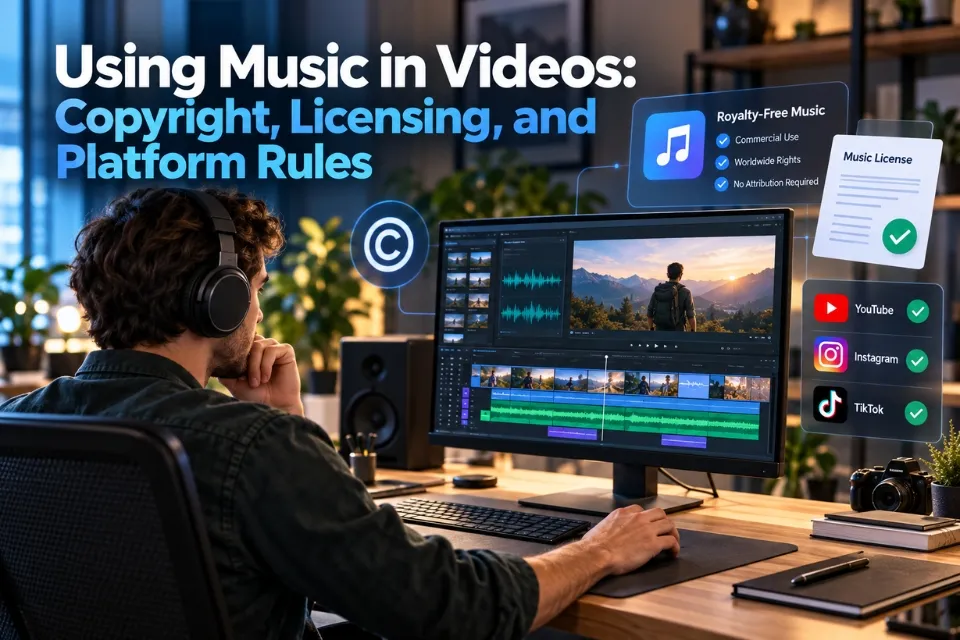
Music can transform a simple video into a memorable story, but using someone else’s recording without understanding copyright can create legal and financial risks. A song included in a YouTube documentary, Instagram Reel, TikTok advertisement, educational presentation, or business promotion may involve several different rights and licensing requirements.
You can legally use copyrighted music in a video when you have the necessary permission, an appropriate license covers your intended use, or a valid copyright exception applies. Public-domain music may also be used without copyright permission, although a particular recording of a public-domain composition can remain protected.
However, legal permission and platform acceptance are separate matters. YouTube may identify music through Content ID even when a creator has a valid license. Instagram and TikTok may make tracks available for personal content without granting unrestricted commercial rights.
This guide explains how music copyright works, which licenses may be needed, when copyright exceptions apply, and how platform copyright claims differ from actual legal infringement.
Can You Legally Use Copyrighted Music in Videos?
Yes. Copyright law does not prohibit every use of copyrighted music. Instead, it gives copyright owners exclusive rights over certain activities involving their works, subject to statutory exceptions and other limitations.
Using music in videos can be lawful under several circumstances.
A creator may obtain permission directly from the appropriate rights holders, acquire a music license covering the intended video, select a track from an authorized platform library, use material that is genuinely in the public domain, or rely on a legal exception that applies to the specific circumstances.
The important issue is not simply where the music was found. It is whether the creator has a valid legal basis for using it.
For example, a business purchasing a song through a digital music store generally receives personal listening rights rather than authorization to synchronize the recording with an advertisement. The purchase does not automatically grant permission for promotional distribution.
Likewise, a creator finding music on a public website cannot assume that the uploader owns the copyright or can authorize reuse.
Four Important Differences
| Concept | What it means | Main consideration |
|---|---|---|
| Copyright permission | Authorization from the relevant rights holder | Has the owner approved this use? |
| Music license terms | Conditions governing authorized usage | Does the license cover the video, platform, territory, and purpose? |
| Copyright exceptions | Legal provisions allowing certain uses without permission | Does the intended activity qualify under applicable law? |
| Platform copyright claims | Automated or manual rights-enforcement actions | Why was the video flagged, and is the claim justified? |
These concepts are related, but they answer different questions.
Permission can exist without an automated system recognizing it. A copyright claim can arise even when a legal exception may apply. Equally, a video that receives no copyright claim may still have been uploaded without authorization.
For reliable publishing decisions, creators should establish the legal basis for using music before distributing the finished video.
How Does Music Copyright Work?
Copyright generally protects two distinct elements of commercially released music: the musical composition and the sound recording.
The musical composition includes the protectable musical expression, such as melody and lyrics. Songwriters, composers, and music publishers may own or administer these rights.
A sound recording is a particular recorded performance of the composition. Its ownership may belong to a recording artist, record label, production company, or another party.
For example, the original studio recording of a song and a newly recorded cover version may share the same composition while involving different sound recording rights.
This distinction is particularly important when adding music to video.
A filmmaker wishing to use the original studio recording usually needs to consider both composition and master recording rights. Recording a new cover version may eliminate the need to use the original master, but it does not eliminate the underlying composition’s copyright.
The U.S. Copyright Office’s guidance for musicians provides official guidance on copyrighted works, ownership, and licensing considerations.
Copyright and Responsible Digital Publishing
Copyright compliance is also a professional ethics issue. Creators should distinguish between legally accessing material and having authorization to reproduce, adapt, or distribute it.
AOFIRS discusses these responsibilities in The Importance of Computer Ethics, including respect for intellectual property, unauthorized copying, and responsible use of digital information. For video publishers, these principles reinforce the need to verify music ownership and usage rights instead of assuming that online availability means unrestricted permission.
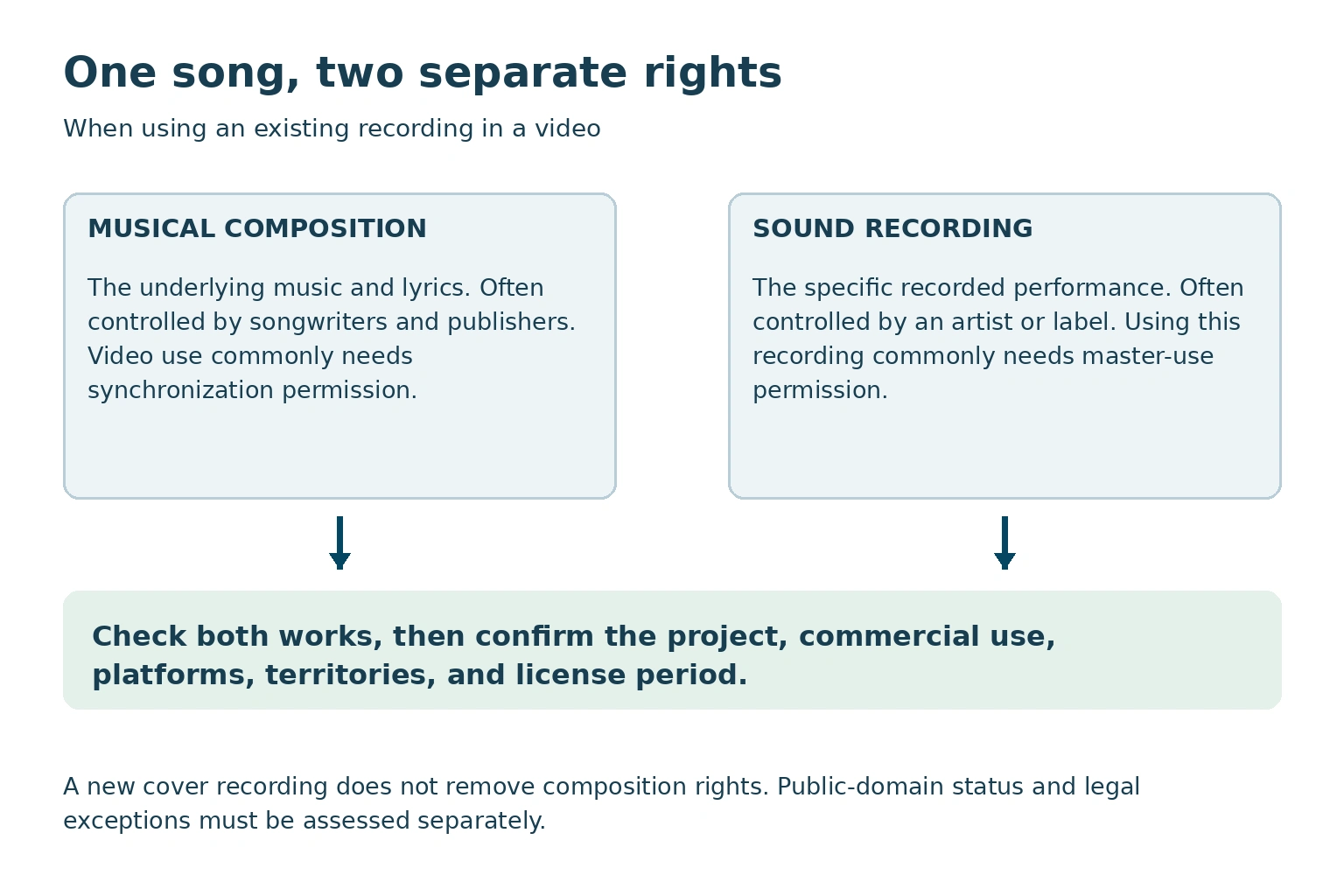
A composition and a particular recording are separate works. A valid exception or public-domain status may change the clearance required.
What Music Licenses Do You Need for a Video?
The licensing requirements depend on the music selected, the way it is incorporated into the video, and where the finished content will be distributed.
Synchronization License
A synchronization license, commonly called a sync license, authorizes the use of a musical composition together with visual content.
Synchronization rights are particularly relevant to advertisements, films, documentaries, promotional videos, and other audiovisual productions.
A license may restrict the authorized use to a specific project, geographic territory, duration, or distribution medium.
For example, permission to include a song in an independently produced documentary does not automatically authorize using the same music in a commercial advertisement.
Master Use License
A master use license authorizes use of a particular sound recording.
If a creator wants to incorporate an existing commercial recording into a video, the relevant master rights may need to be cleared alongside the composition rights.
The same song can have multiple recordings, each potentially controlled by different rights holders.
Public Performance Rights
Public performance rights address certain performances and communications of musical works to audiences.
Depending on the distribution method and jurisdiction, public performance licenses may be handled through broadcasters, platforms, venues, or music licensing organizations.
Organizations such as ASCAP, BMI, SESAC, and PRS for Music administer particular rights, but their ordinary performance licenses do not automatically authorize synchronization or the use of a commercial master recording.
Licensing a Cover Version
A newly recorded cover version involves a different sound recording from the original commercial release.
However, the underlying composition remains relevant.
A mechanical license used for certain audio-only cover distributions should not be assumed to authorize synchronization with moving images.
Licensing Requirements by Video Type
| Video type | Common licensing consideration |
|---|---|
| YouTube video using a commercial song | Composition and master recording rights, unless a valid alternative basis applies |
| Business advertisement featuring popular music | Rights covering commercial synchronization and the selected recording |
| Documentary including music excerpts | Appropriate licensing or an applicable copyright exception |
| Cover song included in a video | Rights involving the underlying composition and the new recording |
| Stock music in a promotional video | Compliance with the stock library’s commercial license |
| Personal Reel using in-app music | Platform-specific permissions and usage restrictions |
| Video featuring public-domain music | Verify both composition and recording status |
These are general examples. Specific requirements depend on jurisdiction, contracts, and the rights involved.
Music Licensing as Part of Content Production
Video production often combines music, recorded dialogue, stock footage, photography, animations, and AI-generated media. Each component can carry separate licensing obligations.
The AOFIRS guide 11 Best Content Creation Tools for Creators in 2026 examines content-production workflows and the need to evaluate commercial suitability, licensing restrictions, and ownership risks when selecting creative tools. These considerations apply equally to music: permission covering a video editing platform does not necessarily grant rights to every copyrighted asset imported into that platform.
Copyright Permission vs. License Terms: What Is the Difference?
Copyright permission is authorization from someone legally entitled to approve a particular use. License terms establish the conditions under which that permission operates.
For example, a music publisher may authorize a song’s use in a nonprofit educational video while restricting paid advertising, geographic distribution, or the length of the agreement.
A stock music provider may offer broader permissions, but its licenses may still exclude certain broadcasts, standalone music redistribution, or uses outside the subscribed account.
Before using a track, examine the actual licensing agreement.
Important conditions commonly include the approved project, intended commercial purpose, distribution channels, territory, duration, attribution requirements, and whether editing or sublicensing is permitted.
A creator should also establish that the licensor controls the rights being offered.
An invoice confirms that a transaction occurred. It does not independently establish that the seller possessed every copyright interest required for the proposed use.
When Can Copyrighted Music Be Used Without Permission?
Copyright laws recognize exceptions allowing certain activities without obtaining permission.
However, their scope varies by jurisdiction. A use permitted under US law may not receive the same treatment in the United Kingdom, Canada, or another country.
Creators should evaluate the relevant law rather than treating internet-wide copyright advice as universally applicable.
Fair Use Under US Copyright Law
Section 107 of the United States Copyright Act recognizes fair use for certain purposes that may include criticism, commentary, news reporting, teaching, scholarship, and research.
Courts evaluate four factors.
Purpose and character of the use. This considers why the copyrighted work was used, whether the activity is commercial or nonprofit, and whether the new use serves a meaningfully different purpose.
Nature of the copyrighted work. Creative works, including songs, generally receive substantial copyright protection.
Amount and substantiality used. Courts consider both how much material was reproduced and whether the excerpt includes a particularly significant part of the work.
Effect on the potential market. The analysis examines whether the use harms existing or reasonably foreseeable markets for the copyrighted material.
No single factor automatically controls the outcome.
For example, a music critic using an excerpt to analyze a recording technique may have a stronger fair use argument than a creator using the same excerpt merely as entertaining background music.
The U.S. Copyright Office’s Fair Use Index provides explanations and summaries of relevant court decisions.
Fair Dealing in the United Kingdom
UK copyright law recognizes specific exceptions, including qualifying uses for criticism, review, quotation, research, private study, and certain educational activities.
These exceptions are not identical to the US fair use framework.
Purpose, fairness, acknowledgment requirements, and the amount used can influence whether an exception applies.
The UK Intellectual Property Office’s copyright exceptions guidance explains the applicable legal categories.
Educational and Research Use
Educational content is not automatically exempt from copyright protection.
The legal analysis may differ between classroom instruction, restricted educational material, online lectures, and videos publicly available to unrestricted audiences.
For example, playing music during qualifying face-to-face teaching is not necessarily treated the same as uploading an entire recording within a public educational video.
Researchers should identify the relevant jurisdiction, statutory exception, and distribution circumstances before relying on an educational justification.
AOFIRS explains the wider importance of legal awareness and primary-source verification in Research in the Age of AI: 5 Realities Modern Researchers Need to Understand. Applying that research approach to music copyright means consulting the actual statute or authoritative legal guidance rather than relying on generalized claims about educational exemptions.
Commentary, Criticism, and News Reporting
A documentary, review, or news report may have a legitimate reason to reproduce a portion of a musical work.
For example, a journalist examining similarities between two recordings might need to present excerpts for critical comparison.
Whether that use qualifies for an exception depends on the applicable legal framework and specific circumstances.
Using the music to illustrate the subject of analysis is different from using it solely to create atmosphere or entertainment.
Is There a Safe Number of Seconds of Copyrighted Music?
A widespread misconception suggests that copyrighted music can legally be used for five, ten, fifteen, or thirty seconds without permission.
There is no universal safe-duration rule.
A short excerpt may include a particularly recognizable or commercially significant part of a recording.
Likewise, there is no general rule authorizing unrestricted use of a fixed percentage of a song.
Under US fair use analysis, the amount reproduced matters, but it is evaluated together with the other factors.
Changing the pitch, slowing the recording, speeding it up, or adding audio effects does not automatically remove copyright protection.
The essential question remains whether the use is licensed or supported by an applicable legal exception.
Using Copyrighted Music on YouTube
YouTube uses copyright licensing agreements, automated content recognition, and formal copyright enforcement procedures.
These systems influence video availability, monetization, and channel status.
How YouTube Content ID Works
Content ID compares uploaded videos against reference material supplied by eligible rights holders.
When a match is found, the relevant rights holder’s policies may allow the video to remain available, monetize it, track its activity, or block it.
Restrictions can differ by geographic territory.
A match does not by itself establish that the creator has infringed copyright. The uploader might possess permission, have an applicable license, or believe the material qualifies for a legal exception.
Content ID Claims vs. Copyright Strikes
| Content ID claim | Copyright strike |
|---|---|
| Frequently arises through automated detection | Follows a copyright removal process |
| May affect monetization or geographic availability | Can affect channel standing |
| Does not normally create a strike | Involves a formal channel strike |
| May be disputed through Content ID procedures | Uses the relevant strike-resolution procedures |
A platform enforcement action should not be confused with a judicial determination of infringement.
The YouTube Content ID documentation explains how matching and rights-holder policies operate. YouTube also distinguishes Content ID claims from copyright removal requests: a valid removal request can result in a strike, while a Content ID claim usually does not.
Why Licensed Music May Still Receive a Claim
Automated detection systems may not recognize independently negotiated licenses.
For example, a creator may obtain stock music from an authorized provider while the recording remains registered with a third-party rights-management system.
When a claim appears, the creator should examine the claimant, recording, licensing documents, and scope of authorization.
A dispute should be submitted only when there is a legitimate basis for challenging the claim.
YouTube Audio Library and Creator Music
YouTube’s Audio Library provides music and sound effects subject to relevant usage conditions.
Some tracks require attribution.
As of October 9, 2026, YouTube’s Creator Music guidance states that paid licenses were phased out beginning in August 2026, with August 10 as the cutoff for purchasing and applying them. Existing paid licenses already applied to videos remain valid until their expiration. The service now focuses on no-cost licenses and revenue-sharing tracks, according to the rights holder’s terms.
Creator Music eligibility and restrictions currently limit availability to eligible US creators. Commercial brand channels and videos primarily made to promote a paying brand are subject to restrictions. Do not treat Creator Music as a general advertising-music license.
The applicable terms may depend on the song, country, video format, and intended distribution.
Music authorized within YouTube Shorts is not necessarily licensed for long-form videos or publication on unrelated platforms.
Instagram and Facebook Music Copyright Rules
Instagram and Facebook offer music through arrangements with rights holders. Meta’s licensed music library guidance explains that the library is intended for personal, noncommercial use and that access is restricted for some business accounts and post types.
However, a track appearing in an in-app library is not automatically available for every commercial purpose.
Personal vs. Commercial Use
Music available for personal, noncommercial content may be restricted for business advertising or branded promotions.
For example, an individual sharing a personal travel Reel may use an in-app song under permissions that do not cover a company’s paid advertisement.
Creators should examine the rules relevant to their account, content type, commercial purpose, and geographic location.
Meta Sound Collection
Meta offers Sound Collection for certain content uses on its services. Review the Sound Collection terms for the applicable permissions.
Business users should review the applicable conditions before selecting tracks.
Permission associated with Instagram or Facebook should not automatically be interpreted as authorization for YouTube, TikTok, external websites, or separate advertising networks.
For cross-platform publishing, music licensing should be confirmed for every intended destination.
TikTok Music Licensing for Personal and Commercial Content
TikTok makes music available through different arrangements, including resources intended for commercial content.
The applicable permissions can vary according to content purpose and account type.
TikTok Commercial Music Library
TikTok’s Commercial Music Library provides tracks cleared for specified commercial uses on TikTok.
Businesses should verify whether a track is permitted for the intended placement, market, and advertising activity. TikTok’s library instructions require selecting the campaign region and provide filters for usable placements.
A trending sound used by personal creators should not automatically be assumed available for brand promotions.
Reusing TikTok Music on Other Platforms
A TikTok-specific music license does not automatically authorize using the recording on Instagram, YouTube, or an external website.
Cross-posting video content may therefore require separate music clearance.
This is particularly important for businesses publishing identical promotions across several digital channels.
Can Businesses Use Popular Songs in Marketing Videos?
Businesses must pay attention to commercial-use restrictions when producing advertising, product demonstrations, corporate presentations, and sponsored social media content.
A clothing company, for example, may want to use a recognizable song in a promotional campaign.
Even if the campaign is published only on the company’s social media account, appropriate music rights may be required.
The same issue arises when a business commissions an influencer to create a video.
An influencer’s permission to select music through an app does not automatically transfer unrestricted advertising rights to the sponsoring business.
Commercial licensing agreements should address the exact recording, intended advertising use, platforms, geographic coverage, and duration of distribution.
The contract between a business and its content creator should also clarify who is responsible for obtaining music permissions.
For companies publishing frequent promotional content, properly licensed production music can be a practical alternative to negotiating rights for individual commercial recordings.
The selected license must still cover the intended use.
Royalty-Free Music vs. Copyright-Free and Public-Domain Music
These terms describe different legal situations.
Royalty-Free Music
Royalty-free music is generally offered under a license permitting specified uses without certain ongoing royalty payments by the licensee.
It does not necessarily mean that the music is free of charge or outside copyright protection.
A license may involve a one-time payment, subscription, or other contractual conditions.
Commercial advertising, broadcasting, and redistribution may be restricted.
Public-Domain Music
Public-domain music is music that is not subject to relevant copyright restrictions in the jurisdiction concerned.
However, the composition and recording must be considered separately.
A historical composition may be in the public domain while a modern recording remains protected.
Public-domain status can also vary by country.
Creative Commons Music
Creative Commons licenses provide standardized permissions subject to defined conditions.
CC BY generally allows commercial reuse with appropriate attribution.
CC BY-NC restricts commercial uses.
Other licenses may impose ShareAlike or NoDerivatives conditions. Creative Commons treats synchronizing music with moving images as an adaptation. Sharing such a video under a NoDerivatives license therefore generally requires separate permission, unless an independent legal exception applies. ShareAlike conditions must also be evaluated for the resulting adaptation.
Creators should also verify that the person applying a Creative Commons license has authority over the relevant rights.
Why Source Verification Matters
Finding music labeled copyright-free or Creative Commons is not sufficient evidence that every use is authorized.
A similar issue arises when researching online images. AOFIRS discusses source ownership, rights verification, and image search limitations in the Ultimate Guide to Image Search Engines and Reverse Image Tools. The underlying principle also applies to music: discoverability does not establish ownership, and an uploader’s licensing statement should be checked against the relevant rights and original source.
How to Obtain Permission to Use Copyrighted Music
Obtaining appropriate music clearance requires identifying the work, establishing who controls the necessary rights, and confirming the intended use.
Step 1: Identify the Exact Music
Record the song title, recording artist, songwriters, publishers, label, and version of the recording.
Step 2: Identify the Rights Holders
Determine who controls the musical composition and sound recording.
More than one party may need to authorize the use.
Step 3: Describe the Intended Video
Document the type of video, duration of the musical excerpt, intended platforms, commercial purpose, geographic distribution, and desired license period.
Step 4: Contact Authorized Licensing Representatives
Request the appropriate permissions through the rights holders or their authorized representatives.
Step 5: Review the License
Confirm that the agreement covers the specific project and intended distribution.
Pay particular attention to commercial advertising, editing, territories, duration, attribution, and sublicensing conditions.
Step 6: Obtain Written Authorization
Keep signed agreements, licensing certificates, invoices, and correspondence.
Step 7: Verify Platform Requirements
Check whether the intended video platform has additional restrictions relevant to the selected music.
Step 8: Preserve the Evidence
Store licensing documents and publication records in an organized system.
These records may help resolve automated claims or ownership disputes.
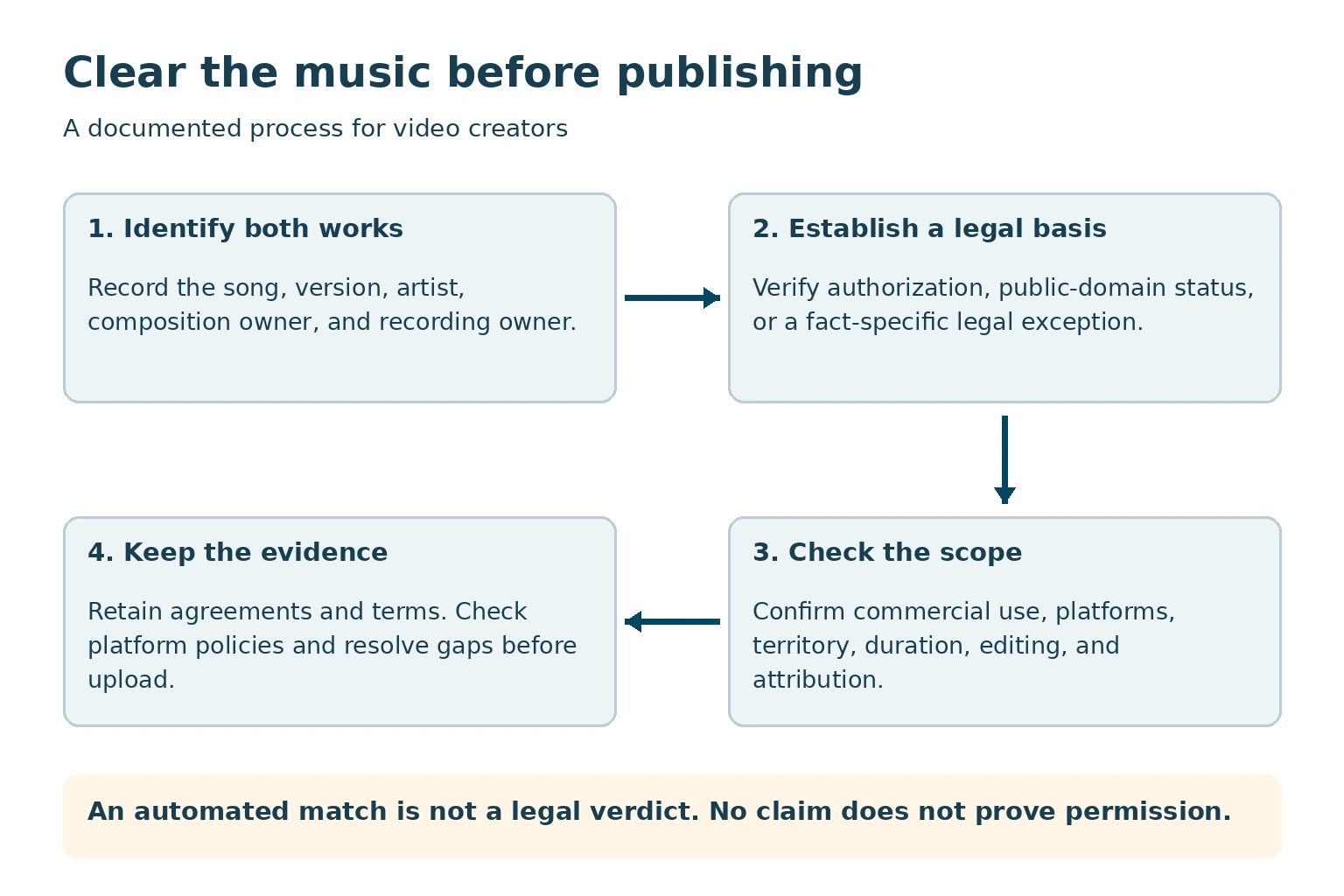
Check both rights and the intended distribution before publishing. A platform match is not a legal determination.
Is AI-Generated Music Copyright-Free?
AI-generated music creates additional uncertainty surrounding human authorship, contractual usage permissions, training data, and potential similarity to existing musical works.
It should not automatically be described as copyright-free.
Human Authorship and Copyright
The US Copyright Office’s AI copyrightability report explains that copyright protection for AI-assisted material depends on sufficient human authorship.
Using AI as a creative tool does not automatically eliminate protection.
However, generating output through prompts alone may not establish copyright ownership over expression produced without sufficient human creative control.
The legal analysis depends on the actual contributions and circumstances.
AI Music Platform Licenses
AI music generators may provide commercial-use permissions under particular subscription plans or service terms.
These contractual permissions are not necessarily equivalent to statutory copyright ownership.
They also do not conclusively establish that every generated track is free from third-party claims.
The distinction between output usage terms and copyright protection also matters for other generative media. AOFIRS’s Best AI Image Generators in 2026 compares creative AI systems and their production capabilities. For synthetic music, the additional legal question is whether a platform’s permission covers the intended distribution and whether the generated material implicates other protected rights.
AI Voice Cloning and Artist Imitation
AI systems can generate synthetic vocals resembling recognizable performers.
Depending on the circumstances, this may raise questions involving copyright, consent, identity, publicity rights, and misleading attribution.
Creators should not assume that an AI-generated imitation is legally unrestricted merely because no original recording was directly copied.
AOFIRS explores related authentication challenges in How to Spot a Deepfake: 9-Step AI Video Verification Guide. Its methods for examining synthetic audio and manipulated media provide useful context for distinguishing genuine performances from artificial imitations, although authentication alone does not settle copyright ownership.
What Happens If a Video Receives a Copyright Claim?
A copyright claim can result in several different outcomes depending on the platform and enforcement process.
Possible consequences include audio muting, monetization restrictions, geographic blocking, removal, or account penalties.
A creator should first identify the type of claim.
When the Creator Has a Valid License
Examine the claim against the licensing documentation.
If the claim appears incorrect, the creator may be able to challenge it through the relevant platform procedure.
When the Creator Has No Permission
Determine whether a valid legal exception applies.
If no defensible basis supports the use, removing or replacing the music may be appropriate.
When the Creator Relies on Fair Use
Review the purpose, amount used, market effect, and other statutory factors.
Simply writing “No copyright infringement intended” does not establish fair use.
Why a Copyright Match Is Not Proof of Infringement
Automated content recognition identifies potential matches against reference material.
It does not independently establish ownership, the scope of a license, or the ultimate legality of a specific use.
This reflects a broader challenge in digital information analysis. AOFIRS examines the distinction between information retrieval and reliable evidence in its research report Information Retrieval in the Age of AI. The research principle is applicable to copyright disputes: an automated result should be examined against relevant source documentation before being treated as a verified conclusion.
Common Myths About Music Copyright in Videos
| Common belief | What copyright law actually means |
|---|---|
| Giving credit makes music free to use | Attribution does not normally replace permission |
| Using only ten seconds is legal | No universal safe-duration rule exists |
| Nonprofit videos are automatically exempt | Noncommercial purpose alone is insufficient |
| Buying a song grants video rights | Personal listening rights do not normally include synchronization |
| Royalty-free music has no copyright | Royalty-free music is commonly copyrighted and licensed |
| Platform music can be reused anywhere | Permissions may be limited to particular services |
| Pitch changes remove copyright | Modifying music does not automatically eliminate protection |
| AI music cannot infringe copyright | AI outputs may implicate third-party rights |
| No platform claim means the video is legal | Lack of enforcement does not establish permission |
| Content ID proves infringement | Automated matching is not a judicial decision |
https://aofirs.org/research-reports/information-retrieval-in-the-age-of-ai/
Practical Examples: When Is Using Music Legal?
Example 1: A YouTuber Uses a Popular Song in a Travel Video
A creator adds a commercial recording as background music.
Without the necessary authorization or a valid copyright exception, the use presents copyright risk.
Not monetizing the video does not automatically provide permission.
Example 2: A Business Uses Trending Music in an Advertisement
A clothing retailer adds a popular track to a paid promotion.
The business should establish whether the relevant music rights have been cleared for commercial advertising and the intended platforms.
Example 3: A Teacher Includes Music in an Educational Video
A teacher uses a short excerpt to demonstrate a musical technique.
An educational exception or fair use may apply, depending on the jurisdiction, purpose, distribution, and amount reproduced.
Example 4: A Journalist Analyzes a Recording
A journalist includes relevant musical excerpts while investigating similarities between songs.
The analytical purpose may support a legal exception, but the outcome depends on the facts.
Example 5: An Instagram Creator Uses In-App Music
A personal creator selects a song from Instagram’s licensed music feature.
The use may be permitted within the feature’s applicable terms.
That permission should not automatically be extended to unrelated advertising or distribution.
Example 6: A Filmmaker Records a Cover
A filmmaker produces an original recording of an existing song.
The new recording avoids copying the original commercial master, but the underlying composition still requires appropriate legal consideration.
Example 7: A Business Uses Creative Commons Music
A company selects music offered under a CC BY license.
Commercial use may be permitted if the license is valid and its requirements are satisfied.
A track governed by a NonCommercial restriction would require additional consideration before promotional use.
Example 8: A Creator Publishes AI-Generated Music
A creator generates background music using a paid AI platform.
The creator should review the platform’s commercial-use terms, any third-party rights issues, and whether the intended distribution is authorized.
Music Copyright Checklist Before Publishing a Video
Before uploading a video, complete the following checks:
- Identify the exact composition and recording.
- Establish the relevant copyright owners or licensing sources.
- Confirm whether permission, a license, or a legal exception supports the use.
- Verify commercial permissions where necessary.
- Check the authorized platforms and geographic territories.
- Review duration, modification, and attribution conditions.
- Preserve written licenses and related documentation.
- Confirm that cross-platform distribution is permitted.
- Review relevant platform copyright policies.
- Maintain a record of any subsequent claims or licensing disputes.
For organizations producing content regularly, a documented clearance process can reduce uncertainty and simplify future reviews.
Frequently Asked Questions
1. Can I use copyrighted music on YouTube if I give credit?
Not automatically. Crediting the artist does not generally replace the required copyright permission, license, or applicable legal exception.
2. How many seconds of a copyrighted song can I use?
There is no universal number of seconds that is automatically legal. The answer depends on authorization, applicable copyright exceptions, and the circumstances of use.
3. Can I use copyrighted music in a non-monetized video?
Non-monetization alone does not make a use lawful. Copyright may still apply even when the creator receives no revenue.
4. Can businesses use trending music on Instagram?
Only when the applicable music permissions authorize the intended business activity. Music available for personal content may not be cleared for advertising.
5. Is royalty-free music completely free to use?
No. Royalty-free music is generally subject to license conditions and may require payment, attribution, or compliance with commercial-use restrictions.
6. Does a YouTube Content ID claim mean copyright infringement occurred?
No. Content ID identifies matches, but the legal position may depend on licensing, ownership, exceptions, and the accuracy of the claim.
7. Is AI-generated music automatically copyright-free?
No. AI-generated music can involve questions of human authorship, contractual permissions, and third-party rights.
8. Do I need permission to use a cover song in a video?
A cover avoids using the original master recording if a new recording is created, but the underlying composition may still require synchronization permission or another valid legal basis.
Conclusion
Using music legally in videos requires distinguishing copyright permission, license terms, statutory exceptions, and platform enforcement. These issues are connected, but they serve different purposes. A valid license grants specified rights, a copyright exception may authorize an otherwise restricted use, and a platform claim reflects an enforcement process rather than an automatic legal finding. For creators, businesses, educators, journalists, and digital researchers, the most reliable approach is to identify the relevant music rights, confirm the legal basis for use, check distribution restrictions, and retain licensing records.
Platform availability should never be treated as unconditional permission. Likewise, an automated copyright match should not be confused with conclusive evidence of infringement. Responsible music use begins with accurate rights research and clear documentation, helping creators publish confidently while respecting the intellectual property of musicians, composers, and recording rights holders.
Legal information notice: This article provides general educational information and is not personalized legal advice. Copyright requirements differ by jurisdiction and circumstances. Seek qualified legal advice where substantial uncertainty exists.