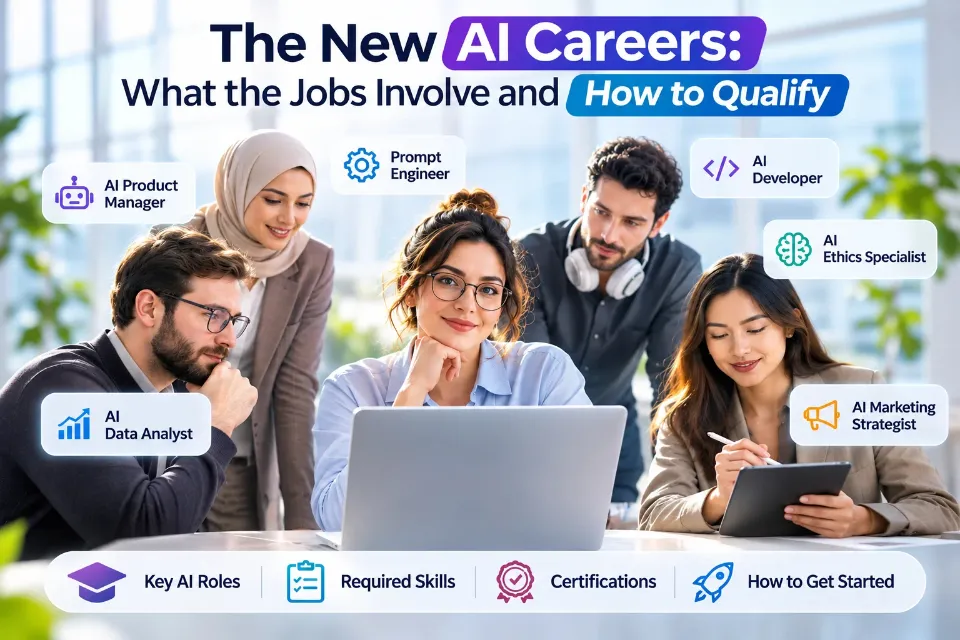
To understand the new AI job market, look beyond the people building models. Reliable AI products also depend on good data, independent testing, trusted sources, domain expertise, security, and human oversight. This creates opportunities for educators, editors, analysts, librarians, cybersecurity experts, subject-matter specialists, operations staff, and software engineers.
According to Microsoft’s 2025 Work Trend Index, 78% of the business leaders surveyed are considering hiring for AI-specific roles. The roles leaders mentioned most were AI Trainer and AI Data Specialist, at 32% each, followed by AI Security Specialist (31%), AI Agent Specialist (30%) and AI ROI Analyst (29%). The survey covered 31,000 workers in 31 markets between February and March 2025 (Microsoft 2025 hiring survey). Keep in mind that these numbers reflect hiring intentions, not actual job openings or standard job titles across companies.
Microsoft’s 2026 research adds another signal. Asked which human skills matter most as AI takes on more work, AI users ranked quality control of AI output first (50%) and critical thinking second (46%), in a survey of 20,000 AI-using knowledge workers in 10 markets (Microsoft 2026 skills survey). The World Economic Forum’s employer survey expects 39% of workers’ core skills to change by 2030 and ranks AI and big data as the fastest-growing skill, followed by networks and cybersecurity and technological literacy (WEF future jobs report).
At a glance: which path might suit you?
| Starting strength | Good first roles to explore |
|---|---|
| Strong writing or editing | AI Response Evaluator; Fact-Checker; AI Trainer |
| Research or journalism | OSINT Analyst; RAG Knowledge Curator |
| Subject expertise (law, finance, medicine, science) | Domain Expert Evaluator; AI Policy Reviewer |
| Data and spreadsheets | AI Data Specialist; Evaluation Analyst |
| IT, software or cyber security | AI Red-Teamer; Agent Security Engineer |
| Compliance, audit or risk | AI Governance Analyst; Model Risk Specialist |
| Operations or business analysis | AI ROI Analyst; Agent Operations Manager |
What “qualified” really means
Employers use different titles for these jobs. Some bring on entry-level contractors to rate text responses, while others look for experienced specialists to design model tests, write secure code, or approve risk assessments. A short online course can help you get started, but it won’t replace a medical license, legal qualification, security experience, or proven technical skills when those are needed. The best proof is a small portfolio that shows your methods, decisions, documentation, and how you spot errors.
Seven visible job families: scope of work and training
1. AI Trainer / AI Training Data Specialist
What the work involves: Create or review examples used to improve AI behavior. Write ideal answers, compare alternative responses, annotate instructions and conversations, apply rubrics, flag unsafe or inaccurate outputs, resolve disagreements and maintain consistent labels. Senior specialists design annotation standards, audit annotator quality and analyze failure patterns.
Training and technical skills: LLM fundamentals; instruction following; rubric design; data labeling; inter-annotator agreement; spreadsheet fluency; privacy and confidentiality; clear written feedback. Add Python/SQL and experimental design for higher-level jobs.
Typical hiring evidence: Entry-level generalists may qualify through writing, reasoning and assessment tests. Specialist work typically requires relevant domain proficiency or demonstrated language/technical expertise. Planning estimate (editorial, not an employer requirement): 4–8 weeks for basic rating skills, 3–6 months for a stronger specialist portfolio.
Portfolio exercise: Produce a 50-item response-comparison dataset, a scoring rubric, agreement checks and a one-page error taxonomy. Use synthetic or permission-cleared samples.
Search job listings for: AI trainer; AI response rater; RLHF annotator; human feedback specialist; AI data quality analyst.
2. AI Evaluation Analyst / LLM Quality Assurance Specialist
What the work involves: Design repeatable tests for factual accuracy, instruction following, refusal behavior, multilingual quality, reliability, latency and regressions. Create gold-standard test sets, analyze errors across models, report confidence intervals when appropriate and recommend fixes.
Training and technical skills: Evaluation metrics (precision/recall, calibration, task success); sampling; anonymous review; rubric consistency; Python notebooks; Git; model APIs; experiment logging. Learn why automated LLM judges need human validation.
Typical hiring evidence: Junior roles can begin with editorial QA, analytics or software testing; engineering-heavy roles may request Python, statistics and experience building evaluation harnesses. Planning estimate (editorial, not an employer requirement): 8–16 weeks after basic AI literacy.
Portfolio exercise: Build an evaluation suite with 100 labeled questions, human-reviewed scores, slice-level failure analysis and a regression dashboard.
Search job listings for: LLM evaluator; AI evaluation analyst; AI QA engineer; model quality analyst; AI benchmark specialist.
3. Domain-Expert AI Fact-Checker / Subject-Matter Reviewer
What the work involves: Check AI-generated claims against credible primary evidence. Identify fabricated citations, missing qualifiers and outdated assertions. Edit answers for technical accuracy, document disagreements and escalate high-risk judgments to an authorized professional. For evidence on why this checking work is gaining value, see verification premium for research jobs.
Training and technical skills: Strong existing knowledge in a discipline; source triangulation; evidence grading; citation checking; research methods; version/date awareness; editorial standards; bias awareness. Learn practical AI failure modes and evaluation rubrics.
Typical hiring evidence: Domain credibility is central. Regulated decisions may require degrees, professional credentials or licensure. General fact-checking can be entered through journalism, research and editing. Planning estimate (editorial, not an employer requirement): 4–8 weeks of AI-specific upskilling on top of domain expertise.
Portfolio exercise: Publish a 20-claim audit with original answer, sources, corrected answer, confidence notes and a decision trail.
Search job listings for: AI fact checker; subject matter expert AI; expert annotator; scientific AI reviewer; legal AI evaluator.
4. AI Red-Team Specialist / Adversarial Evaluation Researcher
What the work involves: Authorised testing of AI systems to discover prompt injection, data leakage, unsafe tool actions, misinformation vulnerabilities, policy bypasses and operational failures. Write reproducible test cases, severity assessments, mitigations and retest results.
Training and technical skills: Threat modeling; secure development; prompt-injection principles; OWASP LLM risks; HTTP/APIs; Python; logging; ethical testing rules; privacy and responsible disclosure. Advanced roles add application security, cloud IAM and agent permission models.
Typical hiring evidence: Security-focused roles commonly favor prior cyber or engineering experience. A separate pathway exists in nontechnical safety policy testing. Planning estimate (editorial, not an employer requirement): 3–9 months depending on prior technical ability.
Portfolio exercise: Create a permissioned demo chatbot, a documented test matrix and a remediation report. Test only systems you own or are authorized to assess.
Search job listings for: AI red teamer; LLM security analyst; AI safety evaluator; generative AI penetration tester; adversarial testing specialist.
5. RAG Curator / Knowledge and Retrieval Quality Specialist
What the work involves: Turn organizational documents into a usable, governed evidence base for retrieval-augmented generation. Select authoritative material, remove duplicates, map metadata, structure documents, manage access and freshness, assess search relevance and check whether answers cite the right passages.
Training and technical skills: Information science; records management; taxonomy and metadata; document provenance; search relevance; text chunking; embeddings and vector search concepts; SQL/Python for technical roles; permissions and privacy; evaluation of retrieval precision and answer groundedness.
Typical hiring evidence: Librarians, technical writers, knowledge managers and content operations staff can enter without advanced ML. Production RAG engineering usually requires coding. Planning estimate (editorial, not an employer requirement): 6–12 weeks for curation, 3–6 months for engineering.
Portfolio exercise: Create a 40-document knowledge base with a source inventory, metadata policy, update schedule, and 30 test questions with citations and error analysis.
Search job listings for: RAG specialist; AI knowledge engineer; knowledge base curator; search relevance analyst; retrieval evaluation specialist.
6. OSINT Investigator / Digital Verification Analyst
What the work involves: Investigate public information for journalism, due diligence, fraud research, threat intelligence and humanitarian work. Verify identities, dates, locations and claims using independently corroborated sources. Preserve records and explain confidence, gaps and ethical limits.
Training and technical skills: Advanced search; source evaluation; archives; geolocation and chronolocation; image/video verification; spreadsheets; documentation; privacy, safety, and legal boundaries. AI can accelerate organization but cannot serve as sole proof.
Typical hiring evidence: Backgrounds in research, journalism, security, or investigations help. Specialised roles may require clearance or sector experience. Planning estimate (editorial, not an employer requirement): 2–4 months plus supervised practice.
Portfolio exercise: Publish a fully sourced investigation using public, non-sensitive material, with evidence log, chronology and uncertainty statements.
Search job listings for: OSINT analyst; open-source investigator; verification researcher; threat intelligence analyst; due diligence researcher.
7. AI Governance / Responsible AI Analyst
What the work involves: Maintain inventories of AI uses; classify risks; document controls and owners; support assessments; review vendor evidence; monitor incidents; audit policies; and communicate findings to product, legal, security, and leadership teams.
Training and technical skills: Risk management; lifecycle documentation; NIST AI RMF; ISO/IEC 42001; basic AI architecture; privacy and data governance; human oversight; impact assessments; policy writing. Learn relevant laws for the jurisdiction and use case, not a one-size-fits-all checklist. The EU AI Act shows why dates matter: its AI literacy and prohibition rules have applied since 2 February 2025, and after the Digital Omnibus amendments the high-risk rules apply from 2 December 2027 for Annex III systems and from 2 August 2028 for AI in Annex I regulated products (as of November 5, 2026; EU AI implementation timeline).
Typical hiring evidence: Compliance, privacy, quality assurance and internal-audit backgrounds transfer well. Lead or regulated-sector positions usually demand proven experience. Planning estimate (editorial, not an employer requirement): 8–16 weeks for an analyst transition, longer for leadership.
Portfolio exercise: Create an AI system register, risk assessment, vendor review checklist, incident workflow and management report for a hypothetical service.
Search job listings for: responsible AI analyst; AI governance specialist; AI risk analyst; model risk analyst; AI compliance officer.
Other AI-specific roles already entering hiring conversations
Microsoft’s 2025 survey separately named AI Security Specialist, AI Agent Specialist, AI ROI Analyst, AI Media & Content Manager, AI Finance Strategist, AI Customer Success Lead, AI Business Process Consultant and Chief AI Officer. The percentages below are the shares of leaders considering each role, not employment growth rates (Microsoft 2025 hiring survey).
AI Security Specialist (31%)
Scope: Protect AI applications, data flows, identities, tools and models; security baselines, testing, monitoring and incident response.
Preparation: Cyber foundations, cloud/IAM, OWASP LLM guidance, Python, threat modeling.
Evidence: Secure an agent demo and produce an AI-specific threat model.
AI Agent Specialist (30%)
Scope: Design, integrate, test and monitor agents that use tools and act across workflows with human approvals.
Preparation: APIs, Python/TypeScript, orchestration, retrieval, permissions, observability and evaluation.
Evidence: Build a limited-scope agent with approval gates and a test log.
AI ROI Analyst (29%)
Scope: Determine whether an AI deployment actually saves time, improves quality or lowers costs without increasing risk.
Preparation: Excel/SQL, experiment design, baseline metrics, causal reasoning, finance and dashboarding.
Evidence: Design a before/after analysis with clear assumptions and sensitivity checks.
AI Media & Content Manager (29%)
Scope: Run content operations that combine AI assistance with editorial quality, brand, accessibility and rights review.
Preparation: Editing, media workflow, provenance, copyright basics, analytics and brand standards.
Evidence: Create a human-reviewed content production workflow and quality scorecard.
AI Finance Strategist (28%)
Scope: Assess AI opportunities in forecasting, finance processes and controls; collaborate with finance leadership.
Preparation: Accounting/finance, controls, spreadsheets, analytics, AI risk, stakeholder communication.
Evidence: Write a finance AI pilot proposal with controls and ROI model.
AI Customer Success Lead (28%)
Scope: Drive responsible AI adoption for customers; train teams, identify use cases and measure outcomes.
Preparation: Customer success, change management, workflow mapping, product literacy and adoption KPIs.
Evidence: Produce a 30/60/90-day AI rollout playbook.
AI Business Process Consultant (28%)
Scope: Redesign workflows around automation, agent handoffs and accountable human review.
Preparation: Process mapping, Lean basics, change management, data literacy, controls and stakeholder interviews.
Evidence: Map a process, automate a safe segment and quantify trade-offs.
Chief AI Officer (27%)
Scope: Set enterprise AI strategy, investment priorities, risk appetite, operating model and accountability.
Preparation: Senior leadership, technology strategy, governance, budgeting, organizational design.
Evidence: Executive-grade strategy memo and multi-year roadmap; this is not an entry-level role.
Emerging jobs and how they may evolve, 2027–2031
The job titles below are predictions based on possible scenarios, not a confirmed list of future openings. Some of these roles already exist in different forms and under other names. The best way to prepare is to master the core tasks rather than focus on a specific job title.
Agent Operations Manager / Human–Agent Team Supervisor
Possible maturation window: 2027–2029
Likely scope: Own escalation queues, permission boundaries, handoffs, uptime, work quality and human oversight across agent teams.
Prepare now: Learn process operations, agent evaluation, incident management and dashboarding; run a pilot with a clear human override.
Agent Identity and Permissions Auditor
Possible maturation window: 2027–2030
Likely scope: Review what autonomous tools can access, approve or change; test least-privilege controls and audit logs.
Prepare now: Build on IAM, zero-trust security, API authorization, audit trails and AI tool security.
AI Evaluation Operations Lead / Benchmark Steward
Possible maturation window: 2027–2030
Likely scope: Own living benchmark libraries and continuous, domain-specific regression testing as models change.
Prepare now: Combine statistics, rubric calibration, dataset lineage, Git and evaluation automation.
Synthetic Data Quality and Provenance Auditor
Possible maturation window: 2027–2031
Likely scope: Assess whether generated datasets preserve useful patterns without leaking confidential or personal data.
Prepare now: Study statistics, privacy, data lineage, bias checks and dataset documentation.
Multimodal Authenticity and Provenance Analyst
Possible maturation window: 2027–2031
Likely scope: Verify AI-generated or altered audio, image and video content in business, journalism and investigations.
Prepare now: Practice media forensics, provenance standards, metadata limits and careful open-source verification.
AI Supply-Chain and Model Vendor Risk Analyst
Possible maturation window: 2027–2030
Likely scope: Evaluate third-party models, datasets, dependencies, contracts and incident disclosures.
Prepare now: Learn procurement risk, software bill-of-materials concepts, vendor security and governance documentation.
AI Assurance / Independent Audit Specialist
Possible maturation window: 2028–2031
Likely scope: Independently test evidence for reliability, oversight, risk controls and claims made about AI systems.
Prepare now: Develop governance, audit sampling, model evaluation and evidence-chain skills; sector expertise matters.
AI Workforce Transition and Learning Designer
Possible maturation window: 2027–2031
Likely scope: Redesign roles and workplace training as human–agent teams change tasks.
Prepare now: Learn instructional design, competency mapping, adoption measurement and process redesign.
A practical 90-day training and hiring plan
Days 1–15 | Choose a pathway
Assess transferable strengths; read 15 real job descriptions; extract required skills and separate must-have credentials from preferences. Study LLM limitations, privacy and how evaluation differs from generation.
Days 16–30 | Learn the workflow
Complete one focused course. Draft rubrics, source-verification steps or risk checklists. Learn spreadsheets and evidence logging; technical candidates add Python, Git and APIs.
Days 31–55 | Produce a first work sample
Deliver one project matched to a role above. Include the problem, methodology, dataset/source permissions, findings, errors, limitations and specific recommendations.
Days 56–75 | Improve it with critique
Ask qualified peers to review results, rerun tests, quantify agreement or errors, and publish a revised version. Add a second, shorter project that shows a different strength.
Days 76–90 | Apply strategically
Use job-title variants; tailor resume accomplishments to the employer’s tasks; prepare an explanation of one error you found and corrected; apply to contract, junior and cross-functional opportunities.
Skills stack and learning resources
- Foundation: LLM capabilities and limitations; evaluation rubrics; strong written communication; critical thinking; privacy and secure data handling.
- Analytical layer: Excel/Sheets; SQL; basic statistics; sampling; reproducible documentation; dashboards.
- Technical layer (role dependent): Python; Git; API calls; retrieval systems; embeddings; vector databases; monitoring; access controls.
- Risk layer: NIST AI Risk Management Framework and Generative AI Profile; OWASP Top 10 for LLM Applications; ISO/IEC 42001; relevant jurisdiction-specific rules.
- OSINT layer: Berkeley Protocol; safe evidence collection; independent source corroboration; provenance and uncertainty reporting.
Good places to start include NIST AI risk framework, OWASP LLM security guidance, ISO AI management standard, Berkeley investigation protocol, the free Hugging Face agents course, and Generative AI evaluation course. Retired AI-102 study guide remains useful reading on implementation and evaluation skills, but Microsoft retired Exam AI-102 on 30 June 2026 and names Exam AI-103 (Azure AI Apps and Agents Developer Associate) as its successor (Microsoft certification transition). These are helpful learning resources, but they don’t replace employer tests or required professional licenses.
How to show readiness on a resume or in an interview
- Use the target job title plus the function, such as “AI Response Evaluation | Rubric Design | Quality Auditing”.
- Be specific about what you checked: include the number of samples, categories, error rates, reviewer agreement, and any improvements after revisions. Don’t make up results.
- Attach concise work samples with a methodology and limitations section. Confidential employer data should not be shared.
- Describe a real example of something that went wrong, why it mattered, how you fixed it, and what you’d do to prevent it in the future.
- Use geographic, language, and sector expertise as strengths; a bilingual accountant may beat a generic AI hobbyist in a finance evaluation.
- Expect practical tests. Contract platforms may require identity, region, language, or domain assessments; passing one doesn’t guarantee work.
- Be careful about job scams, unpaid high-volume tests, requests for payment to get work, and any breaches of confidentiality.
Frequently asked questions
Do I need to learn coding?
Not always. Writing-intensive training, fact-checking, research and governance support may require little coding. Advanced evaluation, RAG implementation, agents and security roles benefit substantially from Python and APIs.
Can a beginner become an AI red-teamer?
A beginner can study authorized safety evaluations, but production penetration testing requires cybersecurity knowledge, explicit authorization and documented professional practices.
Are certificates enough to get hired?
No. They can show structured learning, but employers also assess problem-solving, work samples, background, tests and availability.
Is “prompt engineer” the strongest long-term bet?
Prompt design remains useful, but combining it with evaluation, workflows, subject expertise, security, or measurable business outcomes is a more resilient strategy than relying on a narrow title.
Will these roles disappear?
Some basic rating or labeling jobs might become more automated or pay less over time. Work involving evaluation design, expert judgment, source tracking, safety, and accountability may remain valuable, but demand will vary by employer, sector, and location. No job title is guaranteed to last.
What time and budget should I expect?
As an editorial planning estimate, a disciplined learner might build a starter portfolio in 6–12 weeks. Moving into specialized security, engineering or regulated work can take many months or years. Free resources can cover fundamentals; paid certification is optional unless an employer specifies it.
Conclusion: Choose a Role, Prove the Work
From now until 2031, the best career move isn’t to memorize AI tools. Instead, focus on becoming really good at a skill that’s hard to automate, like defining quality, checking evidence, protecting systems, maintaining reliable knowledge, measuring business value, or ensuring accountable decisions. Combine that skill with AI know-how and clear work samples. Job titles and tools may change, but these abilities will likely remain valuable.
Choose one role that builds on your existing strengths, then compare its requirements across current job postings. Use the 90-day plan to produce a small, well-documented portfolio: show the task, your methods, the errors you found, and the limits of the result. Seek feedback and revise before applying. A course or certificate can support that work, but it does not guarantee employment or replace required qualifications. Your strongest evidence is a relevant work sample and a clear explanation of the judgment behind it.
Research notes
Source selection prioritized Microsoft’s original survey reporting, public standards bodies, a recognized investigations protocol and established skills resources. “Scope” descriptions and all training durations are synthesized editorial career guidance, not formal occupational licensing standards or employer requirements. Projections for 2027–2031 are labeled as scenarios.
References
- Berkeley Human Rights Center & United Nations Office of the High Commissioner for Human Rights. (2020). Berkeley Protocol on digital open source investigations. Berkeley investigation protocol
- DeepLearning.AI & Weights & Biases. (2026). Evaluating and debugging generative AI [Short course; updated May 14, 2026]. Generative AI evaluation course
- European Commission. (n.d.). EU AI Act implementation timeline. AI Act Service Desk. Retrieved November 4, 2026, from EU AI implementation timeline
- Hugging Face. (n.d.). Welcome to the AI Agents Course [Online course]. Retrieved November 4, 2026, from Hugging Face agents course
- Microsoft. (2025, April 23). 2025: The year the Frontier Firm is born [Work Trend Index]. Microsoft 2025 hiring survey
- Microsoft. (2026, May 5). Agents, human agency, and the opportunity for every organization [2026 Work Trend Index]. Microsoft 2026 skills survey
- Microsoft Learn. (2026). Study guide for Exam AI-102: Designing and implementing a Microsoft Azure AI solution [Exam retired June 30, 2026]. Retired AI-102 study guide
- Microsoft Tech Community. (2026, March 3; updated March 23). The AI job boom is here: Are you ready to showcase your skills? Skills Hub Blog. Microsoft certification transition
- National Institute of Standards and Technology. (2023, January 26). AI risk management framework (AI RMF 1.0; Generative AI Profile, NIST AI 600-1, July 26, 2024). NIST AI risk framework
- OWASP Foundation. (2025). OWASP Top 10 for large language model applications. OWASP LLM security guidance
- World Economic Forum. (2025, January 7). The future of jobs report 2025. WEF future jobs report