
AI is repricing parts of online research work. Search and summarization can be faster and cheaper, while checking whether an answer is true, traceable, and fit for a decision still requires judgment. This article calls that shift the verification premium. It is an interpretation of research on AI errors, skills, and employment—not a separately measured wage premium for verification alone.
Finding got cheap. Checking didn’t.
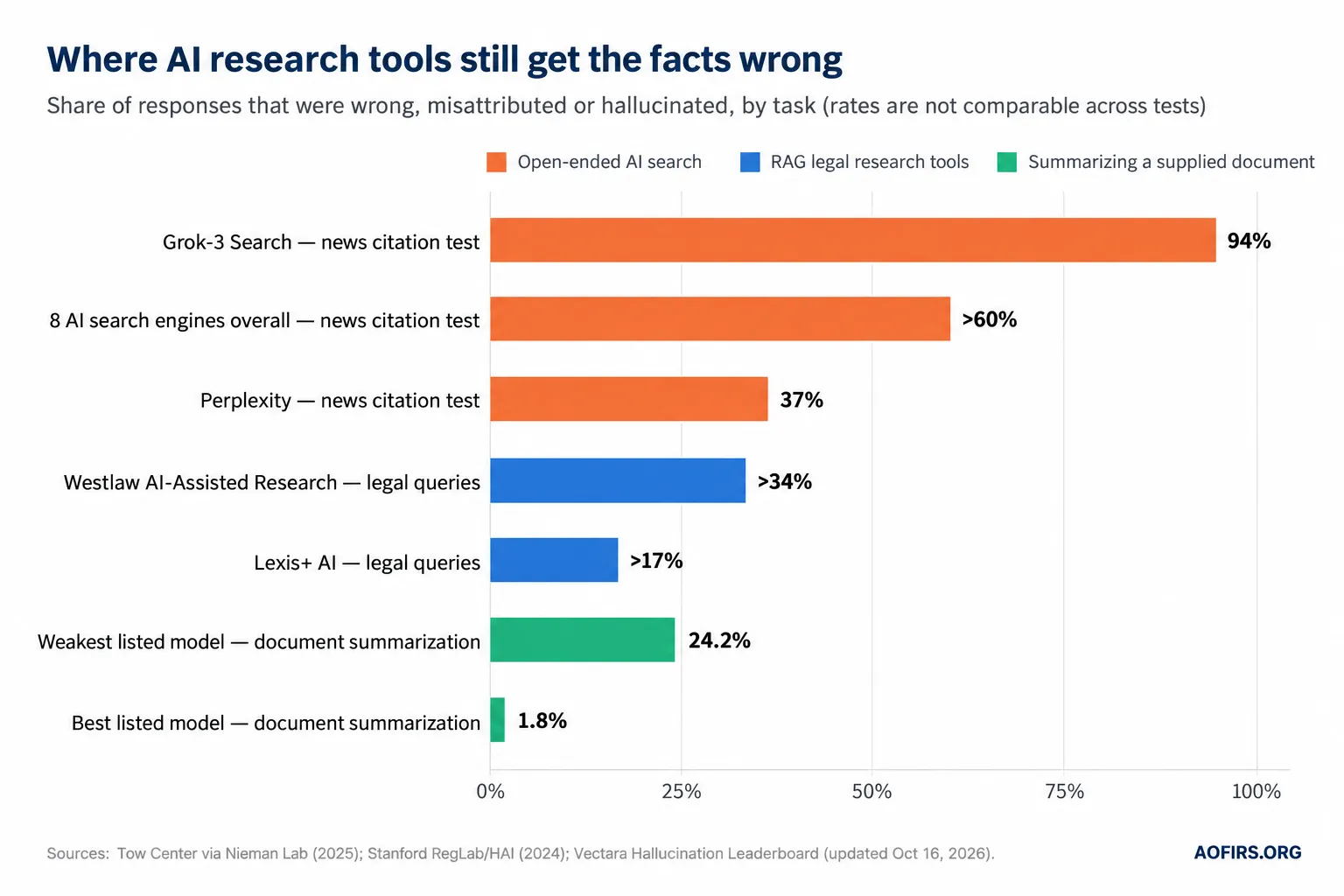
In one dated news-source identification test, AI search tools frequently failed to identify where an excerpt first appeared. When Columbia’s Tow Center for Digital Journalism Tow Center citation study, the tools gave incorrect answers more than 60% of the time. One of them, Grok 3, was wrong 94% of the time (Tow Center citation study; Nieman citation study coverage).
Purpose-built tools do better, but they aren’t clean either. Legal research products that ground their answers in real case law still produced incorrect information on benchmark questions more than 17% of the time (Lexis+ AI) and more than 34% of the time (Westlaw AI-Assisted Research) (Legal AI reliability study; Stanford legal AI evaluation). These results support checking source-grounded answers as well as open-ended ones. They do not establish a universal safety ranking: the tasks, models, error definitions, and dates differ.
Employers are paying for AI skills
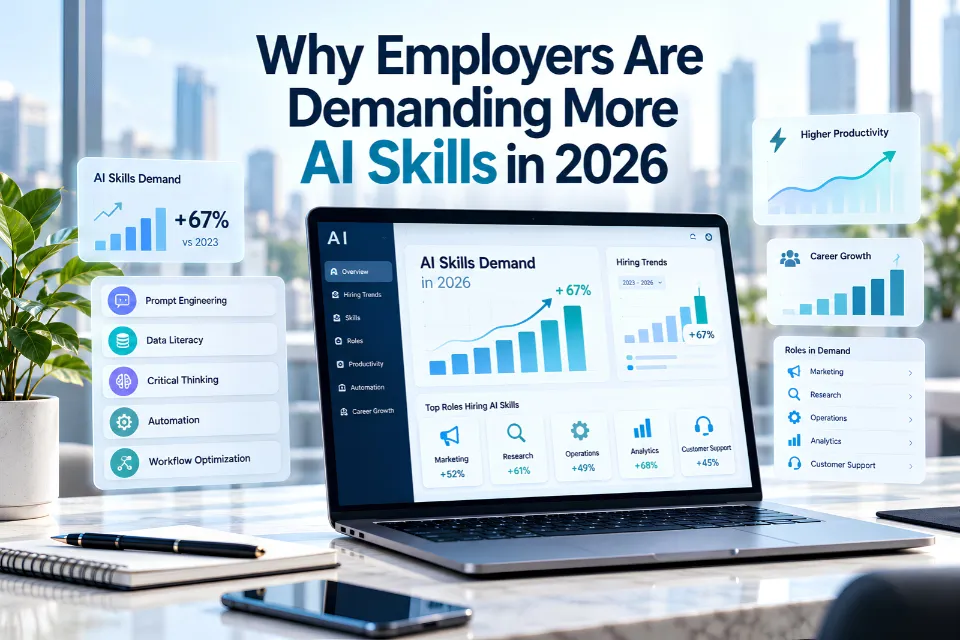
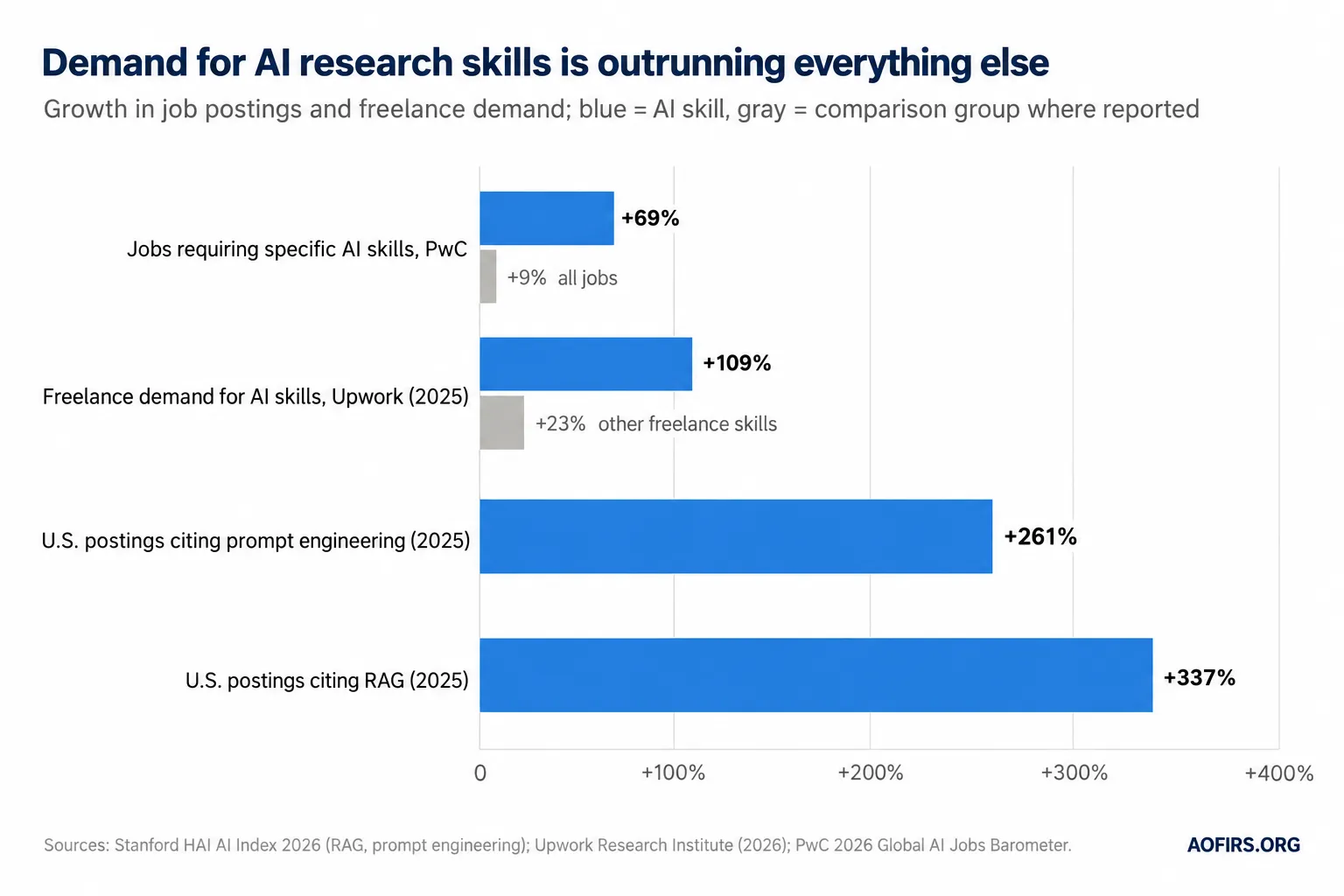
These data sets measure different populations and outcomes. Their premiums are associations, not evidence that learning one skill guarantees a raise. Lightcast analyzed 1.3 billion job postings and found that those asking for AI skills offered 28% more pay, close to $18,000 a year. More than half of them were outside IT (Lightcast AI salary analysis). PwC puts the wage premium for AI-skilled workers at 62% in 2026, up from 57% a year earlier (PwC AI jobs barometer).
The job title matters less than the skill. Stand-alone “prompt engineer” titles have not taken off, yet U.S. AI job postings that cite prompt engineering as a skill rose 261% in 2025, and those citing retrieval-augmented generation (RAG) rose 337%, according to Lightcast data reported in the AI Index (Stanford AI skills index). Sell the capability, not the label.
Who feels it first
The early damage lands on newcomers. Stanford economists using payroll data through June 2026 found that employment of 22- to 25-year-olds in AI-exposed jobs is 19% below where it would otherwise be. Firms didn’t fire them. They simply hired fewer of them (Stanford early-career employment study).
Freelancers felt it even sooner. After ChatGPT launched, writing freelancers on a large online platform saw about 2% fewer jobs and roughly 5% lower monthly earnings, and the best-paid ones lost proportionally more (Freelance employment study).
The door isn’t closing, though. The bar to get through it is rising. PwC found that the most AI-exposed entry-level roles are seven times more likely to ask for senior skills such as judgment, and openings for these roles grew 35% since 2019 (PwC AI jobs barometer). Controlled experiments explain why. AI makes less experienced workers much faster on routine tasks, with larger benefits for less experienced support agents in one study (Published AI workplace study). But on a problem just outside its competence, consultants using GPT-4 were 19% less likely to get the right answer than those working without it (AI consulting task experiment). Somebody has to recognize the limits of the tool and verify its output.
The new research jobs, and what they pay
Titles change from one employer to the next, so look at the work behind the label. Every role below sells a judgment about information, not the information itself. For what each job family involves and how to qualify, see AI career qualification guide.
| Role | What the work involves | Pay or demand signal (U.S., 2025–2026) |
|---|---|---|
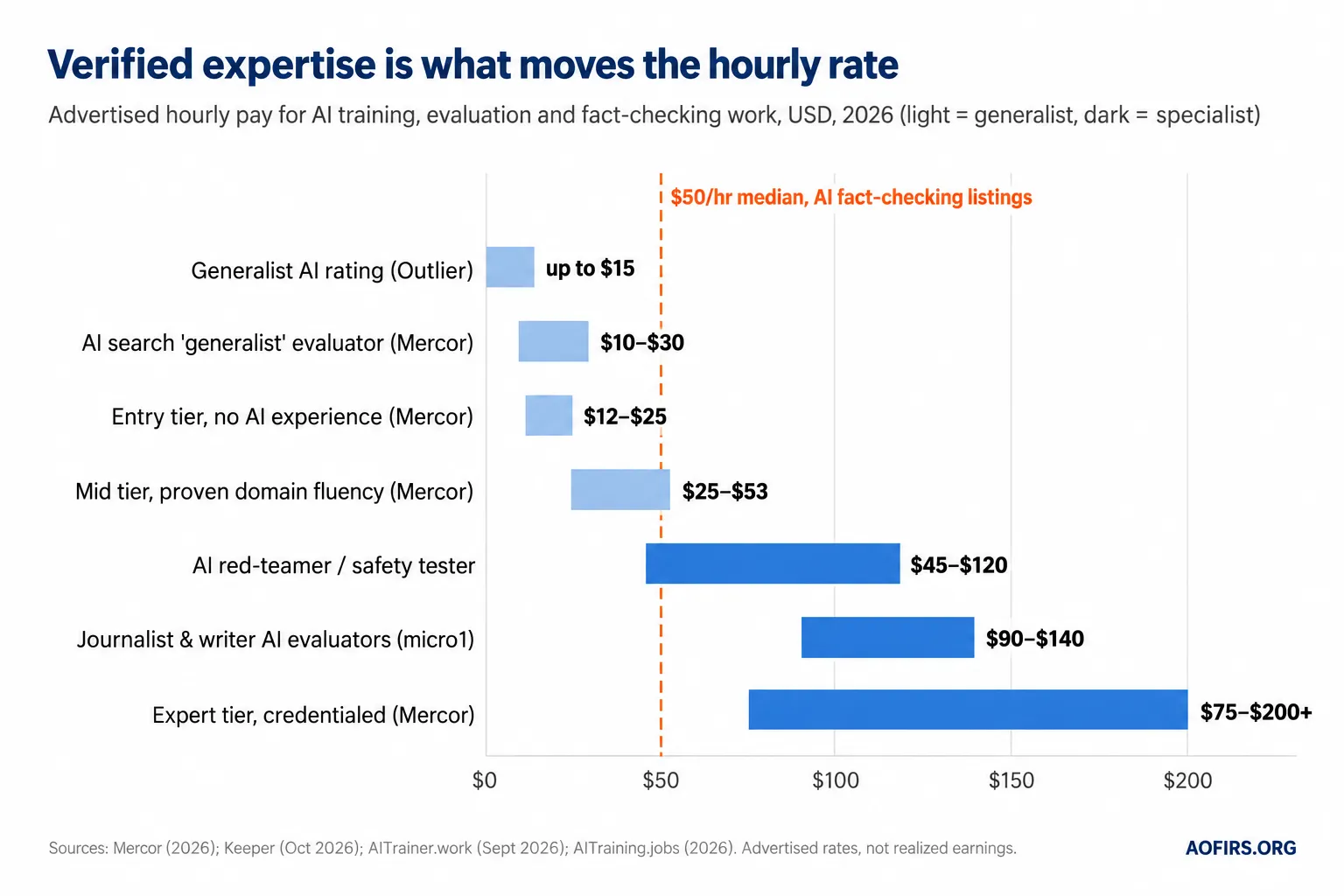
| Domain-expert AI evaluator and fact-checker | Checks AI answers against authoritative sources in law, medicine, finance or science | $50/hr median advertised rate across 153 AI-training listings that include fact-checking (AI fact-checking pay survey) |
| AI red-teamer | Probes models for harmful, biased or false output | No reliable public pay benchmark; security-led roles usually favour prior cyber or engineering experience |
| Knowledge curator (RAG) | Builds and maintains the document collections AI tools search | AI job postings citing RAG up 337% in 2025 (Stanford AI skills index) |
| OSINT and digital investigations analyst | Open-source intelligence, asset tracing, deepfake analysis | No BLS occupation; commercial salary estimates differ by method, so check current postings |
| AI-augmented research analyst | Market or policy research with AI agents, human-verified | $78,760 BLS median for market research analysts (May 2025), 7% projected growth 2025–35 (BLS market research outlook) |
| AI governance and assurance specialist | Risk testing, audit trails, NIST and EU AI Act compliance | EU high-risk AI rules apply from 2 Dec 2027 and 2 Aug 2028 (AI Omnibus timeline analysis) |
| Generalist AI rater | Rates and rewrites AI responses; basic labeling | Up to $15/hr advertised on some platforms (AI training platform rates) |
Hourly contract work is sharply tiered. Mercor describes entry work at $12–$25 an hour, mid-level at $25–$53 and credentialed expert work at $75–$200 or more (Mercor AI trainer rates). Platform work is quick to start, but projects can end without warning and entry tests are often unpaid, so treat generalist rating as a bridge, not a career.
Fake references: the error that looks like evidence
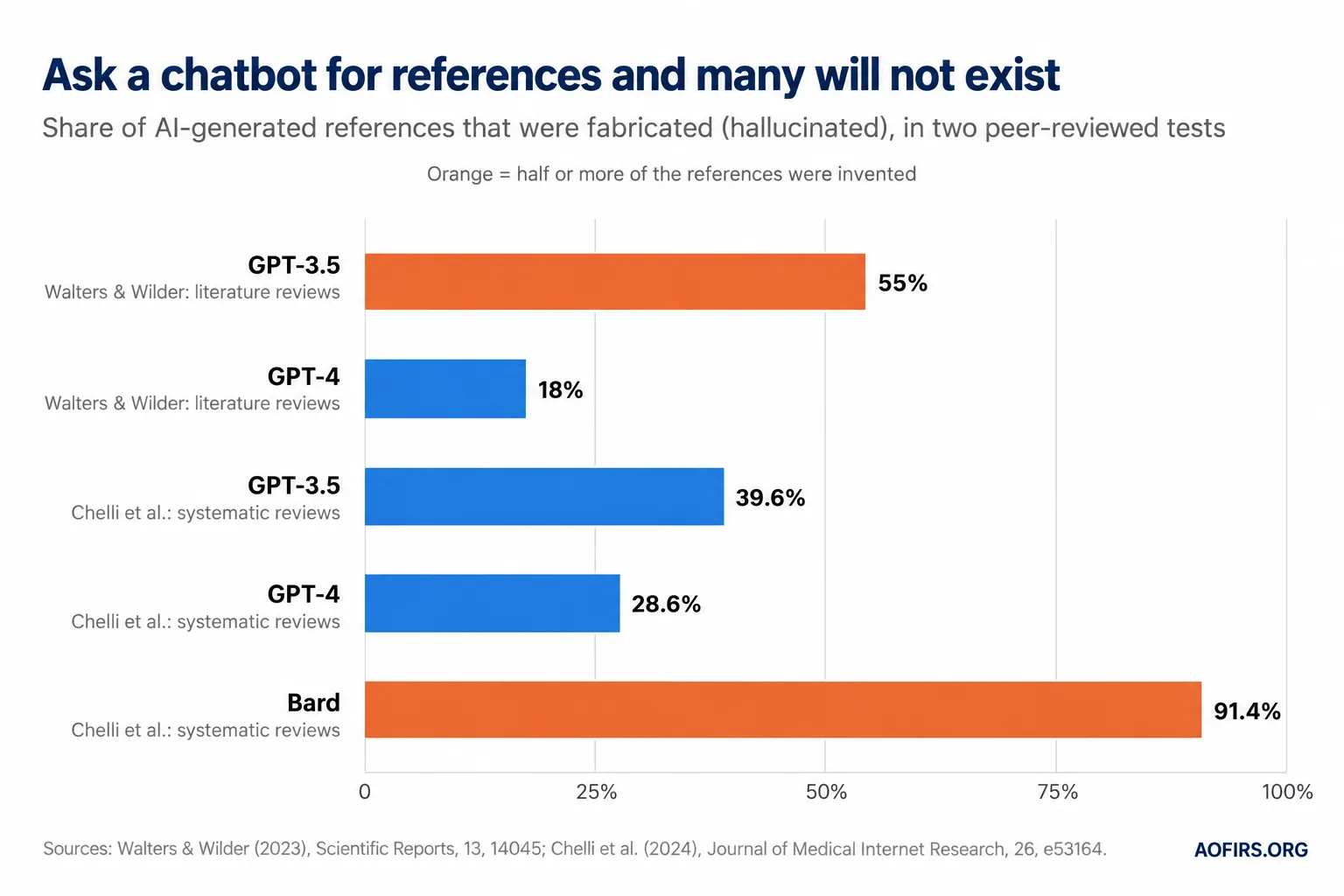
Of all AI mistakes, invented citations do the most harm to a researcher’s reputation, because they look exactly like proof. In a test published in Scientific Reports, 55% of the references GPT-3.5 supplied and 18% of GPT-4’s didn’t exist (AI fabricated citation study). A medical study found hallucination rates of 28.6% for GPT-4 and 91.4% for Bard when the chatbots were asked to find studies for systematic reviews (Systematic review citation study).
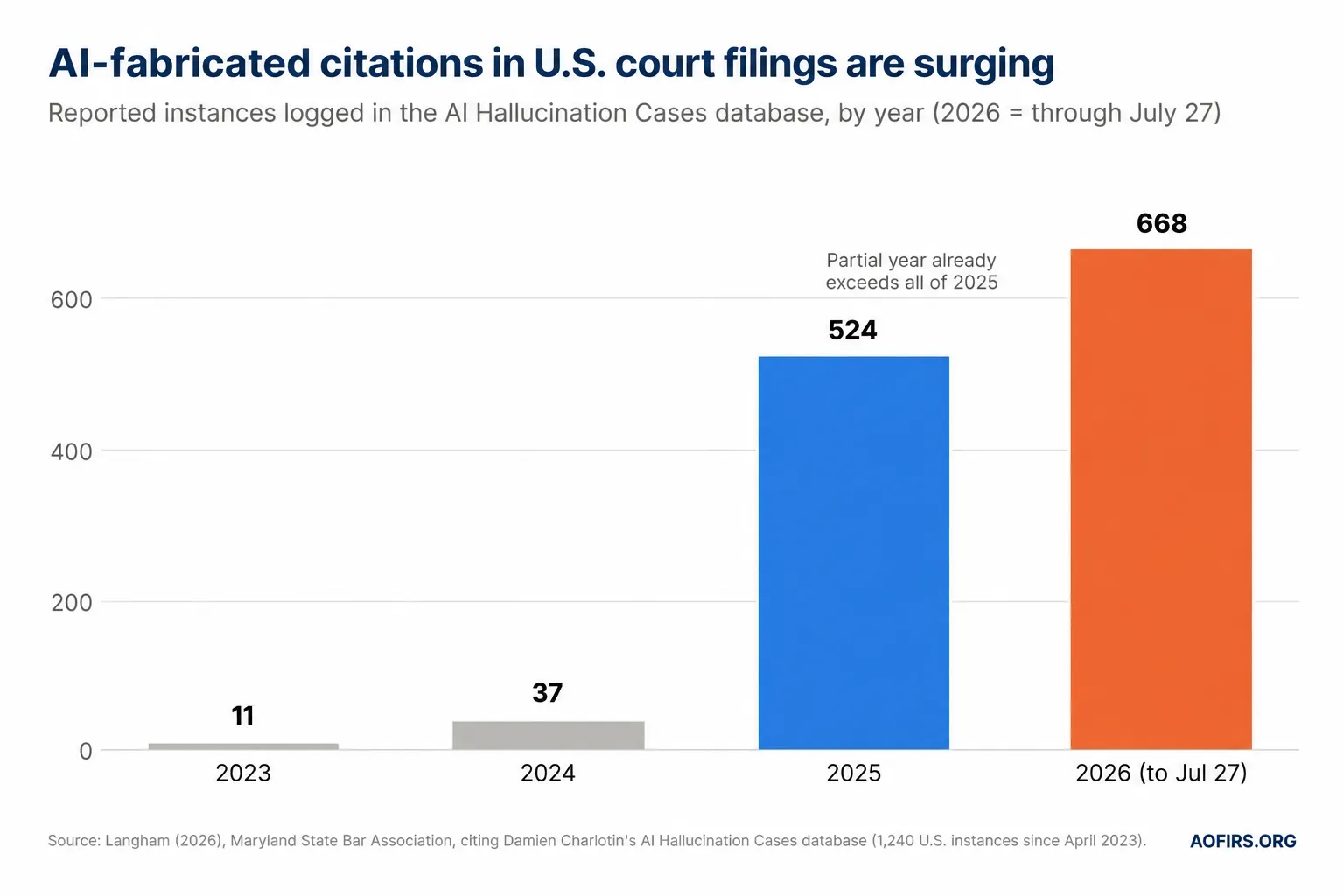
The real-world bill is arriving. In October 2025, Deloitte agreed to partially refund the Australian government for an A$440,000 report that contained a fabricated quote from a federal court judgment and references to nonexistent academic papers (Deloitte report refund coverage). In U.S. courts, the AI hallucination cases database kept by researcher Damien Charlotin had logged 1,240 U.S. filings with AI-fabricated material from April 2023 through 27 July 2026, and the partial 2026 total (668) already exceeded all of 2025 (524) (Maryland court hallucination report). The live count changes as decisions are added: when checked on November 5, 2026, the live database stated that it had identified 2,266 cases worldwide (AI hallucination cases database).
Each of these incidents is, in effect, a job description. Someone should have opened every cited source before the work went out, and clients are starting to pay for exactly that. Source clicking is also limited in the browsing behavior Pew measured: it found that Google users clicked a link inside an AI summary on just 1% of visits (Pew AI search clicks).
How to check AI output: ten steps
The paper’s protocol turns checking from a private habit into something a client can see and pay for:
- Define the claim set. List every fact the output must support before you start.
- Ground the tool. Point the AI at primary and peer-reviewed sources, or a curated collection.
- Demand locators. Require a page, section, table or timestamp for every claim.
- Open every cited source. Confirm it exists and actually says what’s claimed.
- Trace upstream. Follow news and secondary reports back to the original data.
- Check the numbers. Recalculate figures, units, dates and percentages yourself.
- Cross-check with a second method. Use another tool, database or human expert.
- Run a verification pass. Ask the model to generate verification questions and check the answers independently against sources before revising; self-critique alone is not verification (Chain-of-Verification study).
- Label confidence. Mark each conclusion as high, moderate or low, with reasons.
- Keep an audit trail. Save prompts, versions, sources and corrections.
Sources aren’t equal, either. Use the hierarchy as a starting heuristic. Match evidence to the claim, check methodology and provenance, and trace weak leads upstream; a primary source or peer-reviewed label does not by itself guarantee accuracy. Even peer review isn’t a guarantee: more than 10,000 papers were retracted in 2023 (Nature retraction reporting), so check retraction status through Crossref.
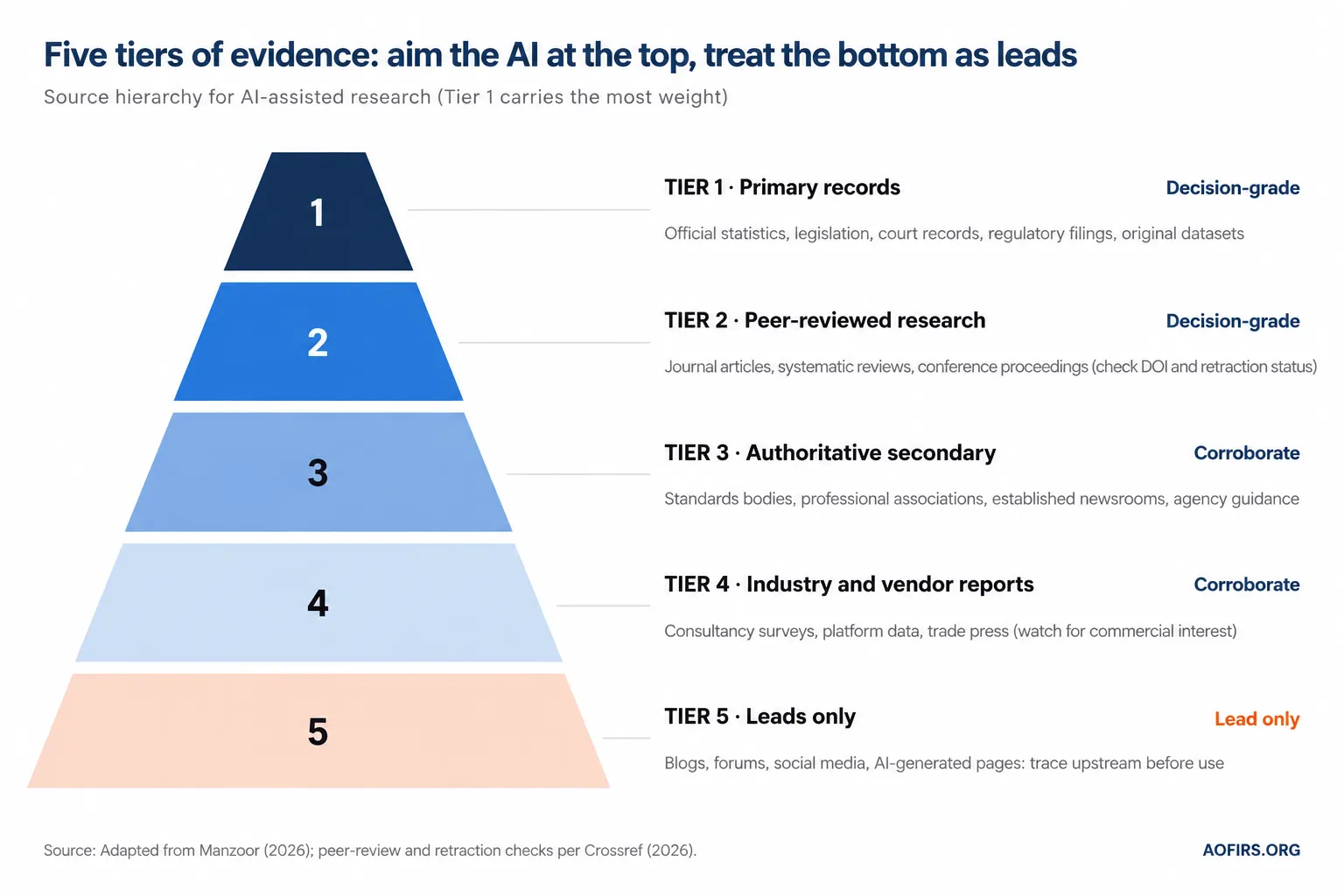
Professional fact-checkers also read laterally: they leave an unfamiliar source to see what others say about it (Lateral reading research). Do the same with a fluent AI answer.
The outlook to 2031
Bain estimates that up to half of U.S. AI jobs could go unfilled by 2027, with demand above 1.3 million against fewer than 645,000 qualified people (Bain AI talent outlook). The paper’s reading is that, for research roles, the shortage is in verified, domain-specific talent rather than in generalist labeling.
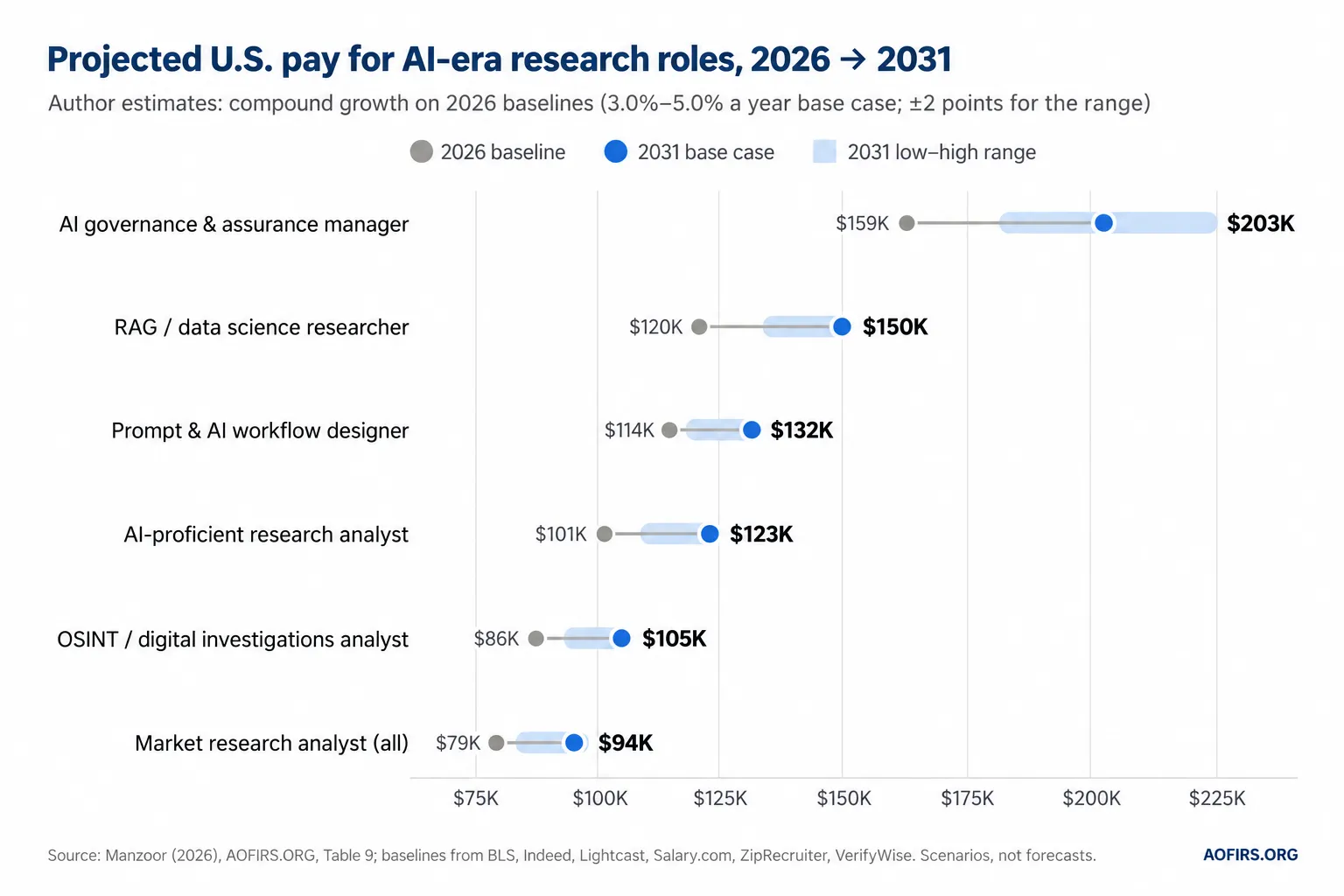
The paper’s salary scenarios apply 3% to 5% annual growth to 2026 baselines. These are scenarios, not forecasts. Two details stand out. The paper’s baseline for an AI-proficient research analyst, about $100,800, is an illustrative calculation: the BLS May 2025 median of $78,760 for market research analysts plus Lightcast’s 28% AI-skills premium, not an observed wage. And “prompt designer” gets the slowest growth, because that title is being absorbed into other jobs.
Regulation is shifting too. The EU’s AI Omnibus amendments, published in the Official Journal on 24 July 2026, changed the AI Act’s AI-literacy duty from requiring providers and deployers to ensure a sufficient level of staff AI literacy to requiring them to support its development. They also moved the high-risk rules to 2 December 2027 (Annex III systems) and 2 August 2028 (Annex I products) (status as of 4 November 2026; AI Omnibus timeline analysis). Check current legal duties for the system and jurisdiction; accountability for a published error remains important.
What to do now
If you’re starting out: Don’t compete on search speed, because speed alone is a weak basis for differentiation. In your first year, learn search and source evaluation, pick one domain specialty, and build three portfolio briefs that show your sources and the AI errors you caught. Then aim for domain-specific evaluation work rather than generalist rating.
If you’re mid-career: Audit your tasks, automate what AI already does well, and move the time you save into verification and advice. Build one AI workflow for your most common job and measure its error rate on past projects where you know the answer. Then price on accountability, not hours.
If you’re late in your career: Relevant domain judgment can qualify you for some expert evaluation projects, whose advertised rates can reach $75 to $200 an hour. Those rates are not guaranteed earnings. Learn to direct and verify AI; some roles require no coding, while technical roles do. On LinkedIn, the number of workers aged 50 and over who list technologies such as AI among their skills rose 25%, nearly double the growth rate for younger workers over five years (Older worker technology study).
Whatever your stage, evidence beats titles. A portfolio of verified work and a documented workflow show what you can do. A professional credential in research and verification, such as AOFIRS’s Certified Internet Research Specialist (CIRS™), can add evidence of structured training, but employers will still test the work itself.
“Use AI to find more, and use human discipline to trust less until the evidence is checked.” — Naveed Manzoor
Conclusion: Build a Verification Practice
The practical opportunity is to combine AI fluency with evidence that your work can withstand scrutiny. Choose a domain, verify consequential claims against primary sources, document uncertainty, and keep a record of the errors you corrected. Show those decisions in portfolio briefs so a client or employer can assess the quality of your judgment.
Treat advertised rates, observed wage premiums, and 2031 scenarios as different forms of evidence. None guarantees a particular income or job. Use AI to improve the speed of a documented workflow, then measure whether verification improves the accuracy and usefulness of its output. That is a concrete way to demonstrate the verification premium rather than merely claim it.
References
- AARP. (2025, December 9). [Article by K. Terrell on AARP–LinkedIn research into older workers’ technology skills]. Older worker technology study
- AITrainer.work. (2026, September 28). AI fact-checking jobs: Who hires and what they pay (2026). AI fact-checking pay survey
- Associated Press. (2025, October 7). Deloitte to partially refund Australian government for report with apparent AI-generated errors. BNN Bloomberg. Deloitte report refund coverage
- Bain & Company. (2025, March 4). Widening talent gap threatens executives’ AI ambitions [Press release]. Bain AI talent outlook
- Brynjolfsson, E., Chandar, B., & Chen, R. (2026, revised August 12). Canaries in the coal mine? Six facts about the recent employment effects of artificial intelligence. Stanford Digital Economy Lab. Stanford early-career employment study
- Brynjolfsson, E., Li, D., & Raymond, L. R. (2025). Generative AI at work. The Quarterly Journal of Economics, 140(2), 889–942. Published AI workplace study (NBER Working Paper 31161: Published AI workplace study)
- Chan, K. (2026, October 7). The 10 best AI training and data annotation jobs in 2026: Legit sites compared on real pay. Keeper. AI training platform rates
- Charlotin, D. (2026). AI hallucination cases database [Database; updated November 2, 2026]. Retrieved November 4, 2026, from AI hallucination cases database
- Chelli, M., Descamps, J., Lavoué, V., Trojani, C., Azar, M., Deckert, M., Raynier, J.-L., Clowez, G., Boileau, P., & Ruetsch-Chelli, C. (2024). Hallucination rates and reference accuracy of ChatGPT and Bard for systematic reviews: Comparative analysis. Journal of Medical Internet Research, 26, e53164. Systematic review citation study
- Dell’Acqua, F., McFowland, E., III, Mollick, E., Lifshitz-Assaf, H., Kellogg, K. C., Rajendran, S., Krayer, L., Candelon, F., & Lakhani, K. R. (2023). Navigating the jagged technological frontier: Field experimental evidence of the effects of AI on knowledge worker productivity and quality (Harvard Business School Working Paper No. 24-013). AI consulting task experiment
- Dhuliawala, S., Komeili, M., Xu, J., Raileanu, R., Li, X., Celikyilmaz, A., & Weston, J. (2023). Chain-of-verification reduces hallucination in large language models (arXiv:2309.11495). Chain-of-Verification study
- Future of Privacy Forum. (2026, July 28; updated August 5). The AI Act implementation timeline: What changes under the AI Omnibus. AI Omnibus timeline analysis
- Hui, X., Reshef, O., & Zhou, L. (2024). The short-term effects of generative artificial intelligence on employment: Evidence from an online labor market. Organization Science. Freelance employment study
- Jaźwińska, K., & Chandrasekar, A. (2025, March 6). AI search has a citation problem. Columbia Journalism Review, Tow Center for Digital Journalism. Tow Center citation study
- Langham, P. (2026, July 27). Confronting the hard numbers behind lawyers, AI, and phantom precedents. Maryland State Bar Association. Maryland court hallucination report
- Lightcast. (2025, July 23). Beyond the buzz: AI skills in job postings [Press release]. Lightcast AI salary analysis
- Magesh, V., Surani, F., Dahl, M., Suzgun, M., Manning, C. D., & Ho, D. E. (2024). Hallucination-free? Assessing the reliability of leading AI legal research tools [Preprint]. Stanford RegLab. Legal AI reliability study
- Manzoor, N. (2026). AI-era and the reality of online research careers: New roles, pay, skills, and the 2026–2031 outlook (1st ed.). AOFIRS.ORG. AI careers research report
- Mercor. (2026, May 8; updated June 23). AI trainer salary and hourly rates. Mercor AI trainer rates
- Nieman Lab. (2025, March 10). AI search engines fail to produce accurate citations in over 60% of tests, according to new Tow Center study. Nieman citation study coverage
- Pew Research Center. (2025, July 22). Google users are less likely to click on links when an AI summary appears in the results. Pew AI search clicks
- PwC. (2026, June 15). AI reshapes global labour market into two distinct paths, rewarding human skills: PwC 2026 Global AI Jobs Barometer [Press release]. PwC AI jobs barometer
- Stanford Institute for Human-Centered Artificial Intelligence. (2024, May 23; updated May 30). AI on trial: Legal models hallucinate in 1 out of 6 (or more) benchmarking queries. Stanford legal AI evaluation
- Stanford Institute for Human-Centered Artificial Intelligence. (2026). Artificial Intelligence Index Report 2026, Chapter 4: Economy. Stanford AI skills index
- Upwork Research Institute. (2026, February 4). In-demand skills 2026: A market view of skills demand in an AI economy. Upwork AI skills report
- U.S. Bureau of Labor Statistics. (2026). Market research analysts. In Occupational outlook handbook. BLS market research outlook
- Van Noorden, R. (2023, December 12). More than 10,000 research papers were retracted in 2023 — a new record. Nature. Nature retraction reporting
- Vectara. (2026). Hallucination leaderboard [GitHub repository]. Retrieved November 4, 2026, from Vectara summarization leaderboard
- Walters, W. H., & Wilder, E. I. (2023). Fabrication and errors in the bibliographic citations generated by ChatGPT. Scientific Reports, 13, 14045. AI fabricated citation study
- Wineburg, S., & McGrew, S. (2019). Lateral reading and the nature of expertise: Reading less and learning more when evaluating digital information. Teachers College Record, 121(11). Lateral reading research (working-paper version: Lateral reading research)