
Stanford researchers found that many students struggled to distinguish advertising from reporting and investigate the sources behind online claims. These influential findings were published in 2016. They are not results from a new 2026 Stanford study.
The lesson remains relevant: familiarity with digital platforms does not automatically provide the skills needed for evaluating online information. Later research has examined similar difficulties and tested ways to improve source evaluation. Students now also need to scrutinize AI answers alongside websites, search results, and social posts.
What did the original Stanford research find?
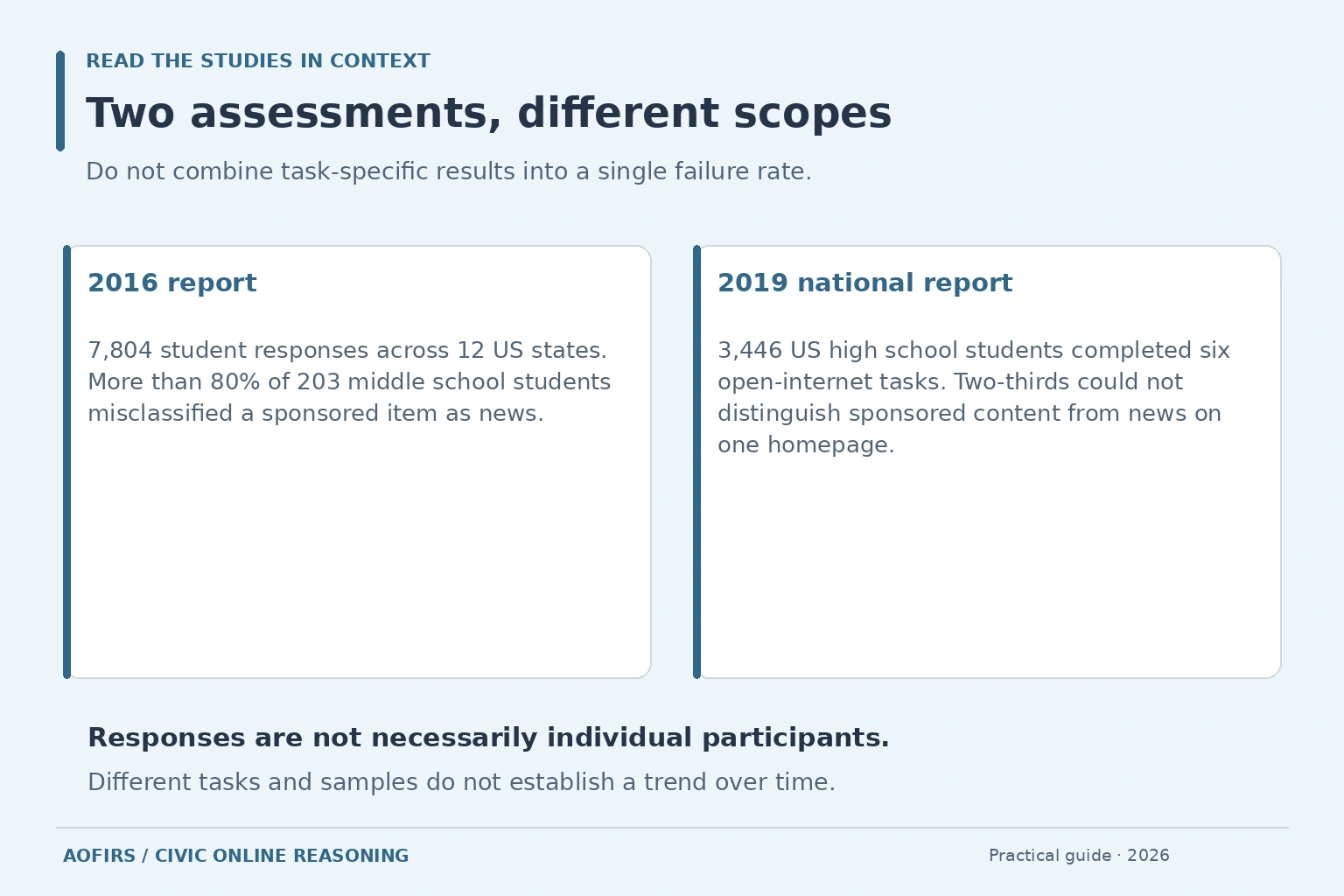
The Stanford History Education Group published Evaluating Information: The Cornerstone of Civic Online Reasoning on November 22, 2016. Between January 2015 and June 2016, researchers administered 56 tasks across 12 US states and analyzed 7,804 student responses. Responses should not be confused with a count of individual participants.
The project developed and validated 15 assessments across middle school, high school, and college levels. In the final version of one exercise, more than 80% of 203 middle school students classified a native advertisement labeled “sponsored content” as news. Stanford’s original announcement describes the tasks and findings.
Researchers recruited through teacher networks for field testing. The 2016 executive summary explains the assessment-development process. Its results show difficulties on those tasks, rather than a nationally representative failure rate for every student.
What subsequent research adds
A larger assessment found continuing difficulties
A later project assessed 3,446 US high school students from June 2018 to May 2019. Researchers described the sample as matching the demographic profile of the country’s high school population. Students completed six open-internet exercises.
Two-thirds could not distinguish sponsored content from news on a homepage. In another exercise, 52% treated a video filmed in Russia as strong evidence of US election misconduct. The national assessment summary reports these findings. Different samples and tasks do not establish whether performance improved or declined since 2016.
Students can learn evaluation strategies
A 2021 college study embedded four one-hour modules in an online nutrition course. Among 87 students, those leaving an unfamiliar website to consult another source increased from 3 before instruction to 67 afterward. Of those 67, only 36 correctly questioned the site’s credibility.
The before-and-after design lacked a separate untreated comparison group. It did not establish long-term retention or everyday use. Opening another tab was useful but did not guarantee good judgment.
A separate district-wide study published in 2022 used a cluster-randomized design. Students taught strategies drawn from professional fact-checkers improved significantly in evaluating digital content. Together, these studies support explicit instruction, with conclusions bounded by their designs and settings.
A 2026 study cautions against promising lasting protection
A 2026 randomized study of 2,666 adults in Germany compared source-focused lateral reading with claim-focused search instruction. Estimated improvements were small, and some were not statistically distinguishable from zero. After two weeks, treatment-control differences were no longer statistically distinguishable; all groups had received debriefing.
This adult study should not be presented as evidence about school students. It also does not show that short interventions create durable protection against misinformation.
Why appearance and popularity are insufficient
Separate three questions: how is the information presented, who is responsible for it, and what evidence supports the claim? A reputable publisher can publish a weak claim. An unfamiliar source can host an authentic document. Both source identity and the particular evidence require examination.
| Cue | Why it is insufficient | Better check |
|---|---|---|
| Professional design | Appearance does not establish accuracy | Investigate the publisher and evidence |
| A .org domain | The suffix does not certify neutrality | Check ownership, funding, and outside coverage |
| High search placement | Ranking does not verify a claim | Open the source and inspect its support |
| Many likes or shares | Popularity is not proof | Trace the original evidence |
| Several agreeing websites | They may repeat one source | Compare their underlying references |
| A long bibliography | References can be irrelevant or inaccurate | Check existence, identity and support |
| Confident AI wording | Fluency does not establish correctness | Check factual statements at source |
For wider background on sponsored material and manipulated information, the AOFIRS report The Visual Fact Check covers source tracing, hidden advertising, and digital-content verification.
What is lateral reading?
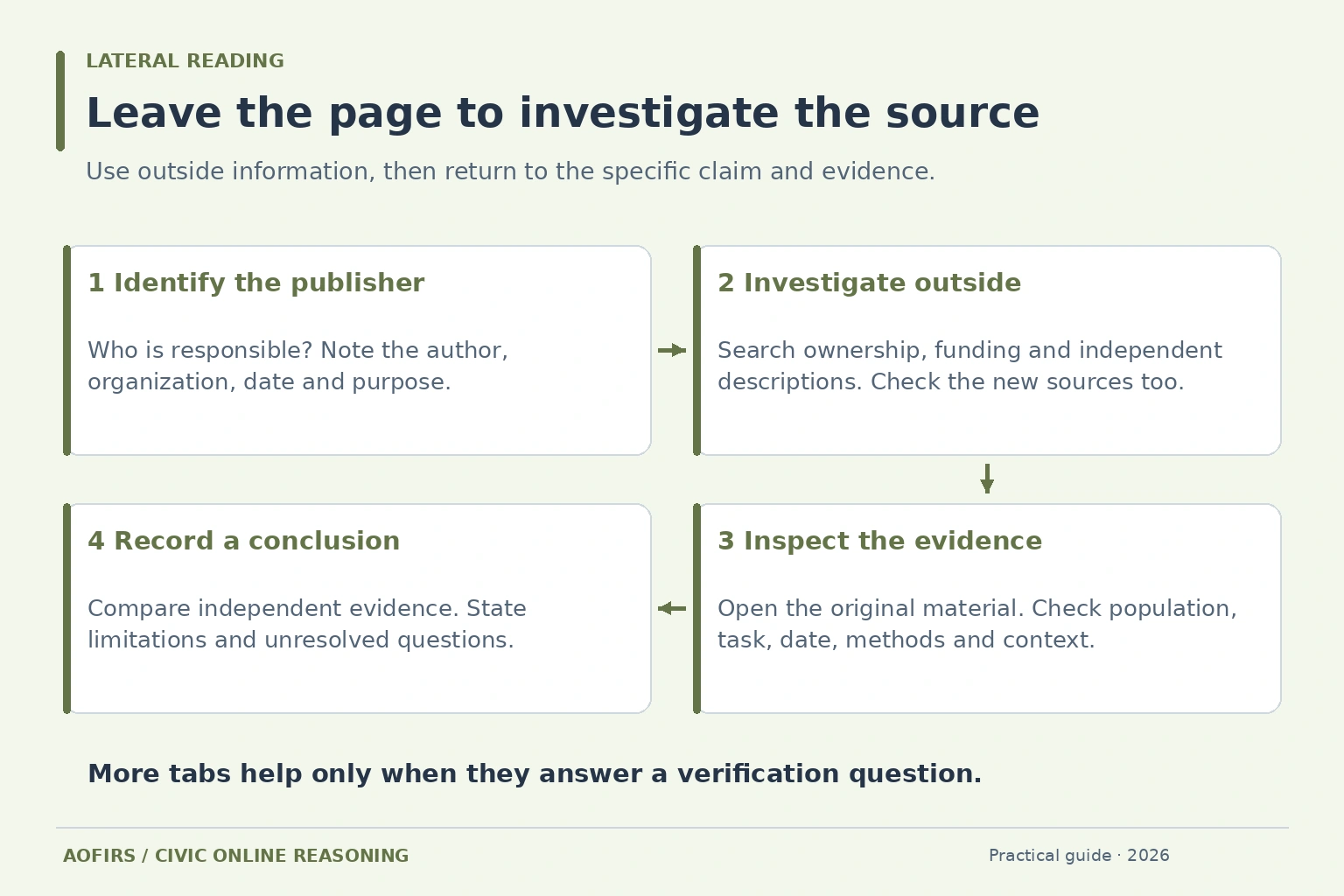
Lateral reading means leaving an unfamiliar page to investigate its source through other sources. Instead of relying on an organization’s own description, search for independent reporting and records about it.
For an unfamiliar educational institute, try its name alongside “funding,” “ownership,” or “research.” Compare its account with outside coverage and the records behind that coverage. New sources also need scrutiny: a repeated allegation is not independent confirmation.
The goal is to answer a question about the source, rather than accumulate tabs. After investigating the publisher, return to the specific claim and its supporting material.
A seven-step workflow for evaluating online information
This practical workflow is informed by the research. It is not a validated scoring system or a guarantee of accuracy.
1. State the exact claim
Replace broad statements such as “students are losing critical thinking skills” with something checkable about a particular assessment, population, and year. Write down what the evidence would need to show.
2. Identify the publisher and purpose
Check author, organization, date, ownership, and relevant funding. Distinguish reporting, opinion, advertising, satire, and research. Sponsored material can contain accurate information, but its commercial purpose matters when interpreting selection and framing.
3. Investigate outside the page
Look for independent information about the publisher and its expertise. Do not count its biographies, testimonials, and affiliated websites as separate corroboration. Follow descriptions to underlying records where possible.
4. Trace the evidence
Follow statistics to reports, quotations to full interviews, and research headlines to papers. Distinguish original publication dates from reposts or updates. With visual media, investigate earlier appearances, uploader, location, and context.
AOFIRS’ reverse video search guide explains how keyframes can help locate related material. A failed reverse search does not establish authenticity.
5. Check whether the evidence fits
Read the relevant methods and limitations. A college sample does not automatically describe children. Reported satisfaction is different from measured learning. An association does not establish causation. Check that the wording matches the population, outcome, and study design.
6. Seek independent corroboration
Five articles quoting one press release are five publications drawing on one source. Seek material contributing its own evidence or analysis. Investigate disagreements in definitions, methods, populations, and dates.
7. Record a proportionate conclusion
Use labels such as supported, supported with limitations, unverified, misleading through missing context, or contradicted by stronger evidence. Save the URL, date, and relevant passage. Explain missing information instead of turning uncertainty into confidence.
AI answers and citations need the same scrutiny
A 2023 study by Walters and Wilder documented fabricated references and errors in genuine citations generated by GPT-3.5 and GPT-4. Its results concern those models and tasks, not current error rates for every AI system.
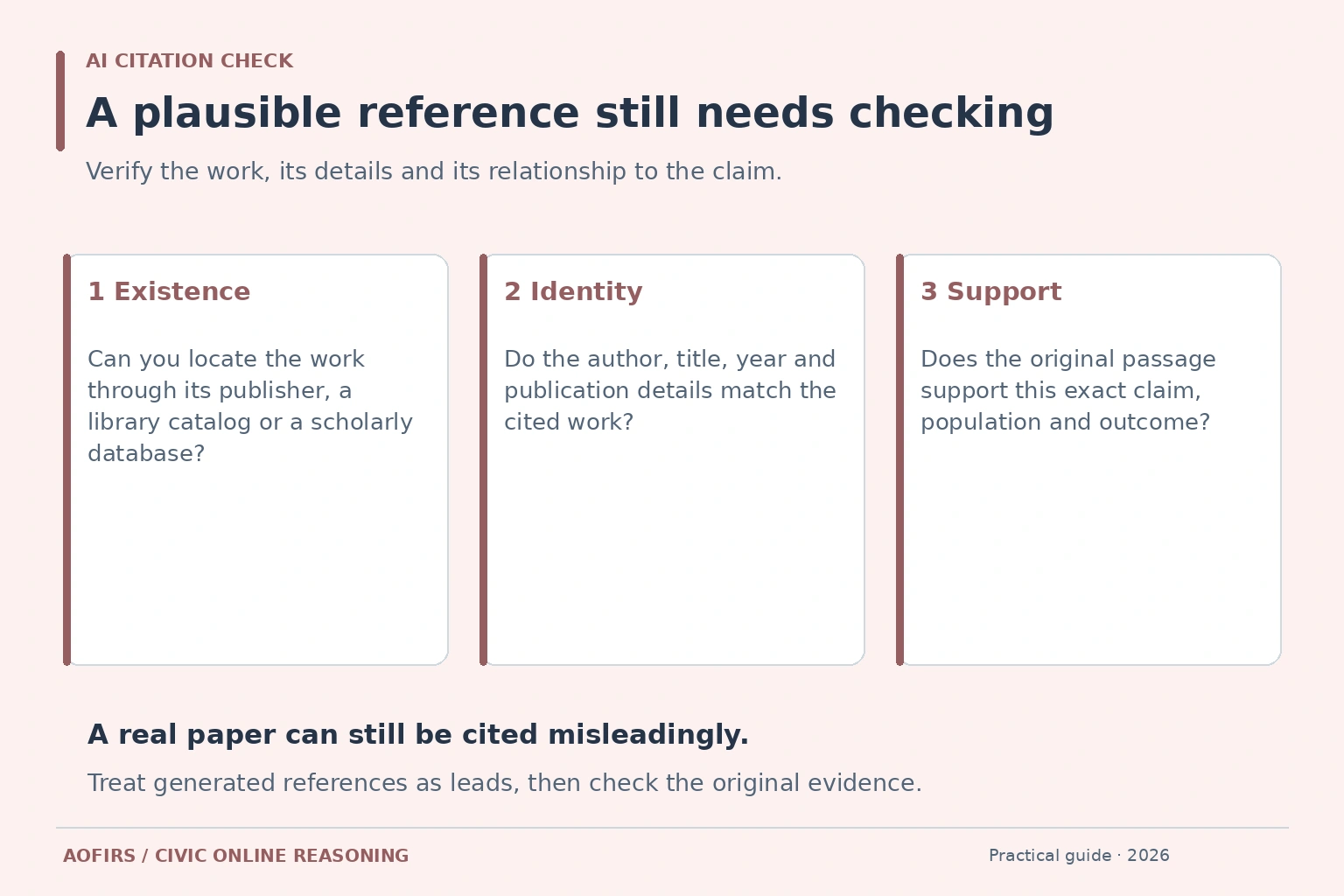
Treat a generated reference as a lead. Check three things:
- Existence: Locate the work through a publisher, library catalog, or scholarly database.
- Identity: Match author, title, date, and publication details.
- Support: Read whether the source actually substantiates the cited sentence.
AI can suggest search terms and organize questions, but the defense of its own answer does not replace source checking. The AOFIRS visual toolkit, Identifying Fakes in the AI Era offers additional material for exploring digital deception. Check context as well as manipulation: a genuine photo with the wrong date or location can mislead without AI editing.
Three worked examples
These are hypothetical teaching scenarios, not additional research findings.
A viral statistic
A post claims “80% of students cannot recognize misinformation.” Find the original report and check the denominator and task. The cited result concerns one sponsored-content exercise among 203 middle school students. Explain the narrower finding rather than repeat a claim about all misinformation.
A polished education website
A website claims its method “doubles academic achievement.” Investigate the publisher, institutional logos, and cited study. If the evidence measures satisfaction rather than achievement, it does not substantiate that claim, regardless of the site’s appearance.
An AI answer with a citation
An AI answer cites a study supposedly proving improved critical thinking. Locate the paper independently. If it measures student opinions, it cannot by itself establish improved thinking. If the reference cannot be located, label it unverified and seek other evidence.
What students and educators can do
Make evaluation visible in coursework. Educators can model a source investigation, explain their choices, and ask students to submit a short verification record. Compare advertising, reporting, and research on one topic, then assess the reasoning behind the answer.
Students can log the claim, source, evidence, limitations, and confidence level. Revisit exercises across subjects and over time. Allow “insufficient evidence” as a defensible conclusion; requiring certainty can reward overstatement.
Frequently asked questions
Was the original Stanford study published in 2026?
No. The original report was published on November 22, 2016, using work conducted from January 2015 to June 2016.
Does it show that all students are poor evaluators?
No. Findings apply to the participants, tasks, and methods studied. They identify difficulties without showing identical performance by every student.
What does civic online reasoning mean?
Evaluating online information relevant to public life by investigating sources, examining evidence, and comparing coverage.
Is lateral reading just finding agreement?
No. It investigates the source through outside information. Agreement matters only when the sources are credible and sufficiently independent.
Is sponsored content always false?
No. Sponsorship identifies a commercial relationship. Examine the claims and evidence separately while considering that purpose.
Can a real citation be misleading?
Yes. A genuine paper may address a different population, outcome, or question. Check relevance as well as existence.
Can AI replace verification?
No. References, quotations, and factual claims still need examination against underlying evidence.
What if the evidence remains unclear?
Describe what is known, identify missing information, and qualify the conclusion. Preserve uncertainty in your notes and final answer.