
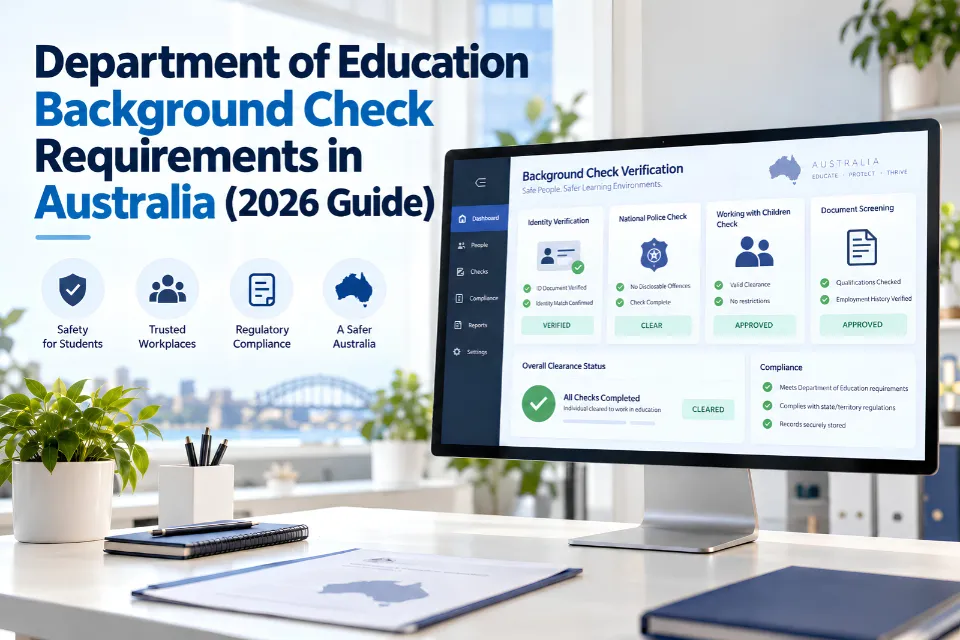
Education background checks in Australia depend on the role, employer and state or territory. Teachers, early childhood educators, support staff, contractors and volunteers may need different combinations of police checks, child-related screening and professional registration.
There is no single national Department of Education clearance covering every education job. State and territory rules apply, with additional obligations for some early childhood education and care services and providers.
The 2026 child-safety reforms added early childhood workforce oversight, training and provider obligations. Some changes are national within the early childhood sector; others apply only in a particular jurisdiction.
This guide covers the various screening requirements, the application process and the key information that education professionals and employers need to know.
What Background Checks Are Required for Education Jobs in Australia?
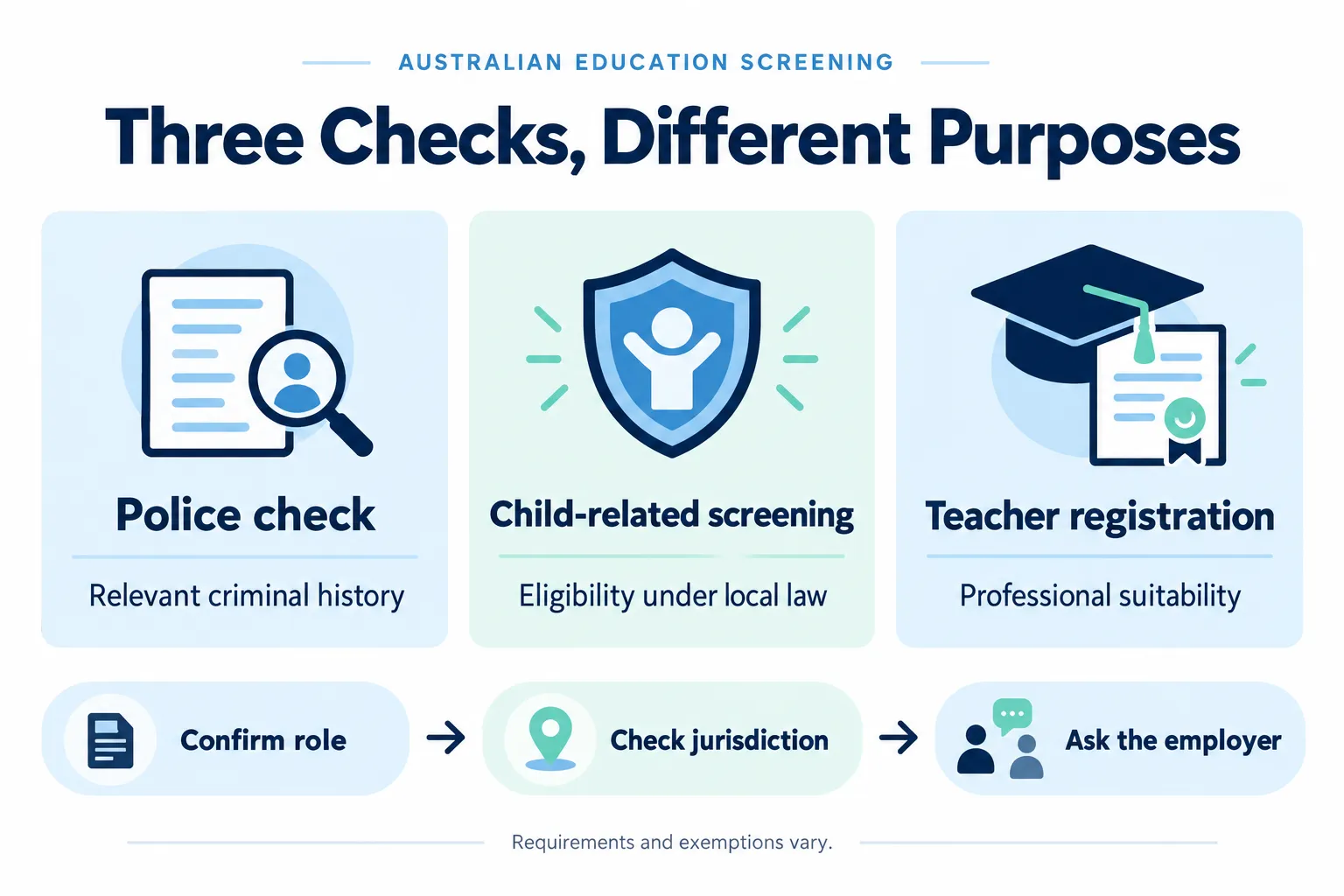
Australian education sector screening generally comprises three main processes: criminal history checks, child-related work screening and professional registration checks.
The exact mix will vary according to the role, the organization and the jurisdiction.
1. National Police Check
A National Police Check (commonly referred to as a criminal history check) checks police records from all Australian jurisdictions.
The ACIC operates the National Police Checking Service in conjunction with the police and accredited organizations.
A check could reveal relevant criminal history information depending on the purpose of the application, the spent convictions legislation and the relevant information release policies.
A police check doesn’t in itself establish that a person is legally eligible to work with children.
2. Working with Children Check (WWCC)
A Working with Children Check is a specific type of screening for people who are working with children.
Depending on the jurisdiction screening may take into account a person’s criminal record, any findings of disciplinary action, any relevant court orders and other child safety information.
Some jurisdictions also monitor new information during the clearance period.
A WWCC is not just another name for a police check. It is a separate eligibility assessment under child protection legislation.
3. Teacher Registration and Suitability Assessment
Teachers generally require professional registration or authorization from the relevant State or Territory authority.
The registration process may involve qualification assessments, a criminal record check, a professional conduct check and a suitability to teach assessment.
Professional registration and employment screening are two quite different things serving two quite different purposes.
A teacher who is registered must still satisfy any further conditions which may apply to their post.
Who Needs a Background Check in Australian Education?
Requirements depend on the duties, setting, applicable law and employer policy, rather than the job title alone.
Commonly affected groups include:
- School teachers: Professional registration and relevant employment screening.
- Early childhood educators: child-related work clearances and the relevant early childhood sector requirements.
- School support staff: Screening where the duties meet the criteria for regulated child-related work.
- Principals and administrators: Employment suitability checks and relevant professional requirements.
- Contractors: Checks will be dependent on the services they provide and their level of contact with children.
- Volunteers: Screening where required by legislation (subject to exemptions).
- Student teachers: Checks or registration arrangements required for practical placements.
- International teachers: Australian registration requirements and potentially overseas criminal history checks.
- Childcare provider managers: additional suitability checks where required under federal and state legislation.
University staff and adult vocational education staff don’t automatically need child work clearances just because they’re in the education sector.
For instance a university lecturer teaching adults and a childcare educator looking after young children could be subject to different screening requirements.
National Police Check vs. Working with Children Check
Although both processes contribute to safer recruitment they answer different questions.
| Feature | National Police Check | Working with Children Check |
|---|---|---|
| Primary purpose | Disclose relevant criminal history | Assess eligibility for regulated child-related work |
| Responsible authority | ACIC service through authorized channels | State or territory screening authority |
| Information assessed | Disclosable police information | Criminal history and other relevant child-safety information |
| Ongoing monitoring | Generally a point-in-time result | Available under applicable jurisdictional schemes |
| Validity | No standard national expiration period | Jurisdiction-specific clearance period |
| Employment use | Used for various occupations | Used for roles covered by child-related work laws |
The ACIC states that a Nationally Coordinated Criminal History Check reflects the information available at the time of the result being issued.
There is no fixed validity period for these police checks. An employer may set an acceptable age for a result (subject to the relevant requirements).
Importantly a police check carried out for one reason may not be appropriate for another as the reason for the check will determine what information is disclosed.
Source: ACIC validity guidance.
Background Check Requirements by Australian State and Territory
Australia has eight jurisdictions with different arrangements in relation to screening of people who work with children.
Applicants must identify the relevant jurisdiction prior to applying.
| State or territory | Screening scheme | Responsible authority |
|---|---|---|
| New South Wales | Working with Children Check | NSW Office of the Children’s Guardian |
| Victoria | Working with Children Check | Social Services Regulator |
| Queensland | Blue Card system | Blue Card Services |
| Western Australia | Working with Children Check | Department of Communities, WWC Screening Unit |
| South Australia | Working with Children Check | Department of Human Services Screening Unit |
| Tasmania | Registration to Work with Vulnerable People | Department of Justice |
| Australian Capital Territory | Working with Vulnerable People registration | Access Canberra |
| Northern Territory | Working with Children Clearance (Ochre Card) | NT Screening Authority, supported by SAFE NT |
Important jurisdictional differences
New South Wales: Child related workers covered by the scheme will need a WWCC. Employers will need to verify the clearance details. A clearance will generally last for five years.
Victoria: The screening process takes into account relevant criminal history, disciplinary records and child safety issues. The new October 2026 requirements also impact training and employer checks.
Queensland: QCT-registered teachers do not need a blue card or exemption card for their registered teaching role at a school. Other child-related work can require an exemption card. Check the role-specific rules.
Western Australia: the WWC Check applies to specified child-related work. A card generally lasts three years. Do not assume that it satisfies another jurisdiction’s requirements.
South Australia: the Department of Human Services Screening Unit assess applications on the basis of a person’s criminal record and other relevant legal information.
Tasmania: Registration to Work with Vulnerable People applies to regulated activities. Check the current activity categories and exemptions before applying.
ACT: WWVP registration covers the specified regulated activities. The ACT also has a number of limited exemptions.
Northern Territory: A Working with Children Clearance is generally known as an Ochre Card. The screening process takes into account an applicant’s criminal record and other relevant suitability information.
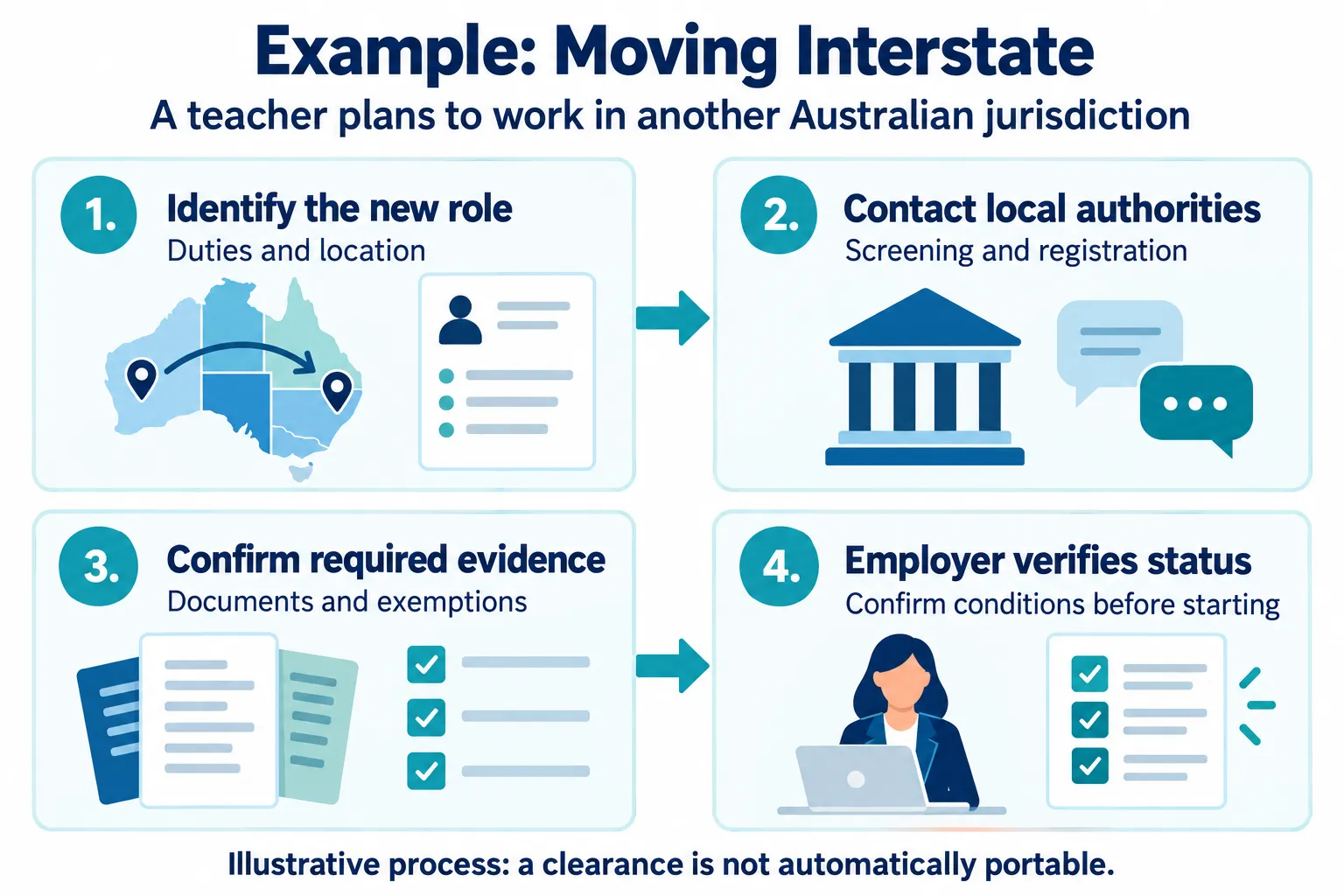
Can a clearance be transferred to another state?
Not automatically.
An applicant moving interstate should check the requirements of the new jurisdiction. There may be limited exemptions or recognition arrangements in certain circumstances but a clearance in one state will not necessarily give you the right to operate in all states.
Official guidance is available from:
- NSW screening guidance
- Victoria WWCC guidance
- Queensland teacher exemptions
- WA application guidance
- SA education screening
- Tasmania RWVP guidance
- ACT WWVP guidance
- NT Ochre Card
Teacher Registration and Criminal History Checks
Teacher registration is the responsibility of the relevant professional body in each state and territory.
Registration authorities will assess whether the applicant meets the professional and suitability requirements.
These assessments may consider:
- Recognized teaching qualifications.
- Professional experience.
- Australian criminal history.
- Overseas criminal record where required.
- Previous registration decisions.
- Professional misconduct or disciplinary findings.
- Other information of relevance to suitability to teach.
For example the Queensland College of Teachers will assess suitability on the basis of a criminal history, professional conduct information, previous registration decisions and other relevant legal information. See QCT suitability guidance.
An applicant’s circumstances may of course warrant individual assessment. Not every criminal record will lead to a refusal.
Teachers should seek advice from their regulator as to whether a previous registration or police certificate will be sufficient for a new application.
Find the relevant state or territory teacher regulator through the Australian Institute for Teaching and School Leadership directory. See teacher regulator directory.
Overseas Police Checks for International Teachers
Teachers who have lived or worked overseas may require overseas criminal history documentation.
The requirements will vary depending on the teacher registration authority, your employment arrangement and the relevant immigration process.
An overseas applicant may be asked to provide:
- Criminal history certificates from specified countries.
- Evidence of identity and previous names.
- Details of overseas residence.
- Certified translations.
- Professional registration or disciplinary history from any previous jurisdiction.
- Supporting documents as requested by the registration authority.
Overseas criminal history may form part of a teacher registration suitability assessment. Confirm the current country, residence and delivery requirements with the receiving regulator.
However residence thresholds or document requirements that apply in QLD should not be assumed to be the national requirements.
Practical tip: get in touch with the teacher registration authority prior to ordering your international police certificate. This will help ensure that you don’t end up with a certificate that they won’t accept.
How to Get a Background Check for an Education Job in Australia
Applicants can follow this process to identify and complete the appropriate screening requirements.
Step 1: Identify the jurisdiction
Determine the state or territory where the work will take place.
Step 2: Confirm the position’s screening requirements
Review the employer’s instructions and applicable legislation. Establish whether the role requires a WWCC, police check, teacher registration, or more than one process.
Step 3: Select the official application service
Use the relevant government screening authority or an authorized provider for the particular type of check.
Step 4: Prepare identification documents
Gather acceptable identification, address details, name-change documents, and other required evidence.
Step 5: Submit the application
Follow the regulator’s application process, including identity verification and payment where applicable.
Step 6: Confirm eligibility before starting work
Some jurisdictions permit limited work while an application is pending, subject to strict conditions. Other roles require a completed clearance.
Do not assume that submitting an application is sufficient authorization to begin working with children.
Step 7: Provide screening details to the employer
Employers may need to verify the result directly through an official system.
Step 8: Maintain ongoing compliance
Monitor renewal dates, update personal details, and report relevant changes when required.
Processing times and application fees vary according to the authority and circumstances.
What’s New in Australian Education Background Checks in 2026?
Australia introduced significant reforms to improve safeguards in early childhood education and care (ECEC).
Several changes took effect during 2026, while broader national screening reforms remain under development.
| Development | Date or status | Main impact |
|---|---|---|
| Stronger National Quality Framework child-safety provisions | Major measures commenced February 27, 2026 | Stronger child-safety and screening obligations |
| National Early Childhood Worker Register | Launched February 27, 2026 | Workforce information recorded for regulated ECEC services |
| National child-safety foundation training | Introduced February 27, 2026 | Mandatory safeguarding training for relevant ECEC workers and volunteers |
| Child Care Subsidy Minister’s Rules amendments | July 1, 2026 | Expanded checks and other provider approval conditions |
| Victoria WWC screening reforms | July and October 2026 | Stronger information sharing, training, and employer verification |
| National Continuous Checking Capability | In development | Intended to improve monitoring and information sharing across jurisdictions |
National Early Childhood Worker Register
The National Early Childhood Worker Register launched on February 27, 2026. See worker register factsheet.
Providers covered by the National Quality Framework must maintain relevant workforce information, including worker identification, qualifications, training, and child-related screening details.
The system is designed to improve visibility of the workforce across services and jurisdictions.
It does not replace the underlying obligation to hold any required screening clearance.
Mandatory child-safety training
National child-safety training was introduced alongside the early childhood reforms.
The foundation course became available on February 27, 2026. Follow current official guidance on completion deadlines, role-specific requirements and refresher training. See national training guidance.
Employers must follow the training obligations applicable to their services and employees.
July 2026 provider screening changes
Amendments to the Child Care Subsidy Minister’s Rules introduced additional requirements relevant to approved providers.
These include checks concerning persons with management or control and other specified individuals, covering matters such as criminal history, Working with Children Checks, ASIC records, insolvency information, and digital verification.
These management suitability requirements should not be confused with the screening rules for every classroom employee. See July provider reforms.
Victoria’s October 2026 changes
From October 19, 2026, new Victorian WWC applicants, renewal applicants and people changing from volunteer to employee clearance must complete the state’s child-safety training before their application is finalized. Existing holders generally complete it when renewing, rather than immediately. See Victoria training rules.
Victoria also introduced WWC Connect on October 19, 2026. Organizations must check clearance status or applicable exemptions, connect workers as required, and maintain relevant records. See WWC Connect guidance.
These changes are separate from the national ECEC training framework.
Are national Working with Children Checks being introduced?
Australian governments are working toward greater national consistency.
Reform priorities include improved recognition of negative decisions, cross-jurisdictional information sharing, and continuous criminal history monitoring.
However, these initiatives should not be interpreted as an already established universal WWCC that replaces every state and territory scheme.
Use current Australian Government and ACECQA guidance to distinguish reforms already in effect from initiatives still being developed. See national reform update and NQF safety changes.
Employer Responsibilities and Ongoing Compliance
Education employers must identify the screening requirements applicable to their workforce and verify that staff meet the necessary conditions.
A sound compliance process includes:
- Identifying roles subject to screening legislation.
- Verifying clearance status through official systems.
- Recording relevant clearance and registration details securely.
- Monitoring expiration dates and changes in eligibility.
- Following notification duties when an employee’s status changes.
- Reviewing overseas applicants’ documentation where required.
- Applying appropriate safeguards to contractors and volunteers.
- Restricting access to sensitive personal information.
Employers must also respond appropriately when a worker receives a suspension, exclusion, or other adverse screening decision.
A commercial screening management service may assist with administration, but it does not replace legally required government checks.
Digital Screening, Privacy, and Emerging Technologies
Australian screening systems increasingly use digital application services, electronic identity verification, online clearance records, and employer verification tools.
For example, Victoria provides digital Working with Children Check functionality through Service Victoria.
Digital systems can make status verification and record management more efficient, but they also create responsibilities involving privacy, accuracy, and cybersecurity.
Employers should collect only necessary information, restrict access to screening records, and follow applicable privacy and retention requirements.
Automated administrative tools should not be treated as substitutes for lawful suitability assessments or appropriate human review.
A Prompt for Researching Official Requirements
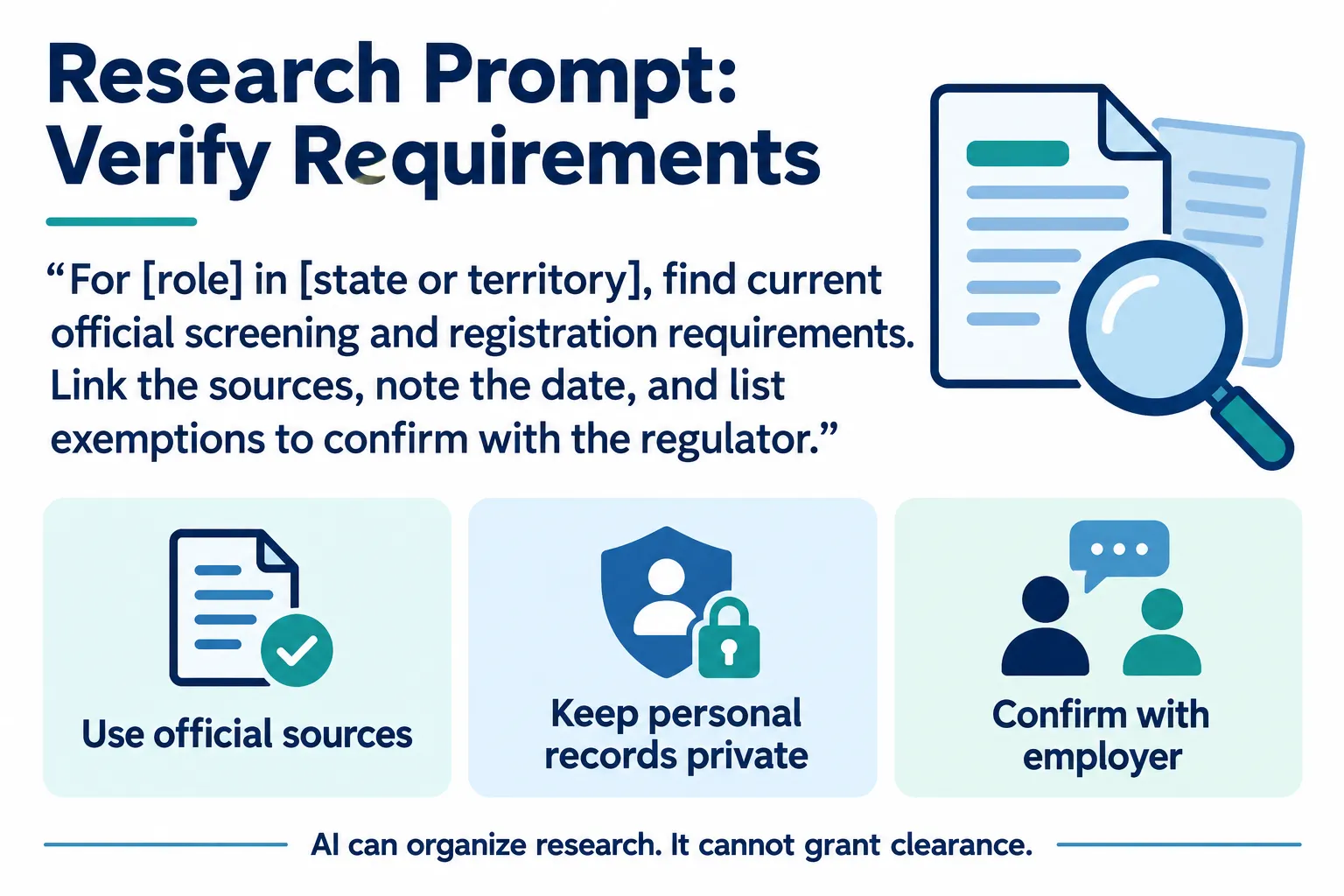
For [role] in [state or territory], find current official screening and registration requirements. Link the sources, note the date, and list exemptions to confirm with the regulator.
Use this prompt only for researching public guidance. Do not upload identity documents, police reports or personal screening records. Confirm the answer with the relevant authority and employer.
Privacy obligations vary by employer, jurisdiction and type of record. The federal Privacy Act includes an employee-records exemption in certain private-sector employment circumstances; it should not be treated as a blanket exemption for all screening data. See OAIC employment guidance.
Frequently Asked Questions
1. Do all Australian teachers need background checks?
Teachers must meet the requirements for professional registration and suitability. This will normally involve a criminal history check. Further employment or child-related screening requirements will vary by state/territory and role. Applicants should check with both their teacher registration body and the prospective employer to confirm the requirements.
2. Is a National Police Check the same as a Working with Children Check?
No. A National Police Check provides disclosable criminal history information for a particular purpose. A Working with Children Check is a check of eligibility to undertake certain child-related activities and may take into account other information. One check does not in any way replace the other.
3. Who issues the Working with Children Checks in Australia?
State and territory screening authorities are the ones who administer the child work clearances. The NSW Office of the Children’s Guardian runs the NSW WWCC, Queensland uses Blue Card Services and Tasmania and the ACT have broader vulnerable person screening schemes.
4. Can teachers work while their background checks are pending?
It will depend on the relevant law, the role and the type of screening. Some jurisdictions will allow limited work under certain conditions whereas other roles will require a full clearance prior to work commencing. ECEC workers will also have to comply with the enhanced 2026 requirements. Employers must check that they have permission before an applicant is allowed to start work.
5. Do education volunteers need a Working with Children Check?
Volunteers may be subject to screening if their activities constitute regulated child-related work. The nature of the exemption will vary from jurisdiction to jurisdiction. Some volunteer applications are free but you must check with the relevant screening body as to your eligibility and the requirements of the application.
6. Do international teachers need overseas police checks?
They may. Teacher registration bodies may require overseas criminal history evidence based on residence and professional history. Immigration and employer requirements can apply separately. Confirm the accepted process before ordering certificates.
7. How long are Australian education background checks valid?
There is no single national validity period. A National Police Check is a point-in-time result. Child related screening clearances have jurisdiction-specific validity periods. For instance, NSW WWCC clearances are generally valid for five years whereas Western Australian WWC checks are generally valid for three years.
8. Can I use my Working with Children Check in another Australian state?
Not automatically. There are some limited exemptions and recognition arrangements but a clearance generally doesn’t confer unrestricted authorization throughout Australia. Anyone moving or working in multiple jurisdictions should check the requirements in each case.
9. What happens if a teacher’s screening clearance is revoked?
A suspension, cancellation, exclusion or negative screening decision can have an impact on eligibility for regulated work. The employer will be required to comply with any applicable restrictions and notification requirements. The individual in question may have the right to review or appeal the decision depending on the nature of the decision and the jurisdiction.
10. What changed in education background checks during 2026?
The major developments were in the area of early childhood child safety with new legislation, the National Early Childhood Worker Register, mandatory safeguarding training, updated Child Care Subsidy provider checks and Victorian WWC reforms. National reforms around information sharing and continuous checking are also underway.
Conclusion
Education background checks in Australia are intended to help create safer learning environments. The requirements vary from jurisdiction to jurisdiction, role to role and institution to institution. A National Police Check, a Working with Children Check and a teacher registration assessment are all separate processes. You need to determine which of these you are required to complete prior to accepting or commencing an education position. The 2026 reforms place additional emphasis on early childhood workforce oversight, child-safety training, and ongoing provider responsibility. For reliable information, always consult the relevant state or territory regulator and official government guidance rather than relying solely on general employment advice. For practical source-checking methods, explore our research articles.
Editorial note: This article provides general educational information based on official materials reviewed in2026. It is not legal advice. Confirm individual requirements with the relevant Australian authority.