
Quick answer
Computer ethics means developing and using digital systems responsibly. Its core concerns include privacy, fairness, security, honesty, accessibility, and accountability. In 2026, these principles also guide AI-generated information, autonomous agents, biometric surveillance, and automated decisions. Human responsibility remains essential when software acts or recommends an outcome.
Reviewed 19 October 2026. This guide explains ethical principles and practical examples. Legal duties depend on jurisdiction, organizational role, and the activity involved.
What is computer ethics?
Computer ethics applies moral reasoning to the design, operation, and use of computers, software, and information systems. It asks who benefits, who could be harmed, which rights are affected, and who is responsible.
For example, an employer may be able to monitor staff activity. An ethical assessment asks whether monitoring is necessary, proportionate, and transparent, and whether a less intrusive method could meet the same purpose. Technical access does not settle those questions.
Computer ethics overlaps with information ethics, cybersecurity ethics, and AI ethics. Cybersecurity protects systems and information; ethical reasoning also examines whether the access, testing or monitoring itself is justified. Legal compliance and ethical justification are related, but they are not identical.
How the field developed
Concerns about computing’s social consequences predate the public web. James Moor’s 1985 paper, What Is Computer Ethics?, remains a foundational contribution. As computing expanded into networked services and AI, familiar questions about rights, responsibility, and harm acquired new technical forms.
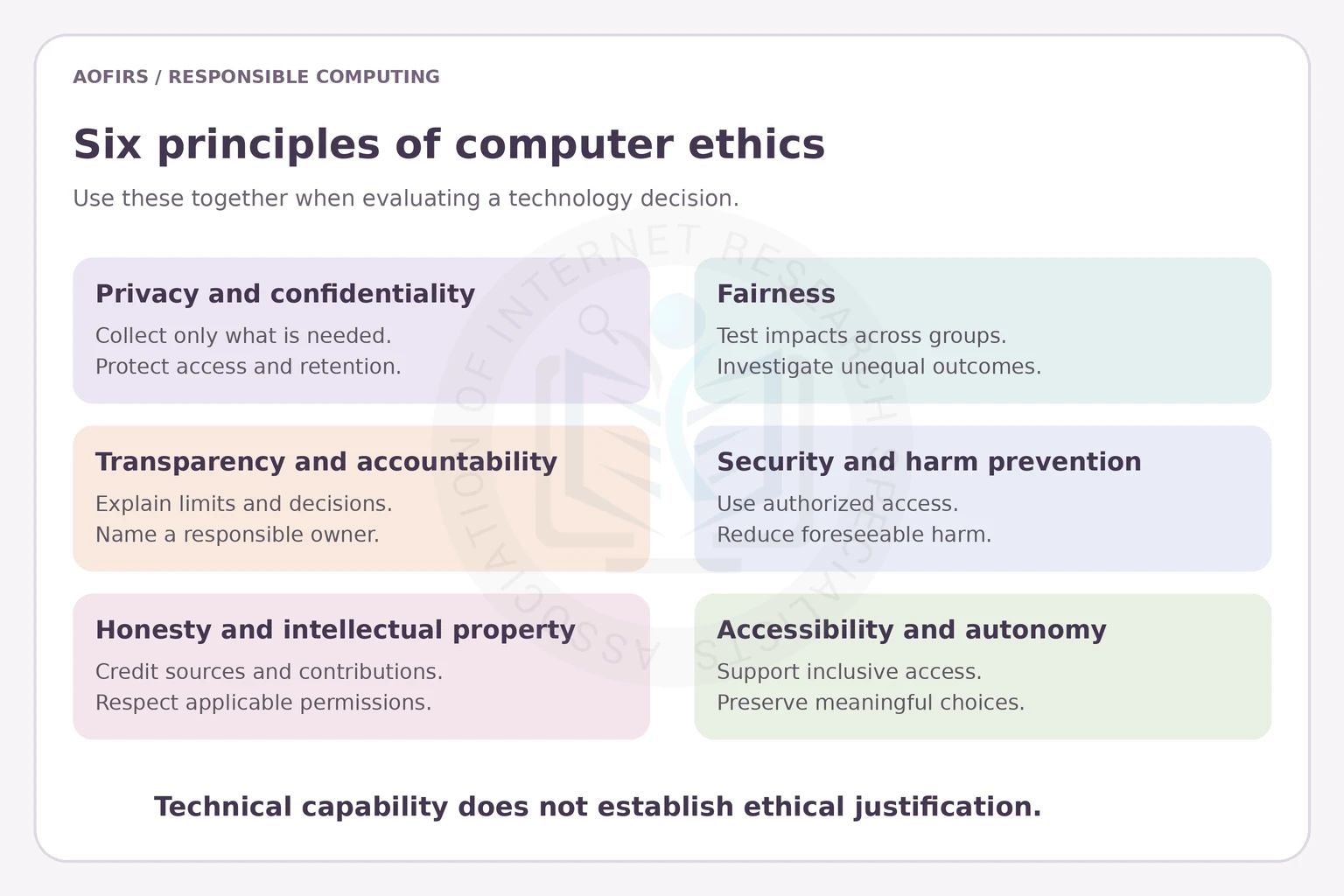
Six core principles of computer ethics
The ACM Code of Ethics and Professional Conduct provides professional guidance on responsibilities such as avoiding harm, respecting privacy, and giving proper credit. The principles below organize these concerns for everyday decisions.
| Principle | Practical application |
|---|---|
| Privacy and confidentiality | Collect necessary information, restrict access and define retention periods. |
| Fairness | Assess whether systems disadvantage people or groups without adequate justification. |
| Transparency and accountability | Explain important limitations and identify who approves, reviews, and corrects decisions. |
| Security and harm prevention | Protect systems, use authorized access, and address foreseeable misuse. |
| Honesty and intellectual property | Attribute contributions, respect applicable permissions, and avoid deceptive claims. |
| Accessibility and autonomy | Support inclusive access and meaningful choices, including ways to challenge consequential outcomes. |
Why computer ethics is important
Protecting information and people
Unnecessary data collection can expose individuals to profiling, unwanted disclosure, or identity misuse. Ethical practice starts by defining a legitimate purpose and questioning how much information is needed. Protecting a database is insufficient if the organization should not have collected some of its contents.
For research workflows, the AOFIRS guide to digital security for researchers explains practical safeguards for accounts, documents, and confidential sources.
Using security capabilities responsibly
Knowing how to access a system does not grant permission to test it. Security work needs agreed boundaries, careful handling of sensitive findings and an appropriate disclosure process. Organizations should also maintain controls, recovery arrangements,, and responsibility for responding when something goes wrong.
Respecting creativity and honest communication
Credit authors, researchers, and developers, and check the conditions governing reuse of software, images, and data. Plagiarism concerns presenting another person’s contribution as your own; copyright concerns legal rights in protected works. Attribution alone does not necessarily provide permission, and permission does not justify misleading attribution.
Supporting fair services and inclusive access
A system can function as designed while excluding users or producing unfair outcomes. Evaluate accessibility, misleading interface choices, and the consequences of automated scoring. Give people understandable information and practical routes to seek help. Trust depends on observable practices, not simply a statement that technology is ethical.
Modern computer ethics challenges in 2026
Generative AI and unreliable information
AI can produce useful drafts and summaries alongside invented claims, inaccurate references, or unsupported interpretations. Verify important outputs and keep confidential information within approved workflows. A polished answer is not evidence of accuracy: AOFIRS’s learning publication on the AI trust illusion examines this confidence problem.
Autonomous agents and delegated authority
Agents can perform sequences of actions involving files, websites, and business systems. A task can succeed technically while exceeding the user’s intentions. Limit permissions, distinguish preparation from consequential actions, record what the agent did, and provide a way to stop it. Name the person responsible for approving deployment and handling errors.
The AOFIRS report on verification debt in online research examines risks created when AI-assisted work expands faster than meaningful checking.
Algorithmic discrimination and human review
Automated systems can influence recruitment, education, and access to services. Unrepresentative data, poorly chosen objectives, or deployment conditions may create unequal effects. Test performance across relevant groups, investigate discrepancies, and provide appropriate review. A human approval step only helps if the reviewer has information, authority, and time to challenge the result.
Surveillance, biometrics, and connected devices
Facial recognition, location tracking, and workplace monitoring raise questions about necessity, proportionality, and alternatives. Assess who can access the information and how errors could affect people. Connected devices also require clear data practices and appropriate security throughout their supported life.
Synthetic media and deception
Synthetic images, voices, and videos can support creative work or enable impersonation and misinformation. Obtain appropriate permissions, label material when required, and avoid implying that generated content documents a real event. Provenance information and detection tools can support investigation, but neither replaces contextual checking.
Environmental responsibility
Ethical technology decisions also consider equipment life, repairability, procurement, electronic waste, and resource use. Compare whether a proposed system offers sufficient benefit for its costs. Environmental responsibility belongs in planning and purchasing decisions, rather than being treated as an unrelated concern after deployment.
Computer ethics examples
These fictional scenarios illustrate decisions that require more than checking whether software works.
| Scenario | Responsible response |
|---|---|
| An employee wants to upload client records to an AI tool. | Check authorization, purpose, service controls, and whether identifying details are necessary. |
| A recruitment system disadvantages qualified applicants from a particular group. | Investigate the results and underlying process; provide meaningful human review. |
| A researcher collects identifiable public posts about a sensitive topic. | Assess privacy expectations, minimize identifiers, and obtain required ethics review. |
| A developer discovers a customer-system vulnerability. | Stay within authorized boundaries and follow the agreed reporting process. |
Ethical codes, frameworks and laws
Professional codes express responsibilities; voluntary frameworks help manage risk; laws create enforceable duties within their scope. Treating them as interchangeable can lead to misleading compliance claims.
| Resource | Role |
|---|---|
| ACM Code of Ethics | Professional ethical guidance for computing. |
| UNESCO AI Ethics Recommendation | International recommendation emphasizing human rights, fairness, and oversight. |
| OECD AI Principles | Intergovernmental principles for trustworthy AI. |
| NIST AI Risk Management Framework | Voluntary guidance for identifying and managing AI risks. |
| NIST Cybersecurity Framework 2.0 | Guidance for managing organizational cybersecurity risk. |
| GDPR | Binding EU personal data legislation within its scope. |
| EU AI Act | Binding risk-based AI legislation with phased application and specific exceptions. |
The European Commission describes transparency rules applying from August 2026, while other obligations follow different schedules. Check the current official timetable for the relevant role and system category rather than assuming every AI requirement starts together.
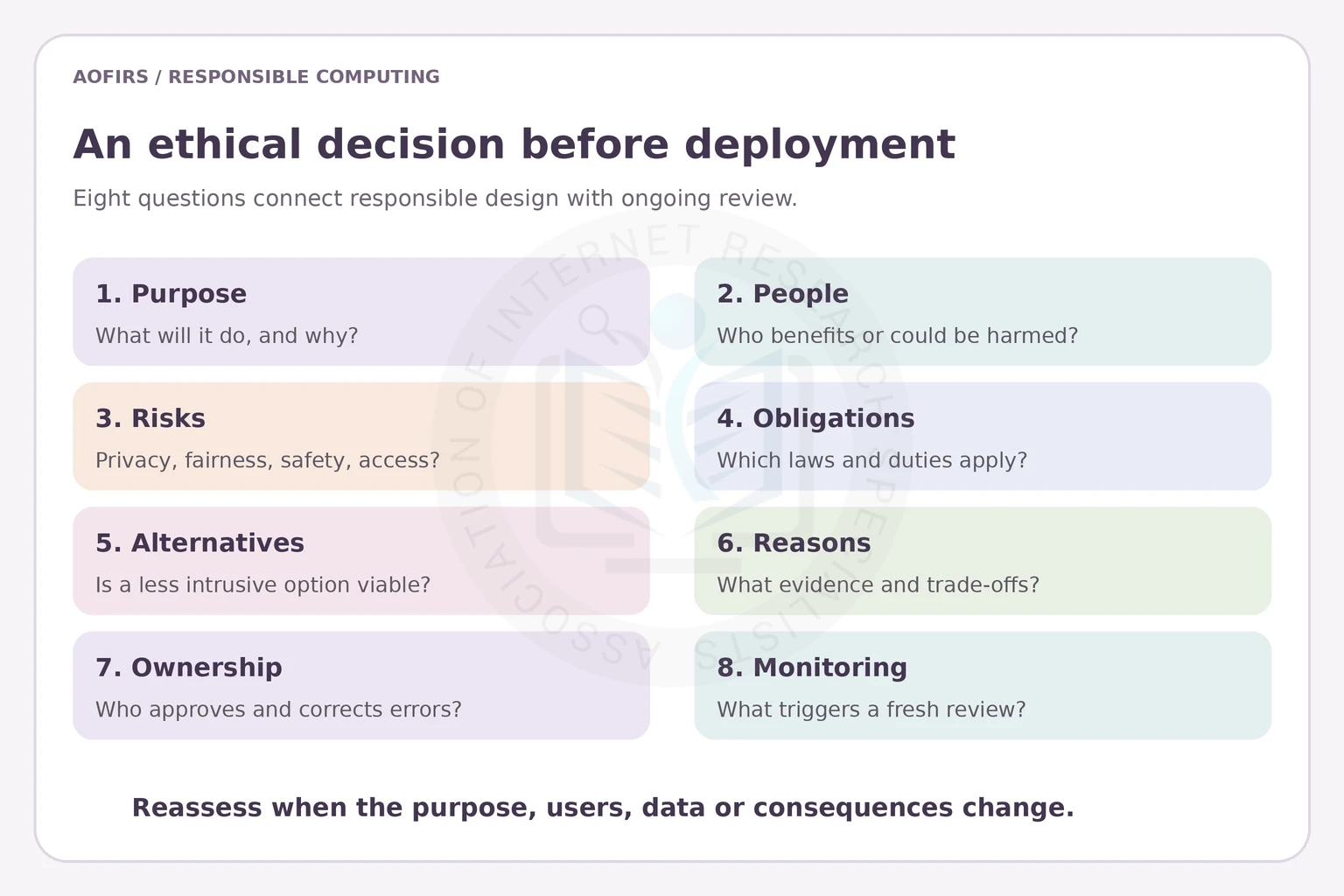
An eight-step ethical decision framework
This practical framework organizes review; it is not a compliance certification or a validated scoring system.
- Define the purpose. What will the technology do, and why is it needed?
- Identify affected people. Who benefits, and who could experience harm?
- Examine risks. Consider privacy, fairness, accuracy, security, and accessibility.
- Check obligations. Review applicable laws, policies, contracts, and professional duties.
- Compare alternatives. Could a less intrusive approach achieve the goal?
- Document the reasoning. Record evidence, assumptions, trade-offs, and unresolved concerns.
- Assign accountability. Name who approves decisions, handles complaints, and corrects errors.
- Monitor outcomes. Reassess when the purpose, data, users, or risks change.
Computer ethics in online research
Public visibility does not automatically justify collecting, analyzing, or republishing personal information. Consider sensitivity, privacy expectations, platform rules and potential harm. Protect identifiable records and seek the approvals required for the project. The AOFIRS report on verification methods for private and public information provides further context for evaluating sources.
Researchers remain responsible for interpreting evidence and reporting it accurately. Follow the guide to verifying AI-generated answers and citations when checking generated references. For provenance, source independence, disclosure and accountability, read AOFIRS’s framework for research integrity in AI-assisted research.
Frequently asked questions
What is computer ethics in simple words?
It means making responsible choices about computers, software, and information, with respect for people’s rights and welfare.
Why is it important for students?
It supports honest attribution, responsible AI use, privacy protection, and careful evaluation of information.
What counts as unethical computer use?
Examples include unauthorized account access, plagiarism, deliberate deception, and unjustified disclosure of personal information.
Is computer ethics the same as cybersecurity?
No. Cybersecurity protects systems and information; ethics also asks whether the activity and use of authority are justified.
How does AI ethics differ?
AI ethics focuses on artificial intelligence, including bias, transparency, and oversight. Computer ethics covers computing more broadly.
Does legal compliance guarantee ethical conduct?
No. A legally permitted practice can still create avoidable harm, exclusion, or unreasonable intrusion.
Who is accountable when an AI agent makes a mistake?
Organizations should assign responsibility for authorization, oversight, and correction. Legal liability depends on the circumstances and applicable law.
How can organizations improve ethical technology use?
Train staff, define permissions, assess impacts, document decisions, and maintain effective routes for complaints and correction.
Conclusion
Responsible computing requires continuing judgment
Computer ethics turns technical capability into a question of purpose, consequences, and responsibility. Protect information, test assumptions, and preserve meaningful human control. Ethical practice continues throughout a system’s life, including when its use changes or problems emerge.