A few years ago, the hardest part of online research was finding information. Now the harder part is knowing what to believe.
AI can scan fast, summarize fast, and generate “answers” instantly. That sounds like the end of the road for online researchers. But it is a shift in what clients pay for. The value is moving away from speed and toward certainty.
This is where the knowledge industry is heading, and why skills programs like AOFIRS have a strong future if they aim at the right problems.
AI will not replace researchers; it will replace the easy part
AI is excellent at first-pass research.
It can:
- collect obvious sources quickly
- Summarize articles and reports
- draft background briefs
- find patterns across lots of text
That means basic research becomes cheaper. It also means “quick research” becomes less special.
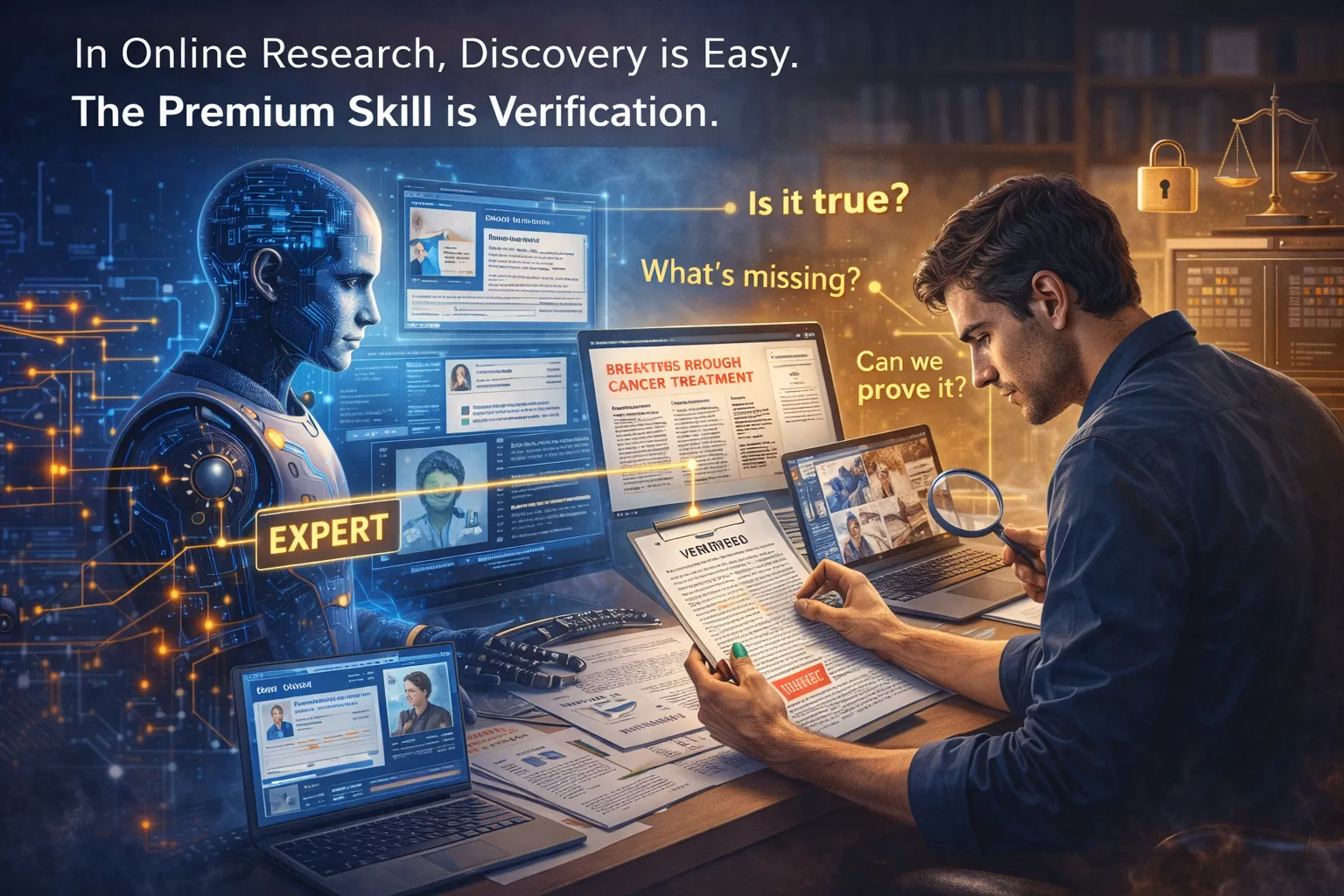
But the moment a decision has consequences; people still need a human who can answer a different set of questions:
- Is this true?
- Can we prove it?
- What is missing?
- What is the risk if we are wrong?
That is the new premium.
The new core job is verification, not discovery
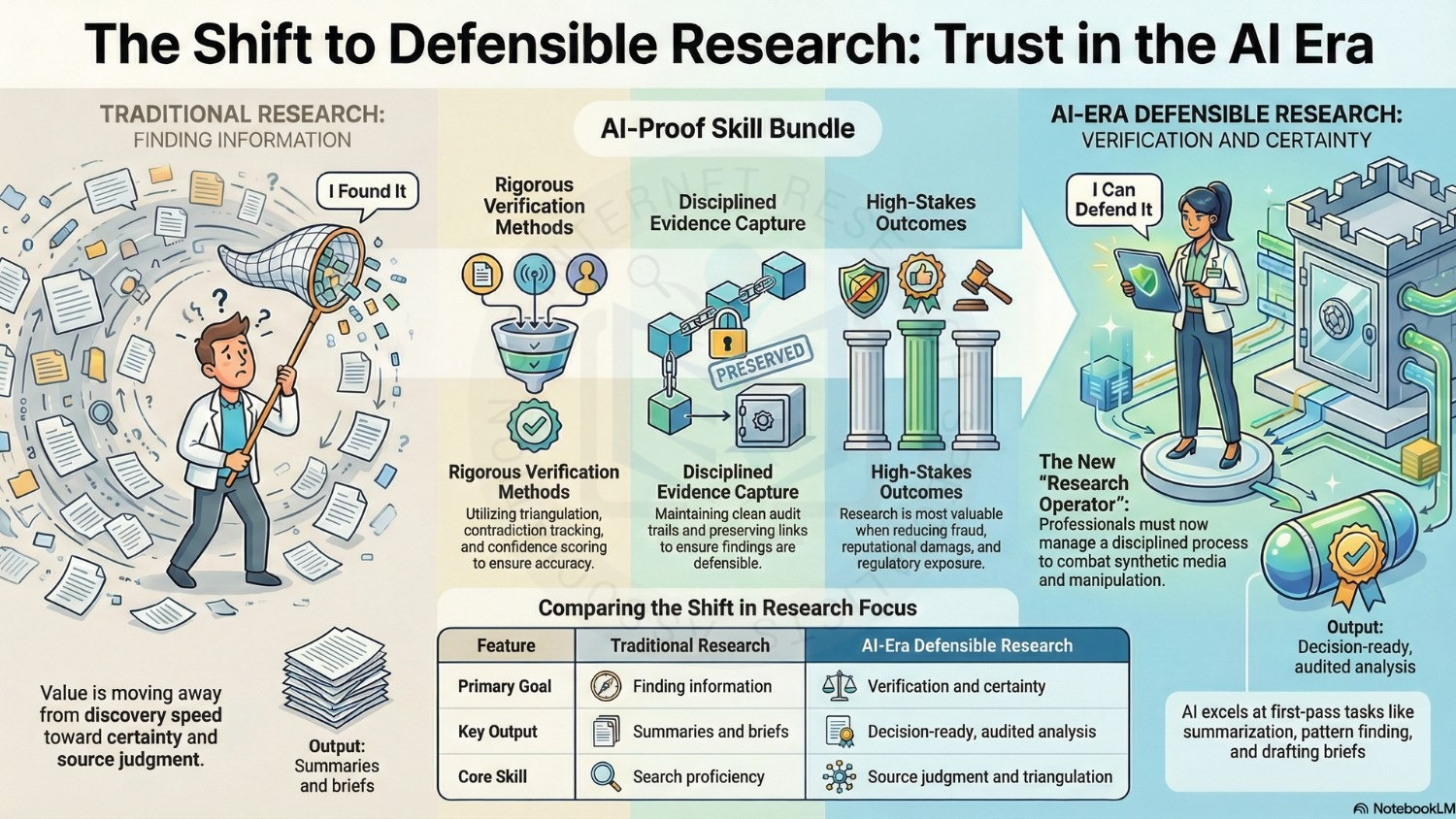
Research report cover titled ‘Trust: The New Research Currency,’ illustrating a professional verifying data amidst a digital storm of AI-generated content, synthetic media, and information overload
AI increases the volume of content and the volume of manipulation.
You are not only dealing with biased sources anymore. You are dealing with:
- synthetic articles that look real
- fake profiles and coordinated activity
- edited images and video
- confident answers with weak sourcing
So, the “research professional” becomes more like a research operator who runs a disciplined process.
Future researchers are paid for:
- source judgment
- triangulation
- Evidence captures
- documentation
- clear confidence levels
- Decision-ready analysis
In simple terms, the work moves from “I found it” to “I can defend it.”
Where the money will concentrate
Earnings will spread out.
Generalists who only provide summaries will get squeezed. Specialists who reduce risk will do well.
The best-paid use cases are the ones tied to outcomes like:
- avoiding fraud
- preventing reputational damage
- making safer partnerships
- supporting disputes or legal strategy
- reducing regulatory exposure
- protecting brands from manipulation
That is why the future of online research connects closely to areas like due diligence, compliance, investigations, risk analysis, and intelligence work.
The training market will grow, but the message must change
If a course looks like “how to search online,” it will struggle.
If a course looks like “how to produce defensible research in an AI world,” it becomes highly relevant.
The buyers are not just curious learners. They are teams with budgets and problems that keep them up at night.
Best target markets for AOFIRS-style training
Highest willingness to pay (B2B)
- compliance and risk teams
- third-party and vendor risk teams
- internal audit and investigations
- corporate intelligence and due diligence
- fraud and threat-intel adjacent roles
- brand protection and comms teams dealing with misinformation
High volume (B2C)
- freelancers doing research and analysis
- students and early-career professionals
- journalists and NGO researchers
- researchers moving into OSINT-style roles
The big opportunity is B2B. One company cohort can equal many individual enrollments.
What AOFIRS should teach to stay ahead of AI
To stay valuable, the curriculum should focus on the parts AI cannot reliably do alone.
Here are the “AI-proof” skill bundles that employers and clients will keep paying for:
- AI-assisted workflows with guardrails
Teach how to use AI to speed up work, without letting it invent facts. - Verification methods
Triangulation, contradiction tracking, confidence scoring, and practical checks. - Evidence disciplines
How to capture sources, preserve links, log steps, and keep a clean audit trail. - Provenance and authenticity basics
How to assess media credibility, and how provenance signals are changing the landscape. - Ethics, privacy, and safe research practice
Clear boundaries, decision rules, and professional standards. - Briefing and reporting
Turn messy inputs into a clear output that leaders can act on.
If AOFIRS owns these outcomes, the certification becomes more than a badge. It becomes a hiring signal.
Future earnings: how the business can scale in a realistic way
No one can predict a single number for future earnings. But the revenue mechanics are clear.
The strongest model is a ladder:
- entry short courses to build trust
- a flagship certification for credibility
- memberships for continuity and community
- advanced tracks for specialized roles
- B2B cohorts for teams
- licensing and partnerships for scale
What makes this powerful is that the need is durable. AI will keep evolving. That keeps the skills market alive. People will need refreshers, updates, and new methods.
The simple conclusion
Online research is not dying. It is upgrading.
AI is turning information into a commodity, and trust into the scarce resource. That makes professional researchers more important in high-stakes environments, and it makes training more valuable when it teaches verification, documentation, and defensible decision support. If AOFIRS positions itself around “research you can prove,” it is not competing with AI. It teaches people how to lead with AI, without being fooled by it.