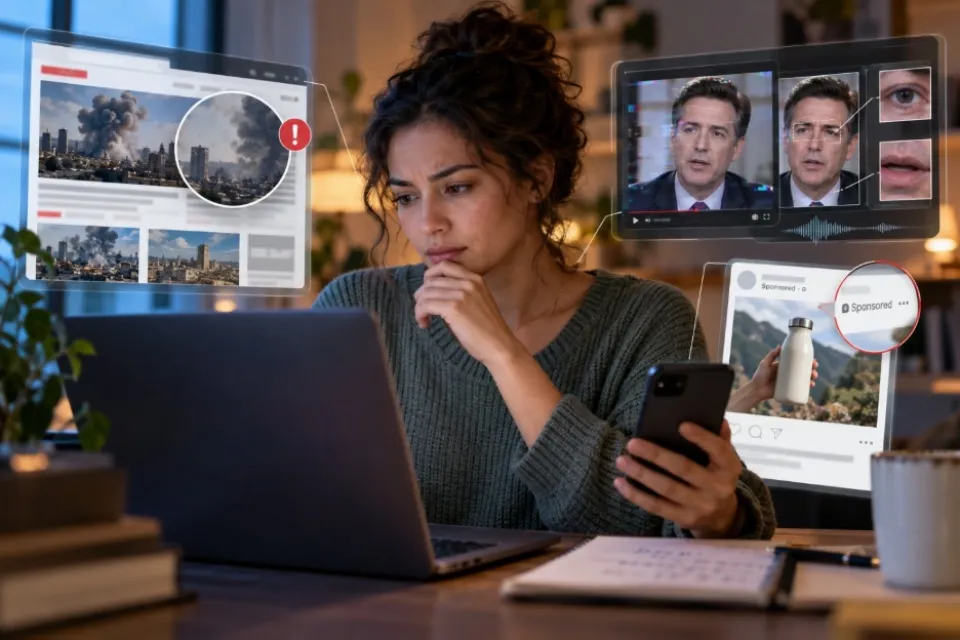
Imagine this: a video shows up in your family group chat. A famous politician, looking worn out, makes a surprising announcement. Within an hour, it’s been shared hundreds of times. Your uncle is angry. Your cousin claims it’s fake. Who’s right, and how can you tell?
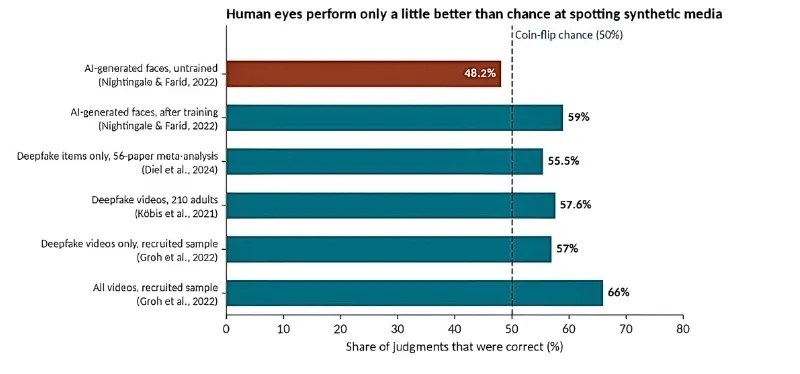
A few years ago, the best advice was to “look closely.” Now, that doesn’t really help. In one study, people trying to tell real faces from AI-generated ones got it right only 48.2% of the time, which is worse than guessing, and they even trusted the fake faces more than the real ones (Nightingale & Farid, 2022). A review of 56 studies with over 86,000 people found that most of us spot deepfakes only about as well as chance (Diel et al., 2024). We also tend to think we’re better at it than we actually are (Köbis et al., 2021).
This article suggests a new approach. Rather than just relying on what you see, focus on asking the right questions. The tips below are based on advice from professional fact-checkers, research studies, and the AOFIRS course on searching news, articles, and blogs (AOFIRS, n.d.). All you need is a phone or a browser.
Why fake stories win the race
False news isn’t just common—it spreads faster. MIT researchers looked at about 126,000 stories shared on Twitter over ten years and found that false stories were 70% more likely to be retweeted than true ones (Vosoughi et al., 2018). Fake stories are often more surprising and emotional, which makes them more appealing to our brains.
But there’s some good news. The main issue isn’t that people want to believe false stories—it’s that they share them without stopping to think (Pennycook & Rand, 2019). Just asking people to think about whether something is true before sharing it can cut down on the spread of false headlines (Pennycook & Rand, 2022). In short, taking a moment to pause is your best tool.
Figure 1. Most people spot synthetic media only a little better than chance
A 2026 Reuters Institute survey found that 62% of respondents across 48 countries were concerned about telling what is real and fake online.
Note. Mean accuracy reported by each study (Nightingale & Farid, 2022; Diel et al., 2024; Köbis et al., 2021; Groh et al., 2022).
Four questions that beat a deepfake
Think of checking information like climbing a ladder. The first step—looking for obvious mistakes—is the weakest. Each step you take beyond that makes your check stronger.
1. Does anything look off?
It’s still worth taking a quick look. MIT researchers recommend checking details like the face, skin, eyes, glasses, facial hair, moles, blinking, and lip movements (MIT Media Lab, n.d.). Also, check the shadows—in a sunny outdoor scene, they should all point in the same direction (Farid, n.d.). Keep in mind, though, that a video that looks perfect doesn’t prove it’s real. Fakes are improving all the time.
2. Does it make sense?
This is where most fakes don’t hold up. Would this person actually say this, in this place, at this time? Does the weather, season, background, or language on signs match what’s claimed? What is the video trying to get you to do—panic, skip voting, or send money? If it urges you to act quickly, that’s a classic warning sign.
3. Where did it come from?
Take a screenshot and use a reverse image search like Google Lens or TinEye. You might find the same image was posted years ago about something else. Also, see if trusted news outlets are reporting the same story. For example, when an AI-generated image of an explosion near the Pentagon spread in May 2023, it briefly shook the stock market. But no local reporters, witnesses, or officials could confirm it, because it never happened (Bond, 2023).
4. Can I confirm it another way?
This is the most reliable step. In 2024, an employee at the engineering firm Arup joined a video call with people who seemed to be the company’s finance chief and colleagues, and ended up sending about US$25 million to scammers (Magramo, 2024). A quick call to a known phone number would have revealed the scam. The same advice applies if you get a panicked message from a “relative” asking for money—hang up and call them directly. Some families even agree on a code word for emergencies.
Remember You do not have to prove something is fake. You only have to notice that it has not been proven real.
The ads that do not look like ads
Not all misleading content is completely false. Sometimes, it’s just trying to sell you something without making it obvious. “Native advertising” is paid content that looks like regular articles. In one study, only 7% of readers realized a native article was actually an ad (Wojdynski & Evans, 2016). Stanford researchers found that 82% of middle-school students couldn’t spot a clearly labeled “sponsored content” item as advertising (McGrew et al., 2017). And when European regulators looked at 576 social media influencers, 97% had posted commercial content, but only one in five always told their followers it was an ad (European Commission, 2024).
Figure 2. Most hidden advertising goes unnoticed
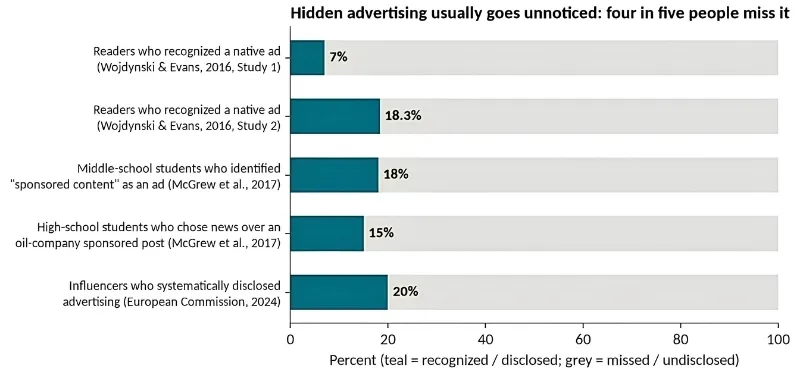
Research shows that readers and social media users can overlook commercial content when advertising is presented in a format that resembles ordinary content.
Note. Sources: (Wojdynski & Evans, 2016; McGrew et al., 2017; European Commission, 2024).
Here is how to catch it:
- Hunt for the label. Look above the headline, beside the author’s name, and at the very bottom for words like “sponsored,” “partner content,” “paid post,” “#ad,” or “paid partnership.”
- Follow the links. If every recommendation links to a shop or comes with a discount code, someone is probably earning a commission.
- Pay attention to what’s missing. Real reviews and real journalism usually mention drawbacks and include different viewpoints. Ads rarely do.
- Copy a sentence from the article and paste it into a search engine with quotation marks. If you see the same words on many sites, it’s probably a press release.
In the United States, the Federal Trade Commission says ads can’t be disguised as something else, and influencers must clearly say when they’re paid or get free products (Federal Trade Commission, 2015; Federal Trade Commission, 2019). The FTC has also banned fake reviews (Federal Trade Commission, 2024). But these rules only work if people follow them, so it’s still important to check for yourself.
When the crowd is not really a crowd
Sometimes the trick is not a single fake story but a fake impression: that “everyone” thinks something, or that “scientists disagree” when they largely do not. Researchers studying a hidden political campaign in South Korea found that the fake accounts gave themselves away by posting the same things at the same moments (Keller et al., 2020). Decades ago, a tobacco company memo put the strategy bluntly: “Doubt is our product” (Brown & Williamson, 1969). Later, internal documents showed how the sugar industry funded research that steered attention away from sugar’s health risks (Kearns et al., 2016).
Be cautious of groups with neutral, public-sounding names if it’s hard to find out who funds them. Try searching the group’s name along with the word “funding”—this often shows who is really behind it. For example, when Stanford researchers asked college students to check a policy website run by an industry-linked group, only 6% figured out who was actually behind it (McGrew et al., 2017).
Check your own blind spots
The hardest bias to spot is your own. We all look for evidence that supports what we already believe (Nickerson, 1998). We’re also more likely to believe things just because we’ve seen them before (Pennycook et al., 2018). Search engines can make this worse by showing results based on our location, language, and search history. The AOFIRS course suggests searching the same topic in another language or changing the country setting in a news search to see a different perspective (AOFIRS, n.d.).
Table 1. Three habits that keep your own bias in check
| Habit | What it looks like |
|---|---|
| Argue with yourself | Before deciding, search deliberately for the strongest evidence against your view. |
| Count sources, not copies | Ten websites repeating one press release still add up to one source. |
| Step outside your bubble | Search signed out, try another region or language, and look at outlets you do not usually read. |
The good news: these skills are easy to learn
You don’t need a degree to learn these skills. When college students took a short online course in “lateral reading”—leaving a website to see what others say about it—the number who checked sources this way jumped from 3 out of 87 to 67 out of 87 (Breakstone et al., 2021). A 15-minute online game where players tried making fake news made them see fake posts as less trustworthy, but their trust in real news stayed the same (Roozenbeek & van der Linden, 2019). Short videos that explain common tricks also helped, even when shown as YouTube ads (Roozenbeek et al., 2022).
Your two-minute checklist
- Pause. Notice if you feel angry, scared, or thrilled. That is your cue to slow down.
- Ask who is behind it. Search for the source on other sites rather than trusting its own “About” page.
- Find the original. Where and when did it first appear? Check the date, and use the Wayback Machine if a page has changed.
- Look for other coverage. If it is real and important, trusted outlets will be reporting it too.
- Ask who benefits. Is someone selling, lobbying, or campaigning?
- Confirm another way before acting on any request for money, passwords, or urgent action.
More people are worried about fake content online. In 2026, 62% of people in 48 countries said they were concerned about telling real from fake online (Reuters Institute for the Study of Journalism, 2026). But worrying isn’t enough. Asking the right questions is what really helps. So, the next time something surprising pops up in your feed, you won’t have to guess—you’ll know what to ask.
For the full evidence, statistics, case studies, and bias guide, see the companion AOFIRS research report, “Detecting Fake News, Deepfakes and Hidden Persuasion: Logical Verification Methods for Internet Researchers.”
References
Association of Internet Research Specialists. (n.d.). Lesson 31: Search in news, articles & blogs [Unpublished course material, Chapter 1-17]. AOFIRS.
Bond, S. (2023, May 22). Fake viral images of an explosion at the Pentagon were probably created by AI. NPR.
Breakstone, J., Smith, M., Connors, P., Ortega, T., Kerr, D., & Wineburg, S. (2021). Lateral reading: College students learn to evaluate internet sources critically in an online course. Harvard Kennedy School (HKS) Misinformation Review, 2(1).
Brown & Williamson Tobacco Corporation. (1969). Smoking and health proposal [Internal memorandum]. Truth Tobacco Industry Documents, University of California, San Francisco.
Diel, A., Lalgi, T., Schröter, I. C., MacDorman, K. F., Teufel, M., & Bäuerle, A. (2024). Human performance in detecting deepfakes: A systematic review and meta-analysis of 56 papers. Computers in Human Behavior Reports, 16, Article 100538.
European Commission. (2024, February 14). Investigation of the Commission and consumer authorities finds that online influencers rarely disclose commercial content [Press release IP/24/708].
Farid, H. (n.d.). How to detect faked photos. American Scientist. Retrieved October 7, 2026.
Federal Trade Commission. (2015, December 22). FTC issues enforcement policy statement addressing “native” advertising and deceptively formatted advertisements [Press release].
Federal Trade Commission. (2019). Disclosures 101 for social media influencers.
Federal Trade Commission. (2024, August 14). Federal Trade Commission announces final rule banning fake reviews and testimonials [Press release].
Groh, M., Epstein, Z., Firestone, C., & Picard, R. (2022). Deepfake detection by human crowds, machines, and machine-informed crowds. Proceedings of the National Academy of Sciences, 119(1), Article e2110013119.
Kearns, C. E., Schmidt, L. A., & Glantz, S. A. (2016). Sugar industry and coronary heart disease research: A historical analysis of internal industry documents. JAMA Internal Medicine, 176(11), 1680–1685.
Keller, F. B., Schoch, D., Stier, S., & Yang, J. (2020). Political astroturfing on Twitter: How to coordinate a disinformation campaign. Political Communication, 37(2), 256–280.
Köbis, N. C., Doležalová, B., & Soraperra, I. (2021). Fooled twice: People cannot detect deepfakes but think they can. iScience, 24(11), Article 103364.
Magramo, K. (2024, May 16). British engineering giant Arup revealed as $25 million deepfake scam victim. CNN Business.
McGrew, S., Ortega, T., Breakstone, J., & Wineburg, S. (2017). The challenge that’s bigger than fake news: Civic reasoning in a social media environment. American Educator, 41(3), 4–9, 39.
MIT Media Lab. (n.d.). Detect DeepFakes: How to counteract misinformation created by AI. Retrieved October 7, 2026, from
Nickerson, R. S. (1998). Confirmation bias: A ubiquitous phenomenon in many guises. Review of General Psychology, 2(2), 175–220.
Nightingale, S. J., & Farid, H. (2022). AI-synthesized faces are indistinguishable from real faces and more trustworthy. Proceedings of the National Academy of Sciences, 119(8), Article e2120481119.
Pennycook, G., & Rand, D. G. (2019). Lazy, not biased: Susceptibility to partisan fake news is better explained by lack of reasoning than by motivated reasoning. Cognition, 188, 39–50.
Pennycook, G., & Rand, D. G. (2022). Accuracy prompts are a replicable and generalizable approach for reducing the spread of misinformation. Nature Communications, 13, Article 2333.
Pennycook, G., Cannon, T. D., & Rand, D. G. (2018). Prior exposure increases perceived accuracy of fake news. Journal of Experimental Psychology: General, 147(12), 1865–1880.
Reuters Institute for the Study of Journalism. (2026, June 16). Overview and key findings of the 2026 Digital News Report. University of Oxford.
Roozenbeek, J., & van der Linden, S. (2019). Fake news game confers psychological resistance against online misinformation. Palgrave Communications, 5, Article 65.
Roozenbeek, J., van der Linden, S., Goldberg, B., Rathje, S., & Lewandowsky, S. (2022). Psychological inoculation improves resilience against misinformation on social media. Science Advances, 8(34), Article eabo6254.
Vosoughi, S., Roy, D., & Aral, S. (2018). The spread of true and false news online. Science, 359(6380), 1146–1151.
Wojdynski, B. W., & Evans, N. J. (2016). Going native: Effects of disclosure position and language on the recognition and evaluation of online native advertising. Journal of Advertising, 45(2), 157–168.
Copyright Statement
Copyright © 2026 Association of Internet Research Specialists (AOFIRS). All rights reserved. All rights in this article, including its text, tables, and adapted charts, belong to AOFIRS. No part of it may be reproduced, distributed, or transmitted in any form or by any means without the prior written permission of AOFIRS, except for brief quotations with clear attribution as permitted by copyright law. Third-party works cited remain the property of their respective owners.