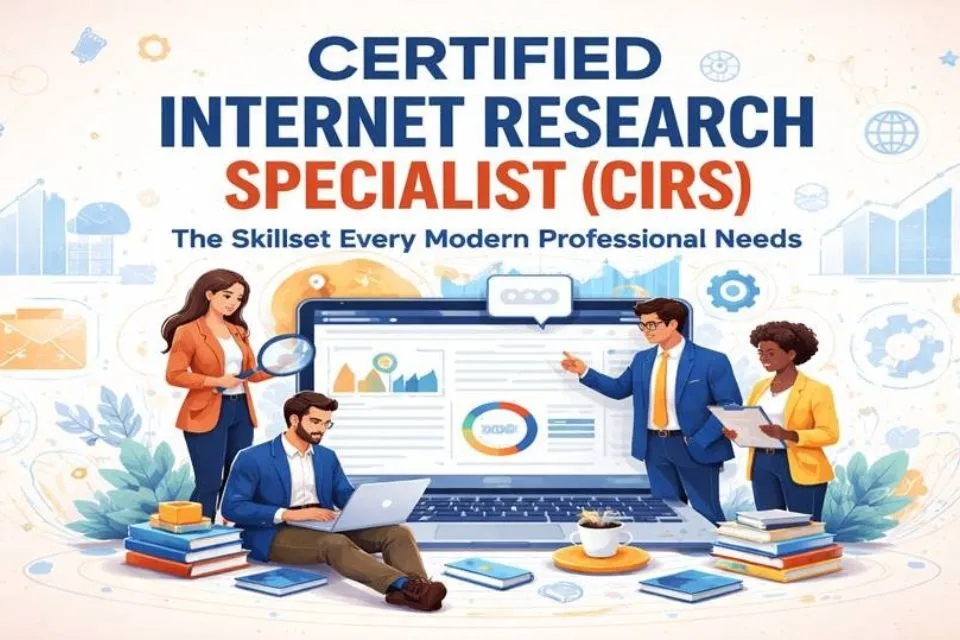
The Certified Internet Research Specialist (CIRS™) certification is designed around five core areas of modern online research: online search and research, research methods and methodology, artificial intelligence in online research, data analysis and analytics, and internet law and ethics. Together, these competencies cover how researchers find information, evaluate and analyze it, use AI responsibly, and work within legal and ethical boundaries.
What Is the Certified Internet Research Specialist (CIRS) Certification?
The Certified Internet Research Specialist (CIRS™) is a professional certification offered by the Association of Internet Research Specialists (AOFIRS), a professional association (About AOFIRS). The program focuses on practical internet research competencies, including advanced search techniques, research methodology, AI-assisted research, data analysis, and legal and ethical considerations.
Rather than focusing only on finding information online, the CIRS framework addresses the broader research process: locating relevant information, assessing its quality, analyzing data, and applying appropriate research practices.
As checked on November 6, 2026, AOFIRS structures the CIRS certification around five examination modules (CIRS certification requirements):
- Online Search & Research
- Research Methods & Methodology
- Artificial Intelligence (AI) in Online Research
- Data Analysis & Data Analytics
- Fundamentals of Internet Law & Ethics
The certification does not require a specific degree or prior research experience. AOFIRS states that the program is intended for researchers, freelancers, professionals, PhD students, and others seeking to develop their internet research skills (CIRS certification requirements).
The Five Core CIRS Competencies
The CIRS certification brings together several research disciplines. Each module addresses a different part of the modern research workflow.
1. Online Search & Research
A professional internet researcher starts by constructing effective searches and retrieving relevant information.
The Online Search & Research module covers advanced search mechanics, including keyword strategies, Boolean logic, search operators, and methods for locating information beyond basic search queries.
Sample research tasks include:
- Building complex search queries using Boolean operators.
- Using advanced search operators to narrow results.
- Searching for information across different types of online sources.
- Refining queries when initial results are incomplete or irrelevant.
- Locating specific documents, websites, records, or other publicly available information.
- Developing repeatable search strategies for professional research projects.
For researchers, the objective is not simply to generate more search results. It is to construct searches that produce information relevant to the research question.
Practice this competency with the AOFIRS guide to advanced Google search operators.
2. Research Methods & Methodology
Finding information is only one part of professional research. Researchers also need a structured methodology to determine what information is relevant, how to assess it, and how to document findings.
The Research Methods & Methodology module covers the strategic framework of professional research, including information verification, source evaluation, risk management, and aspects of conducting research as an independent professional.
Sample research tasks include:
- Defining a research question before beginning a search.
- Establishing criteria for evaluating sources.
- Comparing information from multiple sources.
- Identifying gaps, inconsistencies, or conflicting claims.
- Recording sources and research findings systematically.
- Assessing research risks before using information.
- Developing a repeatable research workflow.
A reliable research process should not treat a single online source as sufficient evidence for every question. The importance of verification depends on the subject, the source, the consequences of using incorrect information, and the quality of the available evidence. Librarians make a similar point: the Association of College and Research Libraries’ Framework for Information Literacy for Higher Education treats authority as “constructed and contextual”, to be judged against the information need at hand (Information literacy framework).
3. Artificial Intelligence (AI) in Online Research
AI has become part of many modern research workflows, but using AI effectively requires more than knowing how to write prompts.
The CIRS AI module covers modern AI tools, including large language models, prompt engineering, and ethical issues such as bias and hallucinations.
Sample research tasks include:
- Creating research prompts for an AI system.
- Using AI to organize or summarize large amounts of information.
- Asking an AI system to identify themes or patterns for further investigation.
- Checking AI-generated claims against original sources.
- Identifying possible hallucinations or unsupported statements.
- Evaluating potential bias in AI-generated outputs.
- Incorporating human verification into an AI-assisted research workflow.
AI can help researchers work with information more efficiently, but AI-generated output should not automatically be treated as verified evidence. The U.S. National Institute of Standards and Technology lists “confabulation”, the production of confidently stated but false or erroneous content, among the main risks of generative AI (NIST generative AI profile). Source checking and human judgment remain important parts of a responsible research process.
4. Data Analysis & Data Analytics
Research often produces more information than can be meaningfully interpreted through simple reading. Data analysis provides methods for organizing, examining, and communicating those findings.
The CIRS Data Analysis & Data Analytics module covers data types, collection methods, statistical analysis, and data visualization. AOFIRS also identifies web scraping and AI-assisted interpretation among the areas addressed within this competency (CIRS certification requirements).
Sample research tasks include:
- Cleaning and organizing collected data.
- Identifying gaps, inconsistencies, or errors in a dataset.
- Structuring unorganized web data for analysis.
- Selecting appropriate methods for analyzing data.
- Identifying patterns or relationships within a dataset.
- Using visualizations to communicate findings.
- Applying AI-assisted techniques to help interpret larger datasets.
The goal is to move from raw information to an understandable research finding while maintaining awareness of data quality and analytical limitations.
5. Fundamentals of Internet Law & Ethics
Internet research can involve copyright, intellectual property, privacy, personal data, cybercrime, and other legal or ethical considerations.
The fifth CIRS module addresses the legal and ethical environment surrounding online research, including intellectual property, copyright, online privacy frameworks such as the EU General Data Protection Regulation (EU data protection regulation) and the California Consumer Privacy Act (California privacy guidance), and cybercrime.
Sample research tasks include:
- Identifying potential copyright issues when using online material.
- Distinguishing legitimate research use from inappropriate use of third-party content.
- Recognizing privacy risks associated with collecting personal information.
- Considering applicable privacy requirements when handling research data.
- Identifying potentially problematic or manipulated online information.
- Evaluating whether a proposed research method is legally or ethically appropriate.
Ethical research is not simply about finding publicly accessible information. Researchers must also consider how they collect, use, store, interpret, and communicate information.
How These Competencies Work Together
The five CIRS modules are connected, not isolated. A professional research project may require a researcher to:
| Research stage | Relevant CIRS competency |
|---|---|
| Define the research question | Research Methods & Methodology |
| Develop search queries | Online Search & Research |
| Locate and collect information | Online Search & Research |
| Evaluate sources and evidence | Research Methods & Methodology |
| Use AI to support the workflow | Artificial Intelligence (AI) in Online Research |
| Organize and analyze collected data | Data Analysis & Data Analytics |
| Interpret and communicate findings | Research Methods & Methodology; Data Analysis & Data Analytics |
| Check legal and ethical considerations | Fundamentals of Internet Law & Ethics |
| Verify important conclusions | Research Methods & Methodology |
This integrated approach matters because an effective search does not automatically produce reliable research results. Retrieval, verification, analysis, and responsible use of information are separate parts of the research process.
Who Should Consider CIRS Certification
CIRS can be relevant to professionals whose work depends on finding, evaluating, analyzing, or communicating information from online sources.
Potential users of these skills include:
- Market researchers, who investigate markets, organizations, competitors, and consumer information.
- AI professionals and prompt engineers, who need methods to research and verify information used alongside AI systems.
- Data analysts, who may need reliable source material and well-structured data before analysis.
- Journalists and content professionals, who need to substantiate claims and evaluate source credibility.
- Academics and students, who conduct online research for papers, projects, and investigations.
- Business professionals, who research markets, companies, customers, and competitors.
- Legal professionals, who may use online research methods to locate and evaluate information relevant to their work.
The value of these skills depends on the individual’s role and how they use internet research in that role. AOFIRS’s own certification FAQ notes that recognition of CIRS varies by employer and that it is not a mainstream requirement in most job families (CIRS certification requirements). The certification itself should not be presented as a guarantee of employment, salary increases, research contracts, or career advancement.
What Are the Requirements for CIRS Certification?
AOFIRS states that there are no formal prerequisites or specific degree requirements for pursuing the CIRS certification. Prior research experience is also not required (CIRS certification requirements).
As checked on November 6, 2026, the official CIRS certification page describes the assessment as follows. The examination is conducted entirely online and is divided into five separate modules, each taken individually and in sequence. Questions are multiple-choice, true/false and cross-reference items, and results are shown immediately after each module is submitted. Each module has a prescribed passing score between 65% and 75%, and partial answers are not accepted. The certification FAQ on the same page states that the examination is closed-book, that external reference materials, notes and websites are not permitted, and that candidates have approximately 1.3 minutes per question. Candidates who reach the passing score in all five modules are awarded the CIRS certification (CIRS certification requirements).
| Rule | What AOFIRS publishes (as checked on November 6, 2026) | Source |
|---|---|---|
| Prerequisites | No formal prerequisites or specific degree; no prior research experience required | CIRS certification FAQ |
| Format | Online, available 24/7; five modules taken one at a time, in sequence | CIRS certification page, exam section |
| Question types | Multiple-choice, true/false and cross-reference items | CIRS certification page, exam section |
| Book rules | Closed-book; no external reference materials, notes or websites | CIRS certification FAQ |
| Time | Approximately 1.3 minutes per question | CIRS certification FAQ |
| Pass mark | 65% to 75% per module, depending on the module; partial answers not accepted | CIRS certification page, exam section |
| Award | Passing all five modules | CIRS certification FAQ |
| Maintenance | Certification FAQ specifies annual renewal and dues plus CPE every 24 months; confirm the applicable membership fee because published pricing differs | CIRS certification FAQ; Membership page |
Candidates can prepare through AOFIRS’s available study pathways, including self-study and instructor-led training options. The self-study route is based around AOFIRS’s CIRS training materials, while the live training program provides instructor-led online learning and additional study resources. Course formats and fees change from edition to edition, so the certification page is the reference for current options.
Keeping the credential active is a separate requirement. The certification FAQ states that CIRS requires annual renewal: yearly membership dues must be paid in full, and a cycle of Continuing Professional Education must be completed every 24 months, starting on the date the certification is first issued (CIRS certification requirements). The membership page describes CPE exams every two years (AOFIRS membership information). Published membership pricing is inconsistent: the certification FAQ calls for annual dues, while the membership page also displays certified membership as free in its comparison table. Confirm the fee and renewal terms applicable to your status with AOFIRS before enrolling or renewing.
How to Become a Certified Internet Research Specialist
The pathway has six steps:
- Review the CIRS curriculum. Understand the five competency areas and determine which research skills you need to strengthen.
- Choose a preparation method. AOFIRS provides self-study and instructor-led preparation options.
- Study the five competency areas. Prepare for online search and research, research methods and methodology, AI in online research, data analysis and analytics, and internet law and ethics.
- Complete the CIRS examinations. The certification examination is administered online and consists of five module-based assessments, taken one at a time and in sequence.
- Pass all five modules. AOFIRS states that candidates who obtain the required passing percentage across all five modules are awarded the CIRS certification.
- Maintain the credential. As checked on November 6, 2026, AOFIRS requires annual membership renewal and a Continuing Professional Education cycle every 24 months (CIRS certification requirements). Candidates should check the current certification and membership pages for the latest maintenance requirements.
Building Practical Internet Research Skills
CIRS preparation is most useful when the concepts are applied to realistic research problems. For example, instead of simply learning what a search operator does, a researcher can practice building a search strategy for a specific research question. Instead of simply learning about source credibility, the researcher can compare several sources reporting the same event and document differences in their evidence.
A practical research workflow can include:
- Define the question.
- Identify the information required.
- Develop search terms and operators.
- Locate potentially relevant sources.
- Evaluate source quality and relevance.
- Cross-check important information.
- Organize the findings.
- Analyze the collected information.
- Use AI where appropriate, while checking its output.
- Document the evidence and limitations.
- Review legal and ethical considerations.
- Present the findings clearly.
This approach helps connect individual CIRS competencies into a repeatable research process.
Why Internet Research Skills Matter in the AI Era
The growth of AI has changed how information can be discovered, summarized, and analyzed. It has not removed the need for research methodology.
AI systems can help researchers generate queries, summarize material, identify themes, and work with large amounts of information. At the same time, AI output can contain errors, omissions, bias, or unsupported claims.
That makes source evaluation and verification increasingly important. A modern researcher needs to understand both traditional information-retrieval methods and the limitations of AI-assisted research. The CIRS framework addresses this combination by covering search, methodology, AI, analytics, and legal and ethical practice.
Frequently Asked Questions
What does CIRS stand for?
CIRS stands for Certified Internet Research Specialist. It is a professional certification offered by the Association of Internet Research Specialists (AOFIRS).
Do I need a degree to pursue CIRS certification?
No. AOFIRS states that there is no specific degree requirement and no formal prior research experience required to pursue the CIRS certification (CIRS certification requirements).
What does the CIRS certification cover?
The current CIRS framework covers five modules: Online Search & Research, Research Methods & Methodology, Artificial Intelligence (AI) in Online Research, Data Analysis & Data Analytics, and Fundamentals of Internet Law & Ethics.
Is the CIRS exam online?
Yes. AOFIRS states that the CIRS examination is administered entirely online and is available 24 hours a day, with results shown immediately after each module (CIRS certification requirements).
Is the CIRS exam open book?
No. AOFIRS describes the current CIRS examination as closed-book. External reference materials, notes, and websites are not permitted during the examination, and candidates have approximately 1.3 minutes per question (CIRS certification requirements).
Do I have to pass every CIRS module?
Yes. AOFIRS states that candidates must obtain the required passing percentage, between 65% and 75% depending on the module, in all five examination modules to receive the CIRS certification (CIRS certification requirements).
Can I use AI during CIRS preparation?
AI can be used as a learning or research-support tool during preparation, but the certification examination itself is closed-book and does not permit external reference materials or websites.
Does CIRS guarantee employment or career advancement?
No certification should be presented as a guarantee of employment, salary increases, research contracts, or career advancement. CIRS is designed to develop and assess competencies in professional internet research.
How do I keep the CIRS certification active?
As checked on November 6, 2026, the certification FAQ specifies annual membership renewal and a Continuing Professional Education cycle every 24 months, starting when certification is issued. Confirm the applicable fee because the membership page displays differing pricing (CIRS certification requirements; AOFIRS membership information).
Conclusion
The skill set behind the Certified Internet Research Specialist certification extends beyond basic web searching. It combines advanced information retrieval, research methodology, AI-assisted research, data analysis, and legal and ethical practice.
For professionals who regularly work with online information, these competencies provide a structured framework for approaching research tasks more systematically. The CIRS certification assesses these areas through five examination modules, giving candidates a clear pathway to develop and demonstrate internet research knowledge. The current syllabus, examination rules, preparation options and fees are published on the AOFIRS CIRS certification page and may change between editions; the rules summarized here were checked on November 6, 2026.
References
- Association of College and Research Libraries. (2016). Framework for information literacy for higher education. American Library Association. Information literacy framework.
- Association of Internet Research Specialists. CIRS™ certification [Certification page, including exam overview and certification FAQs]. Retrieved November 4, 2026, from CIRS certification requirements.
- Association of Internet Research Specialists. Membership. Retrieved November 4, 2026, from AOFIRS membership information.
- Association of Internet Research Specialists. About. Retrieved November 4, 2026, from About AOFIRS.
- California Department of Justice, Office of the Attorney General. California Consumer Privacy Act (CCPA). Retrieved November 4, 2026, from California privacy guidance.
- National Institute of Standards and Technology. (2024). Artificial intelligence risk management framework: Generative artificial intelligence profile (NIST AI 600-1). NIST generative AI profile.
- Regulation (EU) 2016/679 of the European Parliament and of the Council of 27 April 2016 on the protection of natural persons with regard to the processing of personal data and on the free movement of such data (General Data Protection Regulation). (2016). Official Journal of the European Union. EU data protection regulation.