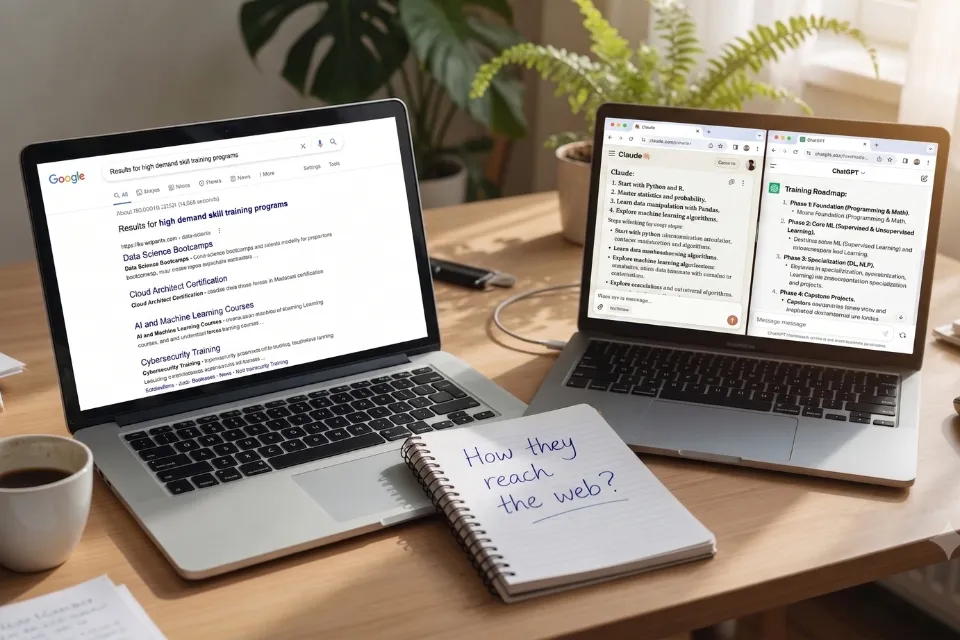
Google Search and AI Search can both help you find information online, but they approach research differently.
Google traditionally gives researchers a set of search results that they can open, compare, and investigate themselves. AI search can pull information from multiple sources and turn it into a conversational answer, often with citations. That difference changes how people do research.
A search result gives you a path to the evidence. An AI-generated answer gives you an interpretation of information gathered from one or more sources. The second approach can save time, but it also introduces another layer between the researcher and the original evidence.
In 2026, the distinction is becoming less clear. Google itself combines conventional search with AI features such as AI Overviews and AI Mode, while other AI search systems can combine retrieval, web browsing, databases, APIs, and language-model synthesis.
So the important question is no longer simply:
Google or AI?
The more useful research question is:
How was the information retrieved, what sources were used, and can the answer be verified?
How Google Search and AI Search Find Information
At a basic level, traditional search helps users find information, while AI search helps users find and synthesize information.
Google Search relies on processes such as crawling, indexing, retrieval, and ranking. Search systems discover pages, process their content, store information about them, and retrieve relevant results when someone searches.
This means Google is not a complete directory of everything published online. A page can exist publicly without appearing in search results because it may be difficult to discover, inaccessible to a crawler, blocked from indexing, poorly connected through links, removed, or changed after it was crawled.
That creates an important research principle: Not finding something in Google doesn’t prove the information doesn’t exist. It means the information wasn’t found through that particular search route. AI search adds another layer.
Different AI search systems use different combinations of search indexes, retrieval systems, language models, web browsing, APIs, proprietary databases, and other information sources. A simplified workflow is:
Question → retrieval → source selection → synthesis → answer
Some systems retrieve information from an existing search index. Others can browse pages directly or access additional sources.
Google’s AI search products have also moved beyond the traditional search-results model. Google describes AI Mode as capable of using query fan-out, where a complex question can be broken into multiple related searches across different subtopics and data sources. The key difference, then, is not simply whether a search engine or language model is involved. It is what happens between retrieval and the final answer.
Traditional search generally leaves more interpretation to the researcher. AI search performs more of that interpretation automatically.
Google Search vs AI Search: Key Differences
You can compare the two approaches across several research factors.
| Research factor | Google Search | AI Search |
| Main output | Search results and source links | Synthesized answer with sources or citations |
| Source inspection | Usually direct | Requires checking cited sources |
| Complex questions | May require several searches | May combine multiple retrieval steps |
| Synthesis | Primarily performed by the researcher | Partly performed by the AI system |
| Query expansion | Search-engine and researcher driven | May happen automatically |
| Citation checking | Researcher evaluates the source | Researcher verifies both source and claim |
| Failure | Poor or missing results may be visible | Incorrect synthesis can appear plausible |
| Main strength | Discovery, source inspection and comparison | Exploration, synthesis and follow-up research |
These are general patterns rather than rules for every product.
Google increasingly incorporates AI into Search, while AI search systems increasingly use web retrieval and external information sources. The boundary between the two categories is therefore becoming less distinct.
A more useful distinction for researchers is how much interpretation occurs before the information reaches the user. With conventional search, researchers normally see the source first. With AI search, the researcher may see a synthesized interpretation before opening the source. That difference matters when a claim’s accuracy matters.
Why AI Search Citations Still Need Verification
One of the biggest changes AI search introduces is how it presents sources. A conventional search result generally provides a link that allows the researcher to inspect the source directly. An AI search answer may instead provide a completed statement followed by one or more citations. That is convenient, but a citation does not automatically prove that the statement is correct.
Before relying on an AI-generated claim, researchers should ask:
- Does the cited source actually exist?
- Does the source say what the AI claims it says?
- Does the source support the specific conclusion being presented?
These are separate checks.
For example, an AI system might state that a government report found that one factor caused another. The citation may genuinely lead to the government report, but the report might only describe a correlation, discuss the two issues separately, or cite another source for the underlying claim.
The citation exists.
The interpretation can still be wrong.
Research cited in the Columbia Journalism Review’s Tow Center article illustrates why this distinction matters. Its testing of eight generative-search tools across 1,600 queries identified substantial problems with source identification and citation accuracy. Those findings belong to that specific study and should not be treated as a universal accuracy rate for every AI search system. The broader lesson is that a citation is not verification.
For professional research, the principle is simple:
Citation presence is not citation verification.
When to Use Google, AI Search, or Both
Google Search is particularly useful when the researcher needs direct access to evidence.
It can help locate a primary document, find an official government source, trace the origin of a claim, investigate a particular website, compare independent sources, locate an exact phrase, find a PDF or report, or reproduce a search process.
The researcher retains direct control over the discovery process. Researchers can change queries, exclude terms, restrict domains, search specific file types, and follow sources independently.
AI search is particularly useful for tasks that involve exploration and synthesis.
It can help researchers understand an unfamiliar topic, identify terminology, compare information, summarize material, generate follow-up questions, and break a complicated research problem into smaller questions.
The important limitation is that:
An AI-generated summary is still a summary.
- If the underlying claim matters, the researcher should return to the original source.
- This is why the most effective workflow is often not Google versus AI search.
- It is Google and AI search.
A Practical Research Workflow
A professional research workflow can combine the strengths of both approaches:
| Stage | Purpose |
| Define | Establish exactly what needs to be answered |
| Explore | Use AI to identify terminology, concepts, and follow-up questions |
| Search | Locate original and authoritative sources |
| Inspect | Open and read the underlying documents |
| Compare | Check claims against the available evidence |
| Verify | Corroborate important information |
| Document | Record the research trail and verification process |
In practice, this means starting with a clear research question, using AI when it helps identify terminology or research directions, searching independently for the underlying sources, inspecting those sources, comparing claims with evidence, and documenting important findings.
The process can be summarized as:
Define → Explore → Search → Inspect → Compare → Verify → Document
Search operators such as site:, filetype:, exact phrases, and date filters can also help narrow conventional web searches.
A Simple Example of Google and AI Search Working Together
Imagine a researcher wants to determine what a government agency said about a new AI regulation.
An AI search system might provide a concise explanation and several citations.
That is useful as a starting point.
The researcher should then open the cited government source and locate the relevant section.
The researcher can check whether:
- the document discusses the same regulation;
- the dates match;
- the policy has been interpreted correctly;
- the source actually supports the AI-generated statement.
The researcher can then perform an independent search, such as:
site: gov.example “regulation name” filetype: pdf
If the independent search leads to the same primary document, the researcher has a stronger source trail.
The AI answer helped with discovery and explanation.
The original document provides the evidence.
That distinction is central to professional online research.
How Search and AI Fail Differently
Traditional search can fail in relatively visible ways.
The researcher may receive irrelevant results, outdated pages, too few results, or no useful results at all.
When that happens, the problem is generally apparent. The researcher knows that the search strategy needs to change.
AI search introduces another type of failure.
The system may produce an answer that looks complete even when the underlying information is incomplete, misunderstood, incorrectly attributed, or unavailable.
This creates an important distinction:
No result is not the same as no reliable evidence.
A missing search result means that one retrieval route did not produce what the researcher needed.
A confident AI answer can instead create the impression that the research problem has already been solved.
That is why verification becomes more important, not less, when the interface produces a fluent answer.
| Potential failure | Conventional search | AI search |
| Irrelevant information | Usually visible in results | May be hidden behind synthesis |
| Missing information | Often apparent | May produce an incomplete answer |
| Incorrect source | Researcher can inspect it | May be presented alongside a claim |
| Misinterpretation | Usually performed by the researcher | Can occur during AI synthesis |
| Verification | Inspect the source | Verify the source and the AI’s interpretation |
Neither workflow is automatically reliable simply because of the interface being used.
The researcher’s verification process remains important.
Google and AI Search Are Converging
The old distinction between Google as “search” and AI as a completely separate category is becoming less accurate.
Google now incorporates generative AI directly into Search through features such as AI Overviews and AI Mode.
At the same time, AI systems increasingly use search engines, live browsing, and external data sources.
The practical distinction for researchers is therefore becoming less about the product category and more about the research workflow.
Regardless of where an answer comes from, ask:
- Where did the information come from?
- How was it retrieved?
- Was it transformed or summarized before I saw it?
- Can I inspect the original source?
- Does the source actually support the claim?
These questions remain useful whether the information arrives through a traditional search-results page, an AI assistant, or a hybrid search interface.
Common Mistakes Researchers Should Avoid
The biggest mistake is treating a generated answer as original evidence.
Researchers should also avoid trusting a citation without opening it, assuming the first search result is automatically the most authoritative source, treating repeated claims as independent corroboration, or failing to check whether an older source is still current.
Another common mistake is treating “AI search” as though every AI system works in exactly the same way.
Different systems use different retrieval methods, browsing capabilities, indexes, data sources, and citation mechanisms.
The safer approach is to evaluate the specific system and specific source rather than making broad assumptions about AI search as a single technology.
Frequently Asked Questions
What is the difference between Google Search and AI search?
Google Search traditionally presents sources and search results for the researcher to investigate, while AI search can retrieve information and synthesize it into a conversational answer. Modern search products increasingly combine both approaches.
Does AI search replace Google?
Not necessarily. AI search can speed up exploration and synthesis, while conventional search remains useful for discovering and directly inspecting primary and authoritative sources.
Can AI search give incorrect answers with real citations?
Yes. A citation can lead to a genuine source but fail to support the exact statement the AI made. Researchers should verify both the source and the claim.
Should researchers trust AI-generated citations?
Important citations should be verified. Open the cited source, identify the relevant passage, and determine whether it actually supports the statement.
Is Google Search still useful for research?
Yes. Google remains useful for source discovery, primary-document research, source comparison, exact-phrase searches, and independent verification. Google itself also incorporates AI into Search.
Does AI search access more of the web than Google?
There is no universal answer. Different AI systems use different retrieval methods. Some rely on search indexes, while others can browse websites, query APIs, or access additional information sources.
Can AI replace professional internet research?
AI can assist with discovery, synthesis, organization, and exploration. Professional research still requires source evaluation, corroboration, documentation, and judgment.
What is the biggest research risk with AI search?
One major risk is that an incomplete or incorrect answer can look convincing, especially when it includes citations. Researchers should therefore verify important claims against the underlying evidence.
Conclusion
Google Search and AI search are becoming increasingly connected, but they still perform different roles within the research process. Google Search is particularly valuable for finding and inspecting sources. At AOFIRS, AI search is particularly useful for exploring questions, synthesizing information, and organizing research.
Neither should be treated as a complete substitute for professional source evaluation.
A stronger research workflow combines the two:
- Use AI to explore.
- Use search to investigate.
- Use original sources to verify.
- Document what you found and how you verified it.
The most important distinction is simple:
An answer is not the evidence. A citation is not the verification. Verification begins with the original source.