
Researchers should note three key findings. First, approximately 90–96% of the World Wide Web remains hidden from standard search indexes, a proportion that has persisted or increased since Michael Bergman’s 2001 measurement. Second, AI-driven search engines do not access unindexed pages; all major AI answer engines retrieve information from conventional surface-web indexes, and their crawlers cannot log in, fill forms, solve CAPTCHAs, or render most script-generated content. Third, and less widely recognized, in 2026 the AI-visible web is shrinking compared to the Google-visible web, as millions of sites now block AI crawlers by default and crawl access is increasingly monetized.
The belief that AI has “superior access to the hidden web” is a misconception. AI offers superior interpretation of the visible web and a limited but expanding ability to access authenticated sources through connectors and agents using the researcher’s credentials.
How much of the web is actually hidden?
Can AI Search Engines Reach Unindexed Pages? The Architecture Says No
To determine whether AI search has “superior access” to the hidden web, it is necessary to examine what these systems actually query. All mainstream AI answer engines use Retrieval-Augmented Generation (RAG): the language model does not access the internet in real time but instead queries a pre-built web index, retrieves passages, and synthesizes responses. The model’s reach is limited to its index, which is a surface-web index built by a crawler facing the same barriers as Googlebot (Clairon, 2026).
This distinction between AI interpretation capabilities and actual web access limitations can be explored with the Hidden Web in the Age of AI Searchto know how retrieval systems, crawlers, and authenticated sources determine what information AI systems can discover.
| AI Answer Engine | Retrieval Backend (2026) | What This Means for Reach |
|---|---|---|
| ChatGPT Search | OpenAI’s own OAI-SearchBot index (historically Bing) | A page unindexed by OpenAI’s crawler cannot be cited, regardless of Google rank. |
| Microsoft Copilot | Bing’s standard index | Bounded entirely by Bing’s crawl of the surface web. |
| Google Gemini / AI Overviews | Google’s traditional index + live retrieval | Same reach as Google Search, no more and no less. |
| Claude (web search) | Brave Search index | An independent but still surface-web index. |
| Perplexity | Proprietary Sonar index (hundreds of billions of pages) + live fetch | Sub-document retrieval of crawlable pages; still cannot enter gated collections. |
| Grok | Web crawl + X (Twitter) firehose | Unique real-time social reach; same barriers at logins and databases. |
The 2026 Reversal: The AI Visible Web Is Shrinking
A major shift has occurred since mid 2025: the open web has increasingly restricted access for AI crawlers, while continuing to allow traditional search engine crawlers.
- Default blocking at infrastructure scale. Cloudflare, which fronts roughly 20% of the web, began blocking AI crawlers by default for new sites in July 2025. In the five months through early December 2025, its customers blocked 416 billion AI-bot requests, and over 2.5 million sites now fully disallow AI training.
- Crawl access is now a paid service. Cloudflare’s Pay-Per-Crawl program responds to AI crawlers with an HTTP 402 payment request. Beginning September 15, 2026, stricter defaults will block training and “mixed use” crawlers on ad-monetised pages across the network.
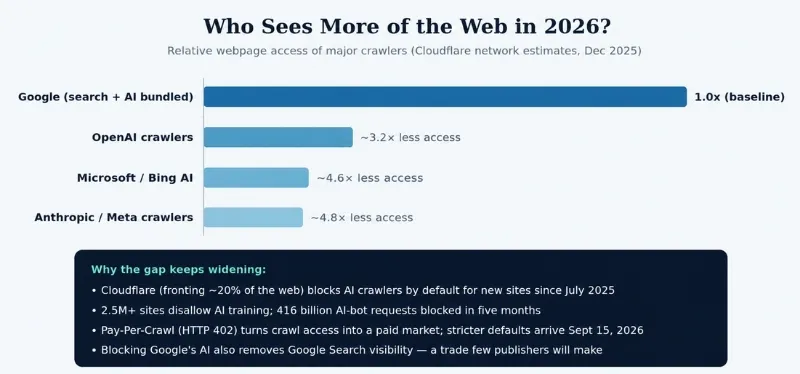
- This asymmetry benefits Google. Since Google has combined its search and AI crawling into a single access point, blocking Google’s AI also removes a site’s visibility from Google Search, a step few publishers are willing to take. Cloudflare data indicates that Google’s crawler now accesses approximately 3.2 times more of the web than OpenAI’s, 4.6 times more than Microsoft’s, and about 4.8 times more than Anthropic’s or Meta’s.
- Publishers are increasingly selective in blocking AI. Among news publishers, 79% block at least one AI training bot. Robots.txt analyses show that GPTBot is the most blocked crawler on the web, with about one in five sites disallowing it.

- Figure: Relative crawler access across the Cloudflare-protected web, per Cloudflare network data reported December 2025.
- Authenticated connectors (MCP): OpenAI’s February 2026 update allows deep research to connect to any MCP source and restrict retrieval to trusted, authenticated repositories. This enables agents to search databases for which the researcher has credentials. The rapid adoption of the Model Context Protocol has made integrating subscription databases with AI a standard workflow.
- Agentic browsing with user credentials: Agent modes using visual browsers, such as ChatGPT agents or browser operating assistants, can navigate query forms, paginate results, and operate within sessions the user has logged into. These agents can perform deep web searches that crawlers cannot, but the access stays under the user’s control.
- Proprietary source research APIs. A distinct 2026 product category offers research agent Proprietary source research APIs. In 2026, a new category of products provides research agents with licensed access to collections that ordinary crawlers cannot reach, such as SEC EDGAR filings, paywalled academic literature, clinical trial registries, patent databases, and real time financial data. These resources are accessible through contractual agreements, not web crawling. Or, restating: AI’s semantic understanding makes it the best available tool for identifying which hidden collections exist, drafting the operator strings and native database queries to search them, and synthesizing what the researcher retrieves. AOFIRS’s tool guides from the classic Search the Invisible Web: 20 Resources to the 2026 Best Deep Web Search Engines catalog the destinations; AI helps you choose among them and interrogate them well.
Notice the pattern: in every genuine extension, AI does not independently access the hidden web; it operates through access the researcher already holds, such as credentials, subscriptions, or licensed APIs. This is fundamentally different from the claim that “AI taps unindexed pages,” and confusing these concepts leads to misunderstanding.
“In direct response to the question: No, AI-driven search engines cannot access pages that are not indexed, nor do they have superior access to the hidden web in comparison to traditional keyword search engines. Google’s crawler currently indexes several times more of the web than any AI crawler. AI’s strengths are in understanding intent, engineering queries, operating authenticated access on behalf of the researcher, and synthesizing findings. Access and intelligence are distinct capabilities, and the gap between them has expanded with 2026’s tools..”
For online researchers using the internet as their primary information source, the working protocol follows from the evidence:
- Use AI to map sources, but require named references. Employ AI to identify relevant registries, archives, and databases, and verify that each named collection actually exists, as hallucinated databases remain a known risk.
- Locate entry points using operator driven keyword search. Google’s index remains the most thorough tool for finding gateway pages and individual documents using operators such as site:, filetype:, inurl:, intitle:, and exact phrases. No AI tool currently matches this breadth.
- Access collections directly. Search deep web repositories using their native interfaces, or connect them to your AI via MCP or agents where you have credentials, permitting the model to operate access you legitimately possess.
- Cross check AI answers against Google, not the reverse. Because the AI visible web is now a subset of the Google visible web, an AI answer’s silence proves nothing. Assume every AI synthesis has blind spots created by crawler blocking, paywalls, JavaScript rendering, and index gaps.
- Base synthesis on retrieved primary documents. Provide verified source material to the model for summarization and contradiction detection. AI output serves as a lead, but the document you retrieve from the registry is the actual evidence.
Over 90% of the deep web has never been accessible simply by typing keywords or prose. Access has always depended on method: knowing where collections are, how to query them natively, and how to verify results. In 2026, AI is the most powerful assistant for this method, but also the most convincing illusion of completeness. Successful professionals will leverage AI’s qualities without mistaking its output for complete coverage because Deep Web May Not Be as Dark as You Think. This distinction defines the expertise of a certified internet research specialist.