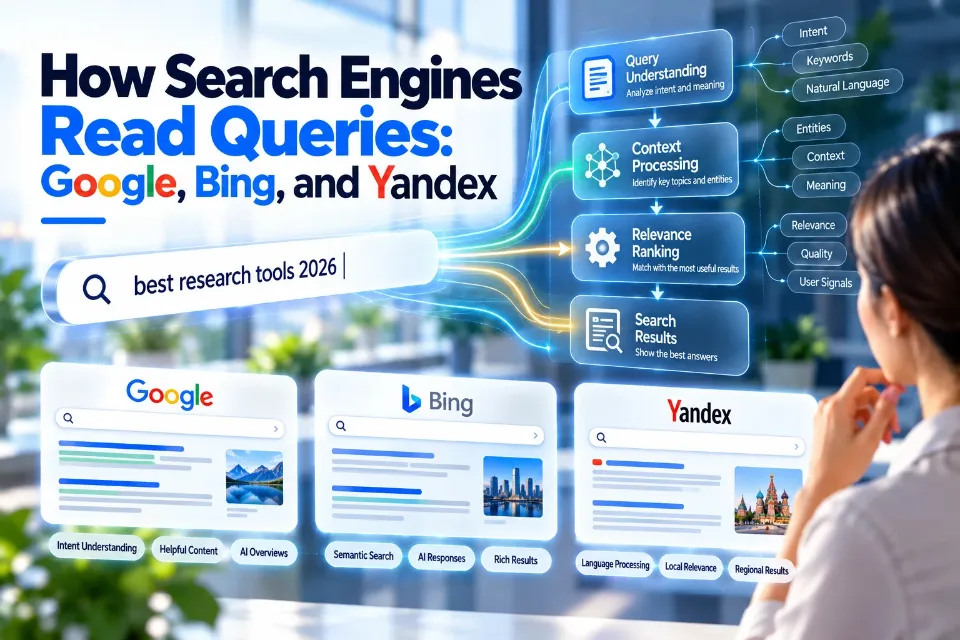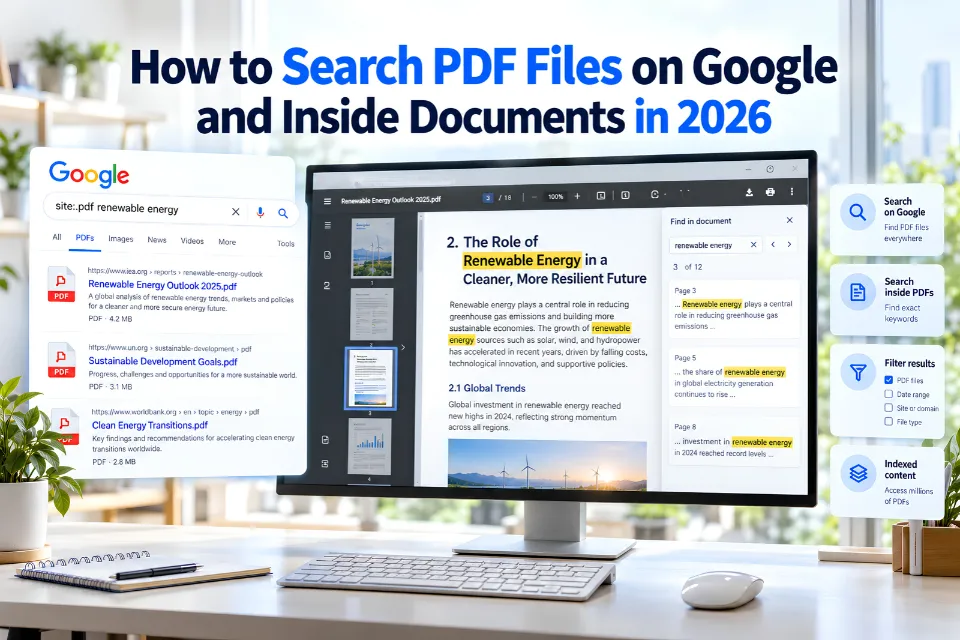
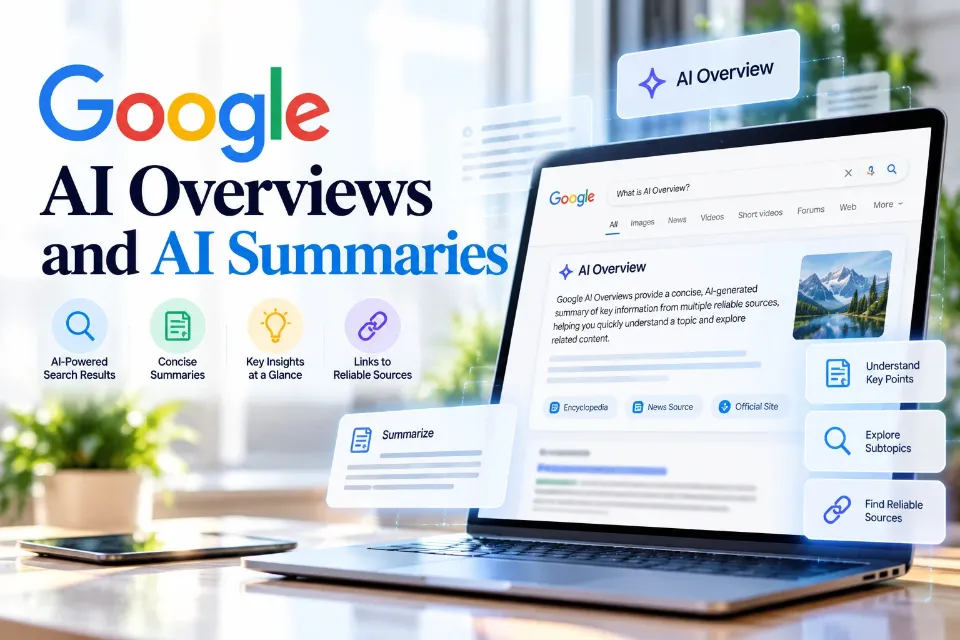
Google Search no longer relies solely on lists of web pages to help people find information. Its AI-powered features can interpret complex questions, generate explanations, and recommend sources for further investigation.
Google AI Overviews are AI-generated responses that appear in Google Search when its systems determine that a summary would be useful. Google AI Mode extends this experience with conversational questions, comparisons, and more complex research tasks.
For researchers, students, and information professionals, these tools can make information discovery faster. However, a convincing AI-generated explanation is not necessarily an accurate research finding.
Understanding how these features work, what changed in 2026, and how to verify their answers is becoming an essential part of modern information literacy.
What Are Google AI Overviews?
Google AI Overviews are AI-generated summaries that help users understand a question or topic directly within Google Search. They combine a generated explanation with links to relevant web content, giving readers opportunities to investigate the subject further.
The term Google AI Summaries is often used informally to describe these responses, but AI Overviews is Google’s official product name.
The feature evolved from Google’s experimental Search Generative Experience (SGE), introduced in 2023, before AI Overviews launched more broadly in 2024.
Unlike a conventional search snippet, which normally displays text associated with an individual page, an AI Overview can synthesize information relevant to several aspects of a question.
For example, someone researching renewable energy might ask:
How do solar and wind energy compare in cost, reliability, and environmental impact?
An AI Overview may present an initial comparison and supporting links. However, it cannot replace reviewing the original research, especially where findings depend on geography, methodology, or publication date.
Google does not generate an AI Overview for every search. Its systems determine when an AI-generated response may add value beyond conventional results. See Google AI guidance.
How Do Google AI Overviews Work?
Google combines search technologies with generative AI to interpret questions, identify relevant information, and construct responses.
The following is a simplified explanation, not a complete account of Google’s proprietary systems.
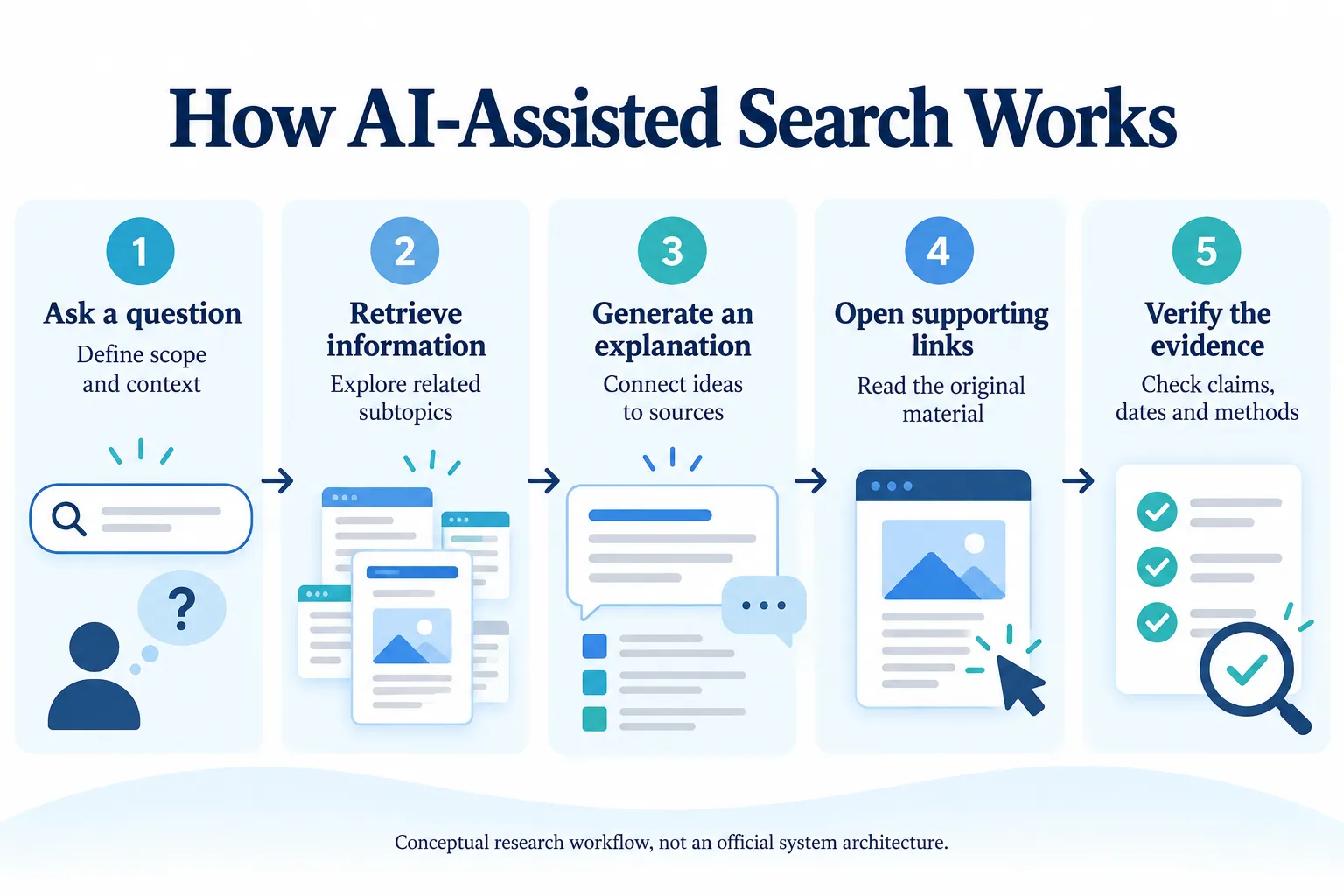
Understanding Search Intent
The process begins with interpreting what the user wants to know.
A query such as What are the effects of climate change on agriculture? may involve several connected subjects, including crop yields, rainfall, temperature, regional differences, and adaptation strategies.
AI-powered search can work with these relationships rather than treating every question as an isolated keyword lookup.
Retrieving Relevant Information
Google Search uses its search infrastructure to identify information relevant to the query.
AI Overviews and AI Mode may also use a technique Google calls query fan-out, which involves issuing multiple related searches across subtopics or data sources.
For a complex agricultural research question, this might involve examining climate projections, crop studies, and regional agricultural evidence.
For practical discovery methods, explore the AI research guide.
Generating and Grounding AI Answers
Generative AI produces a natural-language response using information and context available to the system.
Grounding connects generated responses to retrieved information or other relevant sources. It can improve factualsupport butt does not eliminate mistakes.
Retrieval-augmented generation (RAG) describes a wider class of approaches that combine information retrieval with language generation. Google’s precise implementation should not be assumed to follow one publicly known architecture.
Presenting Sources and Supporting Links
AI Overviews can display links alongside their explanations, allowing readers to explore original information.
A source link is a useful research lead, not automatic proof that the generated statement is correct.
The linked material may support only part of a claim, contain qualifications, or use a different definition from the AI-generated summary.
Conceptual Workflow of AI-Powered Search
Google AI Overviews vs AI Mode vs Traditional Google Search
Google offers different ways to explore information. Their suitability depends on the complexity of the question and the evidence required.
| Feature | Traditional Search | AI Overviews | AI Mode |
|---|---|---|---|
| Main purpose | Find relevant resources | summarize questions | Explore complex topics |
| Interaction | Search queries and links | Generated response with follow-ups where supported | Conversational and iterative |
| Output | Ranked results and search features | AI explanation with supporting links | Detailed AI responses with links |
| Source exploration | Direct website discovery | Linked supporting pages | Links across related questions |
| Research use | Locate primary material | Understand a topic quickly | Scope and compare complex subjects |
| Main limitation | Requires manual synthesis | May omit or distort evidence | May compound errors across responses |
Which should researchers use?
Traditional search remains valuable for locating specific documents, datasets, and original publications. AI Overviews can support preliminary understanding, while AI Mode can help develop questions and explore connected subjects.
For rigorous research, these approaches work best together.
Practical Prompts for AI Search
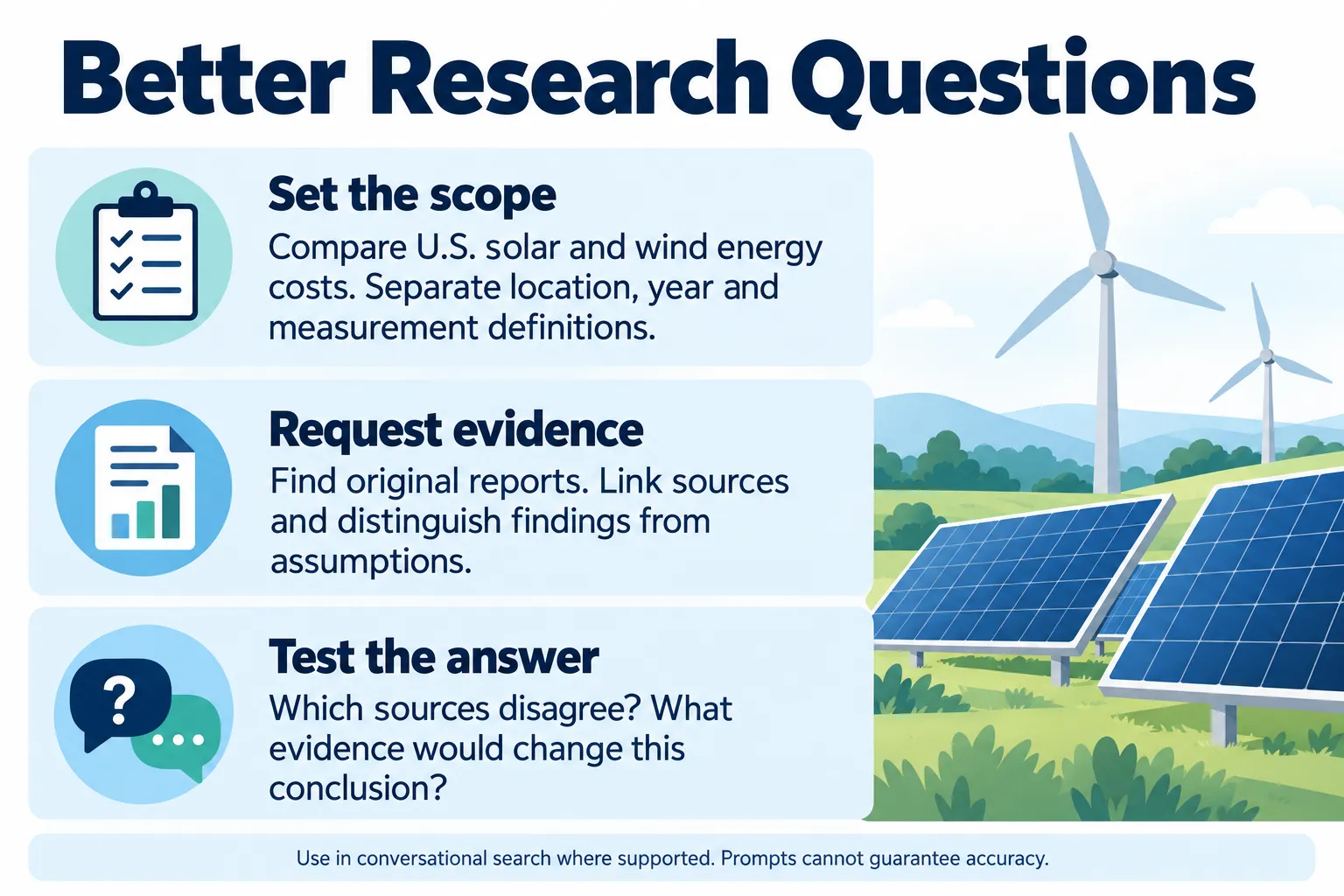
Compare U.S. solar and wind energy costs. Separate location, year and measurement definitions. Find original reports and link the sources. Distinguish findings from assumptions. Which sources disagree, and what evidence would change the conclusion?
Break this into follow-up questions in AI Mode where supported. Open the cited reports yourself and record exactly which evidence supports each comparison. An AI Overview may not appear for this query.
What’s New in Google AI Search in 2026?
Several developments between January and October 2026 expanded Google’s AI search capabilities.
Gemini and Conversational Search
On January 27, 2026, Google announced Gemini 3 as the default model for AI Overviews and introduced a smoother transition from an AI Overview into conversational follow-up questions. See the January Search update.
This made it easier to begin with a brief explanation and continue exploring related questions without starting a separate search.
Multimodal Search and AI Mode
On March 26, 2026, Google announced a broader international expansion of Search Live. The feature supports interactive conversations using voice and camera input in locations and languages where AI Mode is available. See Search Live expansion.
This provides additional ways to investigate visual subjects, although availability still depends on supported products and locations.
Agentic Features and More Complex Tasks
At Google I/O on May 19, 2026, Google announced Gemini 3.5 Flash as the default model for AI Mode globally and introduced further changes to the search interface. See Google’s model announcement.
The announcements included richer multimodal inputs and agentic capabilities designed to help with tasks beyond obtaining a simple answer.
These developments indicate a shift toward task-oriented search, but individual functions may have eligibility restrictions or staged rollouts.
Better Links and Source Discovery
On October 15, 2026, Google announced more prominent inline links and expanded discovery features. Dedicated sections for official website links and clickable creator profiles were described as tests, so these should not be assumed to appear for every user. See the October Search update.
The October updates focused on clearer inline links, more information about supporting sources and improved ways to discover timely articles and original content.
For researchers, this matters because the usefulness of an AI-generated answer depends partly on how easily its evidence can be inspected.
Publisher Insights and Controls
Google Search Console now provides a Generative AI performance report covering impressions in AI Overviews and AI Mode. Google says it rolled out worldwide on August 31, 2026; a site with too few impressions may not see the report. Read the AI performance documentation.
These changes reflect the growing need for publishers to understand how their content is discovered and used in AI-powered search.
Benefits of Google AI Overviews for Online Research
AI-powered search can help researchers at the beginning of an investigation, particularly when a subject is unfamiliar.
Its potential benefits include:
- Faster topic orientation: Obtain an initial explanation before reading detailed reports.
- Research question development: Identify related concepts, terminology, and possible subquestions.
- Source discovery: Find linked resources that may justify deeper examination.
- Comparative exploration: Examine multiple aspects of an issue before selecting a research approach.
- More accessible interactions: Use conversational, visual, or voice-based questions where supported.
For example, a market researcher investigating electric vehicle adoption could use AI Mode to identify possible factors such as infrastructure, costs, policy, and consumer behavior.
The researcher would then need to collect actual statistics from government reports, industry datasets, and independent studies.
For a broader comparison, see the AI search comparison.
Accuracy, Hallucinations and Limitations of AI-Generated Search Answers
AI-generated search answers can be coherent, detailed, and still incorrect.
A hallucination occurs when an AI system produces information that is unsupported or false, potentially presenting it with unwarranted confidence.
Other important limitations include:
- Missing context: A summary may omit exceptions, eligibility conditions, or methodological limitations.
- Source misinterpretation: The answer may overstate what a linked publication actually found.
- Incomplete coverage: Relevant sources may be absent from the generated response.
- Outdated information: A claim may describe a previous policy, product, or research finding.
- Conflicting evidence: Different studies may reach different conclusions that a short summary cannot adequately explain.
- Selection bias: Accessible or prominently surfaced material may not represent the full evidence base.
An especially important problem for researchers is false confidence. A response with professional wording and several links can appear authoritative even if its central conclusion is weak.
AI-generated summaries should therefore be treated as preliminary interpretations rather than verified research results.
How Researchers Can Verify Google AI Overviews
A structured verification process helps prevent AI-generated errors from entering research reports, academic work, or professional decisions.
1. Identify the claims
Separate the AI answer into specific factual statements, figures, and conclusions.
2. Inspect the supporting sources
Open the original pages and locate the passages relevant to each claim.
3. Cross-check the evidence
Consult primary documents, original datasets, or genuinely independent publications.
4. Examine dates and methods
Compare publication dates, definitions, samples, study limitations, and contradictory findings.
5. Document the findings
Record verified conclusions, exact source references, and any unresolved uncertainty.
Practical Example: Verifying a Research Claim
Suppose a researcher asks Google:
Does working from home improve employee productivity?
An AI-generated answer may indicate that remote work improves productivity under certain conditions.
Rather than copying this statement, the researcher should:
- Identify whether the answer refers to productivity, employee satisfaction, or performance.
- Open the underlying studies and verify their findings.
- Compare research involving different industries, occupations, and working arrangements.
- Identify limitations and conflicting evidence.
- Write a qualified conclusion based on the actual studies reviewed.
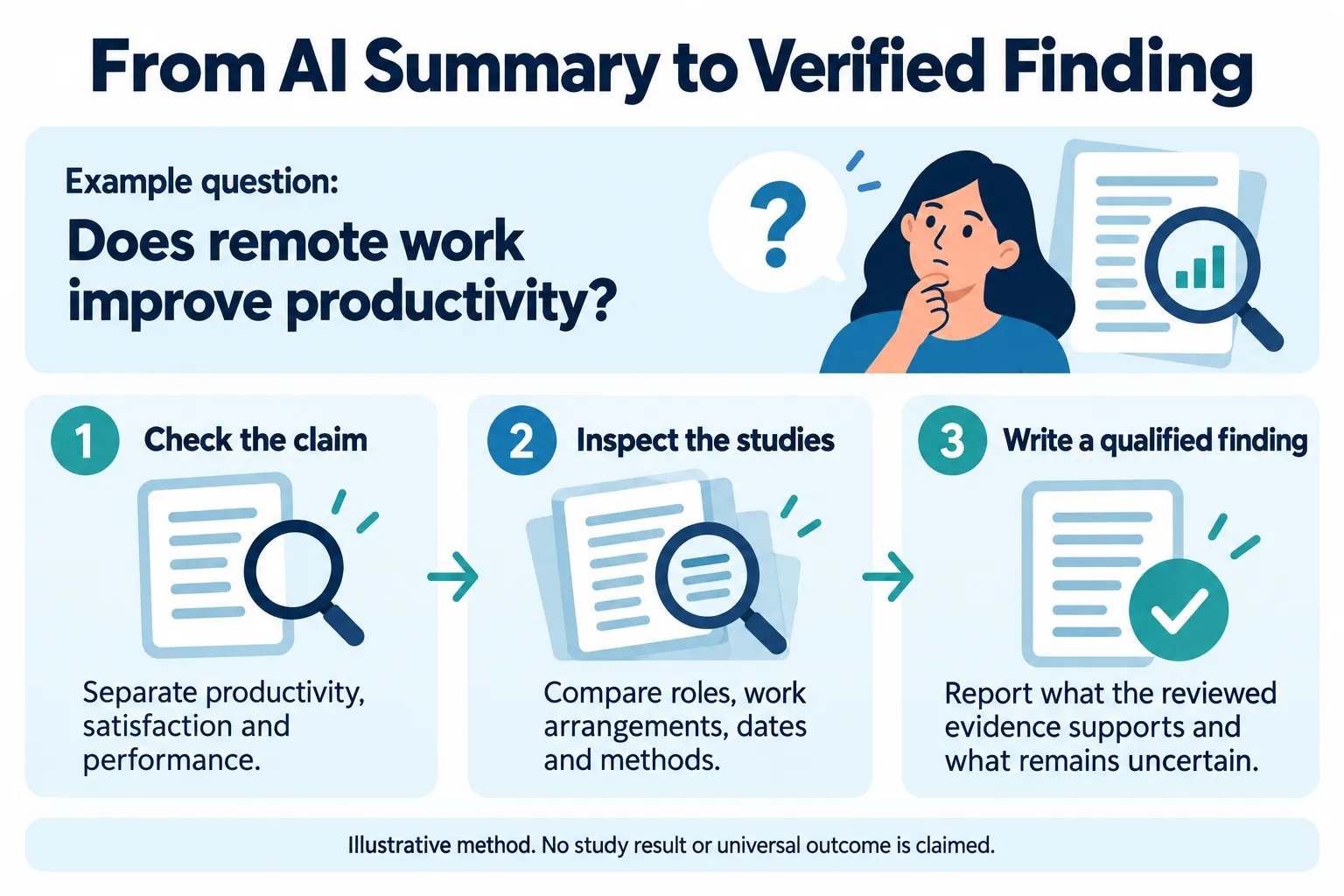
This approach prevents a broad AI summary from becoming an unsupported universal claim.
Use the verification guide to document sources and unresolved claims.
How Google AI Overviews Affect SEO, AEO, and GEO
AI-generated search experiences create additional opportunities for websites to be discovered, but they also change how users interact with search results.
A reader may obtain enough introductory information from an AI Overview to avoid opening another page. Alternatively, an overview may introduce a useful source that the reader would not otherwise discover.
The effect varies by subject, query, and audience.
Create Original, Evidence-Based Content
Publish material that answers genuine questions and contributes something useful beyond repeating existing explanations.
Original research, expert analysis, clear methodology, and credible references make content more valuable to readers.
Maintain Crawlability and Indexing
For a page to be eligible as a supporting link in AI Overviews or AI Mode, Google’s documentation says it must be indexed and eligible to appear in Search with a snippet. See Google’s eligibility guidance.
Website owners should therefore maintain accessible pages, useful internal links, suitable HTML text, and sound technical SEO.
Use Clear Structure and Appropriate Markup
Descriptive headings, helpful comparisons and concise explanations improve readability.
Structured data should match the page’s visible content. Google does not require special AI-specific schema or separate AI text files to appear in its generative search features. See Google’s optimization guide.
Measure Visibility Carefully
Use the AI performance report to track impressions in AI Overviews and AI Mode, then compare website visits and engagement in your analytics. An impression is not a click, a conversion, or proof that every claim in the answer is supported.
However, avoid assuming that every traffic change was caused by AI Overviews.
SEO, Answer Engine Optimization (AEO), and Generative Engine Optimization (GEO) can share practical goals: making content accessible, clear, informative, and trustworthy.
No technique guarantees that Google will cite or display a particular page in an AI-generated answer.
The Future of AI-Powered Search and Information Literacy
Search is increasingly becoming an interactive process rather than a single request followed by a list of results.
Conversational search allows users to refine questions. Multimodal systems introduce images, speech, and other inputs. Agentic capabilities may increasingly assist with research-related tasks and planning.
These advances could improve access to information while introducing more complicated questions about transparency, accountability, and source reliability.
For professional researchers, the priority is not simply learning how to obtain faster answers. It is understanding how those answers were produced, recognizing when evidence is insufficient and knowing how to investigate further.
The value of advanced internet research skills therefore remains substantial.
Frequently Asked Questions
What are Google AI Overviews?
Google AI Overviews are AI-generated responses presented within Google Search. They help users understand questions or complex topics by providing an explanation and links to relevant online material. They appear selectively rather than for every query.
Are Google AI Summaries and AI Overviews the same thing?
Google AI Summaries is an informal description commonly used for summarized answers generated by Google’s AI. AI Overviews is the official name for Google’s AI-generated summary feature within Search. AI Mode is a related but distinct conversational search experience.
How does Google AI Mode differ from AI Overviews?
AI Overviews generally provide an initial explanation within search results, with follow-up capabilities available in supported experiences. AI Mode is designed for deeper exploration, including complex comparisons, conversational questions, and multimodal interactions.
How accurate are Google AI Overviews?
Accuracy varies according to the subject, complexity of the question, available evidence, and system behavior. AI-generated responses can be useful, but there is no universal accuracy rate that applies to every query. Important claims should be checked against reliable original sources.
Can Google AI Overviews provide incorrect information?
Yes. An AI Overview can contain incorrect facts, outdated material, misleading interpretations, or incomplete conclusions. The presence of supporting links does not automatically establish that every statement is justified by those sources.
How can researchers verify AI-generated search answers?
Researchers should identify the claims, examine linked source documents, cross-check important facts, compare relevant studies, and document the evidence they actually reviewed. Significant conclusions should be supported by original or independently verified sources.
How do AI Overviews affect website SEO and traffic?
AI Overviews can influence how users discover websites and whether they click through to individual pages. The impact varies by query and website. Google recommends established SEO fundamentals, including accessible content, indexing, internal linking, and helpful information.
Will AI-powered search replace traditional search engines?
AI-powered features are becoming integrated into search engines, but traditional search remains useful for finding original documents, databases, specific websites, and detailed evidence. The likely direction is continued integration rather than a complete disappearance of conventional search functions.
Conclusion
Google AI Overviews and AI Mode have expanded what users can ask of a search engine. They can help explain difficult subjects, identify related information, and support more exploratory research. However, generated answers remain interpretations that require critical evaluation. For researchers, the most effective approach combines AI-assisted discovery with traditional search methods, primary-source verification, and transparent documentation. The essential research skill in 2026 is not simply finding an answer quickly. It is knowing whether the answer is supported by reliable evidence.