

Online research work offers opportunities for freelancers, students, career changers, and experienced professionals who can find reliable information, analyze evidence, and communicate useful findings. These opportunities range from entry-level internet research and data collection to market intelligence, academic research, fact-checking, and AI response evaluation.
If you want to know how to find online research work in 2026, start by identifying the type of research you can perform, building a small portfolio, searching the right job platforms, and learning to verify information accurately.
Artificial intelligence has changed how researchers work. Tools can now help organize documents, summarize material, and identify patterns, but they can also produce incorrect statements and misleading references. Employers and clients still need people who can evaluate evidence, recognize limitations, and turn information into dependable research deliverables.
This guide explains where to find legitimate online research jobs, what qualifications you need, how to approach your first client, and what different research careers may pay.
What Is Online Research Work?
Online research work is the professional process of finding, evaluating, organizing, analyzing, and presenting information obtained through digital sources. Researchers may use search engines, academic databases, government publications, company records, surveys, and specialized research tools.
The work goes beyond collecting website links. A professional researcher must understand the client’s question, determine which sources are appropriate, separate facts from unsupported claims, and present findings in a useful format.
For example, a business planning to enter a new market might hire an online researcher to investigate competitors, customer preferences, industry regulations, and available market data.
The final deliverable could be a spreadsheet, competitive intelligence report, annotated bibliography, research briefing, or presentation.
Common forms of online research employment
Research work generally falls into three arrangements:
- Remote employment: You work for an employer, often as a research assistant, analyst, or specialist. Some positions are fully remote, while others require occasional office attendance.
- Freelance research: You provide research services to clients on a project basis or through ongoing contracts.
- Task-based research work: You complete defined assignments, such as evaluating AI-generated answers, checking search relevance, or categorizing information.
These arrangements differ in job security, eligibility, payment structure, and professional responsibilities. Understanding the differences helps you target the opportunities that suit your experience.
Types of Online Research Jobs Available in 2026
Online research is not a single occupation. Different industries require different research methods, subject knowledge, and levels of analysis.
| Research role | Typical responsibilities | Suitable background |
|---|---|---|
| Internet Researcher | Find and organize relevant online information | Beginners with strong search skills |
| Research Assistant | Collect sources, maintain records, and support research projects | Students and graduates |
| Market Research Analyst | Study markets, customers, and industry trends | Business, marketing, or analytical experience |
| Competitive Intelligence Researcher | Examine competitors, products, and market positioning | Business research and strategy |
| Academic Research Assistant | Support literature searches and research documentation | Academic or subject-specific knowledge |
| Fact-Checker | Verify factual statements, quotations, and references | Journalism and source evaluation |
| SEO Research Specialist | Research search intent, keywords, and supporting evidence | Digital marketing knowledge |
| Data Research Analyst | Collect, clean, organize, and interpret data | Spreadsheet and analytical skills |
| OSINT Researcher | Analyze lawfully accessible open-source information | Advanced verification and investigative skills |
| AI Response Evaluator | Review AI outputs against evaluation criteria | Language, reasoning, and evidence-checking skills |
Entry-level internet research and research assistance
Beginners can look for assignments involving company research, product comparisons, document organization, source identification, and basic data collection.
For example, a client may request a list of manufacturers that meet specific criteria. The researcher must find the companies, verify the relevant details, and document the sources.
Although such tasks may have lower entry requirements, accuracy, clear formatting, and careful verification still matter.
Market research and competitive intelligence
Market research examines customer behavior, industry conditions, product demand, and commercial opportunities.
Competitive intelligence focuses on understanding competitors through legitimate sources such as public reports, product catalogs, pricing pages, company announcements, and industry publications.
These positions may require greater analytical ability because clients often expect conclusions, not simply collected data.
Academic, legal, and healthcare research support
Universities, research organizations, professional services firms, and healthcare institutions may hire people to assist with literature searches, evidence collection, bibliographies, and research documentation.
Specialized projects can require relevant qualifications, access to databases, confidentiality protections, and familiarity with professional standards.
Researchers should not provide regulated legal or medical advice unless appropriately qualified and authorized.
AI-related research and evaluation opportunities
AI development and deployment have also created opportunities involving the assessment of generated content.
These assignments may involve checking whether AI answers follow instructions, identifying unsupported statements, comparing responses, evaluating search relevance, or labeling data.
Common descriptions include AI trainer, AI response evaluator, search quality rater, data annotator, and subject-matter expert evaluator.
Not all are established occupations with standardized qualifications. Many are temporary, project-based assignments, and the availability of work can vary considerably.
Read about the verification premium.
Where to Find Legitimate Online Research Work
The best place to search depends on whether you want independent clients, a salaried job, an academic position, or task-based AI evaluation work.
Freelance marketplaces
Freelance platforms can help researchers identify client projects, build work histories, and develop long-term professional relationships.
| Platform | Research opportunities to look for | Best suited for | Considerations |
|---|---|---|---|
| Upwork | Internet research, market research, competitive analysis, data collection | Project-based researchers | Competition, service fees, and proposal requirements |
| Fiverr | Defined research services and packaged deliverables | Freelancers offering a specific service | Visibility, pricing, and platform rules |
| Freelancer.com | Research projects, data collection, and business analysis | Freelancers bidding on projects | Competition and project screening |
| PeoplePerHour | Business research and freelance professional services | Independent contractors | Availability varies by specialization |
| Guru | Research, analysis, and related contract services | Freelancers seeking client projects | Review fees and payment protections |
| Contra | Independent consulting and professional freelance services | Researchers with portfolios | Client demand depends on specialization |
A beginner might offer a focused service such as compiling a verified list of industry competitors. Someone with stronger analytical experience could offer a market-entry research briefing.
Before joining a platform, review its current fees, account eligibility, country restrictions, and payment terms. Inclusion in this table does not mean a platform currently has vacancies in every research category.
Remote job boards
For employment, search LinkedIn Jobs, Indeed, FlexJobs, Remote.co, and We Work Remotely. Some boards charge for access or optional services; check current terms before paying.
Use multiple job titles because employers may describe similar duties differently.
For example, a company might advertise a business research associate role rather than an online researcher position.
When reviewing a listing, check whether the role is fully remote, hybrid, limited to certain countries, or subject to specific work authorization requirements.
Remote does not automatically mean worldwide.
Universities and research institutions
Academic research opportunities may appear on university career websites, departmental recruitment pages, and academic job boards.
Researchers can search for positions such as research assistant, research coordinator, literature review assistant, and project research associate.
Suitable sources include institutional career portals and established academic employment directories.
Some roles are remote, while others require laboratory access, fieldwork, institutional affiliation, or a particular academic qualification.
AI training and evaluation platforms
For AI evaluation and data assignments, investigate Outlier, DataAnnotation, TELUS Digital, RWS TrainAI, and Appen careers. These providers offer different recruitment channels, eligibility rules, and assignment types.
These services are relevant to investigate for assignments involving AI response evaluation, data labeling, language assessment, search relevance, and related activities.
However, their recruitment processes, project supply, eligibility requirements, and compensation models are not identical.
Applicants should check official recruitment pages, confirm the country and language requirements, understand any assessment procedures, and verify how payment works.
Do not assume that passing an assessment guarantees a steady flow of paid assignments.
Paid research participation is different from research employment
Participation services such as Prolific, Respondent, and UserTesting connect eligible people with studies or tests. Review each assignment to establish whether you are contributing expertise or participating as a respondent.
Participants typically provide feedback or information that another researcher collects and analyzes.
By contrast, a professional online researcher designs searches, gathers or evaluates evidence, and produces research findings.
Participation can provide occasional supplementary income, but it is not equivalent to employment as a research analyst. Study availability and participant eligibility also vary.
How to Search for Remote and Freelance Research Jobs
A productive job search begins with precise keywords, suitable filters, and a method for evaluating listings.
Use more than one job title
Searching only for “online researcher” may miss suitable positions advertised under other names.
Try searches such as:
- “remote research assistant”
- “freelance internet researcher”
- “market research analyst remote”
- “competitive intelligence researcher contract”
- “AI response evaluator remote”
- “research fact checker freelance”
For academic opportunities, combine your field with terms such as research assistant, literature review, or research associate.
Use advanced search operators
Google Search can help locate opportunities directly on company websites.
For example:
"research assistant" "remote" "contract"site:edu "research assistant" "remote""market research" "freelance" -surveyQuotation marks help search for exact phrases. The site: operator restricts results to a website or domain, while the minus sign excludes terms.
For operator syntax, see Google search guidance. Search results can be incomplete; the employer’s original listing is the final reference.
These operators are useful, but they do not guarantee complete or current results. Always open the original listing and check its status.
Build a shortlist rather than applying randomly
Create a spreadsheet with the employer, job title, source URL, work arrangement, location requirements, advertised compensation, application deadline, and application status.
Before applying, check whether your experience matches the essential requirements, whether the job is accessible from your location, and whether the employer can be independently verified.
This process helps you avoid repeatedly applying for unsuitable roles and makes follow-up easier.
How AI Can Help Online Researchers in 2026
AI tools can support many stages of an online research assignment. They can suggest research questions, propose search terminology, help organize documents, and assist with drafting.
General-purpose tools such as ChatGPT, Claude, and Gemini, along with AI-focused search services such as Perplexity, can be useful in these workflows. Their features, access conditions, and reliability differ.
However, an AI-generated answer is not automatically verified evidence.
A practical AI-assisted research example
Suppose a small company wants to understand the market for reusable food packaging in three US states.
A researcher could use AI to generate a preliminary research plan and identify possible categories of evidence, including market statistics, competitors, regulations, and customer trends.
The researcher would then locate relevant government publications, company documentation, industry reports, and other suitable sources.
A spreadsheet could organize the findings. AI might help compare the collected material and prepare an initial report structure.
Before delivery, the researcher must verify the statistics, check quotations, confirm publication dates, assess the source quality, and distinguish established findings from estimates.
The final report should disclose meaningful limitations and any AI use required by the client’s policies.
Where human verification remains essential
AI may produce convincing statements that lack supporting evidence. It can also misinterpret documents or present outdated findings as current.
Researchers should confirm important claims in accessible primary sources, especially when handling legal, medical, financial, regulatory, or business-critical information.
Confidential client material should not be entered into an AI service without appropriate permission and data protections.
How to Build a Research Portfolio Without Experience
A portfolio demonstrates how you approach research problems. You do not need previous paid clients to create useful work samples.
Start with two or three small projects using public information. Label them clearly as independent or demonstration projects.
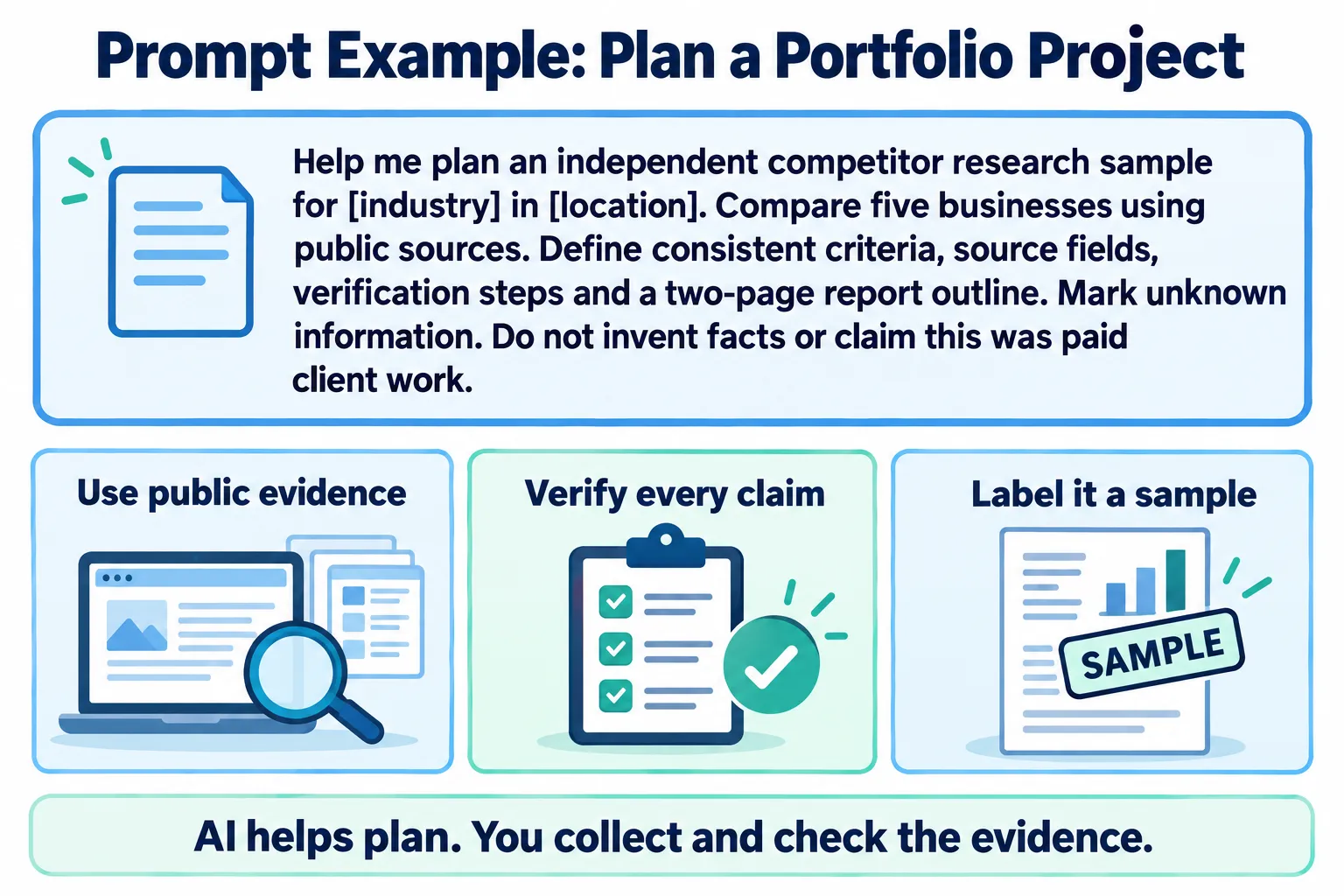
Portfolio planning prompt: Help me plan an independent competitor research sample for [industry] in [location]. Compare five businesses using public sources. Define consistent criteria, source fields, verification steps, and a two-page report outline. Mark unknown information. Do not invent facts or claim this was paid client work.
| Portfolio project | What to demonstrate | Suggested deliverable |
|---|---|---|
| Competitor comparison | Consistent evidence collection and comparison | Two-page report and comparison table |
| Industry trends analysis | Reliable statistics and interpretation | Briefing with sourced charts |
| Fact-checking exercise | Claim verification and source tracing | Verification report |
| Annotated bibliography | Source discovery and evaluation | Organized reference document |
| Public dataset analysis | Data cleaning and interpretation | Spreadsheet and summary |
| AI-assisted research example | AI workflow and human verification | Report with verification notes |
How to Get Your First Online Research Job or Client
Finding the first assignment is often more challenging than completing familiar research tasks. A focused service and convincing work sample can help prospective clients evaluate your abilities.
Choose a specific research service
Instead of advertising that you can research anything, begin with a service you can deliver consistently.
Examples include competitor analysis, business information verification, industry source collection, research bibliography preparation, and online data organization.
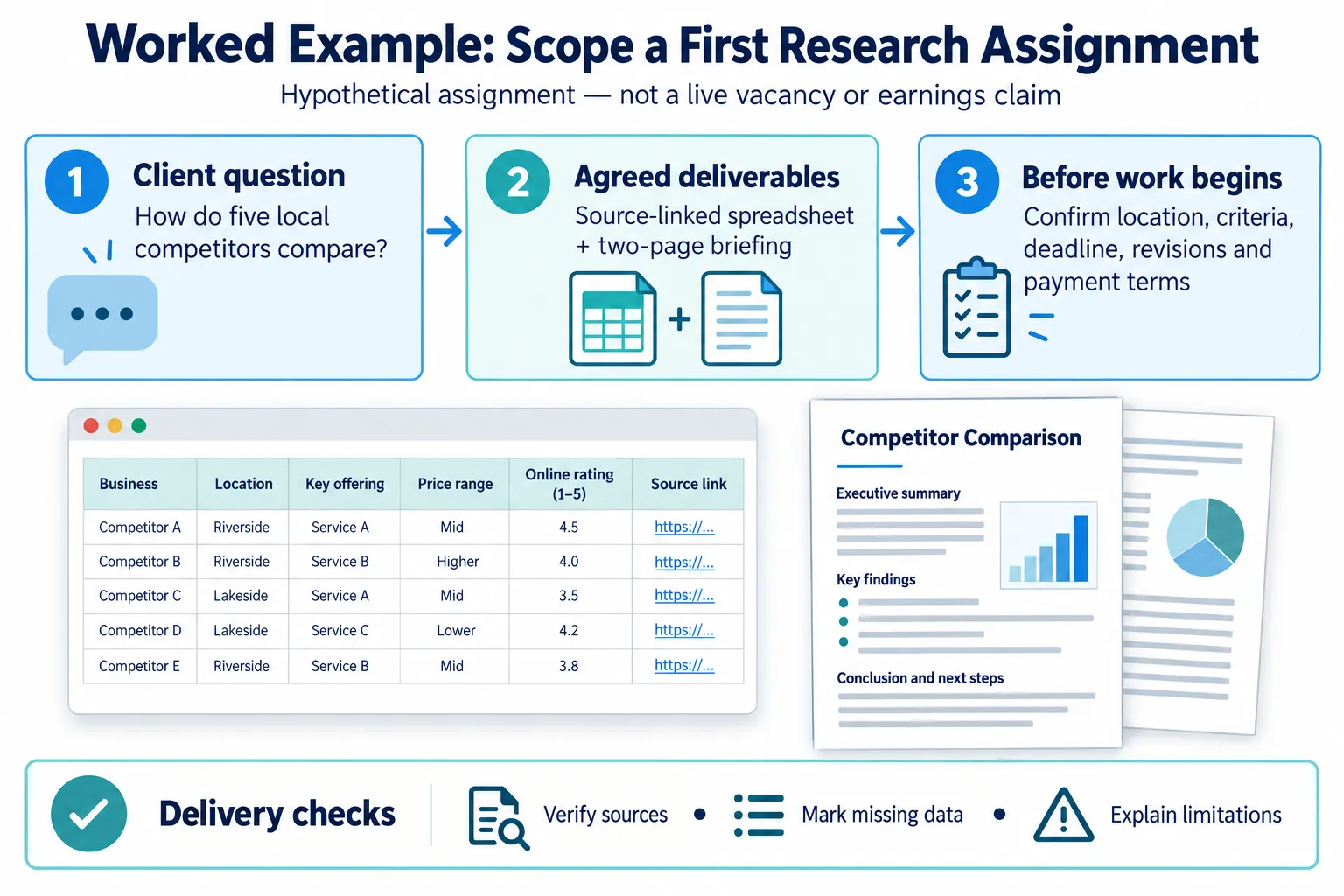
Define the deliverable before setting a price.
Create a clear professional profile
Describe the type of research you perform, the sources and methods you understand, and the final reports clients can expect.
You might use a headline such as:
Online Research Assistant | Market and Competitor Research | Source Verification
Avoid claiming expertise in specialized fields you have not studied.
Write targeted proposals
A proposal should demonstrate that you understand the client’s question.
Here is an example of a freelance market research proposal:
Hello,
I can help you prepare a structured competitor research report for your target market. I would review publicly available company information, compare the agreed criteria, and provide a spreadsheet with source references and a concise summary of findings.
Before starting, I would confirm the target geography, number of competitors, and required deadline so that the research scope is clear.
I can also share a relevant sample report for review.
Thank you for considering my proposal.
Approach potential clients directly
Small consulting companies, marketing agencies, publishers, startups, and professional service firms may need occasional research support.
Direct outreach should be specific and professional.
For example:
Subject: Research Support for Your Business Projects
Hello,
I provide online research support for competitor analysis, market information gathering, and source verification.
I would be happy to share a short sample of my research work and discuss whether your team needs assistance with an upcoming project.
Thank you for your consideration.
Direct outreach does not guarantee a response. It works best when the service is relevant to the organization’s actual needs.
Confirm the scope before beginning
For paid projects, clarify the research question, deliverables, source requirements, deadline, revision limits, confidentiality obligations, and payment terms.
For larger assignments, consider documented milestones.
After successful delivery, ask whether the client needs related research support. Repeat work can develop naturally when clients trust the quality and consistency of your findings.
Online Research Salaries and Freelance Rates in 2026
How much do online researchers earn? The answer depends on the occupation, country, employment arrangement, specialization, and complexity of the work.
A freelance internet researcher completing information collection tasks is not directly comparable to a salaried market research analyst who designs studies and interprets statistical evidence.
Verified US salary benchmarks
The US Bureau of Labor Statistics provides occupational wage data that can help researchers understand the broader employment market.
| Occupation | US median annual wage | Reference period |
|---|---|---|
| Market Research Analysts | $78,760 | May 2025 |
| Survey Researchers | $69,460 | May 2025 |
The Bureau of Labor Statistics also projects 7% employment growth for market research analysts from 2025 to 2035, while employment for survey researchers is projected to decline by 5% during the same period.
These figures describe US occupations, not freelance internet research rates or guaranteed earnings for remote workers.
Sources: BLS market analysts and BLS survey researchers. These are May 2025 employee medians published in the current handbook, not 2026 freelance rates.
What about freelance research rates?
Freelance compensation is less standardized than employee wages.
A researcher may charge hourly, agree on a fixed project fee, or receive payment for individual tasks.
The following distinctions are important:
| Type of work | How payment typically works | What to check |
|---|---|---|
| General internet research | Hourly or fixed project fee | Scope, time required, and revisions |
| Market or competitor research | Hourly, fixed-price, or milestone contract | Depth of analysis and deliverables |
| Specialized research consulting | Negotiated fee or consulting contract | Expertise, responsibility, and complexity |
| AI response evaluation | Project or task-based contractor payment | Eligibility, paid time, and task availability |
| Paid research participation | Payment per eligible completed study | Screening, availability, and withdrawal conditions |
AI evaluation providers may advertise higher rates for specialist assignments. DataAnnotation publishes role-specific advertised rates; these are not typical earnings for every applicant or guarantees of paid hours. When setting freelance prices, estimate the time required for research, verification, analysis, writing, and revisions. Also account for marketplace fees, unpaid administration, software costs, taxes, and the risk of project cancellations.
How to Avoid Online Research Job Scams
Remote research opportunities can be legitimate, but false recruitment offers and misleading task-based earning schemes are significant risks.
The US Federal Trade Commission warns about fake recruiters and task scams involving unexpected messages, unclear work, and demands to deposit money to unlock tasks or withdraw supposed earnings. See its task scam guidance and recruitment scam warning.
Warning signs to recognize
Be particularly cautious when:
- A recruiter contacts you unexpectedly with no clear job description.
- You are promised unusually high earnings for very little work.
- An employer requests payment before you can begin or receive your earnings.
- You are asked to deposit money to unlock additional tasks.
- A recruiter uses an email address or website that impersonates a legitimate company.
- You are pressured to disclose sensitive identity or banking information before the employer can be verified.
- You are asked to publish fake reviews, manipulate search rankings dishonestly, or access information without permission.
How to verify a research opportunity
Check the company’s official website and recruitment channels. Confirm that the recruiter is associated with the organization, and examine whether the proposed work has understandable responsibilities and payment conditions.
For freelance assignments, use appropriate contractual terms and payment protection where available.
For AI evaluation work, confirm that the opportunity appears on the provider’s genuine recruitment platform.
Do not treat positive reviews, professional-looking messages, or a recognizable company logo as sufficient proof of legitimacy.
A Practical 30-Day Plan to Start Finding Online Research Work
A structured month of preparation can help you establish a starting point without spending unnecessary time applying for unrelated positions.
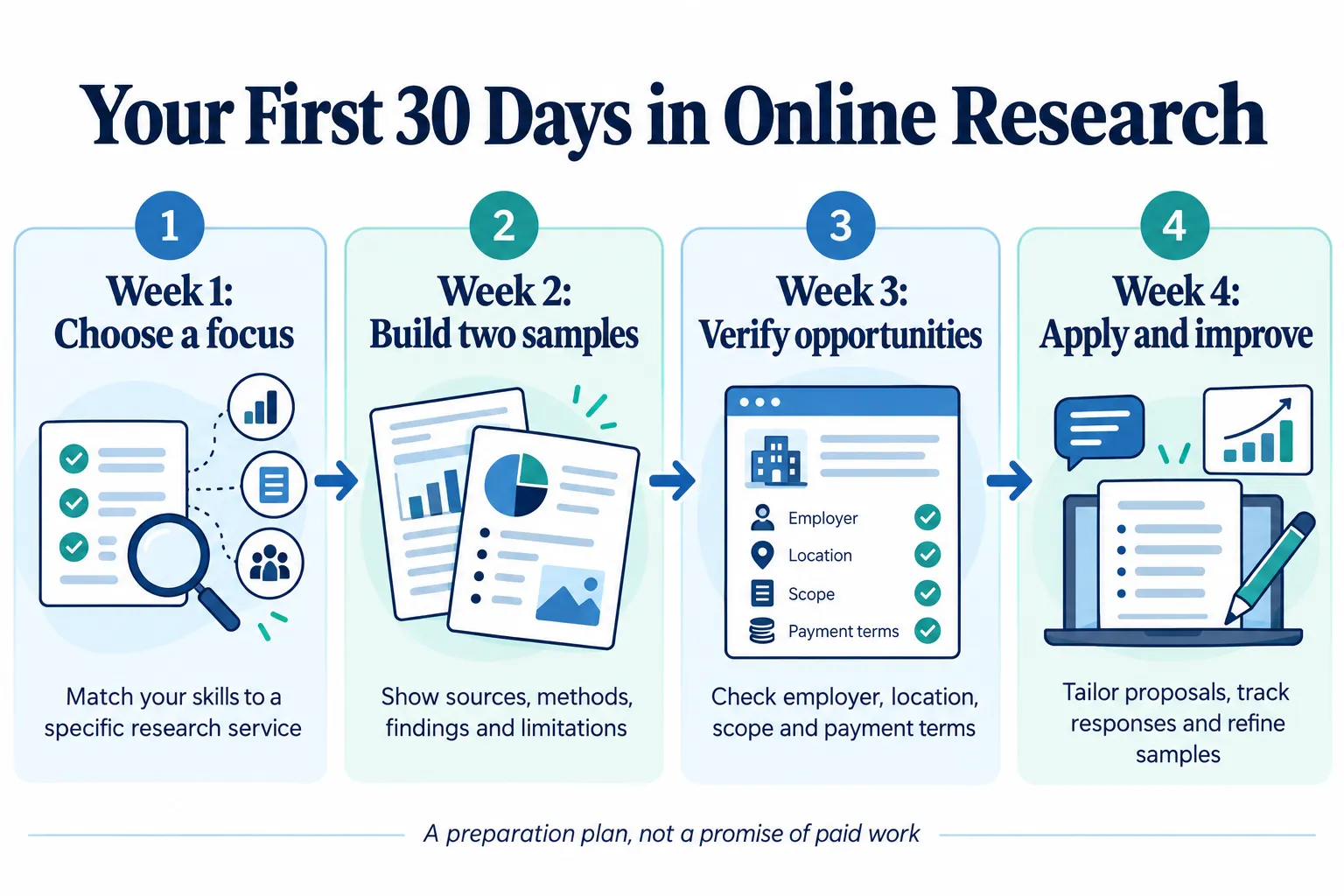
- Week 1: Choose your focus and assess your skillsSelect one or two research specializations. Review suitable job descriptions and identify the skills and tools you need to practice.
- Week 2: Prepare portfolio samplesComplete two original research projects using public sources. Show your methods, evidence, findings, and limitations.
- Week 3: Build profiles and identify opportunitiesPrepare your resume, freelance profile, and a reusable proposal structure. Create a shortlist of legitimate, relevant openings.
- Week 4: Apply, evaluate feedback, and improveSend tailored applications, contact suitable organizations, record responses, and refine your portfolio based on recurring requirements.
The goal is to create a repeatable job-search process, not to guarantee paid work within 30 days.
Frequently Asked Questions About Online Research Jobs
How can I start online research work with no experience?
Begin with tasks that match your existing abilities, such as source collection, basic competitor research, and information organization. Practice using reputable sources and spreadsheets, then create two or three independent portfolio samples. Apply to entry-level research assistant or freelance assignments with clearly defined deliverables. Specialized positions may require additional qualifications.
Where can I find legitimate online research jobs?
Look through established freelance marketplaces, remote job boards, university career portals, professional research organizations, and verified employer websites. Use several related job titles rather than searching only for “internet researcher.” Confirm each opportunity through the employer’s official channels before sharing sensitive information or accepting work.
Can I work as an online researcher from home?
Yes. Many research tasks can be completed remotely when the required information and tools are available online. However, some jobs require access to restricted databases, institutional systems, specialized equipment, or physical locations. A remote listing may also have country, time-zone, or work authorization restrictions.
What skills do I need to become an internet researcher?
Core skills include advanced searching, evaluating source reliability, organizing information, basic data handling, and communicating findings clearly. Familiarity with spreadsheets and citation practices is useful. More advanced positions may require statistical analysis, programming, research design, subject expertise, or specialized investigative methods.
How much can a freelance online researcher earn?
Freelance earnings vary by specialization, market, project requirements, and available work. There is no single reliable rate that applies to all online researchers. Evaluate a project’s expected hours, verification requirements, software costs, and revisions before setting a fee. Do not confuse advertised contractor rates with steady income or US occupational salary benchmarks.
Are AI research evaluator jobs legitimate?
Some legitimate companies offer contractor assignments involving AI response assessment, data annotation, and language evaluation. However, recruitment conditions and project availability vary. Fake recruiters may impersonate established providers. Apply through verified official channels, review payment terms, and avoid any opportunity requiring deposits to release earnings.
What is the difference between online research jobs and paid surveys?
Professional online researchers are paid to investigate questions, gather evidence, analyze information, or produce research deliverables. Paid survey participants provide responses or feedback for studies conducted by others. Participation platforms can offer occasional payments, but they are not equivalent to professional research employment.
Do I need a degree to become an online researcher?
Not every online research assignment requires a degree. General source collection, business research support, and some freelance tasks may be accessible to people with demonstrable skills. Academic, scientific, legal, healthcare, and advanced analytical positions can require formal education, professional qualifications, or specialized experience.
How can AI help me complete research assignments?
AI can assist with planning, organizing material, generating search terms, comparing documents, and preparing draft summaries. Researchers must still verify consequential claims, quotations, statistics, and citations against reliable sources. Sensitive client information should only be processed with appropriate authorization and privacy protections.
How do I avoid scams when applying for remote research jobs?
Verify the employer through its official website and recruitment channels. Be cautious of unexpected messages, unclear responsibilities, unrealistic pay promises, and requests for upfront payments. Read the contract and payment terms before beginning. Never pay to unlock assignments or withdraw supposed earnings.
Final Thoughts
Finding online research work in 2026 requires more than knowing how to search the web. Successful candidates need to identify suitable opportunities, demonstrate reliable methods, understand client requirements, and deliver findings that others can evaluate and use. For beginners, the most practical starting point is a narrow research service, a small evidence-based portfolio, and a focused search across legitimate employment and freelance platforms. As research tools evolve, technical efficiency will remain valuable, but so will human judgment, source verification, and the ability to communicate findings accurately.
Start with the work you can perform competently, document your methods, and develop additional expertise as your opportunities grow.
Related guides: independent research careers, market research prompts, and free research tools.