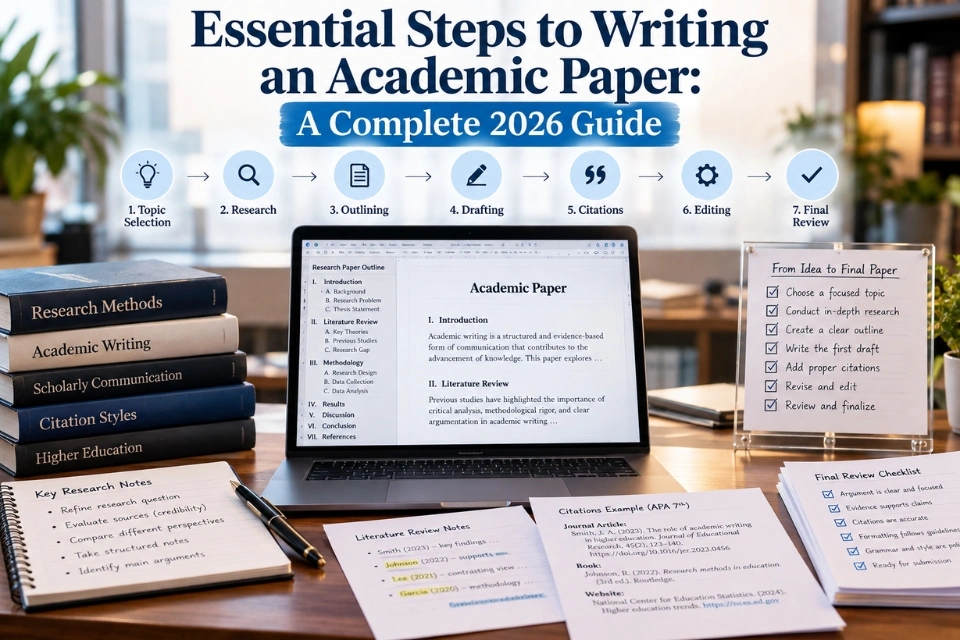
Quick Answer: The Essential Academic Writing Steps
Understand the assignment, narrow the topic, develop a research question, find and evaluate scholarly sources, organise evidence, formulate an argument, outline the paper, draft its sections, cite accurately, revise and check submission requirements. The process is iterative: evidence may change your question or conclusion. AI can assist where permitted, but the researcher remains responsible for accuracy and academic integrity.
A credible academic paper does more than collect information in formal language. It explains what question is being examined, how evidence was obtained, what that evidence supports and where uncertainty remains. This guide takes students and early-career researchers from planning to submission.
Choose the Right Paper Structure
An academic essay defends an argument; a literature review synthesises existing scholarship; an empirical article reports original research. Their structures differ. Follow the assignment or journal instructions rather than treating one template as universal. Many empirical papers use Introduction, Methods, Results and Discussion, commonly abbreviated as IMRaD.
| Paper type | Purpose | Typical organisation |
|---|---|---|
| Academic essay | Defend an interpretation or argument | Introduction, analysis, conclusion |
| Literature review | Compare and synthesise research | Scope, themes, critical synthesis, gaps |
| Empirical article | Report an original investigation | Introduction, Methods, Results, Discussion |
| Systematic review | Synthesise studies using predefined methods | Methods, search and selection, synthesis, discussion |
Steps 1–3: Define the Task, Topic and Question
1. Understand the Assignment
Identify the central task, audience, word limit, citation style and deadline. “Analyse” requires examining relationships; “evaluate” requires judging strengths and weaknesses. For a journal manuscript, check author instructions, reporting requirements and declarations before drafting.
2. Narrow the Topic
Choose a specific, researchable problem suited to your time and resources. “AI in education” is broad; “generative AI and undergraduate source-evaluation skills” is more manageable. Originality can come from comparing evidence or examining a familiar problem in a new context.
3. Develop a Research Question
A question sets the evidence and methods your paper needs. An illustrative example is: “How does guided generative AI use influence first-year undergraduates’ ability to evaluate academic sources?” It identifies an activity, population and outcome without assuming a positive result.
Test the question through preliminary searching. Is enough relevant evidence available? Can you investigate it within the assignment? Not every paper needs a hypothesis: exploratory, qualitative and humanities work may use questions or analytical propositions instead. Revise the scope when the evidence demands it.
Steps 4–6: Find, Evaluate and Organise Evidence
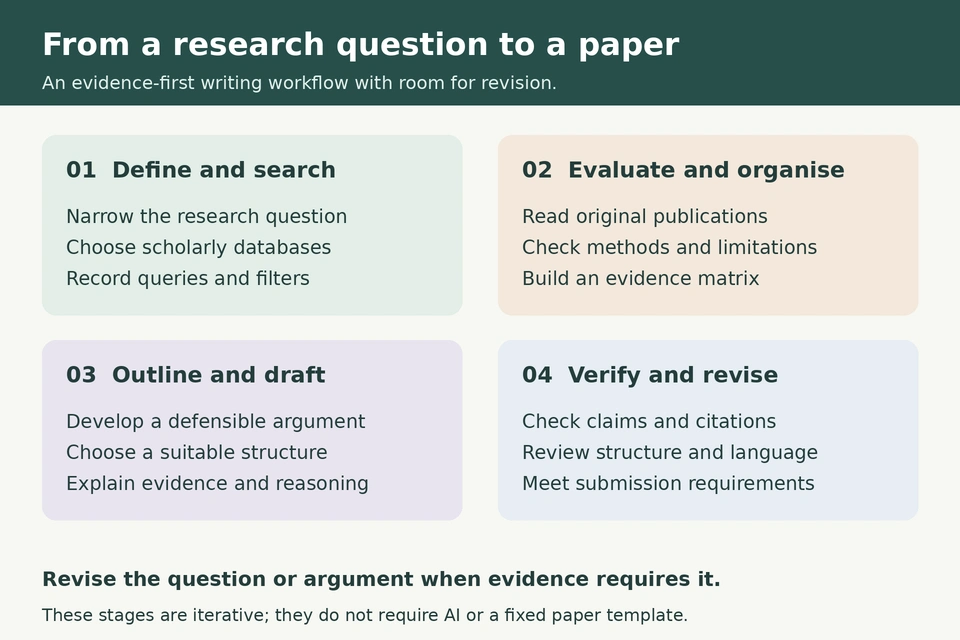
4. Search Scholarly Sources Systematically
Choose databases appropriate to your discipline. Google Scholar offers broad discovery, PubMed focuses on biomedical literature, and repositories can provide accessible versions. Search results may include preprints, theses and reports as well as journal articles: inclusion does not establish peer review or quality.
AOFIRS’ comparison of academic search engines, scholarly databases and AI research tools helps distinguish discovery platforms from citation indexes and repositories. For Google Scholar’s coverage, consult its official overview.
Build searches from concepts and alternative terms. Where supported, OR combines alternatives and AND combines concepts. The following is an illustrative expression; adapt it to your database:
("generative AI" OR "large language models")
AND ("information literacy" OR "source evaluation")
AND (undergraduates OR "higher education")
The AOFIRS guide to high-precision Boolean searching explains query construction and platform differences. Record databases, exact expressions, filters and search dates. Review results before adding exclusions, since NOT can remove useful evidence.
5. Evaluate Credibility and Relevance
Read original publications where possible. Examine author expertise, publication status, methods, data, limitations and relevance to your population or context. Check for corrections and retractions. A newer paper is not automatically stronger than an older foundational study, and peer review does not eliminate the need for critical reading.
Primary sources contain original evidence; secondary sources interpret existing work. Both matter, but trace important findings to their origin. AOFIRS’ guide to verifying online information adds methods for assessing digital provenance and credibility.
6. Create an Evidence Matrix
Record each source’s citation, question, methods, findings, limitations and relevance. Keep quotations separate from paraphrases and your own interpretation. The illustrative matrix below contains extraction prompts, not invented research findings.
| Source | Extract | Evaluate | Use in the paper |
|---|---|---|---|
| Study A | Participants, search tasks, outcomes | Population and measurement limits | Evidence on discovery practices |
| Study B | Source-evaluation procedures | Design and observation period | Comparison of research judgement |
| Study C | Citation errors and verification method | Tool versions and sampling | Limits of AI-assisted referencing |
Organise your review around themes and disagreements rather than successive summaries. Ask why findings differ: participants, definitions, measures or learning conditions may explain variation. An evidence matrix makes those comparisons visible before drafting.
Steps 7–8: Form an Argument and Outline
7. Develop a Thesis or Hypothesis
A research question identifies what you investigate; a thesis states the argument you defend. “AI is useful for students” is vague. A more focused, illustrative position is: “Guided AI use may support research skills when source evaluation, citation verification and independent analysis are explicitly taught.” This example is not an established finding.
Revise the thesis if the evidence does not support it. Do not select only convenient studies or turn an association into a causal claim. For empirical work, an objective or testable hypothesis may be more appropriate than an argumentative thesis.
8. Plan the Paper’s Structure
Arrange sections around the question and supporting evidence. An analytical paper might move through the research problem, literature review, conceptual framework, analysis, implications and conclusion. Check that each section has a purpose and that important counterarguments have a place.
For health research, the EQUATOR Network’s reporting guidance identifies study-specific requirements. A reporting checklist supports transparent reporting; it does not substitute for a suitable research design.
Steps 9–12: Draft the Main Sections
9. Write a Focused Introduction
Move from relevant context to the specific problem, question and contribution. Explain why the question matters and what the paper will examine. Cite factual background and avoid sweeping openings such as claims that a technology has transformed every discipline. Write the abstract after the main argument is stable, where one is required.
10. Build a Critical Literature Review
Synthesise research thematically, methodologically, chronologically or theoretically. Compare findings, explain disagreement and identify gaps. If two studies reach different conclusions, examine their methods before choosing between them. Treat uncertainty as information rather than concealing it to make the narrative sound stronger.
11. Explain Methods Where Applicable
For original investigations, describe data sources or participant selection, procedures, instruments and analysis sufficiently for readers to assess the work. Qualitative methods explore experiences or meanings; quantitative methods examine numerical patterns; mixed methods integrate both. Explain relevant consent, ethics and privacy safeguards.
For systematic reviews, report searches, eligibility criteria, screening and synthesis methods. A short narrative review should not be described as systematic unless its methods justify that label. Match the reporting detail to the study and publication requirements.
12. Present Evidence and Develop the Argument
A useful paragraph moves through a point, evidence, explanation and connection to the wider argument. Explain what a finding supports and what it cannot establish. In empirical papers, Results report observations; Discussion interprets them, considers alternatives and acknowledges limitations.
Label tables and figures, explain units and identify data sources. Do not invent statistics or claim significance without analysis. Avoid repeating every table entry in prose; highlight the pattern relevant to the question.
Steps 13–15: Cite, Revise and Submit
13. Check Citations and References
Attribute borrowed ideas, findings, quotations and paraphrases. Replacing a few words does not remove attribution requirements. Follow the assigned style: APA commonly uses author–year citations; MLA uses author and location; Chicago offers notes/bibliography or author–date; IEEE uses numbered references.
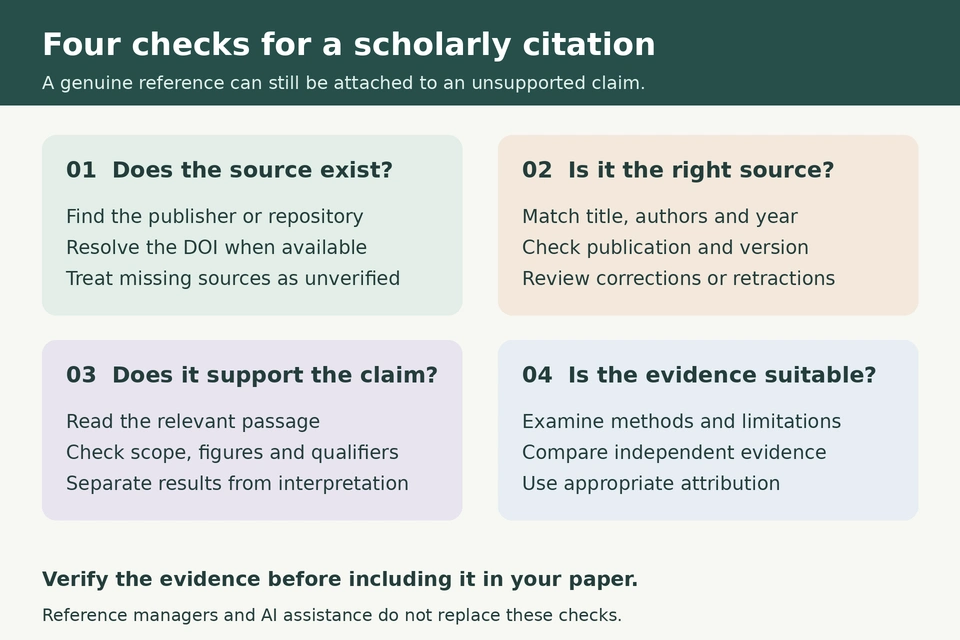
Consult the official APA reference examples when APA is required. Reference managers can organise records, but imported metadata needs checking. Match authors, title, year, publication and DOI; confirm that every citation points to the intended source and supports its attached claim.
14. Revise in Three Passes
First review structure: does the paper answer its question, and does the argument progress logically? Second verify evidence and language: check claims, citations and qualifications, remove repetition and clarify ambiguous sentences. Third proofread references, headings, captions, spelling and formatting. A second reader can identify assumptions you overlooked.
15. Complete the Submission Review
Check word count, file format, layout, references and required supplementary material. Journal manuscripts may require funding, conflicts, ethics, authorship and data-availability statements. Ensure the title, abstract, findings and conclusion are consistent. Limitations acknowledged in the discussion must not disappear from the summary.
Use AI Responsibly in Academic Writing
Where permitted, AI may help generate search terms, organise researcher-provided notes, suggest outlines or improve clarity. Check all output against original evidence. The AOFIRS learning publication on integrating traditional research with generative AI explains how verification and human expertise fit into that workflow.
Verify every suggested reference: establish existence, match identity, open the source and test claim support. AOFIRS’ AI-answer and citation verification guide covers these checks, while its report on verification debt in online research explains why unresolved checks accumulate.
Follow course and journal policies and disclose assistance when required. ICMJE’s AI publishing guidance emphasises human accountability and transparency and excludes AI tools from authorship. Protect confidential records and unpublished material; use only authorised systems and permitted workflows.
Common Mistakes to Correct Before Submission
A paper can contain many references yet remain weak if the sources are merely listed. Replace publication-by-publication summaries with comparisons organised around your question. Explain whether apparent disagreements arise from different populations, definitions or methods. Do not assume that several summaries of one study provide independent corroboration.
Another frequent mistake is strengthening evidence during paraphrasing. If a source reports a possible association in one setting, preserve those qualifications instead of presenting a universal causal conclusion. Check that the abstract and conclusion retain the same boundaries as the main analysis.
In a hypothetical paper about student research skills, distinguish finding sources quickly from evaluating them accurately. Those are different outcomes. A tool that improves discovery does not, by itself, demonstrate better judgement. Your evidence matrix should record what each study actually measured, and your argument should address that outcome rather than a more attractive substitute.
Finally, keep a record of sources you could not retrieve. An abstract or AI summary may suggest relevance, but it cannot replace checking a consequential detail in the original paper. State any unresolved evidence limits rather than concealing them behind confident wording.
A Practical Writing Schedule and Final Check
For a short literature-based assignment, an illustrative two-week plan allocates days 1–2 to scope, 3–4 to searching, 5–6 to evaluation and outlining, 7–9 to drafting, 10–11 to argument and citation review, and 12–14 to formatting, proofreading and submission. Original studies and systematic reviews need substantially longer.
Before submission, confirm a clear question, relevant evidence, analytical synthesis, appropriate methods, acknowledged limitations, accurate attribution and verified references. Check AI-policy compliance and required files. Structural revision comes before cosmetic editing: correct grammar cannot rescue an unsupported argument.
Frequently Asked Questions
How should I start an academic paper?
Clarify the task, conduct preliminary searching, narrow the topic and develop a researchable question before committing to a conclusion.
Is IMRaD required for every paper?
No. It is common in empirical research, but discipline, paper type and publication instructions determine the appropriate structure.
How many references do I need?
There is no universal number. Follow the brief and include enough relevant, critically assessed evidence to support the scope.
How does a thesis differ from a question?
A question defines the investigation; a thesis expresses the argument. Some papers use both, while others prioritise objectives or hypotheses.
What makes a literature review analytical?
It compares studies, methods and limitations, explains disagreement and connects the evidence to the research question.
Does paraphrasing avoid plagiarism?
Paraphrasing still needs attribution. Develop your own analysis and distinguish it clearly from borrowed ideas and quotations.
Can I use AI assistance?
Only within applicable rules. Verify its output, disclose use where required and retain responsibility for the submitted work.
How long does writing take?
A short assignment may take days or weeks; original research can take months. Reserve time for verification and revision.
Conclusion
Academic writing is disciplined inquiry: define a meaningful question, find and evaluate evidence, develop an original argument and explain its limits. Accurate citations let readers inspect the foundations of that argument.
Digital tools can support discovery and organisation, but they do not replace scholarly judgement. A clear structure, critical synthesis and careful revision turn a collection of sources into a defensible paper.