Artificial intelligence is changing online research by transforming how information is searched, retrieved, summarized, and evaluated. Instead of relying exclusively on lists of website links, researchers can ask complex questions, analyze different types of content, and receive AI-generated explanations supported by selected sources.
These capabilities make information discovery easier, but they also raise issues around accuracy, attribution, bias, and researcher independence.
Finding an answer is becoming easier, while establishing whether that answer deserves trust remains a separate responsibility. In 2026, effective research requires understanding how AI systems produce answers, recognizing their limitations and verifying important findings against original evidence.
How Is AI Changing the Way We Search for Information?
AI-powered search allows users to explore information through natural-language questions, conversational follow-ups, and automatically generated summaries. It reduces the need to translate every research question into a short keyword query.
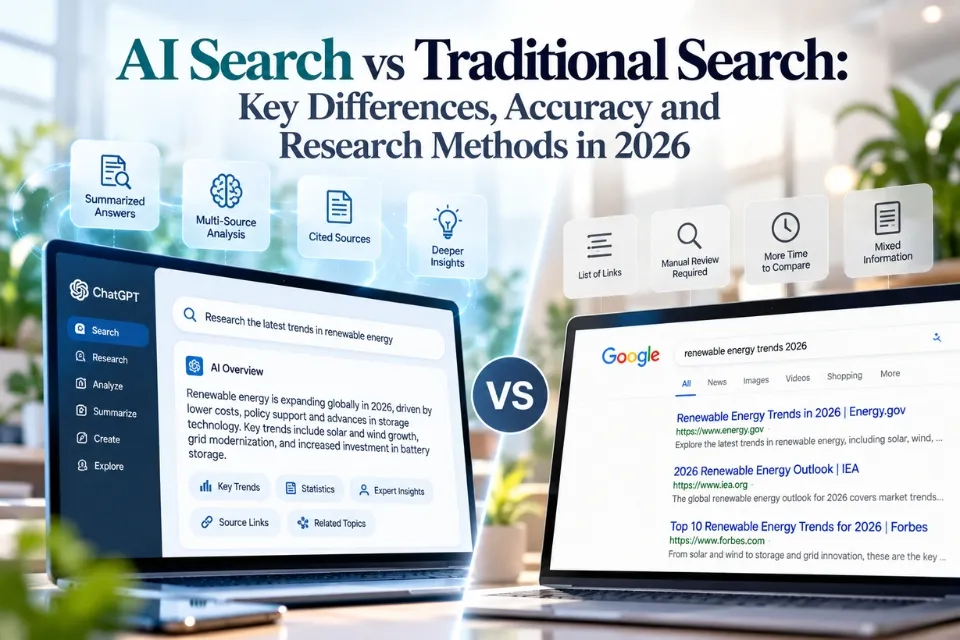
Traditional search engines primarily retrieve and rank relevant documents. AI-enhanced services can also combine information from retrieved sources into a new response.
For example, a conventional search for renewable energy adoption in Europe might return government reports, academic papers, and statistical databases. An AI research assistant may instead organize the topic into major trends, propose comparisons and identify potential references.
The difference matters: a generated explanation is not the same thing as the evidence supporting it.
From keywords to conversational research
Natural-language interfaces allow researchers to ask detailed questions and refine them progressively.
A researcher might begin with:
How have European renewable energy policies changed since 2020?
They can then ask the system to distinguish regulations from voluntary targets, identify country-level differences, or suggest original statistical sources.
This approach can accelerate initial exploration. However, search engines already supported conversational and semantic matching before generative AI became widespread. The improvement is not the invention of natural-language search but the integration of interactive synthesis and retrieval into the research experience.
Retrieval-augmented generation
Many AI research systems use forms of retrieval-augmented generation (RAG), which combine language-model generation with information retrieved from external documents or search indexes. See the foundational RAG paper.
Retrieval can improve factual grounding and access to recent information. It does not guarantee correctness.
A system may retrieve a reliable report but misunderstand a qualification, combine incompatible statistics, or attribute a conclusion to the wrong source.
For researchers, the safest distinction is simple: retrieved sources provide material for examination; AI-generated answers provide interpretations that still require checking.
Traditional Search vs AI-Powered Research
Neither traditional search nor AI-powered search is universally better. Each supports different stages of an investigation.
| Research feature | Traditional search | AI-powered search |
|---|---|---|
| Query method | Keywords, operators, and natural language | Conversational prompts and follow-ups |
| Main output | Ranked documents and information results | Generated responses, often with source links |
| Source evaluation | User examines retrieved pages | User must inspect sources behind synthesis |
| Complex questions | Often requires several searches | May organize multiple subquestions |
| Citation reliability | Depends on the retrieved documents | Generated citations require validation |
| Multimodal inputs | Supported by some established search tools | Often integrated into conversational workflows |
| Reproducibility | Results can vary by time and context | Responses may also vary between generations |
| Best use | Locating original evidence | Exploration, comparison and preliminary synthesis |
The most dependable approach is to combine both methods.
Use AI to identify useful research directions. Use search engines, academic databases, official repositories, and primary records to establish what the evidence actually shows.
For a broader methodology, use the AI research guide.
Google AI Overviews, AI Mode, and Multimodal Search in 2026
Google AI Overviews and AI Mode illustrate how search is moving toward integrated retrieval and explanation.
AI Overviews provide AI-generated summaries for selected queries. AI Mode supports more exploratory interactions, including complex questions, comparisons, and follow-up inquiries.
Google explains that these systems may conduct multiple related searches across subtopics, a technique it describes as query fan-out. The results are then used to assemble responses with supporting links. See Google AI features.
What changed in October 2026?
On October 15, 2026, Google announced additional changes intended to make original websites easier to discover from its AI search experiences. See the October source-link update.
These included more prominent inline links within generated responses, plans to highlight useful official websites, and improved presentation of news and creator information.
The announcement is important because source visibility has become a central concern in AI-powered search. However, newly announced tests should not be confused with universally available features, and improved link presentation does not prove that publisher traffic will recover.
What is multimodal search?
Multimodal search uses more than one type of information input or representation, including text, images, audio, and video.
A researcher might photograph an unfamiliar object, submit an audio question, or use an AI-supported application to analyze a document.
These capabilities are useful when the research question cannot easily be expressed through keywords alone.
However, supported file types, video analysis, document processing, and input combinations vary between services.
An image-based answer can also be wrong. Visual similarity does not establish an object’s identity, origin or authenticity.
The appropriate method is to treat multimodal results as potential leads and confirm important identifications using specialized references.
What AI Search Means for Information Accuracy and Trust
AI-generated answers can sound authoritative even when their factual foundations are weak. This creates a risk that researchers will mistake fluent language for verified knowledge.
Hallucinations and misleading synthesis
An AI hallucination occurs when a system generates inaccurate or unsupported information.
Errors may involve invented references, incorrect dates, distorted quotations or conclusions that go beyond the available evidence.
For example, a well-documented 2024 failure involved Google’s AI Overviews producing an inappropriate suggestion about adding glue to pizza, drawing attention to how unreliable or satirical material can contaminate generated answers. Google acknowledged this in its May 2024 update.
The incident illustrates a broader research problem. A system may reproduce information without adequately recognizing its context, reliability, or intended meaning.
Source provenance and citation verification
Source provenance means identifying where information originated and tracing how it reached the current research output.
An AI-generated response may cite a news article that summarizes a study. The news article may itself rely on a press release rather than the study’s complete findings.
If the researcher treats these as independent confirmations, one original claim can appear more strongly supported than it actually is.
For important statements, researchers should inspect the original publication, author, date, methodology, and relevant passage.
Why lateral reading matters
Lateral reading means leaving a webpage or generated response to investigate its sources and reputation through independent material. See the researchers’ lateral reading study.
Instead of judging credibility solely from professional design or confident wording, researchers examine what reliable external sources say about the organization, author or claim.
This method is especially important when AI systems present unfamiliar sources without sufficient background.
Use the verification guide to investigate generated claims and trace their sources.
The Impact of AI Search on Publishers and the Open Web
AI-generated summaries can change whether users visit the websites that originally published information. This creates economic and attribution challenges for publishers, particularly those dependent on advertising, subscriptions, and search referrals.
What does the evidence show?
A Pew Research Center analysis published on July 22, 2025, examined Google search behavior using March 2025 browsing data from 900 U.S. adults. Read the Pew study.
| Observed share of visits | Behavior in the study |
|---|---|
| 8% | Clicked a traditional result when an AI summary appeared |
| 15% | Clicked a traditional result without an AI summary |
| 1% | Clicked a citation within an AI summary |
Observed shares of visits in Pew’s study, not universal click-through rates.
The findings support concerns about reduced external clicking when AI summaries appear. However, the observational study does not establish that AI summaries alone caused every difference. Search intent, question complexity, and other factors may also affect behavior.
Does AI search mean the end of traditional websites?
No. The decline of all conventional search traffic is not an established outcome.
The original AOFIRS article discusses the Google Zero scenario, a projection in which AI responses substantially reduce visits to independent websites. This remains a useful way to examine potential risks, but it should not be treated as a confirmed future.
Publishers still supply original investigations, specialist expertise, datasets, reporting and analysis that search systems rely upon.
The practical challenge is maintaining an accessible, economically sustainable ecosystem for producing that information.
For website owners, Google’s guidance continues to emphasize original content, crawlability, clear page structure, and existing SEO principles rather than a separate technical system for AI search. See Google AI guidance.
Agentic AI: When Search Systems Begin Taking Actions
Agentic AI extends beyond generating answers. Depending on the product and permissions, an AI agent can use tools, conduct multi-step investigations, monitor information, and sometimes perform actions on a user’s behalf.
For research, this may involve gathering documents, comparing datasets, or preparing a structured report.
However, there is an important distinction between an assistant that recommends an action and an agent authorized to execute it.
A research assistant might suggest contacting a source. A tool-connected agent might be able to prepare or send the email if the appropriate access and authorization are provided.
Three risks researchers should understand
Limited transparency: An agent’s final answer may not reveal every search, excluded source or intermediate decision.
Automation bias: Researchers may accept results simply because the system completed several steps independently.
Access and privacy: Connected systems may process confidential documents or interact with external services.
Researchers should define the permitted scope, review available activity records, and retain human approval for consequential actions.
A useful principle is to delegate repetitive information-gathering tasks while retaining responsibility for source selection, interpretation, and final decisions.
The SMART-M Framework for Responsible AI Research
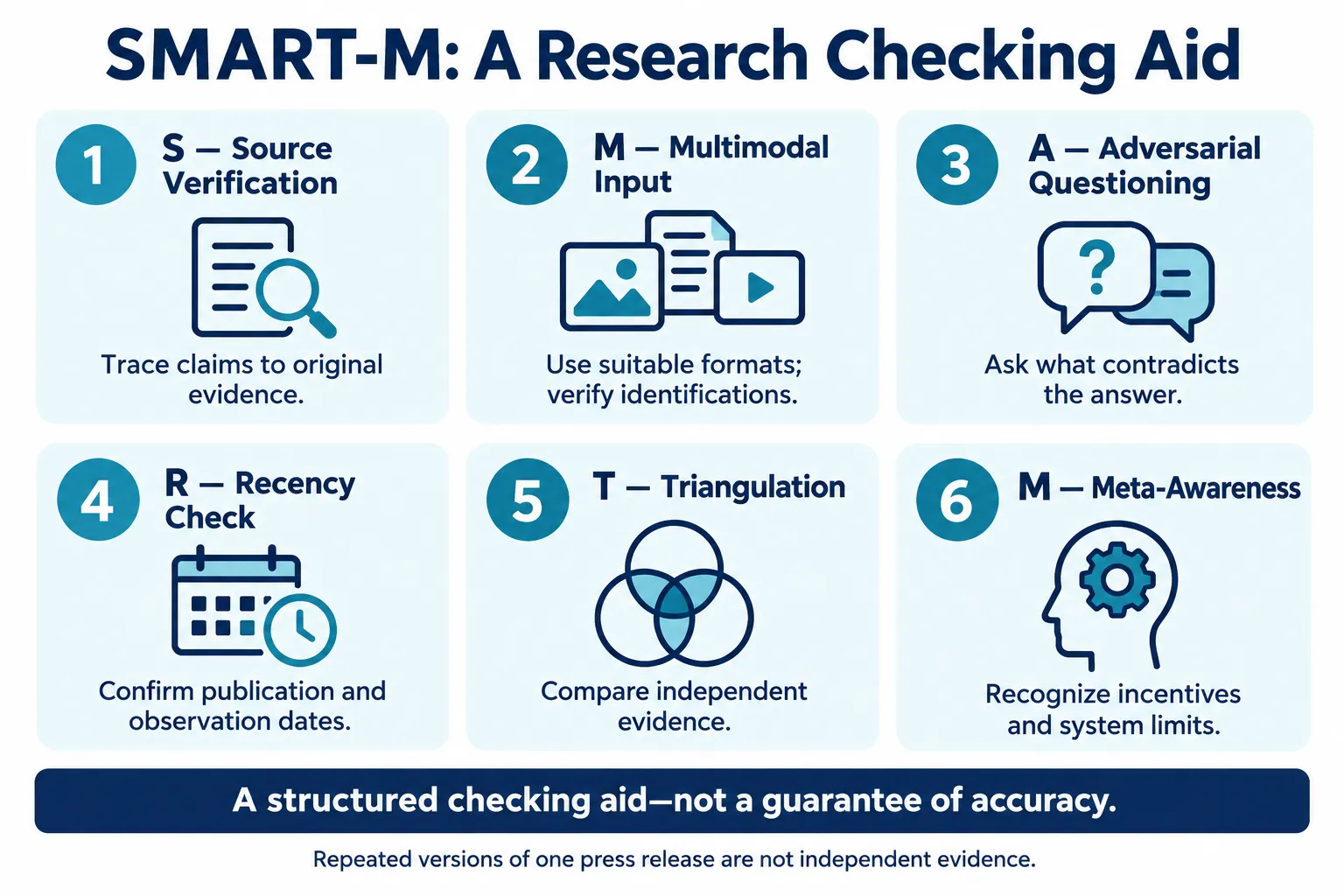
The original AOFIRS article introduces SMART-M, a six-principle framework for using AI-powered search critically rather than passively.
| Principle | What it means | Practical application |
|---|---|---|
| Source Verification | Trace claims to their original evidence. | Open the cited study and check its findings. |
| Multimodal Input | Use suitable text, image, audio, or file inputs. | Compare a photograph with an authoritative visual reference. |
| Adversarial Questioning | Challenge the answer and its assumptions. | Ask what evidence contradicts the proposed conclusion. |
| Recency Check | Establish when information was published or updated. | Check current official records rather than relying on an old summary. |
| Triangulation | Compare independent sources. | Seek several independent sources for consequential claims. |
| Meta-Awareness | Recognize incentives and system limitations. | Distinguish sponsored recommendations from independently assessed evidence. |
SMART-M should be used as a structured checking aid, not a guarantee of accuracy.
Triangulation requires particular care. Three websites repeating the same press release do not constitute three independent sources. Conversely, one authoritative primary document may establish a narrow fact more directly than several secondary accounts.
The purpose is to improve research judgment, not merely increase the number of citations.
A Practical Workflow for Reliable AI-Assisted Online Research
A dependable research process combines efficient discovery with independently checked evidence.
- Define the question. Specify the topic, geographic scope, period, and expected output.
- Choose appropriate tools. Match the task to conventional search, academic databases, specialized repositories, or AI assistants.
- Explore research directions. Use AI to identify terminology, possible evidence, and questions requiring investigation.
- Retrieve original materials. Find official documents, datasets, research papers, and primary records.
- Verify and compare. Confirm figures, dates, definitions, and conclusions against independent evidence.
- Document the findings. Record references, methods, limitations, and any AI assistance used.
A Prompt for Evidence-Based Research
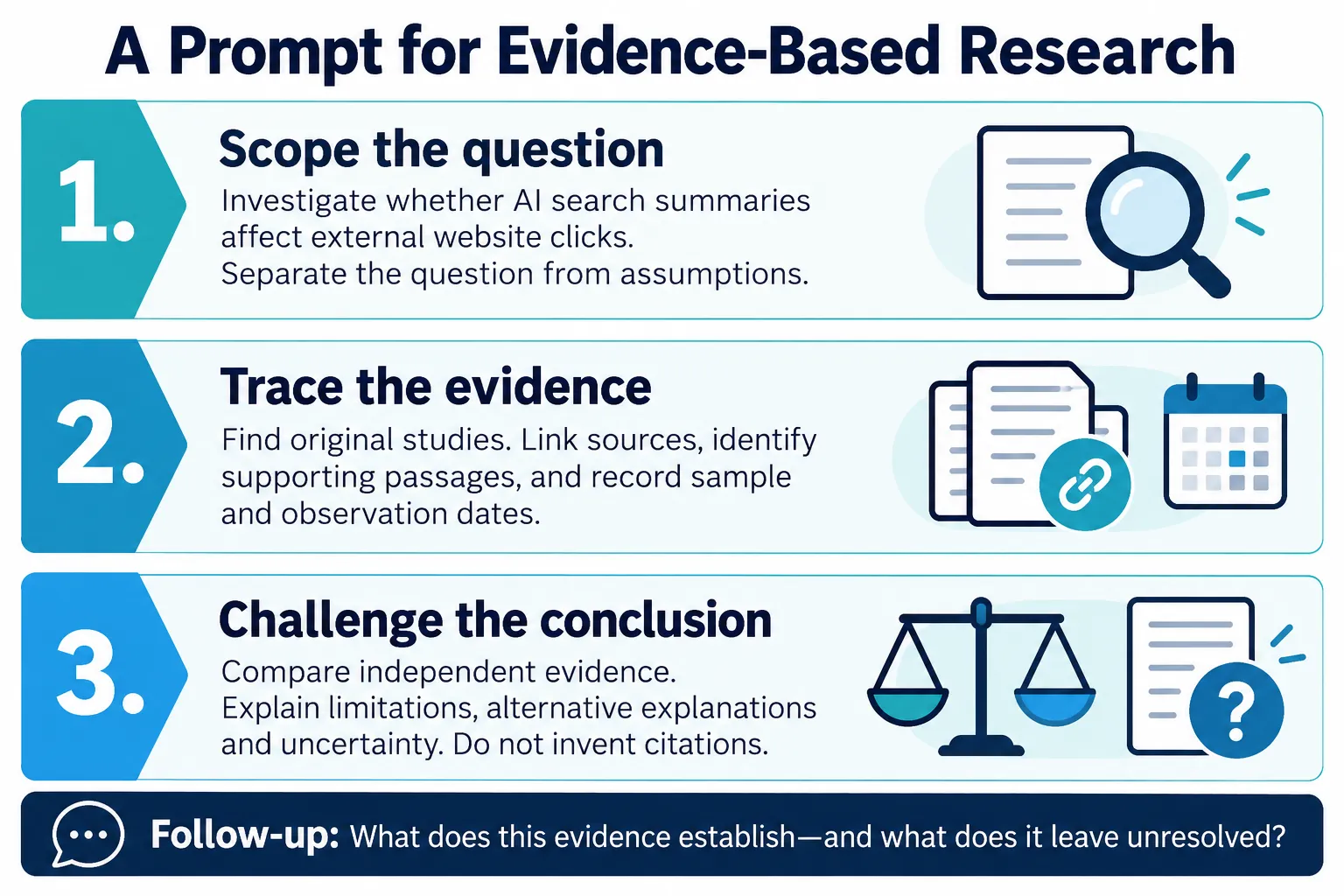
Investigate whether AI search summaries affect external website clicks. Separate the question from assumptions. Find original studies, link sources and identify the passages supporting each finding. Record the sample, observation dates and methods. Compare independent evidence, explain limitations and alternative explanations, and flag uncertainty. Do not invent citations.
Follow-up: What does this evidence establish, and what does it leave unresolved? Verify every important claim in the source before using the answer.
Worked example: Investigating AI’s influence on search clicks
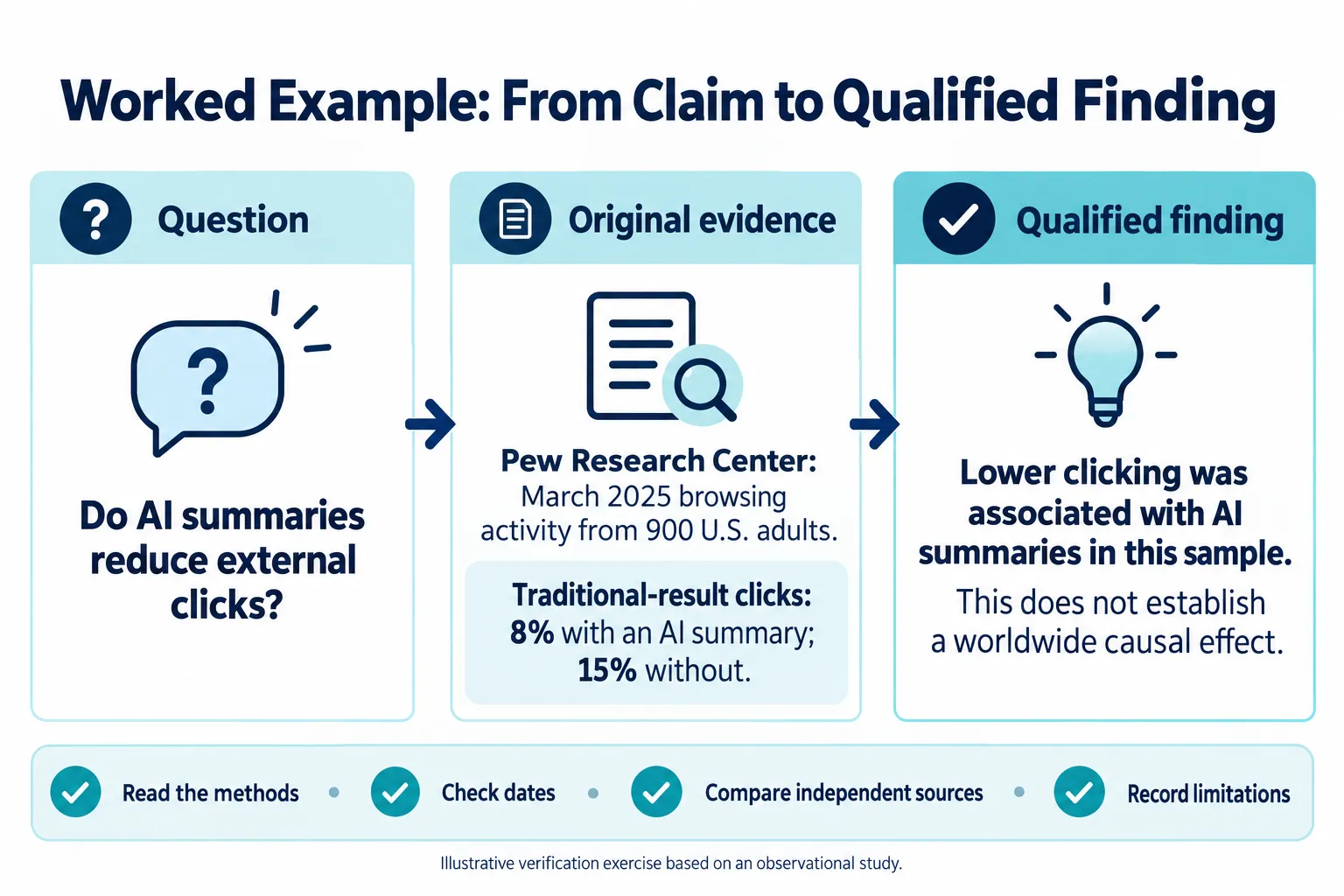
Suppose a research analyst asks an AI assistant:
Do AI-generated summaries reduce clicks to external websites?
The system might answer yes, citing research about Google AI Overviews.
A responsible investigation would proceed further.
First, identify the underlying study. The researcher locates Pew Research Center’s July 2025 analysis and reads its methodology.
Second, inspect the evidence. The study reports that traditional-result clicks occurred in 8% of observed search visits with an AI summary, compared with 15% without one.
Third, examine limitations. The data concerned US adults, a particular observation period, and a specific search environment. The findings should not automatically be applied to every market, query, or search engine.
Fourth, form a qualified conclusion. The evidence shows an association between AI summaries and lower external clicking in the studied sample. It does not, by itself, establish the worldwide effect of AI search or prove causation for every observed difference.
This distinction transforms a convenient AI-generated response into a defensible research finding.
For broader context on evidence and accountability, explore the AI search outlook.
Essential Research Skills for the AI Search Era
As AI tools become more capable, professional research increasingly depends on the ability to evaluate their outputs.
Several established skills remain particularly important:
- Advanced search literacy: Knowing when to use search operators, specialist databases, and original records.
- Critical source evaluation: Assessing authorship, expertise, methodology, context, and evidence quality.
- Lateral reading: Investigating claims and source reputations outside the material initially presented.
- Data interpretation: Understanding statistical comparisons, sampling limitations, and uncertainty.
- Research documentation: Recording source origins, retrieval dates, and methods.
- AI literacy: Recognizing what an AI system has retrieved, inferred, or generated.
For students, these skills support more defensible academic work. For journalists, they protect attribution and reporting accuracy. For librarians and information specialists, they inform the teaching of digital literacy.
The most useful change in researcher behavior is to stop treating AI output as the finished product. Instead, it should become one component within a documented research process.
Frequently Asked Questions
1. How is AI changing online research?
AI is making information discovery more conversational and introducing automated synthesis, multimodal inputs, and research assistance. Researchers can explore topics more quickly, but they must still evaluate the evidence supporting generated answers.
2. Is AI search replacing traditional search engines?
No. Traditional search remains useful for locating documents, websites, and original records. AI-enhanced search adds another way to explore and summarize information. Many modern services combine both approaches.
3. Can AI-generated search answers be trusted?
They can be useful, but accuracy should not be assumed. Important claims need to be verified against original, credible, and appropriately dated sources.
4. How do Google AI Overviews affect research?
They provide initial explanations and links for selected searches. Researchers should inspect supporting material because an AI-generated summary may omit context, misunderstand a source, or contain inaccuracies.
5. What is multimodal search?
Multimodal search uses information from formats such as text, images, audio, or video. It can help researchers investigate questions that are difficult to express through typed keywords alone.
6. What are the risks of agentic AI research?
Risks include incorrect automated decisions, inaccessible intermediate reasoning, privacy exposure, and excessive reliance on recommendations. Clear permissions, documentation, and human review help manage these risks.
7. How can researchers verify AI-generated information?
They should locate the original source, check the relevant passage, confirm dates and context, examine the methodology, and compare independent evidence where necessary.
8. Which research skills matter most in 2026?
Advanced searching, source evaluation, lateral reading, data interpretation, research documentation, and AI literacy remain essential. The ability to distinguish evidence from generated interpretation is especially important.
Conclusion: AI Changes Research, but Verification Remains Essential
AI-powered search offers genuine advantages. It can simplify complex questions, improve exploratory research, and make different forms of information more accessible. Yet the responsibilities of professional research have not disappeared. Sources must still be identified. Claims must still be checked. Uncertainty must still be acknowledged. Conclusions must still reflect the evidence rather than the confidence of an AI-generated response.
The future of online research is therefore not simply a competition between humans and machines. It is a question of how researchers combine technological assistance with sound methodology and independent judgment. AI can help researchers find information more efficiently. The researcher’s responsibility is to establish what that information actually proves.