Generative search changes what it means to be “found”. A traditional search engine returns a ranked list of links. A generative engine, such as ChatGPT search, Perplexity, Google’s AI Overviews and AI Mode, Gemini or Claude with web search, writes an answer and attaches a handful of sources to it. Generative Engine Optimization (GEO) is the name researchers gave to the practice of making content more likely to be used and cited in those answers (Aggarwal et al., 2024). Large Language Model Optimization (LLMO) is a common synonym.
This article explains how generative engines retrieve and choose sources, what the published research says about which content gets cited, and what that means for two groups: publishers who want their work represented accurately, and researchers who need to judge whether an AI answer rests on good evidence. For the wider comparison of AI and traditional search, see our search comparison guide. For a step-by-step method of checking AI answers, see our AI verification guide.
From Rankings to Citations
The clearest evidence of the shift comes from user behavior. Pew Research Center analyzed the browsing data of 900 U.S. adults in March 2025, covering 68,879 Google searches. When an AI summary appeared, users clicked a traditional result in 8% of visits, against 15% when no summary appeared. They clicked a link inside the summary in about 1% of visits, and 26% of visits to a page with an AI summary ended the browsing session, against 16% without one (Chapekis & Lieb, 2025).
For publishers, the unit of visibility is moving from a ranking position to a citation inside an answer. For researchers, the unit of evidence is moving from a page they chose to open to a sentence a model wrote from pages it chose. Both changes depend on the same mechanism: how the engine retrieves and selects sources.
Google’s own guidance is a useful baseline. It states that there are no additional requirements to appear in AI Overviews or AI Mode, and no special optimizations necessary. A page must be indexed and eligible to show a snippet. Google adds that site owners do not need new machine-readable files, AI text files or special schema.org markup (Google Search Central, 2025). GEO research does not contradict this. It studies which ordinary, eligible content is more likely to be quoted once it has been retrieved.
How Query Fan-Out Works
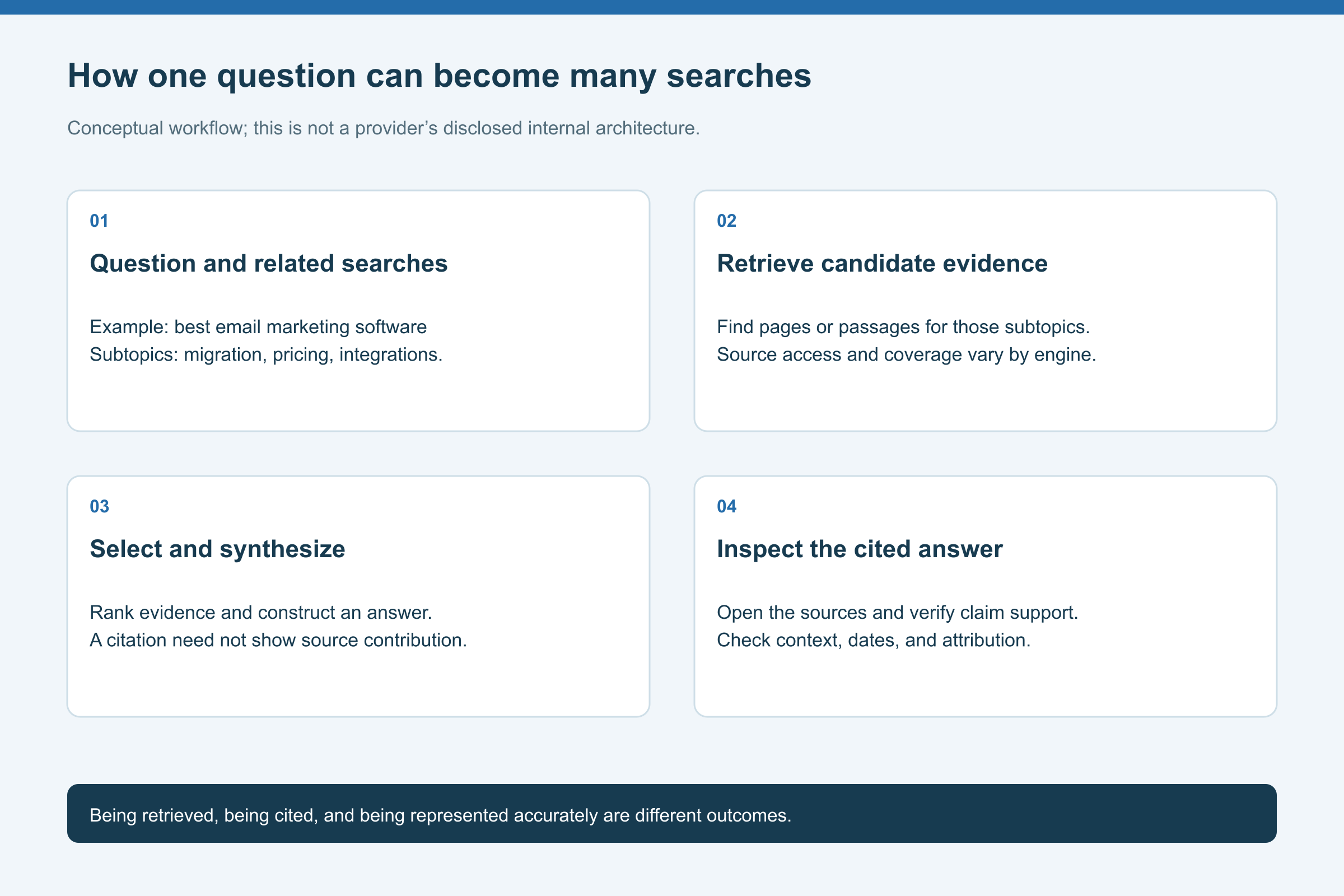
An entered question need not map to a single search. Generative engines often break a question into several related searches. Google describes this “query fan-out” directly: AI Overviews and AI Mode may issue multiple related searches across subtopics and data sources to build a response, which lets them show a wider set of supporting links (Google Search Central, 2025). A page can therefore be retrieved for a sub-question the user never typed.
Illustrative Fan-Out Queries
To plan content around fan-out, map the kinds of sub-questions a broad query tends to produce. The table below is an illustration of common sub-query types, not output captured from any engine.
| Fan-out type | What it does | Illustrative sub-query (parent: “best email marketing software”) |
|---|---|---|
| Equivalent | Rephrases the parent query with synonyms while keeping the intent | “most highly rated email automation platforms for businesses” |
| Follow-up | Anticipates the next step in a purchase or learning path | “how to migrate subscriber lists between email marketing platforms” |
| Generalization | Widens to the broader category for context | “what is the role of email marketing in digital customer acquisition” |
| Specification | Adds constraints, attributes, audiences or use cases | “email marketing tools with open API and HIPAA compliance for healthcare” |
| Entailment | Asks about prerequisites or unstated dependencies | “deliverability rates and sender reputation setup for cold email domains” |
Retrieval, Selection, and Contribution
A useful general model for search-enabled answers is retrieval-augmented generation (RAG): the engine runs live searches, collects candidate passages, ranks them, and passes the best ones to the language model, which writes an answer with citation markers that map back to the sources. Providers do not publish the full details of their ranking layers, so claims about exact thresholds or numbers of reranking stages should be treated as speculation unless the provider documents them.
For practical evaluation, distinguish source selection from source contribution; this is not a claim that every provider implements two literal ranking gates. The first is selection: the page is retrieved and cited at all. The second is absorption: how much of the page’s wording, data or structure actually shapes the answer. A citation alone does not show how much a source shaped the answer. Aggarwal et al. (2024) built their measures around this distinction, scoring how many words of an answer can be attributed to a source and how prominently the source appears (Aggarwal et al., 2024).
Crawl access, technical structure and authority still matter for the first gate. For the second, clear definitions, specific figures with their sources, and well-organized sections give the model something it can quote.
AI Crawlers and Access Controls
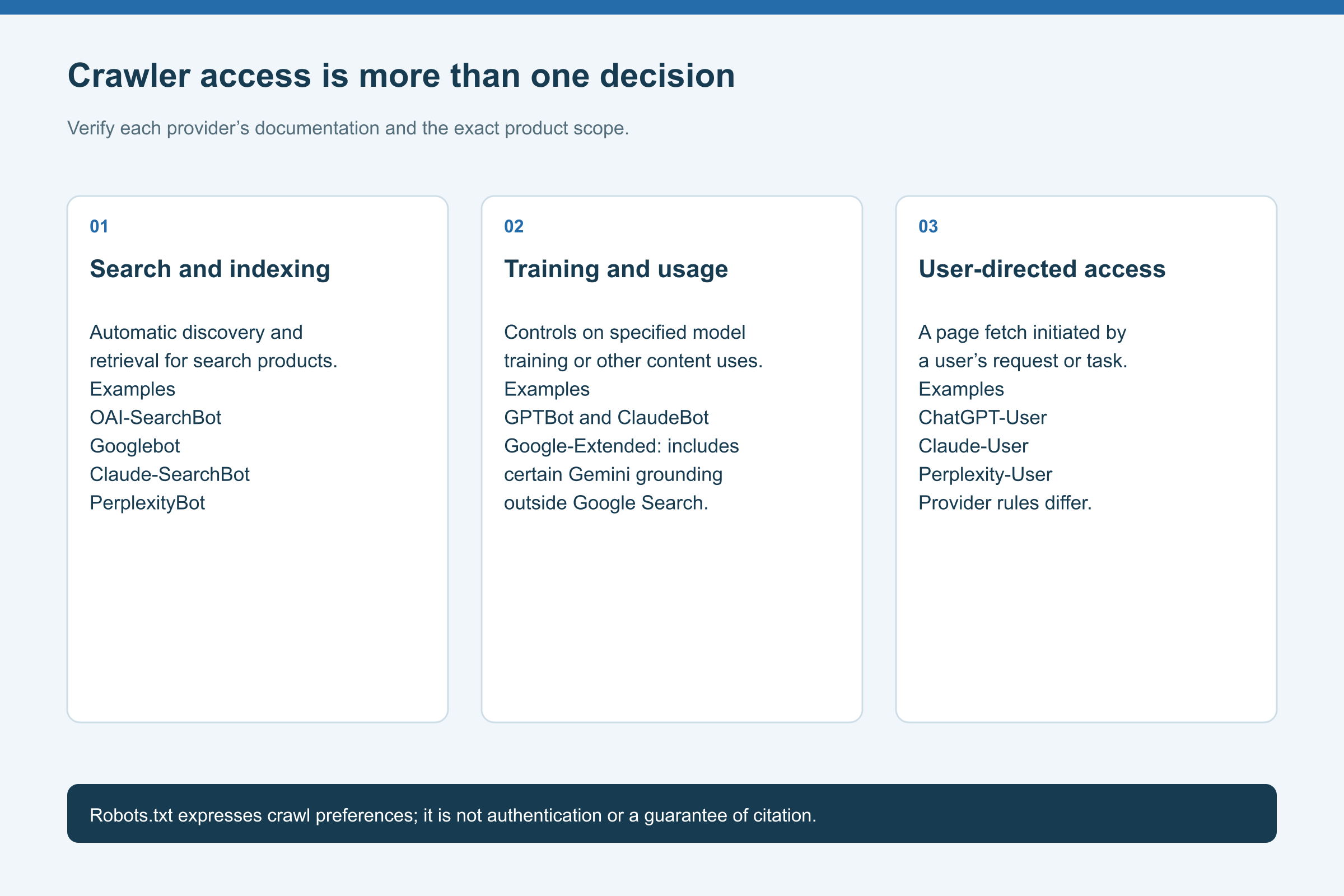
Before a page can be selected, the engine has to be allowed to fetch it. Each major provider documents separate user agents for search, for model training and for fetches triggered by a user’s question. The Robots Exclusion Protocol lets site owners express preferences for each one, but the standard itself says robots.txt rules “are not a form of access authorization” (Koster et al., 2022). The table summarizes the official documentation as of November 17, 2026.
| Provider | Search or indexing agent | Training or other usage control | User-triggered fetcher |
|---|---|---|---|
| OpenAI | OAI-SearchBot. Opted-out sites are not shown as search-answer sources, but may still appear as navigational links | GPTBot | ChatGPT-User. Robots.txt rules may not apply because users initiate the visit |
| Googlebot. AI Overviews and AI Mode use the normal Search index | Google-Extended token governs specified Gemini training and grounding uses; it does not affect Google Search inclusion or ranking | Not separately documented for AI features | |
| Anthropic | Claude-SearchBot | ClaudeBot | Claude-User |
| Perplexity | PerplexityBot. Not used to train foundation models | No separate training crawler listed in the cited documentation | Perplexity-User. Generally ignores robots.txt |
Sources: OpenAI; Google Search Central (2026); Anthropic (2026); Perplexity.
The practical consequence is that “blocking AI” is not one decision. Some providers separate search, training, and user-directed access. Google-Extended also governs certain grounding uses outside Google Search, so read each provider’s scope rather than assuming every control has the same effect. Access alone does not guarantee selection or a citation.
Some sites also publish an llms.txt file, a Markdown summary of a site’s main pages for language models. It is a community proposal first published by Jeremy Howard in September 2024 and revised as version 2 in August 2026, not a universal search ranking requirement (Howard, 2024). Google states that such files are not needed to appear in its AI features (Google Search Central, 2025). Treat llms.txt as optional documentation, not a ranking lever.
What GEO Research Shows
GEO is a young field. The founding paper appeared at KDD 2024; the later studies below are cited here as preprints. Their metrics, tested systems, and tasks differ, so the reported percentages are not directly comparable or forecasts for a particular site.
| Study | Design | Main finding | Status |
|---|---|---|---|
| Aggarwal et al. (2024) | GEO-bench, 10,000 queries; tests on a simulated engine and on Perplexity.ai | Adding quotations, statistics and source citations raised visibility by up to 40%; keyword stuffing gave little or no gain | Peer-reviewed (KDD 2024) |
| Yu et al. (2026) | Structural changes only, tested across six generative engines | Restructuring raised citation rate by 17.3% and judged quality by 18.5% | Preprint |
| Tian et al. (2026) | AgentGEO: diagnose why a page was not cited, then repair it | More than 40% relative citation gain while changing about 5% of the text, against about 25% for baseline methods | Preprint |
| Yuan et al. (2026) | AgenticGEO: evolving a library of rewriting strategies with a learned critic | Outperformed 14 baselines across 3 datasets on two engines | Preprint |
| Zhang et al. (2026) | Production GEO system at Pinterest | 20% organic traffic growth across billions of images | Preprint (industry) |
Content Signals and Evidence
The strongest finding comes from the original GEO study. Three methods worked best: adding relevant quotations, adding statistics, and citing sources. On the authors’ main visibility measure, these gave relative improvements of 30% to 40%. Keyword stuffing, the classic SEO tactic, offered little to no improvement and in the Perplexity.ai test performed about 10% worse than the unoptimized baseline (Aggarwal et al., 2024). The effects varied by domain and tested engine. This historical experiment does not establish a current ranking formula or guarantee a citation.
Content Structure and Citations
Yu et al. (2026) asked whether layout alone, with meaning held constant, changes citation behavior. They describe structure at three levels: macro-structure (the document’s overall architecture and headings), meso-structure (how information is divided into chunks such as sections, short paragraphs, lists and tables), and micro-structure (visual emphasis within sentences). Structural changes alone produced the 17.3% citation gain reported above (Yu et al., 2026). The study is a preprint, and its exact gains should not be expected on any particular site. The direction is consistent with ordinary editorial practice: a descriptive heading for each section, one main claim per paragraph, numbered lists for procedures and tables for comparisons.
Source Preferences Across Engines
Which sources do engines prefer? Chen et al. (2025) compared AI search engines (ChatGPT, Perplexity, Gemini and Claude with web search) with Google’s top-10 results across several product categories. They classified each cited domain as earned media (independent editorial coverage and reviews), brand-owned or social. AI search showed a “systematic and overwhelming” bias towards earned media (Chen et al., 2025).
Source Mix in One Study
| Category (U.S. queries) | Google: earned / brand / social | AI search: earned / brand / social |
|---|---|---|
| Automotive | 45.1% / 39.5% / 15.4% | 81.9% / 18.1% / 0% |
| Software | 45.4% / 43.7% / 10.9% | 72.7% / 26.7% / about 0.6% |
| Consumer electronics | about 52% / 33% / 15% | 92.1% earned; social negligible |
Source: Chen et al. (2025), preprint. Figures marked “about” are derived from the paper’s reported shares.
The same study found a big-brand bias. For unbranded prompts about cola, 56.3% of ChatGPT’s brand mentions and 67.9% of Perplexity’s went to major brands, against 12.3% and 5.8% for niche brands. Engines also disagreed with each other. In automotive queries, the overlap between the domains cited by ChatGPT and by Perplexity was low (a Jaccard similarity of 0.096), and ChatGPT and Perplexity drew on different source types, such as Wikipedia for ChatGPT and YouTube for Perplexity in some tests (Chen et al., 2025).
These findings suggest testing both independent coverage and first-party pages in the relevant market. They do not prove that buying coverage improves rankings or that small organizations cannot earn direct citations. Different engines and query sets can produce different source mixes.
Diagnosing and Testing Citation Failures
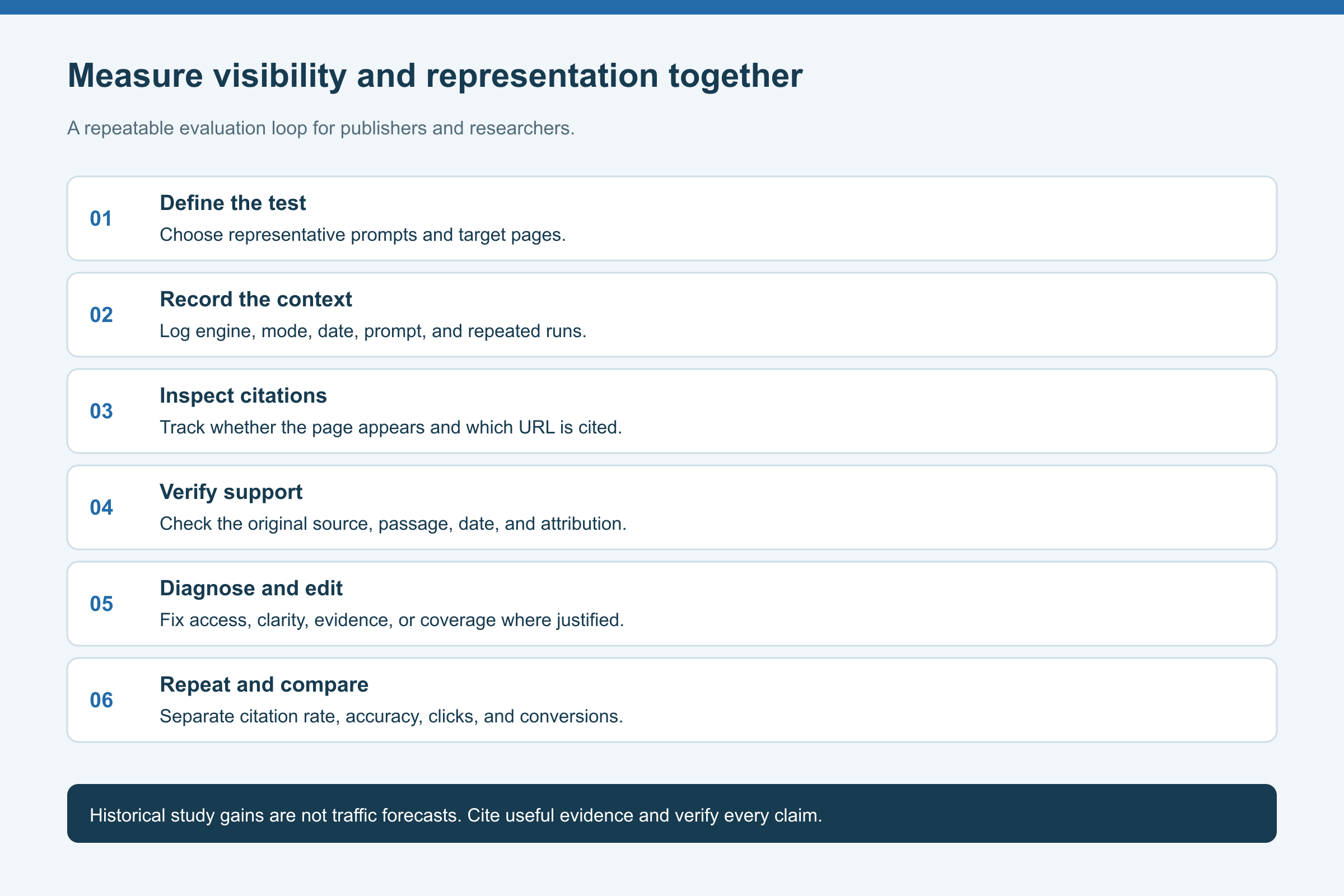
Generic rewriting rules, such as adding conversational phrasing or more keywords, often fail because they do not address why a page was left out. A citation can fail at different stages: the engine may not fetch the page, may not parse it, or may retrieve it and still not use it in the answer.
Recent research treats GEO as a feedback problem. AgenticGEO keeps an archive of diverse rewriting strategies (a MAP-Elites archive) and uses a lightweight critic model, trained on limited real engine feedback, to predict how an engine will react, which reduces costly live tests (Yuan et al., 2026). AgentGEO compares pages that were not cited with pages that were, identifies the likely failure point and applies targeted edits, reporting a citation gain of more than 40% while changing about 5% of the text (Tian et al., 2026).
Citation Accuracy and Attribution
Citation does not guarantee accurate attribution. The Tow Center for Digital Journalism at Columbia Journalism Review gave eight AI search tools 1,600 excerpts from news articles and asked them to identify the headline, publisher, date and URL. Collectively the tools answered more than 60% of queries incorrectly. Perplexity answered 37% incorrectly, and Grok 3 94%. Several tools cited syndicated copies instead of the original publisher, and 154 of Grok 3’s 200 citations led to error pages (Jaźwińska & Chandrasekar, 2025). An earlier audit of four generative search engines found that only 51.5% of generated sentences were fully supported by their citations, and 74.5% of citations supported the sentence they were attached to (Liu et al., 2023).
These are historical tests of particular products, model versions, prompts, and tasks. They are not current error rates or a universal ranking of providers. Publishers should monitor representation as well as citations; researchers should verify the underlying evidence.
Programmatic and Enterprise Approaches
Sites with thousands of pages cannot edit each one by hand. Pinterest’s published GEO system shows one alternative. Instead of writing generic image captions, the team fine-tuned vision-language models to predict the natural-language queries people would actually type, and used those queries to build collection pages grouped by multimodal embeddings. Deployed across billions of images and tens of millions of collections, the system delivered 20% organic traffic growth (Zhang et al., 2026). This is a company-reported deployment result, not an isolated estimate of traffic from AI citations or a guaranteed outcome elsewhere. A practical hypothesis to test is whether clearer query-focused collections improve discovery.
Implications for Researchers
GEO matters to researchers because it shapes which sources an AI answer shows you. Several consequences follow for source discovery and verification.
- A citation reflects retrieval, not authority. An engine cites what it retrieved, ranked and found quotable for its sub-queries. A highly cited page may be well structured rather than the best evidence. Look for the primary source behind it.
- Expect earned-media bias. Because engines favor third-party coverage (Chen et al., 2025), an answer may cite an article about a study rather than the study, or a review rather than the official record. Trace each claim to the original.
- Fan-out hides the real query. The sources behind an answer may come from sub-questions you never asked. Check that a cited page addresses your question, not a neighboring one.
- Optimized content is designed to be quoted. Pages that add statistics and quotations get cited more (Aggarwal et al., 2024). That says nothing about whether the statistics are correct, so check each figure against its source.
- Different engines, different evidence. Low overlap between engines means one engine’s answer is a sample, not a survey. For important questions, compare engines and then go outside them.
- Attribution errors are common. With error rates like those in the CJR audit, open every citation you rely on and confirm that the publisher, date and wording match.
- Record the context. Note the engine, mode, date and exact prompt, because answers change between runs and versions.
For a claim-by-claim process, use our AI citation verification guide.
Practical Guidance for Publishers
Generative engines analyze relationships between concepts, choose sources through retrieval and ranking steps that are only partly documented, and then write answers that may or may not reflect those sources accurately. Search skills still matter in this setting. Our Google search operators guide explains how precise queries help researchers check what AI tools return.
Expertise and reputation are worth documenting accurately, but no single public authority score guarantees inclusion in an AI answer.
To build sustainable visibility, organizations can make these adjustments:
- Measure citations, not only rankings. Track how often and how accurately ChatGPT search, Google AI Overviews, Perplexity and other engines cite your pages, using a fixed set of test prompts run on a schedule and logged with dates.
- Earn independent coverage. Some studies found a preference for third-party coverage. Seek accurate editorial reporting and expert references without treating paid mentions or reputation signals as guaranteed citation levers.
- Write for extraction and verification. Use descriptive headings, short paragraphs with one main claim, tables for comparisons, and statistics and quotations with their original sources. Avoid keyword stuffing.
- Set crawler access deliberately. Allow the search agents you want to be cited by, decide separately on training crawlers, and keep important content in text form. An llms.txt file is optional.
- Test, diagnose and correct. Engines and models change often. Re-run your prompt set, look for fetch, parsing or attribution failures, and correct inaccurate answers at the source by updating your pages and your earned coverage.
References
- Aggarwal, P., Murahari, V., Rajpurohit, T., Kalyan, A., Narasimhan, K., & Deshpande, A. (2024). GEO: Generative engine optimization. In Proceedings of the 30th ACM SIGKDD Conference on Knowledge Discovery and Data Mining (KDD 2024). arXiv:2311.09735. View source
- Anthropic. (2026). Does Anthropic crawl data from the web, and how can site owners block the crawler? Claude Help Center. Retrieved November 9, 2026, from View source
- Chapekis, A., & Lieb, A. (2025, July 22). Google users are less likely to click on links when an AI summary appears in the results. Pew Research Center. View source
- Chen, M., Wang, X., Chen, K., & Koudas, N. (2025). Generative engine optimization: How to dominate AI search (arXiv:2509.08919) [Preprint]. arXiv. View source
- Google Search Central. (2025, December 10). AI features and your website. Google for Developers. View source
- Google Search Central. (2026, October 30). Google’s common crawlers (Google-Extended). Google for Developers. View source
- Howard, J. (2024, September 3). The /llms.txt file [Proposal]. llmstxt.org. View source
- Jaźwińska, K., & Chandrasekar, A. (2025, March 6). AI search has a citation problem. Columbia Journalism Review, Tow Center for Digital Journalism. View source
- Koster, M., Illyes, G., Zeller, H., & Sassman, L. (2022). Robots Exclusion Protocol (RFC 9309). RFC Editor. View source
- Liu, N. F., Zhang, T., & Liang, P. (2023). Evaluating verifiability in generative search engines. In Findings of the Association for Computational Linguistics: EMNLP 2023. arXiv:2304.09848. View source
- OpenAI. Overview of OpenAI crawlers. OpenAI developer documentation. Retrieved November 9, 2026, from View source
- Perplexity. Perplexity crawlers. Perplexity documentation. Retrieved November 9, 2026, from View source
- Tian, Z., Chen, Y., Tang, Y., Liu, J., & Jia, R. (2026). Diagnosing and repairing citation failures in generative engine optimization (arXiv:2603.09296) [Preprint]. arXiv. View source
- Yu, J., Yang, M., Ding, Y., & Sato, H. (2026). Structural feature engineering for generative engine optimization: How content structure shapes citation behavior (arXiv:2603.29979) [Preprint]. arXiv. View source
- Yuan, J., Wang, J., Wang, Z., Sun, Q., Wang, R., & Li, J. (2026). AgenticGEO: A self-evolving agentic system for generative engine optimization (arXiv:2603.20213) [Preprint]. arXiv. View source
- Zhang, F., Cheng, Q., Wan, J., Singh, V., Rao, J., & Boakye, K. (2026). Generative engine optimization: A VLM and agent framework for Pinterest acquisition growth (arXiv:2602.02961) [Preprint]. arXiv. View source