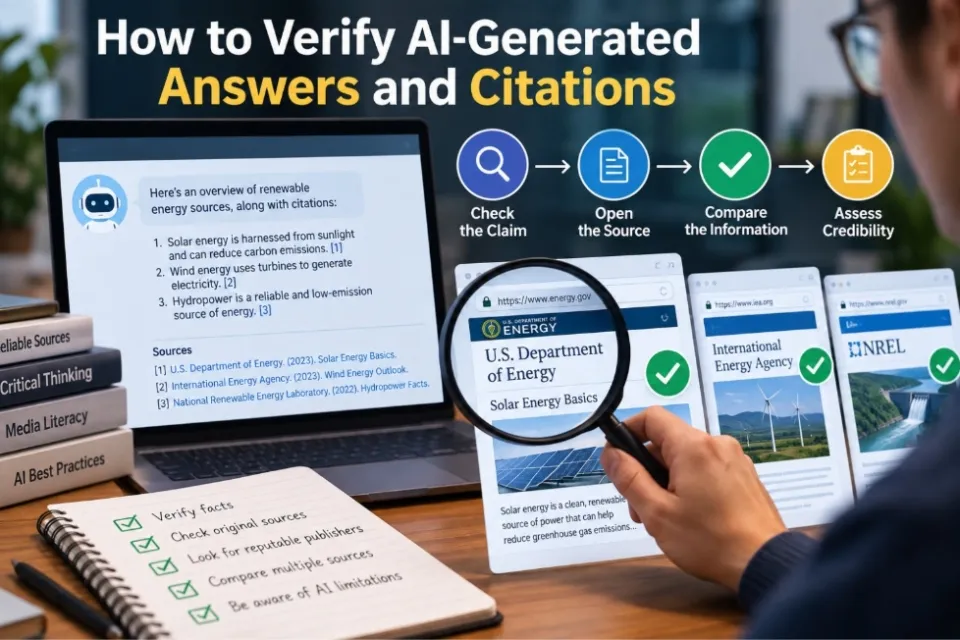

Creating effective online learning content requires more than clear writing or attractive digital lessons. Educational materials must help learners understand new concepts, apply knowledge, practice skills, and demonstrate measurable progress. This requires a structured approach that combines learning objectives, reliable evidence, accessible formatting, meaningful assessments, and careful editorial review.
Unlike traditional classroom instruction, online education often requires learners to navigate materials independently. Instructions must therefore be understandable without constant teacher intervention. Examples should connect theory with practice, and assessments should reveal whether learners can use what they have studied.
Generative artificial intelligence has also introduced new opportunities for drafting lessons, developing exercises, and adapting explanations. However, AI-generated educational materials may contain factual errors, misleading examples, or invented references. Human review remains essential.
This guide explains how educators, instructional designers, researchers, and course creators can develop accurate, accessible, and engaging online learning content using evidence-based instructional principles and responsible AI practices.
What Is Online Learning Content?
Online learning content refers to instructional materials created for delivery through digital environments, including learning management systems (LMS), virtual classrooms, educational websites, and self-paced courses.
These materials may include written lessons, reading assignments, interactive tutorials, instructional videos, practice exercises, case studies, and assessments. Their purpose is not simply to communicate information but to help learners achieve specific educational outcomes.
Effective educational content brings together five essential elements:
- Learning objectives: Define what learners should know or be able to do.
- Evidence-based information: Provide accurate, relevant, and trustworthy explanations.
- Accessible presentation: Make content usable by learners with different abilities and needs.
- Learning assessments: Measure comprehension, application, and progress.
- Quality assurance: Verify instructional accuracy, accessibility, and content integrity before publication.
These elements support one another. A carefully researched lesson may still be ineffective if its learning objectives are unclear, while an engaging activity may have limited educational value if it does not reinforce the intended skill.
Why Effective Writing Matters in Online Education
Online learners frequently encounter instructional materials without immediate access to an educator. They depend on the written content to understand what to study, how to complete activities, and how their performance will be evaluated.
Poorly organized lessons can create unnecessary confusion. Long paragraphs, unexplained terminology, missing instructions, and unrelated examples make educational tasks harder than necessary.
Effective writing reduces these barriers by presenting information in a logical sequence and giving learners clear opportunities to practice.
Writing Should Support Learning, Not Just Reading
Reading an explanation does not necessarily mean a learner can recall or apply it later.
Research by Roediger and Karpicke on test-enhanced learning demonstrated that retrieval activities can improve delayed retention compared with repeated studying under the conditions examined. This evidence supports incorporating opportunities to recall and use information rather than relying exclusively on passive reading.
For example, a lesson about evaluating online information should not end after describing credible sources. It should ask learners to examine a website, identify its evidence, and explain whether its claims are adequately supported.
This changes the activity from receiving information to demonstrating a research skill.
How to Define Clear Learning Objectives
Learning objectives describe the specific knowledge or abilities learners should demonstrate after completing a lesson.
They provide direction for the writer and help learners understand what is expected.
Use Measurable Action Verbs
Vague objectives such as “understand online research” do not clearly explain how achievement will be measured.
More useful objectives describe observable actions.
| Weak objective | Improved learning objective |
|---|---|
| Understand research sources | Identify three characteristics of credible research sources |
| Learn about misinformation | Evaluate two online claims using independent evidence |
| Know how search engines work | Explain the basic stages of crawling, indexing, and retrieving information |
| Become familiar with AI research | Verify an AI-generated statement against an original source |
| Understand academic citations | Create and check citations using a specified referencing style |
The improved objectives make it easier to design relevant exercises and assessments.
Align Objectives With Lesson Activities
Every major instructional activity should contribute to a stated learning objective.
Consider a lesson titled Evaluating Online Sources.
Its objectives might require learners to identify source authorship, examine supporting evidence, distinguish primary from secondary sources, and assess publication dates.
The lesson should then demonstrate each task and provide opportunities for learners to perform it independently.
An assessment that only asks learners to memorize definitions would not fully measure their ability to evaluate actual sources.
This relationship between objectives, instruction, and assessment is known as instructional alignment.
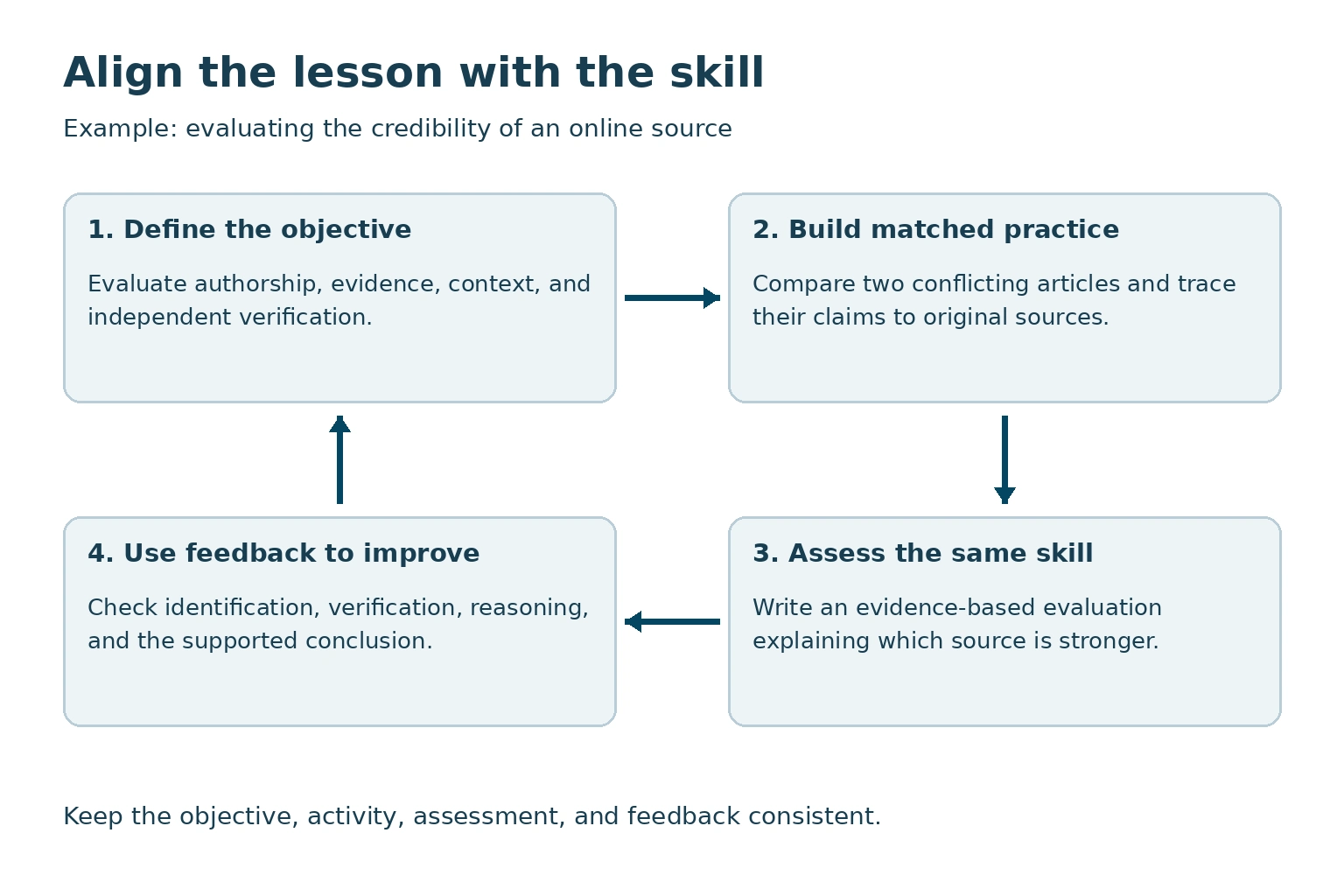
Instructional alignment connects the objective, practice, assessment, and feedback described above.
How to Use Reliable Evidence in Educational Content
Educational writing requires a higher standard of factual accountability than general promotional or opinion-based content. Learners may use instructional materials to make decisions, complete professional tasks, or develop specialized skills.
Authors should therefore distinguish verified information from interpretation, examples, and emerging ideas.
Prioritize Primary and Authoritative Sources
Use original research papers, official technical documentation, academic publications, recognized standards, and institutional guidance wherever appropriate.
For example, an educational lesson discussing digital accessibility should reference the World Wide Web Consortium’s Web Content Accessibility Guidelines (WCAG) 2.2 rather than relying solely on a commercial blog’s interpretation of accessibility requirements.
Similarly, lessons about research methodology should distinguish findings from peer-reviewed studies from practical recommendations developed by the course author.
Apply a Source Verification Process
Before including an important factual claim, the writer should determine who originally published the information, when it was published, how the evidence was collected, and whether the source actually supports the claim.
A cited source may be credible while still being irrelevant to the specific statement. Educational writers must verify both the source’s reliability and its relationship to the claim.
For locating studies and checking publication types, AOFIRS’ guide to academic search engines and scholarly research tools helps writers choose discovery platforms appropriate to the evidence they need.
AOFIRS’ report on verification debt in online research explains how unchecked citations and unsupported claims can accumulate in AI-assisted workflows. Course writers can apply that principle by keeping a claim-to-source review record before publication.
Keep Evidence Current
Educational materials should include a documented review process, particularly when discussing software, artificial intelligence, cybersecurity, search engines, and evolving regulatory requirements.
A lesson may remain conceptually accurate while its screenshots, examples, or procedural instructions become outdated.
Before republishing an existing course module, review time-sensitive claims and replace unsupported or obsolete instructions.
10 Evidence-Based Techniques for Writing Effective Online Learning Content
Well-designed instructional content should help learners move from initial understanding to independent application. The following techniques combine practical writing methods with principles from educational research and instructional design.
1. Organize Content Into Manageable Learning Sections
Divide complex topics into smaller sections, each focused on one concept or task. This approach helps learners follow a logical sequence without having to process several unrelated ideas simultaneously.
For example, a course about online research could separate search query construction, source evaluation, evidence verification, and research reporting into individual lessons.
Each section should explain the concept, demonstrate an example, and provide an opportunity for practice. Section length should depend on the complexity of the material rather than an arbitrary word count.
2. Write Clear and Direct Instructions
Instructional writing should tell learners exactly what they need to do.
Consider this example:
Before: Students are encouraged to undertake a comprehensive evaluation of digital information resources by applying appropriate methodological considerations.
After: Choose two websites discussing the same topic. Identify each website’s author, examine its evidence, and explain which source is more reliable.
The second version specifies the activity and expected outcome. It also makes assessment easier because the learner’s work can be evaluated against observable criteria.
3. Introduce Technical Terms With Examples
Specialized terminology is necessary in professional education, but unexplained jargon can interfere with comprehension.
Introduce each important term using a clear definition and a relevant example.
For instance, Boolean operators are words such as AND, OR, and NOT that help combine or exclude search terms in systems that support them.
A lesson can then demonstrate how an operator changes a database query before asking learners to construct one themselves. AOFIRS’ Boolean search guide provides examples for building such practice tasks, while its Search Query Matrix helps explain why syntax must be checked for each search platform.
4. Use Worked Examples Before Independent Practice
A worked example shows learners how to complete a task, including the reasoning behind important decisions.
In a lesson about fact-checking, a worked example could demonstrate how an instructor traces a statistic to its original publication, checks the research methodology, and evaluates whether the figure has been reported accurately.
After observing the process, learners can complete a similar investigation using different material.
Worked examples are particularly useful when learners are unfamiliar with the task. As proficiency develops, instructional support can be reduced.
5. Include Retrieval Practice
Retrieval practice requires learners to recall previously studied material rather than simply reread it.
A review by Dunlosky and colleagues identified practice testing and distributed practice as especially useful learning techniques across a range of educational settings.
Educational writers can incorporate short knowledge checks after important concepts and provide opportunities to revisit earlier material.
For example, after explaining source credibility, ask learners to list three credibility indicators without looking at the lesson. Follow this step with feedback that explains what they recalled correctly and what requires further study.
6. Connect Learning to Real-World Situations
Practical scenarios help learners understand when and why particular knowledge matters.
A cybersecurity lesson might present a suspicious email and ask learners to identify potential warning signs. A digital research lesson might require learners to investigate conflicting statements made by two online publications.
Scenarios should reflect tasks learners are likely to encounter. They should also include enough context for learners to make informed decisions without unnecessary distractions.
7. Encourage Reflection and Self-Explanation
Learning activities should sometimes ask learners to explain their reasoning.
Instead of asking only which answer is correct, ask why the answer is appropriate and what evidence supports it.
For instance:
Two search results report different publication dates for the same event. What steps would you take to establish the original date, and why?
This type of question encourages learners to examine their method rather than rely on an isolated answer.
8. Provide Useful Feedback
Feedback should tell learners what they accomplished, where their reasoning was incomplete, and what they should do next.
A response such as “Incorrect” provides little guidance. A more useful explanation identifies the error.
For example:
Your answer correctly identifies the publisher, but it does not establish whether the claim is supported by primary evidence. Review the original study and compare its findings with the article’s interpretation.
Feedback should be aligned with the learning objective and delivered when it can help learners improve subsequent performance.
9. Support Revision Over Time
A single exposure to educational material may not be sufficient for long-term retention.
Rather than placing every review activity at the end of a course, distribute opportunities for recall throughout the learning sequence.
A research methodology course might revisit source evaluation during lessons on literature reviews, AI-generated citations, and research reporting.
The review activities should require learners to use earlier knowledge in meaningful contexts rather than merely repeat the same questions.
10. Assess the Skill That Was Actually Taught
A well-written lesson connects its learning objectives to the way achievement is measured.
If the objective is to evaluate research evidence, asking learners to memorize the definition of a primary source is insufficient.
A better assessment asks learners to examine a specific claim, identify the original source, evaluate the evidence, and explain their conclusion.
This approach makes assessments more representative of the skill the course intends to develop.
How Instructional Design Improves Educational Writing
Instructional design provides a structured process for planning learning experiences. Rather than drafting content first and adding exercises afterward, educators identify the intended outcomes, select suitable teaching activities, and decide how learning will be assessed.
Several established frameworks can support this work.
| Framework | Primary purpose | Application to educational writing |
|---|---|---|
| Bloom’s Revised Taxonomy | Describe different types of cognitive objectives | Choose action verbs and assessments appropriate to the expected level of learning |
| ADDIE | Guide instructional development | Organize analysis, design, development, implementation, and evaluation |
| Backward Design | Plan from desired learning outcomes | Determine acceptable evidence of learning before writing lessons |
| Cognitive Load Theory | Consider limits of working memory | Reduce unnecessary complexity and introduce unfamiliar material progressively |
| Universal Design for Learning | Reduce barriers to participation | Provide appropriate options for accessing content and demonstrating understanding |
These approaches are complementary rather than interchangeable. A course designer might use backward design to plan a module, cognitive load principles to present explanations, and accessibility guidance to make the material usable by a wider range of learners.
The CAST Universal Design for Learning Guidelines 3.0, released in July 2024, emphasize reducing barriers and recognizing learner differences. They provide a useful foundation for examining how instructional environments can become more inclusive.
How to Format Online Learning Content for Accessibility
Accessible educational writing allows learners to find, read, understand, and interact with materials using different devices and assistive technologies.
Accessibility should be considered during drafting and course development rather than added only after publication.
Use Meaningful Headings and Logical Structure
Headings should communicate the subject of each section and follow a consistent hierarchy.
Use one main page heading, followed by descriptive subheadings. Avoid selecting heading levels merely to change font size.
For example, a lesson about internet research might contain sections titled Developing Search Queries, Evaluating Search Results, and Verifying Research Evidence.
This organization helps readers navigate the lesson and supports assistive technologies that use semantic headings.
Make Links and Images Understandable
Links should describe their destination or purpose.
A descriptive link such as Web Content Accessibility Guidelines 2.2 is more informative than an unexplained link labeled “read more.”
Educational images should include meaningful alternative text when they convey information. Decorative images generally do not require descriptive alt text.
For example, an instructional screenshot demonstrating a database search should have alternative text explaining the relevant interface or search action, not merely stating “database screenshot.”
Complex diagrams may require a longer explanation in the surrounding lesson.
Make Text and Multimedia Accessible
The W3C’s WCAG 2.2 standard addresses accessibility across desktop and mobile experiences, including text alternatives, captions, navigation, contrast, and content reflow.
Educational writers and course developers should use readable typography, maintain sufficient contrast, supply appropriate captions and transcripts, and avoid instructions that depend exclusively on color.
Tables should have descriptive headers and a simple structure. Wide tables may need a responsive presentation so that their contents remain usable on smaller screens.
Accessibility also means avoiding assumptions about learners’ prior knowledge, culture, devices, or ability to access high-bandwidth media.
How to Design Assessments That Measure Learning
Assessments provide evidence about what learners know and what they can do. They also help instructors identify misconceptions and improve instructional materials.
Effective online courses generally benefit from combining formative assessments with assessments of final achievement.
Formative Assessments
Formative assessments occur during learning and provide information that can guide improvement.
Examples include short quizzes, practice exercises, draft submissions, discussion questions, and scenario-based tasks.
In a lesson about research citations, learners might examine three references and identify which information is missing. Feedback could then explain how to correct each reference.
The purpose is to support learning while there is still an opportunity to improve.
Summative Assessments
Summative assessments evaluate achievement after a unit, module, or course.
They may include final examinations, research reports, presentations, practical demonstrations, or completed projects.
Assessment tasks should resemble the abilities described in the learning objectives.
For professional research education, a practical source-verification assignment may provide stronger evidence of applied skill than a multiple-choice test consisting entirely of definitions.
Match Assessments to Learning Outcomes
EXAMPLE: ONLINE RESEARCH LESSON
Learning objective
Evaluate the credibility of an online source using authorship, evidence, publication context, and independent verification.
Learning activity
Examine two conflicting online articles and trace their central claims to their original sources.
Assessment
Write a brief evaluation identifying the stronger source and supporting the conclusion with evidence.
Success criteria
Accurate source identification, appropriate verification methods, sound reasoning, and a clearly supported conclusion.
This alignment gives learners a clear connection between what they study, what they practice, and how their performance is evaluated.
Assessment quality should also be reviewed after a course launches. Questions that are frequently misunderstood may indicate an instructional problem rather than a lack of learner effort.
How to Use AI to Draft Online Learning Content Responsibly
Generative AI can assist educational writers with preliminary lesson outlines, alternative explanations, practice questions, case study ideas, and editing.
However, generating readable content is not the same as producing academically reliable instruction.
An AI system may present an incorrect explanation confidently, invent a citation, overlook an important exception, or produce an exercise that does not measure the intended learning objective.
UNESCO’s Guidance for Generative AI in Education and Research emphasizes human-centered implementation, privacy protection, and appropriate educational validation. These principles support treating AI as an assistant rather than an autonomous instructional authority.
Suitable Uses of AI in Instructional Writing
AI can be useful during early content development. An educator might supply verified source material and request an initial lesson structure, a simpler explanation of a technical concept, or several alternative practice activities.
An instructional designer might ask AI to compare a draft assessment against stated learning objectives and identify possible gaps.
These outputs should be treated as suggestions requiring professional evaluation.
The UNESCO AI Competency Framework for Teachers identifies human-centered thinking, ethics, AI knowledge, pedagogy, and professional learning as important areas of educator competence.
Human Review of AI-Generated Drafts
Every AI-assisted lesson should undergo a documented human review before publication.
AI Content Review Workflow
- Check factual accuracy. Compare important statements, definitions, dates, and procedures with authoritative sources.
- Verify citations. Confirm that each referenced publication exists and supports the specific claim.
- Review instructional alignment. Make sure explanations and activities support the stated learning objectives.
- Inspect examples and assessments. Check worked solutions, answer keys, distractors, and feedback for errors or ambiguity.
- Check accessibility and bias. Review language, examples, formatting, and possible exclusion of particular learners.
- Approve and document. Record the responsible reviewer, important corrections, and approval date.
A common problem is an AI-generated explanation that sounds correct but oversimplifies an important distinction.
For example, AI might claim that a search result appearing on several websites proves the underlying information is accurate. A qualified educator should correct that explanation because multiple websites may reproduce the same unsupported claim.
Human review must therefore assess the reasoning, not merely the grammar or presentation. AOFIRS’ visual learning publication on the AI trust illusion can support a discussion of why fluent answers feel credible even when their evidence has not been checked.
When incorporating AI-assisted research into course materials, educators can consult AOFIRS guidance on verifying AI-generated answers and citations for additional approaches to evidence checking.
Protecting privacy is equally important. Student records, personal information, confidential assessment materials, and unpublished research should not be submitted to external AI services without appropriate authorization and safeguards.
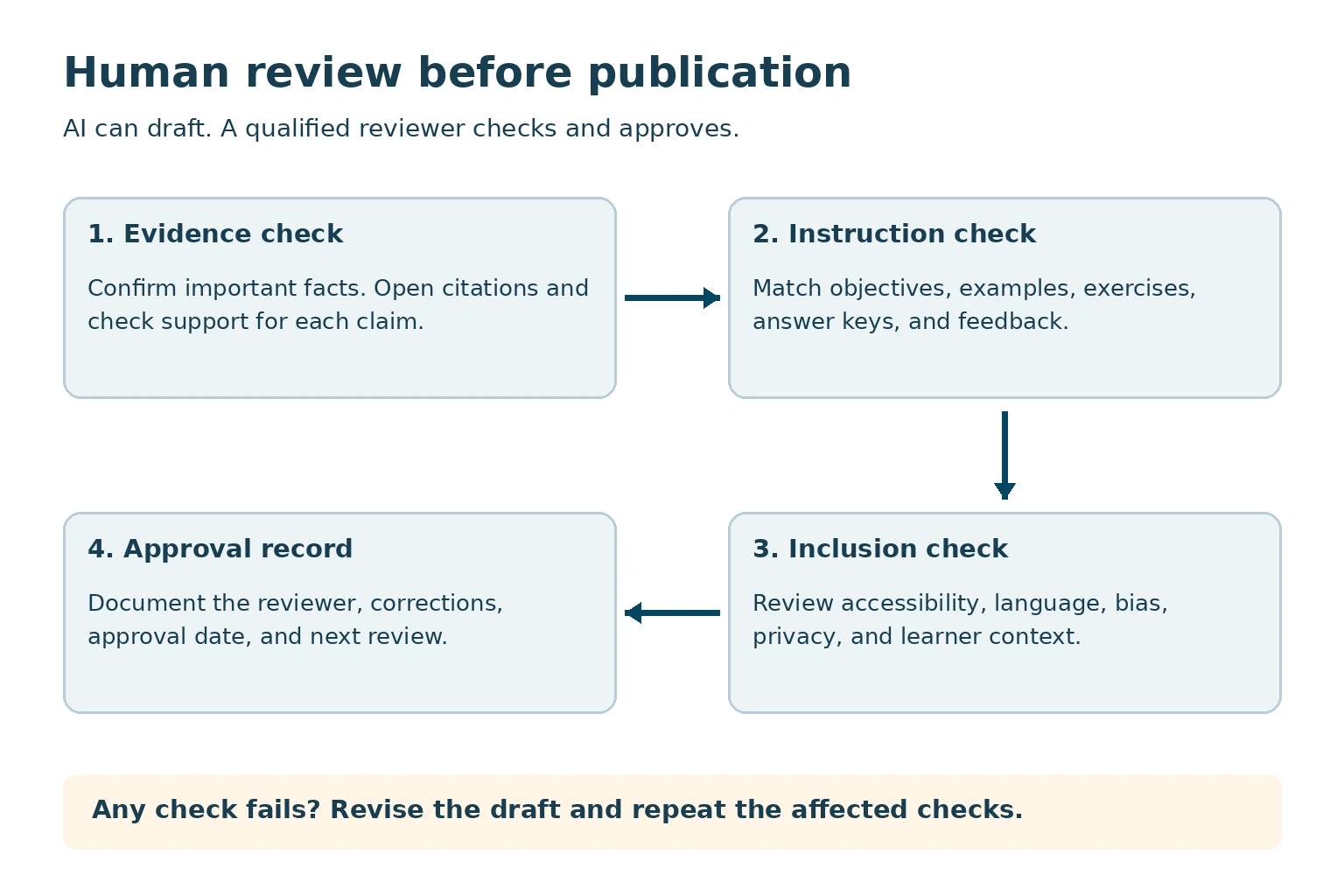
Human review is an approval gate, with revision required when a check fails.
A Practical Workflow for Creating an Online Lesson
A repeatable workflow can improve consistency and reduce preventable errors across educational projects.
Consider an instructional designer preparing a lesson on evaluating AI-generated research answers.
Step 1: Identify the Audience and Learning Objective
Define the learner’s existing knowledge, the intended skill, and the expected performance level.
The objective might be to verify a factual claim and determine whether a cited publication supports it.
Step 2: Gather and Evaluate Evidence
Collect relevant academic studies, official guidance, and practical examples.
Distinguish confirmed information from interpretation and document important sources for future review.
Step 3: Plan the Lesson Sequence
Organize the lesson around the tasks learners must complete.
Begin with the central concept, demonstrate a verification procedure, provide guided practice, and conclude with independent application.
Step 4: Write the Instructional Content
Draft explanations in straightforward language.
Use descriptive headings, define necessary terminology, and provide examples that directly support the learning objective.
Step 5: Develop Activities and Assessments
Create practice tasks that require learners to apply the method.
For the verification lesson, learners might examine an AI-generated paragraph, inspect its citations, and record which claims are supported.
Step 6: Conduct Human and Accessibility Reviews
Have a qualified reviewer check technical accuracy, instructional suitability, and assessment validity.
Review the lesson’s structure, link descriptions, alternative text, and usability with appropriate accessibility testing.
Step 7: Publish and Evaluate
Publish the material in the intended learning environment and test it on relevant devices.
Evaluate learner submissions, assessment responses, and feedback to identify areas requiring improvement.
Keep a version history documenting meaningful changes. This is especially important for lessons covering rapidly changing technologies.
Common Mistakes to Avoid in Online Educational Writing
One recurring mistake is confusing the amount of content with its educational value. A lengthy lesson may contain extensive information without giving learners a clear purpose or useful opportunities to practice.
Another problem is using assessments that reward memorization when the stated objective requires analysis or application.
Educational authors should also avoid unnecessary jargon, inconsistent terminology, outdated examples, inaccessible formatting, and unsupported claims about teaching effectiveness.
AI introduces an additional risk: the publication of polished but unverified materials. A well-formatted AI draft can still contain incorrect citations or misleading explanations. Editorial approval should depend on evidence and instructional quality, not the apparent fluency of the text.
Finally, course authors should not treat completion rates or page views as direct measures of learning. These metrics may describe participation, but assessing educational achievement requires evidence that learners can demonstrate the intended knowledge or skills.
Online Learning Content Quality Checklist
Use this checklist before publishing or substantially updating a lesson.
- The lesson identifies its intended audience and prior knowledge requirements.
- Learning objectives use clear, measurable action verbs.
- Major factual claims are supported by appropriate evidence.
- Explanations, examples, and activities align with the learning objectives.
- Headings, links, images, and tables have been reviewed for accessibility.
- Learners have opportunities for practice and useful feedback.
- Assessments measure the intended knowledge or skills.
- AI-assisted drafts and citations have received qualified human review.
- Instructions and activities have been tested on relevant devices.
- A responsible reviewer and future content review process are identified.
How to Make Online Learning Content Discoverable in Search
Educational resources published on public websites should be organized so that both readers and search engines can identify their purpose and understand their content.
Clear page titles, semantic headings, descriptive internal links, and visible instructional text make material easier to navigate and discover.
Google’s people-first content guidance emphasizes original, accurate, useful content produced primarily for readers rather than search ranking manipulation.
For educational publishers, this means prioritizing instructional value while applying appropriate technical SEO practices.
A lesson should provide an accurate description of its subject, include relevant terminology naturally, and use internal links to connect genuinely related educational resources.
Concise definitions and direct answers may also help search and AI-powered answer systems interpret the content. However, search visibility should never come at the expense of accurate instruction.
Public educational pages should use crawlable text, appropriate canonical URLs, functioning links, and suitable indexability settings. Google’s documentation explains that crawling and indexing are separate processes, and neither indexing nor rankings are guaranteed.
Internal links should point to resources that help learners complete a specific task. A source-verification activity, for example, benefits from a practical evidence-checking guide rather than an unrelated promotional page.
Frequently Asked Questions
What makes online learning content effective?
Effective online learning content combines clear objectives, reliable explanations, accessible presentation, and meaningful practice. Its effectiveness is demonstrated by learners’ ability to achieve the intended outcomes.
How long should an online lesson be?
An online lesson should be long enough to explain its subject and support the intended learning activity without unnecessary information. Complex topics may require multiple shorter sections or lessons rather than one lengthy presentation.
How can learning objectives improve course writing?
Learning objectives help writers select relevant information, examples, and assessments. They also communicate what learners should be able to demonstrate after completing a lesson.
Why is evidence important in educational content?
Evidence helps establish the reliability of instructional claims and recommendations. Authors should verify both the credibility of their sources and whether those sources support the specific statements being made.
How can educators make online lessons accessible?
Educators can use semantic headings, descriptive links, appropriate image alternatives, readable formatting, and accessible multimedia. Accessibility should also be evaluated through technical checks and testing with relevant assistive technologies.
Can AI write online course content?
AI can assist with outlines, explanations, exercises, and preliminary drafts. Qualified educators must still verify accuracy, review instructional suitability, and approve the finished material.
What assessments work best for online learning?
The most appropriate assessment depends on the learning objective and the skill being taught. Knowledge checks can assess recall, while projects, demonstrations, and scenario-based activities can assess application.
How often should online learning content be updated?
Review frequency should reflect how quickly the subject changes and whether errors could affect learners. Technical and AI-related lessons may need more frequent checks than lessons covering stable foundational concepts.
Conclusion
Effective online learning content begins with a clear understanding of what learners need to achieve. Strong educational writing connects measurable objectives with accurate evidence, understandable explanations, accessible design, relevant activities, and assessments that demonstrate genuine learning. These principles help transform digital information into structured instruction that learners can use independently and apply in practical situations.
As generative AI becomes part of educational content development, human accountability becomes even more important. AI can support planning and drafting, but it cannot replace qualified review of evidence, accessibility, instructional relevance, and assessment quality. The most dependable approach combines established educational principles with responsible technology use, ongoing evaluation, and a commitment to improving learning outcomes.