
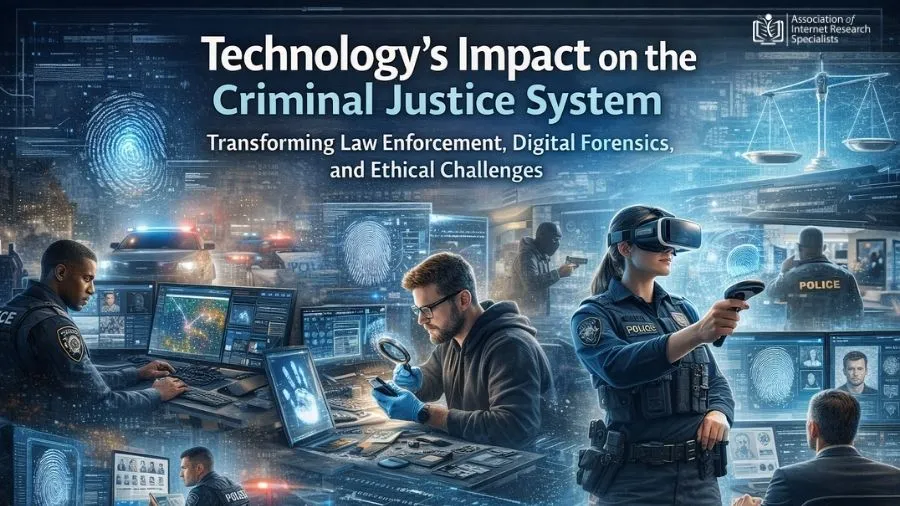
Much of the evidence in criminal cases now starts as data: messages on a phone, location records held by a carrier, posts and videos on public platforms, images matched against a biometric database. The scale is large. In 2025 the FBI’s Internet Crime Complaint Center received 1,008,597 complaints, with reported losses of $20.877 billion, 26% more than in 2024 (IC3 annual report).
For investigators, analysts and the researchers who support them, the practical questions are less about the technology itself than about method. How is digital evidence collected so that it holds up? How is open-source information verified? What do biometric and predictive tools get wrong, and what legal limits apply? This article covers each in turn, with the sources practitioners use.
Digital Evidence Is Now Routine Casework
Digital forensics is the recovery, examination and preservation of data from computers, phones, storage media and networks so that it can be used as evidence. A 2022 NIST scientific foundation review found that digital investigation techniques rest on established computer-science methods and, when used appropriately, are reliable (NIST forensic foundations). The same review lists limits that every examiner and every reader of a forensic report should know. Not all evidence on a device may be found. Recovered deleted files can include unrelated material. Software updates can change what a given artifact means.
The first steps decide whether evidence will hold up. The international standard ISO/IEC 27037 sets out guidelines for four stages: identification, collection, acquisition and preservation of digital evidence. It covers devices from storage media and phones to CCTV and networked computers (ISO evidence handling standard). In practice this means documenting where and how each item was found, using write-protection or verified copies, recording hash values, and keeping a chain of custody showing who handled the material and when.
Open-Source Intelligence in Investigations
Public social media posts, videos, satellite imagery, company registers and archived web pages are open-source information. Used well, they can place a person or event in time and space, connect accounts and corroborate witness accounts. Used carelessly, they can spread misidentification quickly.
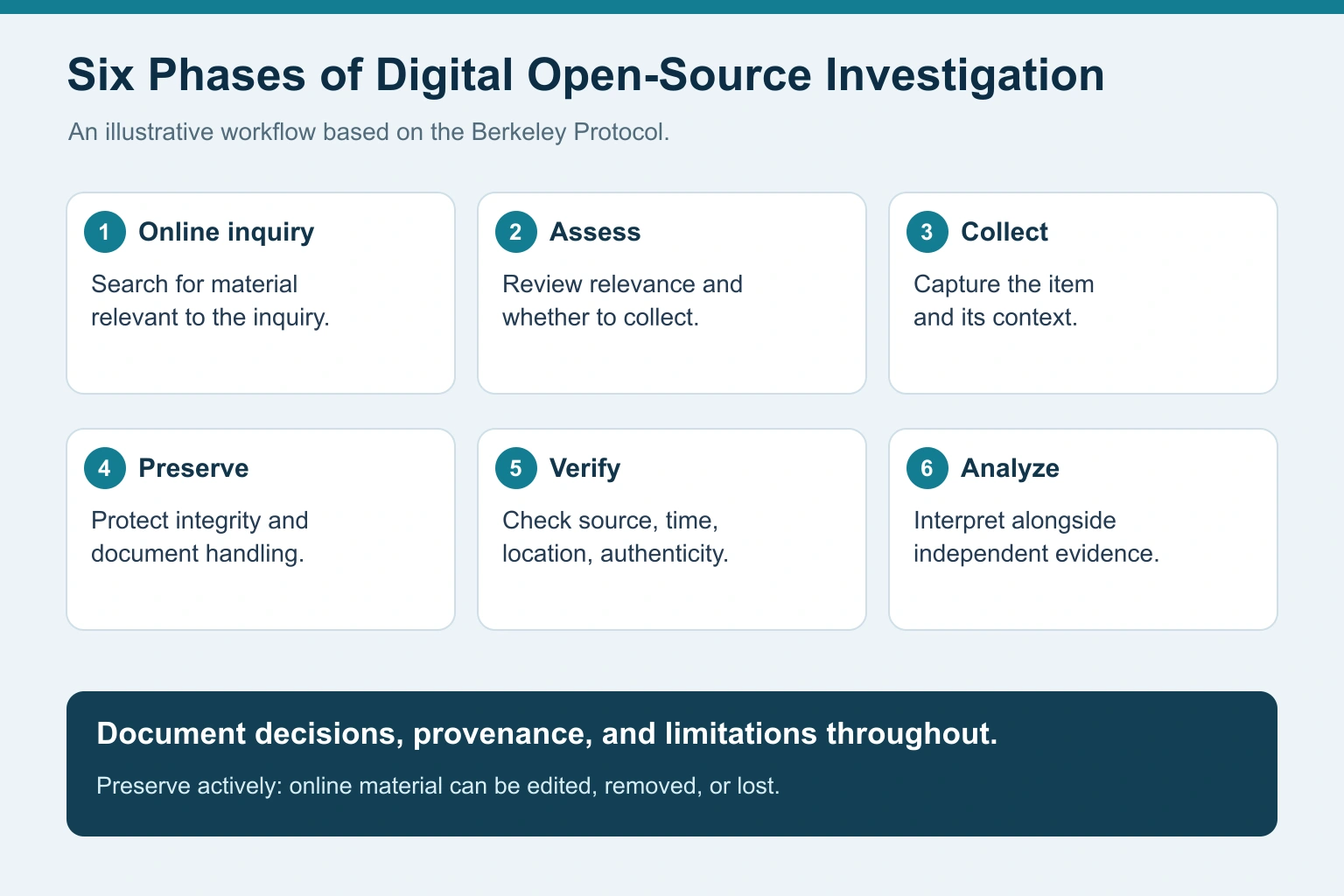
A major international framework for this work is the Berkeley Protocol on Digital Open Source Investigations, published by the UN Human Rights Office (OHCHR) and the Human Rights Center at UC Berkeley School of Law. It was written for international criminal and human rights investigations, but its method transfers to domestic casework. It describes six phases (Berkeley Protocol):
- Online inquiry: searching for relevant material.
- Preliminary assessment: deciding whether an item is relevant and worth collecting.
- Collection: capturing the item and its context.
- Preservation: keeping it safe from loss, editing or platform removal.
- Verification: establishing its source, date, location and authenticity.
- Investigative analysis: interpreting what it shows alongside other evidence.
The Protocol stresses that online content can disappear or be edited, so it must be preserved actively. Material offered in court generally needs documented authenticity and a chain of custody. For related research methods, see AOFIRS’ guides to social media verification and visual fact-checking.
AI in Analysis: Useful With Human Checks
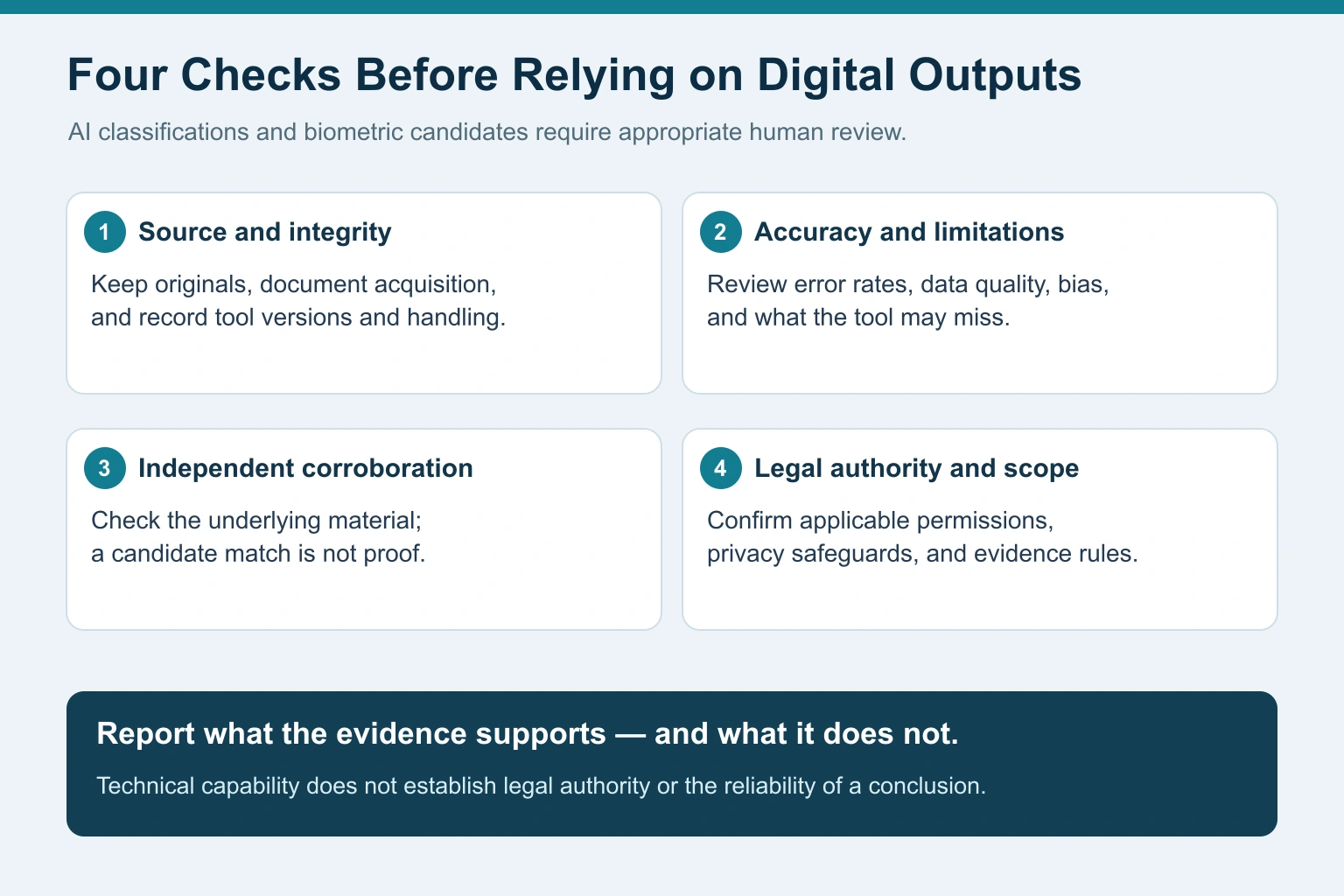
AI tools are most useful in investigations where the volume of material is too large to read: sorting seized data, transcribing and translating recordings, grouping similar images and flagging items for review. Each of these outputs is a lead, not a finding. A transcription can mishear a name, a translation can lose a qualifier, and a classifier can miss the one image that matters. Good practice is to record which tool and version produced an output, keep the original material alongside it, and have a person check every item that will be relied on in a report or in court. Courts and opposing parties can ask how a conclusion was reached, and “the software said so” is not an answer.
Biometrics: Speed, Scale and Error Rates
The FBI’s Next Generation Identification (NGI) system replaced the earlier fingerprint system, IAFIS, in stages from February 2011. It holds fingerprint and palm print records, an iris service and the Interstate Photo System, which supports facial recognition searches against more than 30 million criminal mug shots. It also runs Rap Back, which notifies authorized agencies of later arrests (FBI biometric system). According to the FBI, its Advanced Fingerprint Identification Technology raised matching accuracy from 92% to more than 99.6%. The rapid search used by officers in the field returns results in under 10 seconds.
Accuracy differs by modality and algorithm, and that matters most for face recognition. NIST’s 2019 study of demographic effects tested 189 mostly commercial algorithms from 99 developers. False positive differences between groups were much larger than false negative differences, often by a factor of 10 to 100. In tests using application photos, false positives were highest for West and East African and East Asian people. They were 2 to 5 times higher for women than men, and elevated for children and the elderly. More accurate algorithms generally showed smaller differences (NIST demographic study). These findings describe the algorithms and conditions in the 2019 evaluation, not a universal error rate for current systems. NIST continues to publish demographic results for submitted algorithms (NIST demographic evaluations). The practical rule follows: a face recognition result is an investigative lead that needs independent corroboration and trained human review, never an identification on its own.
Predictive Policing: What the Evidence Shows
Predictive policing uses past data to estimate where crime is more likely or who is at higher risk. RAND’s review of predictive policing concluded that these methods “are not a crystal ball”. They estimate elevated risk, cannot reliably forecast specific events, and help only when predictions lead to well-resourced action (RAND predictive policing review). Researchers have also asked what happens when such systems are trained on biased historical policing data, since the output can reflect where police have looked rather than where crime occurs (Predictive policing bias study).
The Los Angeles Police Department shows the gap between claims and evidence. The original version of this article said LAPD’s AI-based crime mapping had increased patrol efficiency. In March 2019, however, the LAPD Office of the Inspector General reported that inconsistent data made it difficult to draw conclusions about whether PredPol, the location-based tool LAPD had used since 2011, reduced crime (LAPD inspector general review). In April 2020 LAPD announced it would stop using PredPol. Chief Michel Moore cited budget pressures during the COVID-19 pandemic, while campaigners credited community opposition (LAPD PredPol discontinuation).
Regulation is also catching up. Since 2 February 2025, the EU AI Act has prohibited AI systems that predict whether a person will commit a criminal offense based solely on profiling or on personality traits. The exclusion concerns tools supporting a human assessment of involvement in criminal activity that is already based on objective, verifiable facts directly linked to that activity (EU AI Act; European Commission AI guidance).
Legal and Ethical Constraints
Digital methods are bound by the same rules as physical ones, and courts have adapted those rules to digital data. In Riley v. California (2014), the U.S. Supreme Court held that police generally need a warrant to search the digital contents of a phone seized during an arrest. The opinion’s answer to what officers must do was “get a warrant” (Riley Supreme Court decision). In Carpenter v. United States (2018), the Court held that the government must generally obtain a warrant supported by probable cause before acquiring historical cell-site location records from a carrier (Carpenter Supreme Court decision).
In the EU, the AI Act prohibits real-time remote biometric identification in publicly accessible spaces for law enforcement, except where strictly necessary for listed purposes. The narrow exceptions concern specified victim or missing-person searches, certain threats to life or safety or terrorist attacks, and locating or identifying suspects for specified serious offenses. Judicial or independent administrative authorization and other safeguards normally apply; in duly justified urgent cases, authorization must be requested without undue delay and no later than 24 hours after use begins (European Commission AI guidance). Rules differ by country and change often, so investigators should check the law where the data is held and where the case will be heard.
The warrant rules are subject to their case-specific scope and recognized exceptions, including exigent circumstances; they do not create a single rule for every type of digital record.
Ethics goes beyond legality. Collecting only what the inquiry needs, protecting bystanders who appear in open-source material, recording every search and decision, and disclosing tool limits to the court are the habits that keep digital evidence credible.
Skills and Credentials for Investigators and Researchers
Employers in this field need people who can combine investigative judgment with technical method. The U.S. Bureau of Labor Statistics reports a median pay of $72,060 for forensic science technicians in May 2025, about 20,100 jobs in 2025, and projected employment growth of 13% from 2025 to 2035, much faster than average; a bachelor’s degree is the typical entry requirement (BLS forensic career outlook).
These BLS figures describe forensic science technicians as an occupational group, not all criminal justice careers or a separate forecast for digital forensic examiners.
Core skills include:
- evidence handling and chain-of-custody documentation;
- device and file-system examination with validated tools;
- structured open-source research, including search technique, archiving and verification;
- data analysis and clear reporting of uncertainty;
- working knowledge of the search, privacy and evidence law in the relevant jurisdiction.
Practitioner certifications can help demonstrate training and assessed skills. They do not by themselves establish legal authority, expert-witness eligibility, or the reliability of a particular examination. Two examples, described from their official pages: the International Association of Computer Investigative Specialists’ Certified Forensic Computer Examiner (CFCE) has a peer-review phase of practical problems and a certification phase with a practical exam and a written test (CFCE certification). The GIAC Certified Forensic Examiner (GCFE) covers Windows forensics, browser forensics and evidence reporting through a proctored exam (GCFE certification). On the research side, AOFIRS describes internet research careers and the skills needed to find and verify online information.
Technology has changed what evidence looks like and how fast it can be gathered. It has not changed what makes evidence reliable: documented collection, independent verification, honest reporting of error and respect for legal limits.
Key Takeaways
- Digital forensic methods are reliable when used appropriately, but examiners must report what their tools may miss (NIST IR 8354).
- Open-source evidence needs active preservation, verification and a chain of custody (Berkeley Protocol).
- Face recognition error rates vary by algorithm and demographic group; treat matches as leads (NIST).
- Predictive policing has a weak evidence base; LAPD dropped PredPol in 2020, and the EU now bans solely profiling-based offense prediction.
- Warrant requirements for phone data and location records (Riley, Carpenter) show that legal limits now extend to digital evidence.
References
- European Commission. Navigating the AI Act. Official guidance on prohibited practices and biometric identification. European Commission AI guidance.
- Carpenter v. United States, No. 16-402, 585 U.S. ___ (2018). Carpenter Supreme Court decision.
- Federal Bureau of Investigation. Next Generation Identification (NGI). Retrieved November 9, 2026, from FBI biometric system.
- FBI Internet Crime Complaint Center. (2026). 2025 IC3 annual report. IC3 annual report.
- GIAC. GIAC Certified Forensic Examiner (GCFE). Retrieved November 9, 2026, from GCFE certification.
- Grother, P., Ngan, M., & Hanaoka, K. (2019). Face recognition vendor test (FRVT) part 3: Demographic effects (NISTIR 8280). National Institute of Standards and Technology. NIST demographic study.
- International Association of Computer Investigative Specialists. Certified Forensic Computer Examiner (CFCE). Retrieved November 9, 2026, from CFCE certification.
- ISO/IEC. (2012). Information technology — Security techniques — Guidelines for identification, collection, acquisition and preservation of digital evidence (ISO/IEC 27037:2012; confirmed 2018). ISO evidence handling standard.
- Lum, K., & Isaac, W. (2016). To predict and serve? Significance, 13(5), 14–19. Predictive policing bias study.
- Lyle, J., Guttman, B., Butler, J., Sauerwein, K., Reed, C., & Lloyd, C. (2022). Digital investigation techniques: A NIST scientific foundation review (NISTIR 8354). National Institute of Standards and Technology. NIST forensic foundations.
- Macaulay, T. (2020, April 22). LAPD ditches predictive policing program accused of racial bias. The Next Web. LAPD PredPol discontinuation.
- National Institute of Standards and Technology. (2025). Face recognition technology evaluation: Demographic effects in face recognition (1:1 tables updated March 5, 2025). NIST demographic evaluations.
- Office of the Inspector General, Los Angeles Police Commission. (2019, March 12). Review of selected Los Angeles Police Department data-driven policing strategies. LAPD inspector general review.
- Office of the United Nations High Commissioner for Human Rights & Human Rights Center, UC Berkeley School of Law. (2022). Berkeley Protocol on digital open source investigations. United Nations. Berkeley Protocol.
- Perry, W. L., McInnis, B., Price, C. C., Smith, S., & Hollywood, J. S. (2013). Predictive policing: The role of crime forecasting in law enforcement operations. RAND Corporation. RAND predictive policing review.
- Regulation (EU) 2024/1689 of the European Parliament and of the Council of 13 June 2024 laying down harmonised rules on artificial intelligence (Artificial Intelligence Act). Official Journal of the European Union. EU AI Act.
- Riley v. California, 573 U.S. 373 (2014). Riley Supreme Court decision.
- U.S. Bureau of Labor Statistics. (2026, October 29). Forensic science technicians. In Occupational outlook handbook. BLS forensic career outlook.