Quick Answer: How Do Search Engines Work?
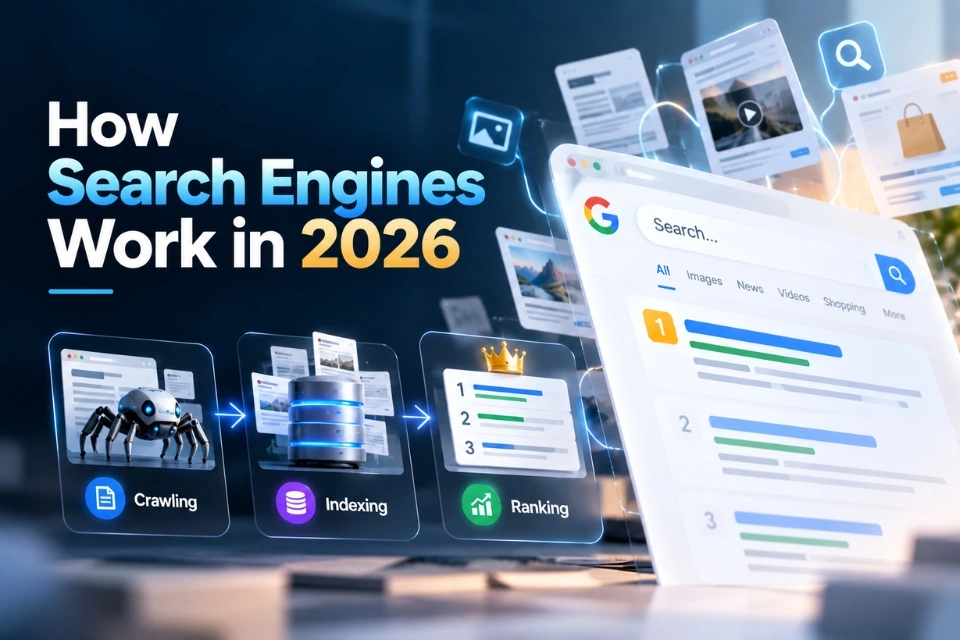
Search engines discover and fetch resources, process their contents into searchable indexes, interpret a query, retrieve relevant candidates, and rank selected results. Generative search adds a synthesis layer: an AI model uses retrieved information to produce an answer, often with citations. Neither a high ranking nor a citation guarantees accuracy or complete coverage.
Search in 2026 can return links, images, maps, excerpts, and conversational answers within the same interface. Understanding how those outputs are produced helps researchers distinguish a useful lead from verified evidence.
The transition from keywords to semantic and conversational discovery is explored in AOFIRS’ Information Retrieval in the Age of AI. The underlying stages remain distinct, even when a product presents them as one seamless answer.
The Classic Search Pipeline
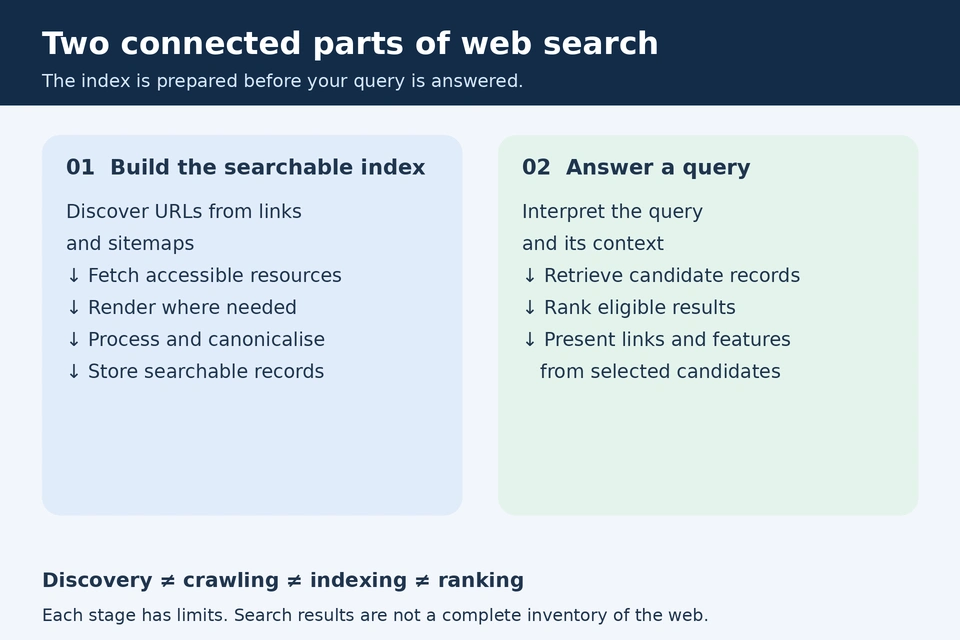
A conventional web search engine prepares its index before answering queries. Discovery, crawling, rendering, and indexing build that searchable representation; query interpretation, retrieval and ranking use it. Real systems can repeat these operations, run them in parallel and update different resources at different times.
1. Discovery and Crawling
Links, sitemaps and previously known URLs help a system discover resources. A crawler then requests selected URLs and receives content, redirects or errors. Scheduling determines what gets fetched and revisited; discovering a URL does not guarantee crawling.
2. Rendering and Processing
Rendering can expose content added by JavaScript after the initial HTML arrives. Processing extracts useful information and handles duplicates. A page may be accessible while important content remains unavailable because it requires an interaction or blocked resource.
3. Indexing
The system stores a searchable representation of eligible content, including information such as text, titles, links and language. It searches that infrastructure instead of rereading the entire web for every question. Crawling alone does not guarantee inclusion.
4. Retrieval and Ranking
The system interprets a query, identifies possible matches and prioritises eligible candidates. Presentation may combine ordinary links with specialised results. Being indexed does not guarantee visibility for every query.
Google’s overview of crawling, indexing, and serving results describes these broad stages. Its JavaScript search guidance also explains why fetching HTML and rendering a page are different operations.
Crawl Controls and Canonical URLs
A robots.txt rule controls crawler access; it is not a reliable way to hide confidential information. Google may still list a blocked URL discovered elsewhere. A noindex instruction must be accessible to the crawler to be read. Use authentication for private material, and consult Google’s robots.txt documentation for these distinctions.
Several URLs can contain substantially the same content, such as tracking variants or printer versions. Search engines select a representative canonical URL. Redirects and canonical annotations provide signals, but the selected version is not necessarily the earliest publication. Google’s duplicate-URL guidance explains those signals. Search visibility alone cannot establish authorship or provenance.
Why a Page Can Exist but Remain Invisible
Consider an archive record reached only after submitting a database form. A researcher can open the record in a browser, yet a general search engine may never discover a stable URL for it. A newly published report presents a different problem: its URL may be known, but processing and inclusion may not have occurred. These are access and timing limits, not evidence that the records are absent.
For source tracing, distinguish the document’s stated publication date from the date you discovered it. Compare versions, check the issuing organization, and look for earlier references. An indexed copy, a canonical URL, and the original publication are different things; the most visible version may not establish where a claim began.
What Happens When You Enter a Query?
A system may interpret spelling, language, synonyms, entities, location, and likely intent. It can reformulate a query before retrieving candidates. Your entered words and the system’s internal retrieval operations therefore need not be identical.
Exact wording still matters when checking a quotation, identifier, or technical term. Operators also vary across engines: the AOFIRS Search Query Matrix helps researchers compare syntax and construct more deliberate searches.
| Retrieval approach | How it helps |
|---|---|
| Lexical | Matches terms or phrases. An inverted index associates terms with documents containing them. |
| Semantic | Uses representations of meaning, such as embeddings, to find related material with different wording. |
| Hybrid | Combines lexical and semantic methods, balancing explicit terminology with conceptual similarity. |
Ranking Is Not Verification
Retrieval identifies candidates; ranking prioritizes them. Relevance, quality, freshness, context, links, spam detection, and duplicate handling can influence results. There is no universal public formula or fixed weighting for every engine and query. Google’s ranking systems guide describes several systems rather than one simple checklist.
A prominent result can contain an error, while a less visible document can hold decisive primary evidence. News, images, and local, and organic results may also involve different systems. Treat rank as a discovery signal, then assess the document itself.
Precision, Meaning and Search Intent
A hypothetical query for a particular report number illustrates lexical precision: the identifier can distinguish the required document from hundreds of related pages. A broader question about the report’s subject may benefit from semantic retrieval because relevant sources use different terms. Researchers can use both approaches, first identifying vocabulary and then testing exact names, phrases, or references.
Intent also changes the evidence required. A request for an explanation, an official document, and a recent update can concern the same topic but call for different sources. Make the information need explicit. When results look plausible yet answer a neighboring question, reformulate the query instead of assuming that higher-ranked material satisfies the original research task.
How Generative Search Changes the Pipeline
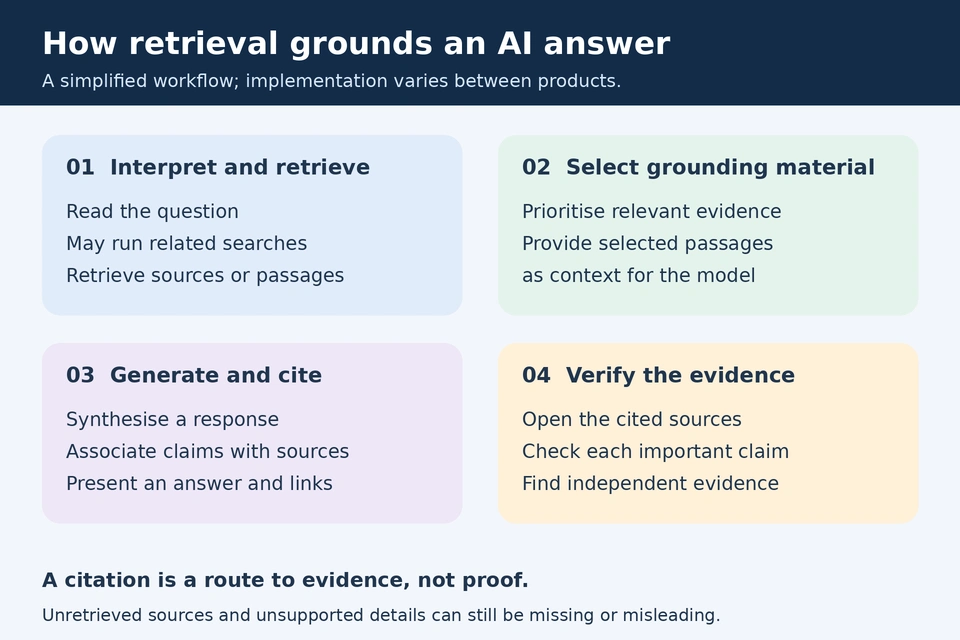
Generative search commonly adds answer generation to retrieval. The system interprets a question, retrieves sources or passages, selects grounding material and asks a model to synthesise a response. It may then associate claims with citations. This is a simplified architecture, not a description of every product’s internal implementation.
Retrieval-Augmented Generation and Query Fan-Out
Retrieval-augmented generation (RAG) combines a generative model with externally retrieved information. Selected evidence becomes context for the response. The original RAG research paper describes an approach that combines parametric model knowledge with retrieved documents; current implementations vary.
Some systems split a question into related searches. Google states that AI Overviews and AI Mode may use query fan-out in its AI search features documentation. This can broaden discovery, but users may not see every query or rejected source.
Not every chatbot response uses live search. A model-only answer differs from one grounded in retrieved sources, and neither guarantees that all relevant evidence was considered. AOFIRS’ guide to the shift from keywords to conversations provides further context for this change in the search experience.
Source Selection Creates Another Research Boundary
Imagine asking how AI search has changed research since 2024. A system could investigate citation behavior, semantic retrieval, and researcher workflows separately. That decomposition may uncover useful material, but an omitted subquestion can leave an entire line of evidence unexplored. The coherent final response does not reveal whether alternative terminology or contrary findings were considered.
Selection can continue after documents are retrieved. A useful passage may become grounding context while surrounding qualifications are excluded. The model then creates new wording from that context, and citations expose selected source connections. Researchers should therefore distinguish retrieved documents, passages supplied to the model, and claims finally displayed. None is necessarily a complete representation of the previous stage.
Classic Search vs Generative Search
| Feature | Classic search | Generative search |
|---|---|---|
| Main output | Ranked links and search features | Synthesised answer with selected sources |
| Synthesis | Primarily performed by the researcher | Partly performed by a model |
| Source visibility | Results expose selected documents | Citations expose only part of the evidence used |
| Main verification task | Check each document’s claims | Check both sources and generated claims |
| Coverage limit | Accessible and selected indexed material | Accessible, retrieved and selected grounding material |
The categories overlap: modern products can combine both experiences. Generated answers may accelerate exploration and suggest useful terminology, but their compression can hide contradictory evidence, alternative interpretations, or neighboring sources.
Why Citations and Search Coverage Need Checking
A citation is a route back to evidence. It may support only one part of a sentence, point to a secondary account, or fail to justify the model’s stronger conclusion. A real source can coexist with an inaccurate summary. Follow AOFIRS’ method for verifying AI answers and citations when assessing consequential claims.
Neither classic nor generative search inventories the whole internet. Authenticated portals, specialist databases, dynamic records, poorly linked pages, archives, and newly published documents can be absent. AOFIRS’ research on AI search and hidden-web access examines this boundary, while its AI vs. the Hidden Web visual guide illustrates the coverage problem.
A Worked Citation Check
Suppose a generated answer states that a study proves a technique is universally effective. Opening its citation reveals a secondary article describing a small study in one setting. The link is genuine, but it does not establish the answer’s broad conclusion. Find the original study, examine its population and method, and compare the authors’ actual language with the generated statement.
If the study reports a possible association, retain that qualification. Check whether the answer changed the date, denominator, or scope of a statistic. Then seek independent evidence rather than counting repeated summaries of the same study. This example shows why verification operates at claim level: one accurate detail cannot validate every assertion in a paragraph.
A Practical Verification Workflow
- Use answers as leads. Collect terminology, organizations, and possible primary records.
- Open consequential citations. Compare the exact wording, figures, dates, and scope with the source.
- Trace the origin. Locate the underlying study, filing, official record, or dataset.
- Search independently. Change terminology, engine, date range, and source type; seek contradictions and corrections.
- Check independence. Several pages repeating one source are not separate corroboration.
- Record the trail. Save prompts, queries, dates, documents examined, and unresolved limitations.
The AOFIRS report on verification methods for public and private information expands this approach to source tracing and evidence assessment. The objective is a reviewable conclusion supported by documents, rather than confidence derived from presentation.
Make the Research Trail Reviewable
For an important question, keep a compact evidence log: the prompt or query, search system, search date, document URL, primary source, and the claim it supports. Add a note explaining any disagreement between the source and the generated answer. Recording unsupported claims is as useful as recording confirmed ones because it shows where further investigation is needed.
Separate discovery from your final conclusion. An AI answer can suggest a source without supporting a claim; a source can support a narrow finding without justifying a broader interpretation. State remaining coverage limits, including databases or records you could not examine. This makes the research easier to review even when another person receives different search results or generated wording.
Frequently Asked Questions
How do search engines work?
They discover resources, crawl and process content, build searchable indexes, interpret queries, retrieve candidates, rank results and present selected information.
What is the difference between crawling and indexing?
Crawling fetches a resource. Indexing processes it into searchable infrastructure. A fetched page may never be indexed.
Why does rendering matter?
JavaScript can add content after HTML arrives. Rendering may reveal it, provided the required resources and interactions are accessible.
Does the highest-ranked result prove a claim?
No. Ranking estimates relevance or usefulness; researchers still need to check evidence, provenance, and independent corroboration.
What is retrieval-augmented generation?
RAG supplies externally retrieved information as context for a generative model, helping ground its answer in selected material.
Does every chatbot search the web?
No. Whether retrieval occurs depends on the product, mode, and request. Check the actual sources and retrieval behavior.
Does an AI citation guarantee accuracy?
No. Open the source and confirm that it supports each important claim, including qualifications and dates.
Can AI search miss important information?
Yes. Access restrictions, index coverage, retrieval choices, and source selection can leave relevant documents out of the answer.
Conclusion
Search engines still depend on discovery, crawling, indexing, retrieval, and ranking. Generative search adds selected evidence, model synthesis, and citations, making the experience more conversational while introducing another layer to inspect.
Reliable research continues beyond the results page. Open sources, trace claims, compare independent evidence, and document what remains uncertain. Understanding how a system retrieves information helps you recognize what its answer may have missed.