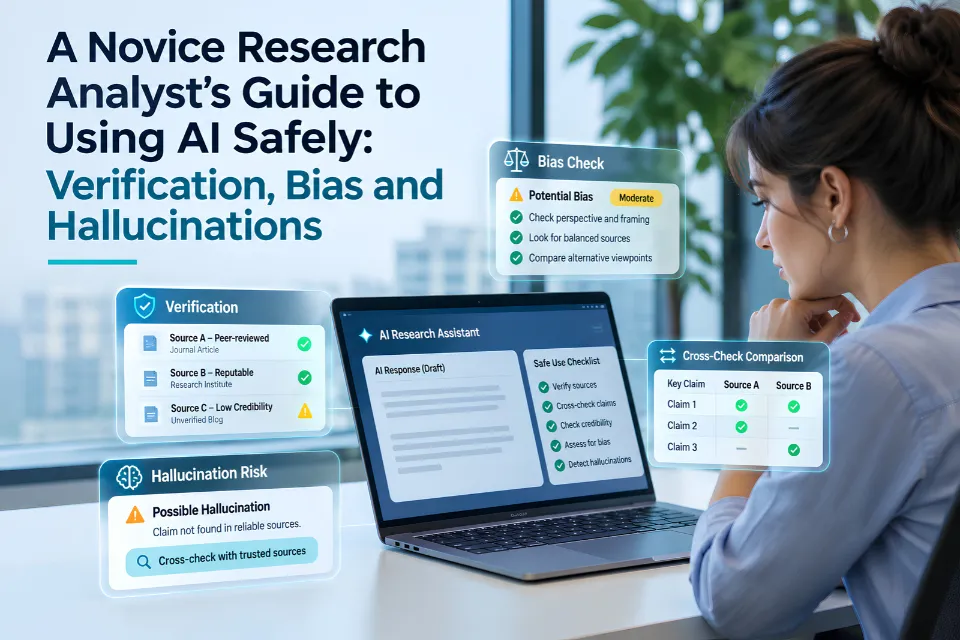
AI tools can save a new research analyst hours of work: they suggest search terms, summarize long papers and draft outlines in seconds. They can also put errors into a report that look exactly like facts. For a novice, the safest change of mindset is to stop treating AI as an “answer engine” and start treating it as a collaborative assistant that needs constant supervision. This guide explains how to do that in practice: where AI helps, why it fails, how to check a claim it gives you, and which skills to build first. For prompt technique in more depth, see prompt engineering for researchers; for a full citation-checking workflow, see verify AI answers and citations.
1. Start With a “Cautious Optimist” Approach
A novice analyst should adopt a “Cautious Optimist” approach. The goal is to use AI to speed up academic and professional work without handing over the critical thinking that defines good research. Three habits put that into practice.
Use AI for assistance, not replacement
Give AI the labor-intensive tasks: generating initial keywords and synonyms, summarizing long documents you will then read, drafting a structure for a report, or listing the kinds of sources that might hold an answer. Keep the final analysis and the conclusions for yourself. A useful test: if a sentence in your report would change a decision, a person must have checked the evidence behind it.
Treat prompts as part of your method
Prompts behave like research instruments, and small changes can move the results a long way. In one study, subtle changes to the formatting of a few-shot prompt, not to its meaning, changed one open model’s accuracy on the same task by up to 76 percentage points (Prompt formatting sensitivity study). Keep a prompt log: the tool and model version, the date, the exact prompt, and which version produced output that held up when you checked it. The log helps you retrace the method, explain it to a supervisor, and identify misleading prompts. Repeating a prompt does not guarantee identical output.
Treat every output as a hypothesis
An AI summary is a claim about a source, not the source itself. If AI summarizes a paper, read at least the abstract, methods and the passages it relies on before you repeat the summary. If it gives you a statistic, find where the number comes from. Until you have done that, label the output in your notes as “unverified”.
2. Why AI Produces Flawed Research
The root of most problems is how generative models work. A large language model predicts the next likely word (token) in a sequence; generative models “approximate the statistical distribution of their training data” (NIST generative AI risk profile). That process produces fluent text, but next-token prediction alone does not establish whether the text is true; retrieval and verification tools provide separate checks. NIST calls the resulting failure “confabulation”: systems that “generate and confidently present erroneous or false content”, including confabulated citations (NIST generative AI risk profile). Research literature usually calls it hallucination (Hallucination research survey).
| Flaw type | What it is | Typical consequence | Verification action |
|---|---|---|---|
| Hallucination (confabulation) | Plausible but false content, including invented sources (NIST generative AI risk profile) | Nonexistent citations, wrong figures, or misattributed quotes | Open cited sources and trace numbers to their origin |
| Algorithmic bias | Amplification of historical and systemic bias or a narrowed range of outputs (NIST generative AI risk profile) | Stereotypes or missing viewpoints, regions, and communities | Identify omissions and search deliberately for underrepresented sources |
| Contextual blindness | Missing local, recent, or cultural context | Misread events or political and cultural circumstances | Check with sources close to the subject |
| Over-reliance | Accepting summaries without reading primary evidence | Reports with unchecked errors | Keep human checks where claims enter the report |

Fabricated and distorted citations
Fabricated references are the best-measured form of hallucination. In a peer-reviewed study of 84 short literature reviews written by ChatGPT, 55% of the GPT-3.5 citations and 18% of the GPT-4 citations referred to works that do not exist, and many of the real citations contained substantive errors (AI citation fabrication study). Those results describe the models and tasks tested in 2023, rather than the current error rate of every AI tool. The lesson for a novice holds: a reference that looks correct is not evidence until you have opened it. Why fluent AI answers feel more trustworthy than they are is covered in why people trust AI hallucinations.
Bias and missing perspectives
Bias is harder to see than a fake citation because nothing looks wrong. If a model’s training data over-represents some countries, languages or groups, its answers will too. When AI gives you a list of “key sources” or “main viewpoints”, treat it as a starting sample and ask what a researcher from another region, discipline or community would add.
3. Worked Example: Verifying an AI-Generated Claim
Suppose an AI assistant gives you this sentence for a briefing on AI risks: “A 2023 study in Nature found that more than half of the citations ChatGPT produced were fake.” It sounds specific and credible. Here is how to check it against the primary source.
- Break the claim into checkable parts. There are four: a study exists; it was published in 2023; it appeared in Nature; it found that more than half of ChatGPT’s citations were fake. Each part can be wrong on its own.
- Find the primary source, not a summary of it. Search a scholarly index (Google Scholar or PubMed) for terms such as ChatGPT fabricated citations 2023. The likely match is Walters and Wilder, “Fabrication and errors in the bibliographic citations generated by ChatGPT”, Scientific Reports, 13, 14045. Resolve its DOI (10.1038/s41598-023-41032-5) to reach the publisher’s page rather than a blog post about it.
- Read the methods before the headline. The authors had GPT-3.5 and GPT-4 write 42 short literature reviews each (84 papers) and checked all 636 citations in them (AI citation fabrication study). The finding is about those models, on that task, in 2023.
- Compare the numbers. The paper reports 55% fabricated citations for GPT-3.5 and 18% for GPT-4, and that 43% (GPT-3.5) and 24% (GPT-4) of the real citations contained substantive errors.
- Rate each part of the claim. The study exists and dates from 2023: correct. “In Nature”: wrong; Scientific Reports is published on nature.com but is a different journal. “More than half”: true only for GPT-3.5, not for GPT-4. “ChatGPT” without a model version: misleading.
- Rewrite the claim and log it. Corrected sentence: “A 2023 study in Scientific Reports found that 55% of citations generated by GPT-3.5, and 18% of those generated by GPT-4, referred to works that do not exist (AI citation fabrication study).”
A matching evidence-log entry might read:
| Field | Entry |
|---|---|
| Claim as received | “A 2023 study in Nature found more than half of ChatGPT’s citations were fake” (AI assistant, prompt 14) |
| Primary source | Walters & Wilder (2023), Scientific Reports 13, 14045; DOI 10.1038/s41598-023-41032-5 |
| What the source says | 55% fabricated for GPT-3.5 and 18% for GPT-4; 636 citations in 84 reviews |
| Verdict | Partly accurate: wrong journal; the majority figure applies to one model |
| Confidence | High for this source-specific finding after checking methods and results |
This check corrects the journal name and qualifies the numerical result by model version. It illustrates how a plausible statement can mix accurate details with errors and overgeneralization.
4. Factors to Consider Before Reaching Conclusions
Before a research report is finalized, check these factors to make sure its conclusions rest on evidence:
- Triangulation and cross-referencing: A conclusion should never rest on a single AI-generated data point. Find at least two independent, credible sources for any claim that matters.
- The “So What?” test: AI can identify patterns, but people decide what they mean. Ask why the finding matters to the stakeholder who will read the report.
- Traceability: Can each conclusion be traced back to the raw data and sources? If the path from data collection to conclusion is hidden inside an AI tool, the conclusion is not yet supported.
- Ethical standards and transparency: Apply the principles of fairness, accountability, transparency and ethics (often shortened to FATE) and say which parts of a report used AI assistance. Disclosure is becoming a legal expectation in some settings: under Article 50(4) of the EU AI Act, deployers who publish AI-generated text to inform the public on matters of public interest must disclose it, subject to the article’s scope and exceptions, including human review or editorial control together with a person or organization holding editorial responsibility (EU AI transparency obligations).
5. Skills Required to Vet Online Data
Vetting data when deepfakes and AI-generated misinformation are common needs a skill set that blends traditional journalism with data literacy.
Stylometric clues, and their limits
Analysts are often told to spot AI writing by its style: repetitive structure, no personal detail, and low “burstiness”, which GPTZero defined as how much a document’s writing patterns vary across its sentences (GPTZero detector methods). Use these clues only as a reason to check where a text came from, never as proof. GPTZero itself says it stopped relying on perplexity and burstiness in 2023 (GPTZero detector methods). OpenAI withdrew its own AI-text classifier in July 2023 “due to its low rate of accuracy”; in its tests it caught 26% of AI-written text and wrongly flagged 9% of human text (OpenAI classifier limitations). Seven detectors tested on essays by non-native English writers flagged them as AI-generated with an average false-positive rate of 61.3% (AI detector bias study). Accusing a real author on the basis of a detector score is a research error in its own right.
Source pedigree assessment
Tell original reporting apart from content farms and syndicated marketing copy. Trace a story back to its earliest digital footprint: the first publication, the original dataset, the named person who said it. If every version of a claim leads back to the same unnamed source, you have one source, not many.
Detecting marketing bias
Learn to distinguish objective research from native advertising: content designed to look like a report but written to sell a product. Check who published it, who paid for it, whether the methodology is disclosed, and whether the conclusions happen to favor the publisher’s product.
Adversarial thinking
Develop a skeptic’s lens. Look deliberately for reasons a source might be biased, and for signs that a dataset has been corrupted, for example by bot-generated survey responses or coordinated accounts. Ask what evidence would prove your conclusion wrong, and go looking for it.
Conclusion: Use AI for Speed, Keep Responsibility for the Evidence
A novice analyst does not need to avoid AI to produce reliable research. Start with tasks you can check: refining search terms, organizing notes, and drafting from sources you have read. Treat generated claims as unverified until you trace them to evidence, confirm the context, and record what supports them.
Before submitting a report, check its consequential claims and citations, look for missing perspectives, document uncertainty, and explain where AI assisted the work. Keep sensitive information within approved tools and follow your organization’s disclosure rules. The goal is a report whose evidence another person can inspect and whose conclusions you can defend.
References
- European Commission. (2026). AI Act, Article 50 [Consolidated text with Digital Omnibus amendments]. AI Act Service Desk. Retrieved 4 November 2026, from EU AI transparency obligations
- Ji, Z., Lee, N., Frieske, R., Yu, T., Su, D., Xu, Y., Ishii, E., Bang, Y., Chen, D., Dai, W., Chan, H. S., Madotto, A., & Fung, P. (2023). Survey of hallucination in natural language generation. ACM Computing Surveys. Hallucination research survey (hallucination survey preprint)
- Liang, W., Yuksekgonul, M., Mao, Y., Wu, E., & Zou, J. (2023). GPT detectors are biased against non-native English writers. Patterns, 4(7), 100779. AI detector bias study
- National Institute of Standards and Technology. (2024). Artificial intelligence risk management framework: Generative artificial intelligence profile (NIST AI 600-1). NIST generative AI risk profile
- OpenAI. (2023, January 31; updated 2023, July 20). New AI classifier for indicating AI-written text. OpenAI classifier limitations
- Sclar, M., Choi, Y., Tsvetkov, Y., & Suhr, A. (2024). Quantifying language models’ sensitivity to spurious features in prompt design or: How I learned to start worrying about prompt formatting. International Conference on Learning Representations (ICLR 2024). Prompt formatting sensitivity study
- Tian, E. (2023, March 1). Perplexity, burstiness, and statistical AI detection. GPTZero. GPTZero detector methods
- Walters, W. H., & Wilder, E. I. (2023). Fabrication and errors in the bibliographic citations generated by ChatGPT. Scientific Reports, 13, 14045. AI citation fabrication study