
Choosing a background check website starts with one question: what are you legally and practically trying to do?
A business screening a job applicant needs a very different service from someone trying to reconnect with an old contact, identify an unfamiliar phone number or search public records. Treating those services as interchangeable can produce inaccurate results and, in employment or housing decisions, create legal problems.
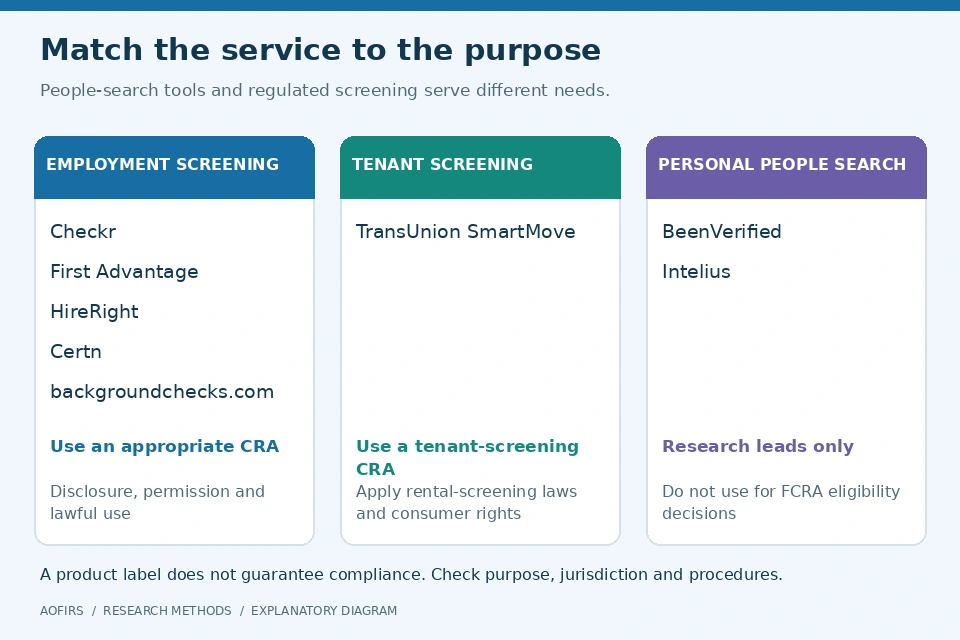
For professional employment screening, this guide compares five consumer reporting agencies (CRAs): Checkr, First Advantage, HireRight, Certn and backgroundchecks.com. They differ mainly in scale, pricing model and how they combine database and court searches.
For tenant screening, TransUnion SmartMove is a dedicated tenant-screening service and is the appropriate category of tool, not a consumer people-search website. For personal public-record research and personal people search, BeenVerified and Intelius can generate leads, but both state that they are not consumer reporting agencies, so they must stay outside employment, housing, credit, insurance and other decisions covered by the Fair Credit Reporting Act (FCRA).
2027 edition, evidence checked 20 November 2026. This guide uses provider documentation and current FTC, CFPB, EEOC and statutory sources. Published prices are a November 2026 snapshot, not a guarantee of 2027 pricing. People-search descriptions use official app listings; website subscription prices were not independently confirmed. Confirm the current package, fees and permitted use before ordering.
Quick Answer: Which Service Fits Which Purpose
Matched to purpose, the services compare as follows:
- Employment screening with published self-service prices and an API: Checkr
- Enterprise and multi-country screening: First Advantage
- Complex international and regulated-industry programmes: HireRight
- Low published entry price for small and midsize businesses: Certn
- U.S. criminal searches that layer a database with county courts: backgroundchecks.com
- Independent-landlord tenant screening: TransUnion SmartMove
- Personal people search and contact research: BeenVerified
- Structured U.S. public-record leads: Intelius
- Free starting points: official records and limited self-report tools can help, but do not assume that any free product provides a comprehensive professional screening report.
No single service suits every kind of background research. A platform designed for personal people search should not be substituted for a consumer reporting agency when a decision involves employment, housing, credit, insurance or another FCRA-regulated purpose.
Background Check Services Compared
| Provider | Fits | Service type | FCRA screening | Entry price (checked 20 Nov 2026) | Coverage |
|---|---|---|---|---|---|
| Checkr | Employment screening, self-service and API | CRA / background screening | Yes, for supported employment screening | $29.99 per report plus pass-through fees | U.S., international from $32 per check |
| First Advantage | Enterprise and global screening | Background screening and identity | Yes, where applicable | Quote | 200+ countries and territories (company figure) |
| HireRight | Complex global and regulated-industry screening | Background screening | Yes, where applicable | Quote | 200+ countries and territories (company figure) |
| Certn | SMB self-service screening | Background screening | Yes, where applicable | $13.99 U.S. Core, plus $9.99 county search where applicable | International |
| backgroundchecks.com | U.S. criminal searches | CRA / background screening | Yes, for supported uses | Current price not verified; check account options | Primarily U.S. |
| TransUnion SmartMove | Tenant screening | Tenant-screening consumer reports | Yes, for supported rental screening | $25 | U.S. |
| BeenVerified | Personal people search | People search, not a CRA | No | Subscription; price not re-verified | Primarily U.S. |
| Intelius | Public-record leads | People search, not a CRA | No | App lists single reports at $19.99 | Primarily U.S. |
The table lists published entry prices only. Pass-through court, DMV and database access fees, taxes and add-ons can raise the final cost. AOFIRS did not purchase or test any of these services for this edition (see the method below).
What Is a Background Check Website?
A background check website is a service that gathers or verifies information about a person from one or more data sources. Depending on the service, those sources can include court records, criminal databases, government records, property records, credit information, driving records, employment records, education records, professional licences, contact databases and other public or commercial information.
The phrase “background check website” is broad. It can describe both a regulated employment-screening company and a consumer site that aggregates publicly available information.
That distinction matters.
A criminal-record result appearing on a people-search site does not make that site suitable for employment screening. Likewise, a reverse-phone database and an employment consumer report may contain some overlapping information while being governed by entirely different rules and quality-control processes.
People Search vs. Professional Background Screening
| Question | Consumer people-search service | Professional CRA/background screener |
|---|---|---|
| Main purpose | Personal information research and public-record discovery | Eligibility-related screening such as employment or tenancy |
| Common searches | Name, phone, email, address, relatives, property, public records | Criminal records, employment, education, MVR, identity, credentials, sanctions |
| FCRA consumer report | Usually no | Often yes for covered U.S. purposes |
| Employment decisions | Generally prohibited by service terms | Supported when legal requirements are met |
| Tenant decisions | Generally prohibited by service terms | Supported by appropriate tenant-screening CRAs |
| Candidate/applicant authorization | Usually not part of ordinary people search | Often legally required |
| Adverse-action workflow | No | Commonly supported |
| Consumer dispute rights under FCRA | Not simply because the site displays public data | Apply to covered consumer reports |
| Best use | Research leads that should be independently verified | Regulated screening within an appropriate compliance process |
Under the FCRA, an employer that obtains a consumer report for employment purposes must give a clear written disclosure in a document that consists solely of that disclosure, obtain written authorization, and, before taking adverse action based on the report, give the person a copy of the report and a description of their rights (15 U.S.C. § 1681b). The FTC and EEOC’s joint guidance adds that federal anti-discrimination rules apply to any background information an employer uses, whatever its source, and state and local laws can add further restrictions (FTC & EEOC, 2014).
This is why describing a service simply as “FCRA-compliant” can be misleading. FCRA compliance is not a product certification. It depends on the report, provider, purpose, user, procedures followed, applicable jurisdiction and how the information is used.
How We Compared These Services
Documentation review only. No reports were purchased, ordered or tested for this update. The comparison uses published product, pricing and legal-use documentation, official app listings, company disclosures, FTC materials and the relevant statutes. Provider descriptions of accuracy, coverage or turnaround are attributed claims, not AOFIRS test results.
The comparison considers the following factors; no numerical provider scores were calculated:
| Evaluation factor | What to check |
|---|---|
| Data coverage and source capability | Actual sources and jurisdictions |
| Accuracy and verification safeguards | Identity matching, source verification and updates |
| Legal-use and compliance transparency | Permitted purposes and user duties |
| Search/workflow/API functionality | Required searches and integrations |
| Privacy and consumer controls | Disputes, suppression, retention and access |
| Pricing and pricing transparency | Package price, extra fees and subscriptions |
| Support and documentation transparency | Clear documentation and correction processes |
Providers are grouped by service type: employment screeners first, then the tenant screener, then personal people-search services. Numbering is for navigation. The guide does not award accuracy scores or claim that one provider is universally best.
We gave more weight to source quality and legal-use clarity than to claims such as “billions of records” or “instant results”. Large databases can be useful discovery tools, but record count alone does not prove that a report is complete, current, correctly matched to the person or suitable for a consequential decision.
Verification snapshot: 20 November 2026. The source types and remaining limitations are shown below.
| Provider | Price source | Status of check |
|---|---|---|
| Checkr | Checkr pricing page | Verified 20 Nov 2026 |
| First Advantage | Quote only; company figures from its About page | Verified 20 Nov 2026 |
| HireRight | Current quote required; provider brochure | Brochure reviewed; website text could not be fully inspected |
| Certn | Certn U.S. pricing page | Verified 20 Nov 2026 |
| backgroundchecks.com | Current product page | Legacy package URL unavailable; current price not verified |
| TransUnion SmartMove | SmartMove pricing page | Verified 20 Nov 2026 |
| BeenVerified | Google Play listing | Official app listing reviewed; website price not verified |
| Intelius | Apple App Store listing | Official app prices reviewed; website price not verified |
What Changed from the Previous AOFIRS Edition
Several services in older lists should no longer be treated as independent competitors.
First Advantage completed its $2.2 billion acquisition of Sterling Check on 31 October 2024 (First Advantage, 2024). Sterling therefore does not have a separate entry here.
Checkr announced its acquisition of GoodHire on 12 April 2022 (Checkr, 2022). Checkr’s FAQ for GoodHire customers describes Inflection as the company “whose flagship brand GoodHire” it acquired and says customers should not expect immediate changes to the GoodHire product or brand (Checkr). GoodHire may still be relevant as a product, but it is not an unrelated competitor to Checkr.
Intelius, TruthFinder, Instant Checkmate and US Search are all brands of PeopleConnect, which also lists Classmates (PeopleConnect). Ranking several closely related services as though they were independent data strategies makes a comparison look broader than it is.
The previous article also contained AI, record-count, accuracy and FCRA claims that could not all be substantiated from current primary documentation. Those claims have not been carried forward, and in this update any claim that could not be re-checked on 20 November 2026 has been removed or marked.
The Background Check Services, Reviewed
1. Checkr: Employment Screening with Self-Service Pricing and an API
Fits: employment screening · Type: consumer reporting/background-screening provider · FCRA use: yes, for supported employment purposes · Coverage: U.S. with international checks · Entry price: $29.99 per report plus pass-through fees · Free search: no · Checked: 20 November 2026
Checkr fits employers seeking a combination of criminal searches, identity verification, integrations, an API and published self-service pricing.
Checkr lists Basic at $29.99, Essential at $59.99 and Complete at $94.99 per report. Basic includes an SSN trace, sex offender registry, global watchlist and national criminal search. Essential adds identity verification and unlimited county criminal searches. Complete adds unlimited state criminal searches and a federal criminal search. Court and database access fees may be additional. Enterprise pricing requires a quote; check the current pricing page for other products and add-ons (Checkr).
Checkr is one of the few providers here whose AI claims are tied to specific documented functions. Its technology page says a machine-learning “charge classifier” categorises criminal charges, that report-completion estimates use “millions of data points from county courts”, and that its compliance engine “filters out any information that is not legally reportable” (Checkr). These are the company’s own descriptions; AOFIRS has not tested them.
Pros
- Published entry-level pricing
- County, state, federal, national and watchlist options
- Identity verification in higher packages
- Open API and extensive integration strategy
- Documented machine-learning applications
- Candidate portal and report-access processes
- Compliance-oriented workflows
Cons
- Pass-through fees can increase actual cost
- More extensive packages become expensive for low-volume businesses
- Compliance software does not remove the employer’s own legal responsibilities
Consider Checkr if you need an API-friendly employment screening service with automation, configurable searches and self-service access.
Look elsewhere if you only need an occasional personal people search or a reverse-phone lookup.
2. First Advantage: Enterprise and Global Screening
Fits: large enterprises and multinational screening · Type: background screening and identity platform · FCRA use: yes, where applicable · Coverage: 200+ countries and territories (company figure) · Entry price: custom quote · Free search: no · Checked: 20 November 2026
First Advantage is an enterprise-scale provider with a broad international screening portfolio.
The company reports 80,000 customers, more than 200 million screens a year, coverage of more than 200 countries and territories, more than 100 ATS and HCM integration partners and more than one billion records in proprietary databases, all as stated in its company disclosures (First Advantage). These are company disclosures, not independent measurements.
Its product portfolio includes criminal background screening, identity solutions, credential verification, drug and health screening, and continuous monitoring.
On automation, First Advantage says approximately 90% of its U.S. criminal searches “utilize intelligent automation” (as stated in its company disclosures) and that candidate data collected upfront feeds automatically into background-check forms (First Advantage). Its identity products use automated analysis of identity documents.
The biggest structural change is Sterling. Because First Advantage completed its acquisition of Sterling in October 2024, organisations comparing “First Advantage vs. Sterling” should check which legacy products, contracts or workflows remain distinct rather than assuming they are unrelated providers.
Pros
- Extensive global reach
- Enterprise-scale infrastructure
- Large ATS/HCM integration ecosystem
- Identity, screening and monitoring capabilities
- Documented automation
- Fits multinational programmes
Cons
- Pricing generally requires sales engagement
- May be more platform than a very small employer needs
- Exact availability still varies by country, source, product and law
Consider First Advantage if you are managing high-volume or multi-country screening and need a broad enterprise platform.
Look elsewhere if transparent, immediate pay-per-check pricing is your main priority.
3. HireRight: Complex Global and Regulated-Industry Screening
Fits: global organisations, transportation and complex screening programmes · Type: background-screening provider · FCRA use: yes, where applicable · Coverage: 200+ countries and territories (company figure) · Entry price: quote · Free search: no · Checked: 20 November 2026
HireRight is an enterprise provider suited to programmes that combine several kinds of checks across multiple jurisdictions. Its 2026 life-sciences brochure describes global screening and integration capabilities; confirm the exact service and local availability in a current proposal.
HireRight describes criminal-record searches, employment and education verification, identity checks, drug and health screening, driving checks and related services. Its official brochure states that its platform supports more than 200 countries and territories and more than 70 ATS integrations. These are provider-reported coverage figures; source access and legal requirements differ by location (HireRight).
HireRight’s candidate help pages explain where its information comes from, but their text loads by script and could not be re-read for this update. The general point stands on other evidence: there is no single database holding everyone’s complete background. Employment and education usually need direct verification, and criminal history is researched in court and government records (see “How Background Check Websites Find Information” below).
Pros
- Long international screening experience
- Fits complex enterprise programmes
- Employment, identity and criminal verification
- Transportation-focused screening capabilities
- API/integration support
Cons
- Public pricing is limited
- Turnaround varies significantly by country and source
- Not designed for personal public-record research
Consider HireRight if your organisation needs configurable screening across countries or regulated industries.
Look elsewhere if you want instant public pricing and occasional self-service searches.
4. Certn: Low Published Entry Price and International SMB Screening
Fits: small and midsize businesses wanting published prices · Type: professional screening provider · FCRA use: yes, for applicable supported screening · Coverage: international · Entry price: $13.99 U.S. Core · Free search: no · Checked: 20 November 2026
Certn publishes detailed self-serve prices while still supporting more advanced screening.
Its U.S. Core Criminal Check is $13.99 and covers an SSN trace, national criminal database, sex offender registry, global watchlist and sanctions screening and a contingent county search. Certn says county searches run automatically where applicable for an extra $9.99, and third-party access fees may apply. The $49.99 Complete package includes county searches covering seven years of addresses, and Complete+ at $79.99 adds OneID, education verification and most-recent employment verification (Certn).
OneID costs $3.50 as a standalone check and uses facial recognition to match a real-time selfie with a government-issued identity document (Certn). Certn also lists motor vehicle records ($25.99 plus state fees), a credit report, reference checks, and employment, education and credential verification.
Its social media check ($42.99) identifies risk indicators in candidates’ public posts. This is one area where careful human governance matters. Automated categorisation can help prioritise review, but employers should not treat a flag as verified misconduct or as a hiring decision.
Pros
- Strong pricing transparency
- No need to start with an enterprise contract
- International capability
- Identity, employment and education verification
- API and integrations
- Specific product descriptions rather than vague “AI-powered” claims
Cons
- County and pass-through fees may apply
- Availability varies by jurisdiction
- Automated social-media classifications require careful human review
Consider Certn if you want professional screening without opaque enterprise pricing.
Look elsewhere if you only need personal contact information or reverse-phone research.
5. backgroundchecks.com: Layered U.S. Criminal-Record Searches
Fits: employers combining instant databases with court searches · Type: consumer reporting/background-screening company · FCRA use: yes, for supported professional purposes · Coverage: primarily U.S. · Entry price: current price not verified · Free search: no · Checked: 20 November 2026
backgroundchecks.com illustrates a point many comparison articles miss: a national criminal database search is not the same as searching every courthouse in the United States.
The current product page describes national database, county, statewide and federal criminal searches, plus employment, education, driving and other checks. Pricing is directed to account options. A current public package price was not verified for this update, so confirm the exact searches, fees and turnaround estimate before ordering (backgroundchecks.com).
Database searches and direct courthouse checks are different products. Ask which jurisdictions will be searched and how source updates and possible matches are verified. A fast database result should not be confused with complete coverage.
The current product page presents employment screening as its intended use. The employer still has responsibilities for permissible purpose, disclosure, authorisation and adverse-action procedures.
Pros
- Published individual package pricing
- Strong U.S. criminal-search focus
- Database and courthouse searches can be layered
- API and business screening options
- Useful for organisations wanting granular control
Cons
- Additional courthouse/access fees can apply
- Database results alone should not be treated as universal coverage
- Less suited to a centralised multinational screening programme
Consider it if you need U.S.-focused criminal screening and want control over the sources ordered.
Look elsewhere if global enterprise consistency matters more than granular U.S. search selection.
6. TransUnion SmartMove: Tenant Screening
Fits: independent landlords and smaller property owners · Type: tenant-screening consumer reporting service · FCRA use: yes, for supported rental screening · Coverage: U.S. · Entry price: $25 · Free search: no · Checked: 20 November 2026
Tenant screening should not be improvised with BeenVerified, Intelius, Spokeo or another people finder that is not a consumer reporting agency.
SmartMove is designed for rental screening. It offers combinations of criminal, credit, eviction, income and identity information and a ResidentScore. The prospective tenant takes part in the process and verifies their identity before reports are released to the property owner.
Published packages on 20 November 2026 (plus tax where applicable):
- SmartCheck Basic: $25 (ResidentScore and criminal background report)
- SmartCheck Plus: $42 (adds credit report and eviction-related report; previously $40)
- SmartCheck Premium: $49 (adds income estimator and identity check reports)
Income verification can be added for $11. Owners can pay or, where permitted, pass the cost to the applicant. SmartMove says most reports are delivered the same day after the applicant verifies their identity (TransUnion SmartMove). TransUnion Rental Screening Solutions’ privacy notice sets out FCRA rights, including how to dispute consumer-report information, and state privacy rights (TransUnion Rental Screening Solutions, 2026).
Pros
- Designed specifically for tenant screening
- Applicant identity verification and participation built into the process
- Credit and criminal information
- Eviction-related information in higher plans
- No recurring membership required
- Published pricing
Cons
- U.S.-focused
- Applicant must complete identity verification before reports are released
- Local and state laws can restrict reportable records
- The landlord remains responsible for lawful use and adverse-action obligations
Consider SmartMove if you are an independent U.S. property owner who needs actual tenant screening.
Look elsewhere if you are conducting general investigative research unrelated to housing.
7. BeenVerified: Consumer People Search
Fits: personal public-record and contact research · Type: people-search/data-aggregation service · FCRA use: no · Coverage: primarily U.S. · Price: subscription; not re-verified · Free search: limited search funnel, not a free professional report · Checked: 20 November 2026 (official app listing; website price not verified)
BeenVerified is a personal-research service, not a substitute for eligibility screening. This entry uses its official Google Play listing for product descriptions and FCRA-use restrictions. Website subscription pricing has not been independently confirmed.
The official listing describes people, phone, email, property and vehicle (VIN) searches, and lists dark-web monitoring and unclaimed-money search as website-only features (BeenVerified, 2026).
The most important fact is its legal-use statement. The listing states that BeenVerified is not a consumer reporting agency as defined by the FCRA and points users to its terms for permitted and prohibited uses.
So it should not be used to decide whether to hire an employee, rent to an applicant, extend credit, issue insurance or make another FCRA-regulated eligibility decision. BeenVerified review covers the service in more detail.
Pros
- Multiple search types
- Reverse phone and email research
- Property and vehicle information
- Mobile access
- Useful as an investigative starting point
Cons
- Not for FCRA-regulated screening
- Aggregated information can be incomplete or outdated
- Subscription model
- Results should be verified at original sources
Consider BeenVerified if you need leads for personal public-record research.
Look elsewhere if the result will affect employment, housing, credit, insurance or another regulated eligibility decision.
8. Intelius: Structured U.S. Public-Record Leads
Fits: people, phone, address and public-record discovery · Type: consumer people-search service · FCRA use: no · Coverage: primarily U.S. · Price: app lists single background reports at $19.99 and Premier subscriptions at $9.99 and $19.99 · Free search: search preview only · Checked: 20 November 2026 (official app listing; website price not verified)
Intelius offers people search, reverse phone and address lookup and property research. This entry uses its official Apple App Store listing for functions, use restrictions and app-specific purchase examples. App prices should not be treated as verified website subscription prices.
The listing is explicit about legal limits. It states that Intelius “does not provide ‘consumer reports’ and is not a ‘consumer reporting agency'” under the FCRA, and that its services may not be used to determine eligibility for credit, housing, insurance, employment or any other FCRA purpose (Pubrec, 2025).
Like every people finder, its records are aggregated and can be incomplete or out of date; they should not replace independent due diligence. Intelius review covers it in more detail.
Pros
- People and public-record searches
- Reverse phone and address lookup
- Property information
- Clear current FCRA restrictions
- Useful for generating research leads
Cons
- Not a professional employment or tenant screener
- Subscription model
- U.S.-centric
- Aggregated information requires independent verification
Consider Intelius if you need a structured U.S. people-search and public-record research tool.
Look elsewhere if your decision requires a consumer report.
Background Check Service by Use Case
| Use case | Service that fits |
|---|---|
| Employment screening, self-service and API | Checkr |
| Enterprise/multinational screening | First Advantage |
| Complex international screening | HireRight |
| SMB and self-service business checks | Certn |
| U.S. database + county court searches | backgroundchecks.com |
| Tenant screening | TransUnion SmartMove |
| Personal people search | BeenVerified |
| Public-record/reverse-address research | Intelius |
| Free professional background check | No universal free report; check official sources |
Free vs. Paid Background Check Websites
Do not assume that a free search covers every relevant court, employer, education institution, driving repository or government record. Checkr, for example, lists a free personal profile with selected verifications; that limited product is different from a comprehensive screening package for an employer.
Free people-search sites can be useful for lead generation. Search engines, county court portals, property assessor databases, state licence databases, corporate registries and other official sources can also provide valuable information at no charge.
The trade-off is fragmentation. Researchers must identify the correct jurisdiction, understand what the source covers, disambiguate people with similar names, and verify dates and identifiers.
A paid service can make discovery faster, but payment does not guarantee accuracy.
For regulated screening, a national database is often a starting layer rather than a substitute for source-level verification.
How Background Check Websites Find Information
Background-screening and people-search platforms can draw from combinations of:
- County and state court records
- Federal court records
- Sex offender registries
- Corrections data
- Sanctions and watchlists
- Property and deed records
- Phone and address databases
- Professional licensing agencies
- Education institutions
- Employers or verification services
- Motor vehicle agencies
- Credit bureaus
- Commercial data providers
- Public websites and social platforms
There is no single commercial search that should be assumed to cover every relevant record. Provider documentation distinguishes national databases from county, state and federal searches, as well as employment, education and other verifications. Identify the sources that match the purpose and the jurisdictions involved.
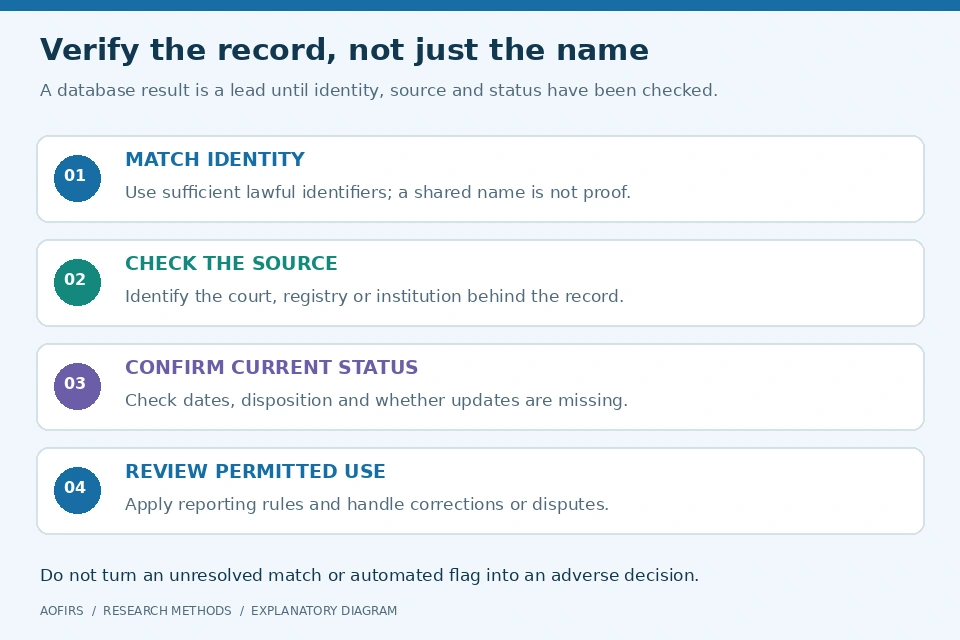
This is why researchers should ask which sources were checked, not just how many records a vendor claims to have. verify people-search results sets out a source-by-source method.
How Accurate Are Online Background Checks?
No background check website should be treated as 100% accurate.
Errors can occur because of:
- Common names
- Similar dates of birth
- Incomplete identifiers
- Old addresses
- Delayed court updates
- Data-entry mistakes
- Duplicate records
- Expunged or sealed information
- Missing jurisdictions
- Incomplete database feeds
- Incorrect entity matching
- Outdated commercial data
For employment reports, the FCRA requires consumer reporting agencies to follow “reasonable procedures to assure maximum possible accuracy” and to investigate disputes. The FTC lists reporting offences that belong to someone else, or including expunged or sealed records, as signs of unreasonable procedures (FTC, 2016). Section 1681k adds that a CRA reporting adverse public-record information for employment must either notify the person at the time or keep strict procedures to ensure the information is complete and up to date (15 U.S.C. § 1681k).
For researchers, the practical lesson is simpler: a database hit should trigger verification, not end the investigation.
If a consequential result says a person has a criminal record, verify the identity and current status at the relevant authoritative source whenever appropriate and legally permitted.
Are Background Check Websites Legal?
Background-check websites are legal to operate and use in many circumstances, but the legality of a particular search or decision depends on the purpose, information, jurisdiction and applicable law.
Personal public-record research is not the same activity as obtaining a consumer report to decide whether someone receives employment or housing.
For U.S. employment screening, 15 U.S.C. § 1681b sets conditions for obtaining and using consumer reports. In the usual employment context, the employer must provide a clear disclosure and obtain written authorization before procuring the report. Before certain adverse actions based on the report, the consumer must receive a copy of the report and a description of FCRA rights.
The joint FTC and EEOC guidance for employers also reminds them that federal anti-discrimination law applies to background information (FTC & EEOC, 2014). One change matters here. On 28 October 2026 the EEOC voted to rescind its 2012 Enforcement Guidance on the Consideration of Arrest and Conviction Records in Employment Decisions, effective immediately. The EEOC stated that Title VII still prohibits race and national-origin discrimination and that the rescission “does not give employers license to engage in unlawful discrimination” (EEOC, 2026). State and municipal fair-chance rules are unaffected by the federal change.
This article is general research information, not individualised legal advice. Background-screening laws vary by jurisdiction and use case. Organisations making regulated decisions should obtain qualified legal guidance appropriate to their circumstances.
What Does an FCRA-Compliant Background Check Mean?
An “FCRA-compliant background check” is not simply a report purchased from a well-known company.
Compliance involves the entire process.
Depending on the situation, that can include:
- Having a legally permissible purpose.
- Making required disclosures.
- Obtaining required authorization.
- Certifying lawful use to the CRA.
- Applying relevant federal, state and local rules.
- Following pre-adverse-action requirements.
- Giving the person an opportunity to review the report.
- Following final adverse-action requirements.
- Respecting dispute and consumer-report rights.
The FTC says that companies selling background screening reports for employment are consumer reporting agencies under the FCRA, even if they do not see themselves that way (FTC, 2016).
This is why a site’s statement that it is “not a consumer reporting agency” should be taken seriously. It means the service is telling users not to use its reports for FCRA eligibility decisions. The FTC has enforced this line: in 2012 Spokeo paid $800,000 to settle charges that it marketed profiles to employers and recruiters without meeting FCRA duties (FTC, 2012).
How Far Back Can a Background Check Go?
There is no universal “seven-year rule” that applies to every record and every jurisdiction.
Under the federal FCRA, civil suits, civil judgments and arrest records generally cannot be reported once they are more than seven years old, or until the governing statute of limitations expires, whichever is longer. Records of criminal convictions are excluded from the seven-year limit. The time limits also do not apply to reports for a job with an annual salary of $75,000 or more (15 U.S.C. § 1681c). State laws can impose further restrictions, and the rules can depend on the type of check and purpose.
A service advertising a fixed nationwide lookback period without explaining jurisdictional differences should therefore be treated cautiously.
Privacy Risks of Background Check and People-Search Websites
People-search engines make fragmented public and commercial information easier to discover. That convenience creates a privacy trade-off.
A report can potentially connect:
- Current and historical addresses
- Phone numbers
- Email addresses
- Relatives or associates
- Property records
- Court information
- Social profiles
- Vehicle information
- Other public or commercial data
Users should review the service’s privacy policy, retention practices, state privacy rights, opt-out process and data-sharing disclosures.
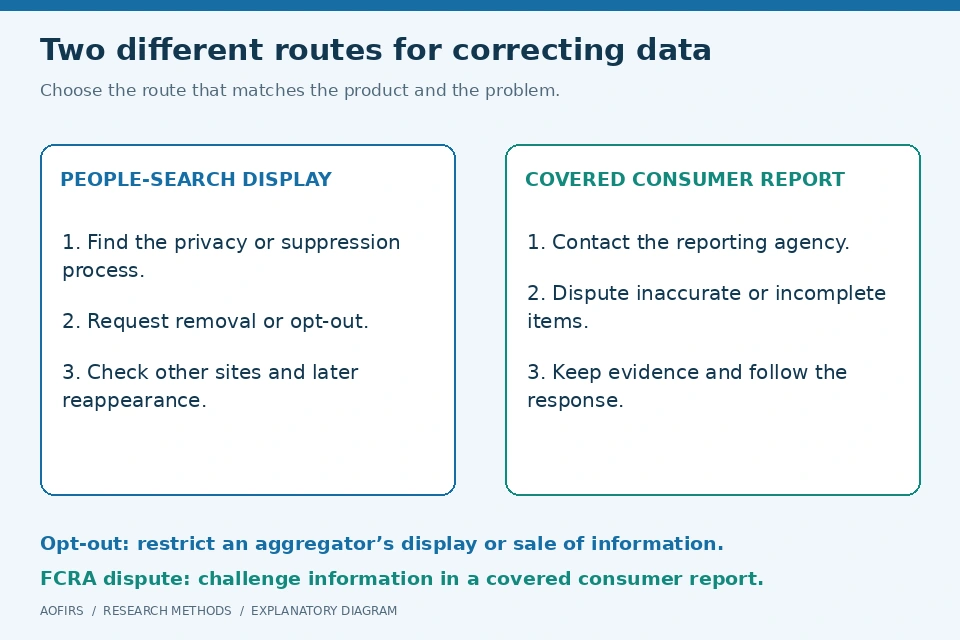
The distinction between people-search removal and an FCRA dispute is especially important.
An opt-out request generally asks a people-search or data-broker site to stop displaying or selling information about you.
An FCRA dispute challenges inaccurate or incomplete information in a consumer report, and the CRA must investigate it. These are not interchangeable processes.
For example, TransUnion Rental Screening Solutions publishes consumer-report rights and dispute information. PeopleConnect provides privacy and suppression resources for its people-search brands. Use the process for the specific service involved, and do not confuse a data-broker suppression request with a dispute about a regulated report (TransUnion Rental Screening Solutions; PeopleConnect).
How to opt out, as of 20 November 2026. The FTC advises searching each people-search site for your own listing, using its opt-out link or searching the site name with “opt out”, repeating on other sites and checking back periodically, because information can reappear when public records change. Opting out does not remove government records, and your details may still appear in relatives’ reports (FTC, 2024). California residents can also use DROP, the state’s free Delete Request and Opt-out Platform, which sends one deletion request to registered data brokers. It opened to consumers on 1 January 2026, and since 1 August 2026 brokers must check it at least every 45 days (California Privacy Protection Agency, 2026). FastPeopleSearch opt-out guide walks through one site’s process step by step.
How AI Is Changing Background Screening
AI and machine learning are being used in background-screening systems, but their documented role is narrower and more practical than many marketing pages suggest.
1. Record classification
Checkr says its machine-learning charge classifier categorises varying criminal-charge language into standard categories (Checkr).
2. Turnaround-time prediction
Checkr also says it uses data from county courts to estimate completion times for reports (Checkr).
3. Identity verification
First Advantage uses automated analysis of identity documents in its identity products. Certn’s OneID uses facial recognition to match a real-time selfie to an identity document (Certn).
4. Social-media classification
Certn’s social media check identifies risk indicators in public posts. Such flags require context and human review.
5. Workflow automation
Automation is increasingly used to route searches, connect ATS systems, update status information, standardise records, manage consent and prioritise manual work. First Advantage says about 90% of its U.S. criminal searches use automation (First Advantage).
These uses can improve efficiency, but AI does not automatically make a background check more accurate, unbiased, fair or legally compliant.
The regulatory picture has also changed. The CFPB’s January 2024 advisory opinion on background screening and its Circular 2024-06 on background dossiers and algorithmic scores for employment decisions were both withdrawn on 12 May 2025, together with the 2021 advisory opinion on name-only matching (CFPB, 2025). They should not be cited as active CFPB guidance. The FCRA itself and current FTC guidance remain the better foundation.
What AI Cannot Reliably Do in Background Screening
AI cannot make poor source data correct simply by processing it faster.
It also cannot reliably:
- Turn a common-name match into a confirmed identity without sufficient identifiers
- Make every local court searchable instantly
- Guarantee that a national database contains every relevant record
- Determine whether every record is legally reportable in every jurisdiction
- Decide automatically whether a past event is relevant to a particular job
- Eliminate bias simply because the decision is algorithmic
- Guarantee that a social-media post has been interpreted in context
- Replace required human judgment
- Guarantee FCRA compliance
- Guarantee that data is current
A matching model can reduce some manual work while creating new risks if users place too much confidence in its output.
How to Choose the Right Background Check Website
Start with purpose, not price.
Choose a professional employment screener if:
- You are making employment-related decisions.
- You need candidate authorization workflows.
- You need criminal, education or employment verification.
- You need an adverse-action process.
- You need ATS or HRIS integration.
- You need documented consumer-report procedures.
Choose a dedicated tenant screener if:
- You are evaluating a rental applicant.
- You need applicant consent.
- You need rental-specific credit, criminal or eviction information.
- You need a consumer-report process designed for housing.
Choose a people-search site if:
- You are trying to reconnect with someone.
- You need a possible phone number or address.
- You are conducting personal public-record research.
- You want research leads that will be independently verified.
Avoid a people-search site if:
- You are hiring.
- You are deciding whether to rent housing to someone.
- You are making a credit or insurance decision.
- The service expressly prohibits your intended use.
- You need a legally regulated consumer report.
For professional screening, ask vendors about actual source coverage, court access, pass-through fees, dispute handling, international restrictions, security controls and certifications, integrations and how records are verified. Ask for documents, not marketing claims.
Background Check Websites to Approach With Caution
A cautious approach does not mean assuming that every inexpensive or consumer-facing site is unreliable. It means recognising warning signs.
Watch for:
- “Free” searches that reveal a charge only at the final step
- Unclear recurring billing
- No obvious cancellation information
- No clear company identity
- Unsupported “100% accurate” claims
- Claims to search “every criminal record”
- Vague AI language with no documented function
- No explanation of FCRA status
- Consumer people-search sites promoted for employment or tenant decisions
- Criminal results with no source or jurisdiction
- No meaningful correction or dispute process when one is required
TruthFinder and Instant Checkmate
In September 2023 the FTC announced that TruthFinder and Instant Checkmate would pay $5.8 million under a proposed order. The FTC alleged that the companies told users that subjects had criminal or arrest records when the records were only traffic tickets, advertised unverified data as “the MOST ACCURATE information available to the public”, and operated as consumer reporting agencies without following the FCRA, including by marketing reports for employee and tenant screening (FTC, 2023).
TruthFinder’s current Google Play listing (updated 29 April 2026) now states that it is not a consumer reporting agency and may not be used for credit, housing, insurance, employment or other FCRA purposes (Pubrec, 2026).
Treat people-search use restrictions as a boundary on eligibility decisions. A general people finder is not interchangeable with a supported employment or tenant-screening consumer report.
Background Screening Trends to Watch
These are outlook themes based on documented developments, not predictions presented as facts.
Digital identity will move closer to the start of screening
Employers increasingly need to establish that the person being screened is the applicant. First Advantage, Certn and Checkr already build identity verification into screening workflows, so identity assurance is likely to become more closely tied to background screening.
Automation will shift from retrieval to orchestration
The competitive difference is increasingly about coordinating court searches, verification status, candidate communications, ATS data, compliance workflows and human review, not merely finding records.
Data provenance will become more important
As generative AI makes summaries easier to create, employers and researchers will have more reason to ask where a record originated and whether it was verified at the source.
Consolidation will complicate comparison articles
First Advantage’s Sterling acquisition, Checkr’s GoodHire acquisition and PeopleConnect’s family of people-search brands show why brand lists can exaggerate the number of independent screening ecosystems. Researchers should track parent companies as well as brands.
Global screening will remain locally constrained
A provider may operate internationally without having identical access in every jurisdiction. Criminal records, identity documents, employment information and privacy requirements vary significantly by country.
Human oversight will become more valuable, not less
The more screening systems automate classification and prioritisation, the more important it becomes to distinguish a machine-generated signal from a verified fact, and a verified fact from a legally justified decision.
Which Background Check Service Fits Your Purpose?
No single service fits every purpose. Match the service type to the decision first: an employment CRA for hiring, a tenant-screening CRA for rentals, and a people-search site only for personal research leads. Within each type, the use-case table above shows which provider fits which need. The key question is not which site has the biggest database. It is what kind of information you are obtaining, where it came from, whether it belongs to the correct person, how current it is, and whether you are legally permitted to use it for your intended purpose.
Frequently Asked Questions
What is the best background check website?
It depends on the purpose. For employment screening, AOFIRS’s document review found that Checkr combines documented coverage, verification features, compliance workflows, API access, integrations and published prices; First Advantage and HireRight suit very large global programmes. Personal researchers should use people-search tools such as BeenVerified only for appropriate non-FCRA purposes.
What is the most accurate background check site?
There is no independently proven “most accurate” website for every type of background check. Accuracy depends on the source searched, jurisdiction, identifiers used, record age, verification procedures and type of report. A sound screening strategy often combines database discovery with source-level or courthouse verification.
Is there a completely free background check website?
Free official records, personal-report features and people-search resources exist, but a free result should not be assumed to be a comprehensive employment or tenant-screening report. Court portals, property records and licence registries may require separate searches across jurisdictions.
Which background check site is best for criminal records?
For professional U.S. screening, Checkr and backgroundchecks.com offer different layers of criminal-record searches. Compare the national, county, state and federal sources included, the verification process and the jurisdictions relevant to the role. Price and speed alone do not establish suitability.
Can I run a background check on someone without their permission?
For ordinary personal public-record research, authorization requirements differ from regulated consumer-report use. For U.S. employment screening through a consumer reporting agency, written disclosure and authorization generally apply. Tenant screening also involves regulated consumer-report considerations. Always check the specific law and service terms for your intended purpose.
Can I use Spokeo, BeenVerified or Intelius to screen an employee?
Do not use a people-search product for employment eligibility decisions when its terms prohibit that use. BeenVerified and Intelius state in their current app listings that they are not consumer reporting agencies for FCRA purposes, and the FTC fined Spokeo in 2012 for marketing profiles to employers. Use an employment background-screening provider instead.
What is an FCRA-compliant background check?
It is better to think in terms of an FCRA-compliant screening process. The FCRA regulates consumer reporting agencies and users of consumer reports. Depending on the situation, compliance can involve permissible purpose, disclosure, authorization, accuracy procedures, pre-adverse action, adverse action and consumer rights.
Are online background checks accurate?
They can be useful, but no online database is infallible. Records can be missing, duplicated, outdated or matched to the wrong person. Consequential findings should be confirmed through authoritative sources, especially when common names or incomplete identifiers create uncertainty.
How far back does a background check go?
There is no single nationwide answer. Federal FCRA limits differ by record type: most adverse items are limited to seven years, convictions are excluded from that limit, and the limits do not apply to jobs paying $75,000 or more a year. States can impose additional limits.
Can someone tell if I searched for them?
It depends on the service and type of search. Ordinary consumer people-search websites generally work differently from employment and tenant screening. Regulated screening commonly involves disclosure, authorization or applicant participation, so the subject usually knows that a report is being requested.
Can background checks find social-media accounts?
Some consumer research products aggregate social or online information, and some professional screening vendors offer dedicated social-media screening. Coverage is never universal. Employers should also consider relevance, accuracy, discrimination risk, privacy and local law before using online activity in a consequential decision.
Can AI perform a background check?
AI can assist parts of a background-check workflow, including identity verification, charge classification, record matching, completion-time prediction and public-content classification. It cannot guarantee complete data, correct identity matching, fairness or legal compliance. Human review and source verification remain important.
What is the difference between a people search and a background check?
A people search generally helps locate publicly or commercially available information such as addresses, phone numbers and possible relatives. A professional background check used for employment or housing can be a regulated consumer report and trigger FCRA and other legal requirements.
How do I remove my information from a people-search website?
Use the site’s privacy, suppression, opt-out or “do not sell or share” process, and repeat it on other sites, as the FTC advises. California residents can send one request to registered data brokers through DROP. Removing information from one aggregator does not remove it from the original public record or from other data brokers.
Which background check services suit businesses?
Checkr suits employers wanting self-service pricing and an API, First Advantage enterprise and global operations, HireRight complex international programmes, Certn low-cost self-service screening, and backgroundchecks.com organisations that want granular control over U.S. database and courthouse searches.
References
1. backgroundchecks.com. Background checks and screening products. Retrieved 20 November 2026, from Provider documentation.
2. BeenVerified, Inc. (2026). BeenVerified [Mobile app listing, last updated 26 August 2026]. Google Play. Retrieved 20 November 2026, from Provider documentation.
3. California Privacy Protection Agency. (2026). DROP: Delete Request and Opt-out Platform. Retrieved 20 November 2026, from Provider documentation.
4. Certn. US pricing [Page last modified 15 October 2026]. Retrieved 20 November 2026, from Provider documentation.
5. Certn. Identity verification. Retrieved 20 November 2026, from Provider documentation.
6. Checkr. (2022, April 12). Checkr acquires GoodHire to accelerate growth [Blog post]. Provider documentation.
7. Checkr. Pricing. Retrieved 20 November 2026, from Provider documentation.
8. Checkr. Checkr acquires GoodHire: FAQ. Retrieved 20 November 2026, from Provider documentation.
9. Checkr. Our technology. Retrieved 20 November 2026, from Provider documentation.
10. Consumer Financial Protection Bureau. (2025). Withdrawn guidance [Items withdrawn 12 May 2025]. Retrieved 20 November 2026, from Provider documentation.
11. Federal Trade Commission. (2012, June 12). Spokeo to pay $800,000 to settle FTC charges company allegedly marketed information to employers and recruiters in violation of FCRA [Press release]. FTC guidance.
12. Federal Trade Commission. (2016, April). What employment background screening companies need to know about the Fair Credit Reporting Act. FTC guidance.
13. Federal Trade Commission. (2023, September 11). FTC says TruthFinder, Instant Checkmate deceived users about background report accuracy, violated FCRA while marketing reports for employee and tenant screening [Press release]. FTC guidance.
14. Federal Trade Commission. (2024). What to know about people search sites that sell your information [Last modified 15 November 2024]. Consumer Advice. FTC guidance.
15. Federal Trade Commission & U.S. Equal Employment Opportunity Commission. (2014, February). Background checks: What employers need to know. FTC guidance.
16. First Advantage. (2024, October 31). First Advantage completes acquisition of Sterling Check for $2.2 billion [Press release]. Provider documentation.
17. First Advantage. About us [Figures as stated in its company disclosures]. Retrieved 20 November 2026, from Provider documentation.
18. First Advantage. Criminal background checks [Page last modified 20 October 2026]. Retrieved 20 November 2026, from Provider documentation.
19. HireRight. (2026). Life sciences background screening brochure. Provider documentation.
20. Legal Information Institute. 15 U.S. Code § 1681b – Permissible purposes of consumer reports. Cornell Law School. FCRA statutory text.
21. Legal Information Institute. 15 U.S. Code § 1681c – Requirements relating to information contained in consumer reports. Cornell Law School. FCRA statutory text.
22. Legal Information Institute. 15 U.S. Code § 1681k – Public record information for employment purposes. Cornell Law School. FCRA statutory text.
23. PeopleConnect. People search brands. Retrieved 20 November 2026, from Provider documentation.
24. Pubrec, LLC. (2025). Intelius Search (Version 6.0.3) [Mobile app]. App Store. Retrieved 20 November 2026, from Provider documentation.
25. Pubrec, LLC. (2026). TruthFinder [Mobile app listing, updated 29 April 2026]. Google Play. Retrieved 20 November 2026, from Provider documentation.
26. TransUnion Rental Screening Solutions. (2026, July 1). Rental screening services privacy notice. Provider documentation.
27. TransUnion SmartMove. Pricing. Retrieved 20 November 2026, from Provider documentation.
28. U.S. Equal Employment Opportunity Commission. (2026, October 29). EEOC votes to rescind enforcement guidance on arrest and conviction records [Press release]. Provider documentation.