Background verification is now a key part of managing risk in today’s world. Whether you are hiring someone, investigating a legal matter, handling insurance claims, working as a private investigator, or checking out a business partner, being able to confirm someone’s identity and the truth of their claims is not just helpful — it is essential.
But background verification is more complicated than simply searching online. Information is divided into two main types: public and private. Each is governed by different laws, accessed differently, and carries its own legal risks if mishandled.
This article offers a clear, step-by-step guide to verifying both public and private information during a background check. It is based on the AOFIRS CIRS™ Program Training Module 10, Unit 24, and includes the latest research, legal updates for 2025–2026, and practical methods for professionals.
SECTION 01
Understanding the Information Sphere: Public vs. Private
Before a single search is conducted, the investigative researcher must understand which category the desired information belongs to — because the category determines the legal pathway for access, the tools available, and the consequences of unauthorized retrieval.
Figure 1 — Public vs. Private Information Classification Guide (AOFIRS, 2025–2026)
1.1 Public Records: The Foundation of Any Background Check
A public record is information kept by courts, legislatures, or government agencies so the public can hold them accountable. Public records exist because transparency is necessary in a democracy, allowing citizens to hold institutions and individuals responsible.
The following are the most important categories of public records available for background verification in the United States and Canada (AOFIRS CIRS™ Module 10, 2025):
| Public Record Category | What It Reveals / Investigative Value |
|---|---|
| Court Records | Civil and criminal case filings, judgments, case dispositions, and plea records |
| Criminal Convictions | Court-filed criminal records (not investigation records, which are protected) |
| Property Records | Real-estate ownership, assessed values, deed history, tax records |
| Business / Corporate Filings | Business registrations, officers, directors, and annual reports |
| Professional Licenses | License status (valid, expired, suspended, revoked), disciplinary actions |
| Bankruptcy & Lien Records | Bankruptcy petitions (Chapter 7/11/13), federal/state tax liens, judgments |
| Vital Records | Birth, marriage, death, and divorce certificates (access varies by state) |
| Voter Registration | Confirmed identity data at a specific address (where publicly accessible) |
| Sex Offender Registry | Registered sex offenders: a nationwide database via public registry |
| Driver’s License Status | License validity, suspensions, DUI convictions, traffic violations (DPPA-governed) |
1.2 Private Information: Protected by Law
Private information encompasses all personal details shielded from unauthorized disclosure by federal or state statute. The crucial distinction is this: private information cannot be accessed without the subject’s written consent, a valid court order or subpoena, or a specific statutory exemption. The major categories of legally protected private information include:
- Social Security Numbers (SSN) & ITINs: accessible only under FCRA permissible purposes or with consent
- Tax returns and tax information: protected by Section 6103 of the Internal Revenue Code (a felony to disclose without authorization)
- School and education records: protected under FERPA (Family Educational Rights and Privacy Act)
- Medical records and health information: protected under HIPAA
- Credit bureau reports: governed by the FCRA; require permissible purpose and, in most contexts, written consent
- Criminal investigation records: distinct from court records; protected as active law-enforcement intelligence
- Bank account details and financial records: protected by the Gramm-Leach-Bliley Act (GLBA)
SECTION 02
The Legal Framework: What Every Verifier Must Know
The legal framework governing background verification in the United States is multi-layered, with federal statutes forming a baseline and state laws adding jurisdiction-specific requirements. As of 2025–2026, more than 20 U.S. states have enacted comprehensive consumer data privacy laws that expand the obligations on anyone collecting, processing, or using personal information for background screening purposes.
2.1 The Core Federal Statutes
| Federal Law | What It Governs & Why It Matters |
|---|---|
| Fair Credit Reporting Act (FCRA) | Governs all consumer reports: who can access them, permissible purposes, consent, and adverse-action procedures. Non-compliance: civil and criminal penalties. |
| Gramm-Leach-Bliley Act (GLBA) | Protects consumers’ financial information held by financial institutions. Prohibits obtaining financial records under false pretenses (pretext). |
| HIPAA | Governs protected health information. Investigators can access it only through court order, patient authorization, or specific statutory exceptions. |
| FERPA | Protects students’ education records. Third-party credential verification requires the student’s written consent. |
| Driver’s Privacy Protection Act (DPPA) | Restricts access to personal data in motor-vehicle records to specified permissible purposes. |
| Freedom of Information Act (FOIA) | Entitles the public to request federal agency records, subject to nine enumerated exemptions covering privacy, national security, and law enforcement. |
| Section 6103 (IRC) | Makes unauthorized disclosure of tax information a federal felony, even for government officials. Exceptions require court orders or statutory authority. |
2.2 The 2025–2026 Privacy Law Expansion
The rapid expansion of state-level data privacy laws has created a complex, jurisdiction-specific compliance landscape for investigators and HR professionals. Key developments affecting background verification include:
- As of January 2026, more than 20 U.S. states have enacted comprehensive consumer privacy laws, including Delaware, Iowa, Maryland, Minnesota, Nebraska, New Hampshire, New Jersey, Tennessee, Indiana, Kentucky, and Rhode Island (O’Melveny, 2026)
- Maryland’s Online Data Privacy Act (MODPA), effective October 2025, is the most restrictive state regime, limiting personal-data collection to what is ‘reasonably necessary and proportionate’ to the stated purpose
- The FTC’s 2025 COPPA amendments (effective June 23, 2025) strengthen protections for minors’ data across all digital channels
- Connecticut (effective July 2026) requires privacy disclosures when personal data is used to train AI or large language models
- California’s CCPA regulations (effective January 2026) require extensive privacy risk assessments before initiating high-risk data processing
SECTION 03
The 6-Step Background Verification Process
Professional background verification is not an ad-hoc search exercise. It is a structured, legally defensible process. The following seven-step framework, drawn from the AOFIRS CIRS™ Program Training Module 10 (2025), represents best practice for investigators and HR professionals conducting background checks on individuals.
Figure 2 — 6-Step Background Verification Workflow (AOFIRS CIRS™ Framework, 2025–2026)

Define Your Purpose & Establish Legal Authority

Obtain Written Consent & Authorization
For any background check that will include consumer-report data (credit reports, employment records, criminal history from a third-party screening company), you must obtain written consent from the subject before the check is conducted. This is a mandatory requirement under the FCRA, which specifies that consent must be provided in a standalone document separate from the employment application.

Verify Identity
Identity verification is the foundation of any background check. All other data is only meaningful if it is correctly attributed to the right person. Use the following identifiers to anchor your investigation to the correct subject:
- Full legal name (and all known aliases, maiden names, and name variations)
- Date of birth
- Current address and address history
- Social Security Number (where authorized and legally permissible)
- Government-issued photo ID number (driver’s license, passport)
Examine these identifiers across multiple independent sources to confirm identity before proceeding. Name discrepancies, SSN mismatches, and date-of-birth variations between records are themselves considerable red flags — and should be documented, not dismissed.

Search & Verify Public Records
Once identity is confirmed, the systematic search of public-record databases begins. A comprehensive public-records verification sweep typically covers the following layers:
- National criminal database search (multi-state aggregation from court records)
- County and state criminal court records (hand-searched for greatest accuracy)
- Federal court records search (PACER: Public Access to Court Electronic Records)
- Civil court records search (upper court and lower / small-claims court)
- Bankruptcy, lien, and judgment records (nationwide)
- Sex-offender registry search (national)
- Property records search by subject name (all relevant jurisdictions)
- Professional license verification through state licensing-board databases
- Business and corporate filings (Secretary of State databases in all relevant states)
- Driving record search (MVR), where relevant to the position or investigation

Verify Credentials & Employment History
Employment-verification discrepancies have risen dramatically — from 9.9% in FY2021 to 14.26% in FY2024, a 44% increase (Business Standard, 2024). Meanwhile, around 34% of job applications globally contain fabricated information (The Wall Street Journal / Insight Partners, 2024). Scholarly and professional credential verification is therefore a high-priority step in any thorough background check.
Employment Verification
- Contact the HR department of each employer listed directly (use independently obtained contact information, not numbers supplied by the applicant)
- Verify: job title, dates of employment, reason for leaving, and eligibility for rehire
- Note any gaps in employment history; these warrant follow-up
- For current employment, The Work Number (an Equifax service) provides instant, consent-based verification of employment and salary
Academic Credential Verification
- Check the awarding institution’s accreditation through the Council for Higher Education Accreditation (CHEA) database or the U.S. Department of
- Education’s accreditation database
- Use the National Student Clearinghouse (US) for consent-based degree verification
- Contact the institution’s registrar’s office directly for official transcript confirmation
- For international credentials, check the UNESCO International Association of Universities database or Ministry of Education registries

Compile Compliant Report

Figure 3 — Social Media Intelligence Research Framework (AOFIRS CIRS™ Module 10, 2025)
What to Look For on Social Media
The purpose of social media review is not to find personal information that shouldn’t affect hiring decisions. It is to identify content that is directly relevant to the position and context. Legitimately relevant categories include:
| Platform | Key Background Verification Content |
|---|---|
| Employment history consistent with the resume, recommendations, dates of employment, certifications, and connections confirming professional affiliations | |
| Timeline posts, check-ins, and the About section may reveal location history, relationship status, affiliations, and behavioral patterns | |
| Location-tagged photos and lifestyle evidence can corroborate or contradict claimed circumstances (e.g., physical-limitation claims vs. activity photos) | |
| X (Twitter) | Public statements, affiliations, and behavioral patterns. Confidentiality violations, discriminatory language, or threats may be evident |
| TikTok | Video content revealing activities, behaviors, and public statements |
| YouTube | Channel content and activity demonstrating interests, expertise, and behavioral patterns |
Legal Boundaries in Social Media Screening
Social media screening must strictly adhere to the following principles to maintain FCRA compliance and avoid EEOC violations:
- Review only publicly available content: never request passwords, access private accounts, or use deceptive means (pretexting) to reach non-public profiles
- Focus exclusively on job-relevant content: social media naturally exposes protected characteristics (race, religion, age, national origin, disability, sexual orientation) that cannot legally be used in employment decisions
- Obtain written consent when using a third-party screening service to conduct social media checks; FCRA compliance requires standalone authorization
- Document findings with timestamped screenshots and URL records, maintaining a chain of custody for any content used in a decision
- Apply consistent standards to all subjects; screening some candidates and not others of the same category is a discriminatory practice
SECTION 04
Legally Accessing Private Information
Private information cannot be accessed without legal authority. However, many investigative and professional contexts do provide legitimate, legally defined pathways to restricted data. Understanding and following these pathways is what separates professional investigative research from illegal information gathering.
4.1 Credit Reports (FCRA-Governed)
Credit reports are among the most information-rich documents available in a background investigation. They reveal not just credit history but potential indicators of identity fraud, address history, employment history, and patterns of financial behavior. However, they are strictly regulated:
- You must have a documented FCRA permissible purpose (employment screening, tenant screening, creditor’s use, or licensed investigative purpose)
- You must obtain the subject’s written authorization in a standalone disclosure document
- You must work through an FCRA-compliant consumer reporting agency (Equifax, Experian, TransUnion, or authorized resellers)
- If taking adverse action based on a credit report, you must provide a pre-adverse-action notice, a copy of the report, and an opportunity to dispute inaccuracies
4.2 Bank Account & Financial Searches
Bank-account searches are among the most powerful — and most restricted — tools in investigative research. Legitimate searches use GLBA-compliant methods through licensed private investigators who employ proprietary software to identify open accounts by name and SSN. No pretext to the financial institution or the account holder is permitted under any circumstances.
Permissible purposes include judgment-collection enforcement, divorce discovery, child-support and alimony enforcement, fraud investigation, and pre-litigation asset assessment. Supporting documentation of the legal purpose is required before any such search commences (AOFIRS CIRS™ Module 10, 2025).
4.3 Medical & Health Information (HIPAA)
Access to an individual’s health information requires either their written authorization or a lawful legal mechanism such as a subpoena or court order. In employment contexts, medical information is strictly separated from the rest of an employment file and may only be reviewed for specific, limited purposes. Investigators accessing medical information for insurance fraud or liability investigations must work through the appropriate legal channels, including subpoenas duces tecum to medical providers.
4.4 Education Records (FERPA)
Schools and universities will not release transcripts, degree records, or enrollment history to third parties without either the student’s written consent or a court order. The most efficient consent-based pathway for professional background screening is the National Student Clearinghouse, which provides employer-authorization-based degree and enrollment verification.
SECTION 05
Recognizing & Evaluating Red Flag Indicators
A red flag is a pattern, data point, or piece of information that raises reasonable suspicion justifying further investigation. Red flags do not prove wrongdoing; they signal that additional scrutiny is justified. A professional investigator evaluates red flags holistically: a single anomaly may have an innocent explanation; a pattern of anomalies across multiple categories is a meaningful signal.
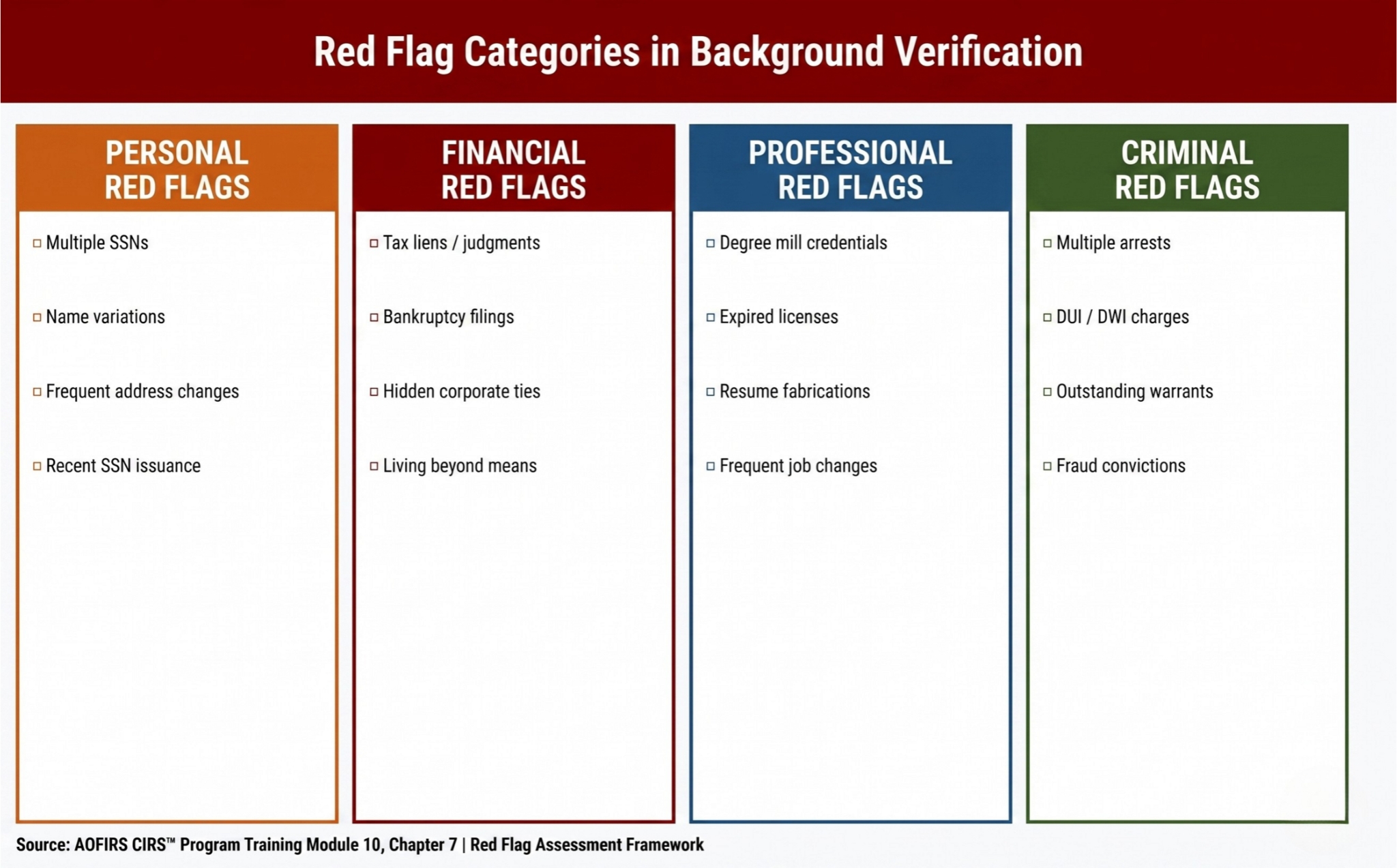
Figure 4 — Red Flag Categories in Background Verification (AOFIRS CIRS™ Module 10, Chapter 7)
5.1 Identity Red Flags
Identity anomalies are often the earliest and most important signals in a background check. They may indicate identity fraud, deliberate concealment of a prior history, or an attempt to distance the subject from negative records under a different identity:
- Multiple Social Security Numbers associated with one individual
- Multiple date-of-birth variations across records
- Multiple aliases, maiden names, or name-spelling variations inconsistent with normal variation
- Recently issued SSN for an adult claiming decades of work history — an immediate red flag
- Frequent address changes with no apparent lifestyle justification
- Multiple active email addresses and domain-name registrations
5.2 Financial Red Flags
Financial red flags often co-exist with legitimate explanations, but they must be examined rather than assumed away. Key indicators include:
- Tax liens (federal or state): indicate failure to pay legally owed taxes
- Multiple or recent bankruptcy filings, especially Chapter 7 liquidations following periods of apparent prosperity
- Outstanding civil judgments: unresolved court-ordered payment obligations
- Lifestyle inconsistent with declared income (flashy vehicles, luxury travel, high-value possessions)
- Hidden or undisclosed corporate affiliations and board memberships
- Pattern of delinquent or defaulted credit accounts
5.3 Professional Credential Red Flags
Professional misrepresentation is one of the most frequently encountered forms of background fraud. The statistics are sobering: 46% of credential checks reveal discrepancies between stated and actual information (AccuSource, 2023), and around 34% of job applications globally contain fabricated information. Key credential red flags include:
- Degrees from institutions with no recognized accreditation or from known diploma mills
- Professional licenses that are expired, suspended, or were never actually issued in the stated name
- Employment dates or job titles that do not match the employer’s records
- Gaps in employment history that cannot be explained or verified
- Implausibly high grades, academic honors, or accomplishments that cannot be verified
- Frequently changing job titles over a short period at the same employer (may indicate lateral demotion rather than advancement)
5.4 Legal History Red Flags
A pattern of legal involvement — particularly civil litigation, regulatory complaints, and administrative proceedings — can indicate behavior that poses a risk to future stakeholders. Key indicators:
- Multiple civil-lawsuit appearances as defendant (particularly fraud, breach of contract, or discrimination suits)
- Regulatory complaints from professional licensing boards or consumer-protection agencies
- Pattern of insurance claims suggesting fraudulent or risk-related behavior
- Workers’ compensation claim patterns inconsistent with stated physical capabilities
5.5 Criminal History Red Flags
Criminal records must be assessed in context; the nature, severity, and recency of any conviction are all material. The investigator’s role is to surface the facts and document them accurately. The end-user of the background check makes the judgment call on relevance to their specific context.
- DUI / DWI charges (particularly multiple or recent convictions)
- Outstanding warrants in any jurisdiction
- Felony convictions, particularly those involving fraud, violence, or dishonesty
- Multiple arrests across jurisdictions (even without convictions, a pattern may be meaningful)
- Sex-offender registration status
SECTION 06
Detecting Fraudulent Credentials
Credential fraud has become highly sophisticated in the Internet era. From altered transcripts to diploma-mill degrees to fabricated professional licenses, the variety and quality of fraudulent credentials encountered in background verification have increased substantially. The following guidance, drawn from the AOFIRS CIRS™ Module 10 research framework (2025), provides a practical detection protocol.
6.1 Physical Document Red Flags
When examining physical or digital copies of academic or professional credentials, look for:
- Evidence of white-out, erasures, burn marks, or digital manipulation
- Inconsistent fonts, irregular spacing, or misaligned text within the document
- Missing institutional seal, or seal placed incorrectly over a photograph
- Ink-color inconsistencies or paper quality that does not match institutional standards
- Grades that are implausibly high or that mathematically do not add up to the stated GPA
- Document submitted at the last possible moment (allowing minimal verification time)
- Poor grammar, unprofessional language, or misspellings in an official document
6.2 Detecting Diploma Mill Degrees
Diploma mills issue degrees for payment with minimal or no genuine academic study. They are designed to look official while conferring no legitimate educational standing. Key indicators include:
- The institution claims accreditation by an unrecognized or self-created organization
- A degree can be obtained in weeks or months (no genuine program is this fast)
- Degrees are awarded based solely on ‘life experience’ or a résumé review
- The institution has no verifiable physical address — only a P.O. box or overseas mail address
- The website prominently displays major credit-card logos (a transactional rather than educational model)
- The institution’s name closely mimics a legitimate, well-known university
SECTION 07
Digital Evidence Capture & Documentation Standards
When information from online sources — social media profiles, web pages, and digital records — is to be used as part of a background investigation or in legal proceedings, it must be captured, preserved, and documented in a manner that satisfies legal standards for authenticity and chain of custody.
7.1 Web Page & Social Media Evidence Capture
A screenshot alone is insufficient for legally defensible evidence. The following protocol, derived from the AOFIRS CIRS™ Module 10 framework (2025), should be followed for any digital evidence intended for legal or formal use:
- Screenshot capture: capture the complete visible page, scrolling through all sections (profile, About, Timeline, Photos, Groups). Include the URL bar and timestamp
- Source-code capture: open the page in Chrome, right-click, and select ‘View Page Source.’ Save the complete HTML with a timestamped filename — source captures preserve metadata that visual screenshots do not
- Metadata documentation: record the URL, IP address of the page, domain registration information, page title, and meta-tags
- Professional e-discovery tools: for legally sensitive investigations, use tools (Hunchly, Logikcull, Zapproved) that provide automatic audit trails and digital signatures confirming capture date, time, and content
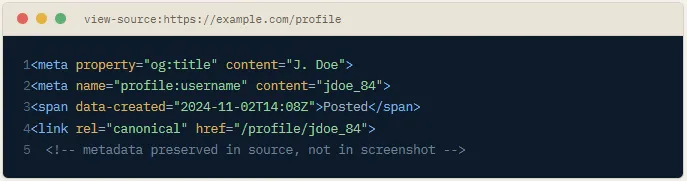
Figure 5 — Web Page Source-Code Capture Methodology: ‘View Page Source’ in Chrome reveals the underlying HTML behind any social media page (AOFIRS CIRS™ Module 10, 2025)
7.2 Recovering Deleted or Altered Web Content
If a subject deletes or alters online content after an investigation has commenced, the following recovery tools may apply:
| Recovery Method | How to Use It |
|---|---|
| Browser Cache (Chrome) | Enter chrome://cache to access recently visited pages cached locally (if the cache has not been cleared) |
| Google Cache | Search the cached copy of a URL (works until Google refreshes its index) |
| Wayback Machine (archive.org) | Visit web.archive.org and enter the URL. Best tool for recovering historical versions of public web pages going back years |
| Platform Legal Request | Law enforcement and legal professionals can submit formal data-preservation requests to platforms through their legal portals |
SECTION 08
AI & Technology in 2025–2026 Background Verification
Artificial intelligence has become a catalytic force across every dimension of background verification — from automated social media screening to AI-powered digital-evidence management to cross-lingual OSINT analysis. Investigators and HR professionals in 2025–2026 must understand both the capabilities and the legal and ethical boundaries of AI-assisted screening.
| AI Verification Tool | Primary Application |
|---|---|
| Babel Street | Multilingual OSINT analysis across 200+ languages; cross-platform social media intelligence; identity-connection mapping across cultural and linguistic variations |
| ShadowDragon SocialNet | Cross-platform social-network analysis; maps connections between accounts and usernames across dozens of platforms; real-time monitoring for law enforcement |
| Hunchly | Automated web-investigation tool capturing all browsed pages with timestamps and digital signatures for legally defensible evidence |
| Cellebrite (2025–2026) | AI-powered mobile-device forensics; digital-evidence extraction from 15,000+ device profiles; cloud-service evidence integration |
| Neotas Enhanced Due Diligence | AI platform covering 600B+ archived web pages, 1.8B+ court records, 198M+ corporate records, global social media, and 40,000+ media sources from 100+ countries |
| AI-Powered Redaction (DEMS) | Automated face, license-plate, and PII redaction from video evidence; required for FOIA compliance and privacy-law adherence |
8.1 Key Compliance Considerations for AI in Background Checks
The use of AI tools in background verification introduces new compliance obligations the industry is still adapting to:
- California’s CCPA regulations (effective January 2026) require opt-out rights when AI automated decision-making (ADMT) substantially replaces human assessment. Human review of AI-created background-check outputs is required
- EEOC guidelines flag AI-powered social media screening as a high-risk practice, because automated systems may unintentionally screen for protected-class information. Documented human review of AI findings is essential
- The FCRA’s ‘maximum possible accuracy’ standard applies to AI-generated consumer reports as much as to human ones. AI screening errors that result in adverse action can create substantial liability
- Continuous background monitoring (AI tracking changes in employee records in real time) is growing in high-risk industries (Edge Information, 2025). Continuous-monitoring consent frameworks must cover ongoing screening, not just pre-employment
SECTION 09
Compiling a Complete, Compliant Verification Report
The output of a professional background-verification process is a documented report that integrates findings across all relevant data categories, details the method and sources used, and presents them in a format suitable for the decision-maker’s purpose. The following standards apply.
9.1 Documentation Criteria
Figure 5 — Web Page Source-Code Capture Methodology: ‘View Page Source’ in Chrome reveals the underlying HTML behind any social media page (AOFIRS CIRS™ Module 10, 2025)
9.2 Adverse Action Compliance (FCRA)
If a background check conducted through a consumer reporting agency reveals information that causes you to take adverse action against an individual (denial of employment, tenancy, credit, or similar), the FCRA requires a specific two-step adverse-action procedure:
| Adverse Action Step | Required Action |
|---|---|
| Pre-Adverse Action Notice | Before a final decision, send a pre-adverse-action letter including (1) a copy of the consumer report, (2) a copy of the FCRA rights notice, and (3) identification of the specific information driving the potential decision |
| Reasonable Response Period | Allow the subject a reasonable period (commonly five business days) to dispute the accuracy of the information or provide context that may affect the decision |
| Final Adverse Action Notice | If you proceed, send a final notice including (1) the decision taken, (2) the CRA’s name and contact, (3) a statement that the CRA did not make the decision and cannot explain it, and (4) the subject’s right to a free copy of the report within 60 days |
CONCLUSION
Verification Is a Professional Responsibility
Background verification is not a checkbox exercise. It is a professional responsibility that sits at the intersection of legal compliance, ethical conduct, and the protection of organizations, individuals, and the public. Getting it right — fully, accurately, and within the law — requires understanding the difference between public and private information, mastering the legal pathways to each, applying a structured verification methodology, and detecting the red flags that signal risk.
The landscape is changing rapidly. As of 2025–2026, more than 20 U.S. states have enacted extensive privacy laws. AI tools are transforming both the capabilities and the compliance obligations of practice. Social media screening has become an industry standard while carrying its own substantial legal risks. Credential fraud is more sophisticated and more common than ever.
In this environment, the Certified Internet Research Specialist (CIRS™) designation offered by the Association of Internet Research Specialists (AOFIRS) delivers a rigorous, current, and professionally recognized framework for research professionals operating in this domain. The principles, methods, and juridical frameworks outlined in this article — drawn primarily from the CIRS™ Training Module 10, Unit 24 (2025–2026 edition) — represent the current best-practice standard for investigative research professionals conducting background verification.
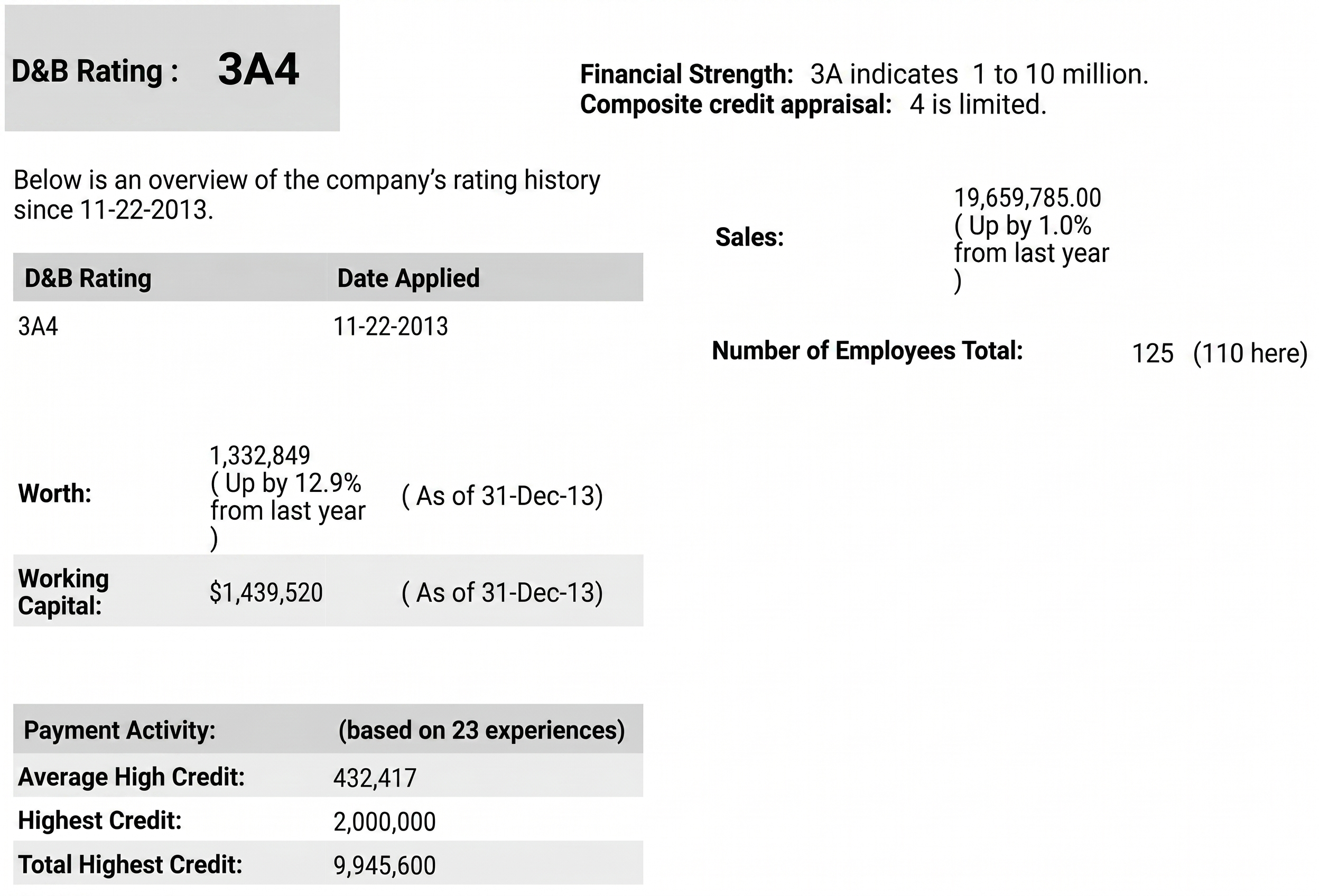
Figure 5 — Web Page Source-Code Capture Methodology: ‘View Page Source’ in Chrome reveals the underlying HTML behind any social media page (AOFIRS CIRS™ Module 10, 2025)