Ever feel like you’re drowning in research papers? You are not alone. The world of research is back-breaking. However, Artificial intelligence (AI) has burst onto the scene, and it’s not just a futuristic gimmick—it is a powerful tool that is already changing how a job gets done.
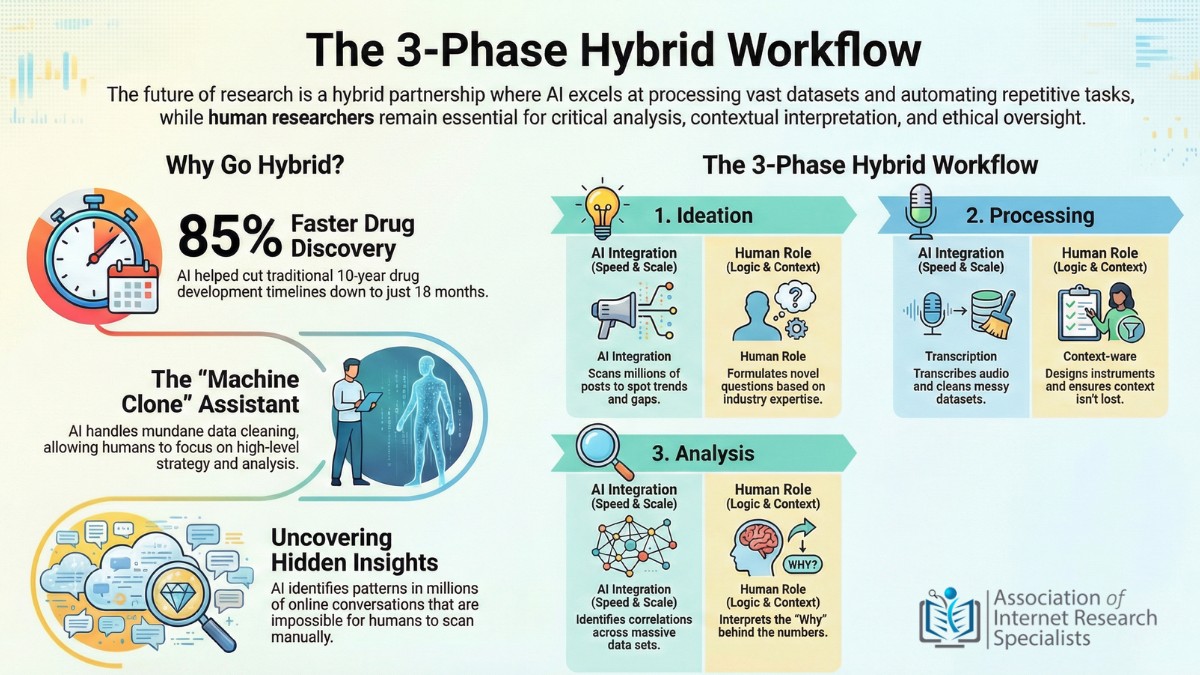
Today, we’ve moved past asking if we should use AI and are now focused on how to use it smartly and responsibly. Let’s clear something up: this isn’t a battle between AI and human researchers. The real magic happens when they work together. Think of AI not as a replacement for your brain, but as machine clone research assistant—a partner that handles load so you can focus on what you can do the best: thinking, interpreting, critically analyzing and then penning it down.
Want to boost your research? Combining AI with traditional methods through hybrid research is the key. Come, let’s dive in! {module Banner In-article Ad}
Understanding AI and Traditional Research Methods
Before we begin to explore AI, it is crucial to remember what makes research, well, good. These traditional methods aren’t getting tossed out the window. In fact, in the age of AI, they are more important than ever. They are your compass for making sure your work is solid, trustworthy, and makes a real impact.
Let us first understand the two components at play: traditional research techniques and AI in research methods.
Traditional research techniques often involve manual data collection, analysing raw data, and conducting surveys or interviews. This has been the gold standard in many fields, particularly in academia. However, these methods can be time-consuming, subject to human error, and often struggle to scale when dealing with large datasets.
On the other hand, AI in research methods uses machine learning, natural language processing (NLP), and other AI technologies to automate processes, analyse large datasets, and provide insights that humans might miss. AI can perform tasks like data cleaning, data analysis, and even predictive analytics, dramatically reducing the time and effort needed for traditional research tasks.
Debunking the Fear of Human Labour Being Replaced by AI
A common misconception is that AI will replace human labour, especially in research. This conversation surrounding AI is buzzing with a mixture of excitement and anxiety. We hear whispers of AI replacing human scientists and algorithms rendering traditional methods obsolete. But this framing of “AI vs. research” presents a false narrative. The true revolution lies not in replacement but in the combination of both. Basically, AI is designed to amplify human capabilities and remove the more mundane aspects of a job, i.e., conduct thorough research.
Benefits of Using AI in Research
- Automates routine tasks: AI takes care of repetitive tasks like sorting and cleaning data, saving researchers time.
- Speeds up analysis: It quickly handles initial analyses, letting you dive deeper into the important stuff.
- Predicts outcomes: AI uses historical data to forecast trends, guiding your research direction.
- Boosts efficiency: By freeing up time, AI lets researchers focus on strategy and insights.
- Improves accuracy: Reduces human errors, leading to more reliable results.
- Uncovers hidden insights: AI finds patterns and connections you might miss, offering fresh perspectives.
- Scales research: AI can handle large datasets, making research faster and more comprehensive. {module Banner In-article Ad}
Case Studies
A comprehensive study from the University of Florida put leading AI models through the paces of academic research and concluded that while AI is a “valuable assistant,” it falls short of replacing human scientists in many critical areas (source: UFNews, 2025). The consensus is that AI is best used to augment human capabilities, not to supplant them (source: Harvard Business Review, 2021).
Case Study: AI in Medical Research
One fascinating case study involves the use of AI in drug discovery. Researchers at Insilico Medicine used AI to identify potential drug candidates for diseases like cancer and ageing. By combining AI with traditional research techniques, the company accelerated the drug discovery process, cutting down the usual 10-year timeline to just 18 months (source: NIH, 2024).
Similarly, AI algorithms were used to identify protein structures related to COVID-19, dramatically reducing the time required for critical research. According to a recent medical report, AI tools accelerated the identification of promising drug molecules by analysing biological data, an otherwise highly time-consuming process (source: MDPI, 2022).
Hybrid Research Methods with AI: The Best of Both Worlds
By integrating AI into traditional research, you get the best of both worlds: the accuracy and precision of traditional techniques, combined with the speed and scalability of AI. Hybrid research methods are rapidly becoming the future of research because they allow researchers to process more data faster and with fewer errors. AI can handle repetitive tasks like data cleaning, enabling human researchers to focus on higher-level analysis and decision-making.
Example One: AI in Market Research
Phase 1: Ideation and Market Trends Identification
- Task: Pinpointing emerging trends and identifying untapped market opportunities.
- AI Integration: AI tools like Crimson Hexagon or MonkeyLearn can analyse vast amounts of social media posts, customer reviews, and forum discussions to identify market shifts and trending topics. These AI-powered tools can scan millions of online conversations to spot emerging patterns, keywords, and topics, helping you stay ahead of the curve without spending weeks manually analyzing data.
- Human Role: The market researcher uses AI insights as a foundation, applying their knowledge of the industry to interpret the findings. They critically assess which trends are truly relevant and how they might impact the business strategy, ensuring the AI-generated patterns align with real-world scenarios.
Phase 2: Data Collection and Audience Segmentation
- Task: Gathering customer data and segmenting the audience effectively.
- AI Integration: AI can automate the collection of customer behaviour data from various sources, such as web analytics, surveys, or e-commerce platforms. It can also categorise and segment customers based on demographics, purchase behaviour, and engagement. Tools like HubSpot or Google Analytics use machine learning to build accurate customer personas and predict future behaviours, saving researchers from manually sorting through piles of raw data.
- Human Role: While AI segments the data and highlights key trends, the researcher is responsible for creating the survey questions and refining customer personas based on their industry expertise. They review AI-driven insights to ensure they match the business’s target market and address key strategic questions.
Phase 3: Data Analysis and Insights Generation
- Task: Extracting actionable insights from the collected data.
- AI Integration: AI shines in this phase, performing large-scale quantitative analysis and even sentiment analysis. Tools like Tableau or Power BI can integrate various data sources, running predictive models to forecast customer behaviors, market demand, and sales trends. AI can automatically uncover hidden patterns and correlations, providing a deeper understanding of consumer preferences and market shifts.
- Human Role: The researcher interprets the AI-generated patterns, identifying the “why” behind the numbers. They analyze market dynamics, provide context, and validate AI-driven insights. They’re also responsible for making sure the AI’s findings align with broader market conditions and the company’s strategic goals.
Phase 4: Reporting and Presentation
- Task: Delivering research findings in a clear and persuasive manner.
- AI Integration: AI tools like Quill or Narrative Science can automatically generate reports, summarise findings, and even create visualisations of complex data sets, making it easier for stakeholders to understand the results. AI can also suggest actionable recommendations based on data analysis, streamlining the reporting process.
- Human Role: The researcher is the storyteller, weaving together the AI-generated insights into a coherent narrative. They ensure the report speaks to the stakeholders, providing clear, actionable recommendations and offering critical analysis that AI alone cannot generate. They also ensure the ethical use of the data and clarity in communication, maintaining the human touch in the final presentation.
Example Two: AI in Academic Research
Phase 1: Ideation and Literature Review
- Task: Overcoming information overload to identify research gaps and formulate novel questions
- AI Integration: Use artificial intelligence research tools like Elicit, Habit, and conduct semantic searches that find relevant papers even without perfect keyword matches. These tools can visualise author networks, generate initial literature summaries, and highlight connections between studies, dramatically accelerating a process that traditionally takes weeks.
- Human Role: The researcher provides the critical thinking that AI summaries lack. They use these AI-generated maps as a starting point to critically read the most relevant papers, synthesise overarching themes, and formulate a truly novel research question that pushes the field forward.
Phase 2: Data Collection and Processing
- Task: Gathering raw data and preparing it for analysis.
- AI Integration: Automate tedious and repetitive tasks. AI can transcribe hours of interviews, clean large datasets by automatically identifying errors and missing values, and help sort and categorise unstructured data like open-ended survey responses or social media comments.
- Human Role: The researcher remains the architect of data collection. They design the survey instruments, craft the interview guides, and oversee the automated cleaning process to ensure crucial context is not accidentally discarded. They also handle the highly complex or ambiguous unstructured data that AI still struggles to interpret correctly.
Phase 3: Data Analysis
- Task: Finding meaning and drawing conclusions from the data.
- AI Integration: This is the core of the hybrid research method. Use AI for large-scale quantitative analysis, identifying predictive patterns, and synthesising insights across mixed datasets (e.g., combining survey numbers with interview text). AI can perform automated triangulation, cross-validating findings from multiple data sources to increase the reliability of conclusions.
- Human Role: The researcher acts as the interpreter. They take the patterns and correlations identified by the AI and provide the contextual understanding to explain why these patterns exist. The human analyst connects the quantitative “what” with the qualitative “why,” bridging the gap between correlation and causation and adding the emotional depth that numbers alone cannot convey.
Phase 4: Writing, Editing, and Dissemination
- Task: Communicating research findings clearly and effectively.
- AI Integration: Use AI tools to assist in structuring the paper, suggesting logical section headings, improving writing clarity and conciseness, and managing citations with tools like Research Pal or Rayyan AI.
- Human Role: The researcher is the author. They are solely responsible for the core argument, the intellectual narrative, and the final conclusions. AI is an assistant, not a co-author. Rigorous human oversight is essential to ensure accuracy, maintain the author’s unique voice, and prevent any form of plagiarism.
Tips for Effective Hybrid Research with AI
- Start with Simple AI Tools: Don’t dive into complex AI tools right away. Start by integrating tools like AI-powered literature search platforms or data cleaning tools to get comfortable with the technology.
- Use AI for Repetitive Tasks: Leverage AI for tasks like data collection, sorting, and cleaning. This will free up more time for you to focus on high-level analysis.
- Combine Human Intuition with AI Insights: While AI can crunch data faster than any human, it’s still important to apply human intuition to interpret the results in the context of your research.
- Stay Updated on AI Trends: AI is constantly evolving. Follow AI research publications and participate in webinars or workshops to stay updated on the latest advancements in AI research methods.
Conclusion: The Future of Research is Hybrid
The future of research isn’t about choosing between AI vs human; it’s about leveraging the best of both worlds. Hybrid research methods with AI offer researchers an unprecedented opportunity to amplify their capabilities, enhance their productivity, and accelerate the research process. As AI continues to evolve, integrating it into traditional research methods will become increasingly essential.
AI will not replace researchers; rather, it will empower them by streamlining repetitive tasks, offering insights faster, and enabling them to focus on what truly matters: generating meaningful findings and innovative solutions.
Ready to take the next step? Invest in your career by becoming a CIRS-certified professional. If you’re serious about mastering the hybrid research methods that will shape the future of research, CIRS (Certified Internet Research Specialist) is the number one certification you need. As the premier credential from the Association of Internet Research Specialists (AOFIRS), the CIRS certification will arm you with the tools and expertise to harness AI effectively in your research career. It’s your pathway to becoming a trusted and skilled professional in the evolving landscape of digital research.
For further insights, check out the book Artificial Intelligence (AI) in Online Research: Training Guide for Professional Research. Don’t miss the book, as this guide is packed with valuable insights that will help you leverage AI in your research career, making it an essential read for any aspiring professional researcher.