Technology has repeatedly raised fears of worker replacement. Economic research shows that automation can substitute for particular tasks while also complementing workers and creating demand elsewhere. The balance depends on the technology, sector, institutions, and time horizon (Automation and employment). Computers and the internet transformed office work, but their effects were uneven across occupations and workers.
This article argues that AI is reshaping knowledge work as well as automating parts of it. Evidence from specific tasks supports the possibility of useful human–AI collaboration. It does not establish that every job is protected, that gains reach everyone, or that past technology transitions guarantee AI’s future effects.
The practical question is how knowledge work changes, who benefits, and what preparation workers need.
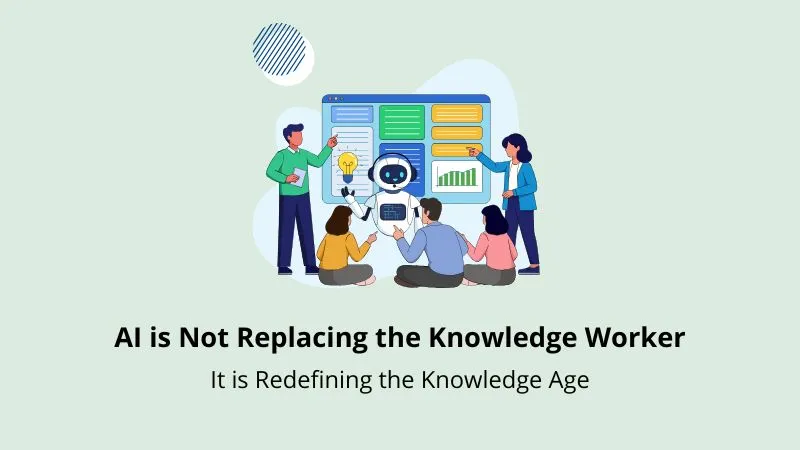
From Cognitive Labor to Cognitive Leverage
Knowledge work depends on research, calculation, interpretation, and documentation. Generative AI can assist with drafts, summaries, code, and data exploration. Speed and reliability vary by task, tool, data, and review process; fluent output can still be wrong.
This does not remove the human from knowledge work. It changes the role of the human within it.
Workers can spend more time directing tasks, evaluating evidence, editing, communicating, and making accountable decisions when a tool reliably reduces other work. That opportunity depends on workflow design and the quality of the output.
IBM’s IBM technology principles frames technology as a way to augment human capabilities. That is a stated organizational principle, not independent evidence that deployment always protects jobs or improves work.
How the Knowledge Industry May Reorient
The World Economic Forum’s 2025 employer survey projects 170 million jobs created and 92 million displaced by 2030, a net increase of 78 million. These projections concern multiple structural trends, including technology, demographics, and the green transition; they are not an estimate of jobs created by AI alone. The report also expects 39% of existing skills to change or become outdated. These are survey-based projections, not guaranteed outcomes (Future of Jobs report).
AI can:
- Summarize large research libraries, with errors to check.
- Generate first drafts.
- Detect patterns across very large data volumes.
- Simulate outcomes.
Human responsibility remains essential for:
- Defining the values and goals a system should serve.
- Interpreting lived context and the people affected.
- Making accountable ethical trade-offs.
- Earning trust through conduct and transparency.
- Communicating purpose and responding to concerns.
- Reviewing meaning, cultural context, and consequences.
The argument here is that faster technical work can increase the importance of judgment, verification, and communication. It does not follow that these changes automatically increase every worker’s bargaining power or employment security.
What the Productivity Evidence Shows
| Study | Reported result | Interpretation limit |
|---|---|---|
| Writing experiment, 2023 | 40% less task time; 18% higher output quality. | Selected writing tasks and 453 professionals; not a whole-job employment forecast. |
| Customer support, published 2025 | 15% more issues resolved per hour on average. | One organizational deployment; gains and quality effects varied by worker. |
| Consulting experiment, published 2026 | More and faster completed tasks within the tested frontier; lower correctness on an outside-frontier task. | Task suitability matters; persuasive presentation can coexist with a wrong answer. |
Three widely cited studies measure what happens when knowledge workers get access to generative AI.
In a preregistered experiment with 453 college-educated professionals doing occupation-specific writing tasks, access to ChatGPT cut the time taken by 40% and raised output quality by 18% (Writing productivity experiment).
The published 2025 customer-support study examined 5,172 agents and reported a 15% average increase in issues resolved per hour after access to an AI assistant. Gains varied: less experienced and lower-skilled workers benefited more, while experienced, highly skilled workers saw small speed gains and small quality declines (Customer-support study). This describes one deployment, not a universal workplace effect.
A field experiment with 758 consultants found that GPT-4 users completed 12.2% more tasks and worked 25.1% faster on tasks within the tested capability frontier, with higher quality. On a complex task outside that frontier, AI users were 19% less likely to produce a correct solution. The study, initially circulated in 2023 and published in Organization Science in 2026, illustrates why task selection matters (Consulting field experiment).
Together, these studies show gains on some measured tasks and harm on others. They use different populations, tools, outcomes, and designs, so their percentages should not be pooled into a single productivity estimate. Knowing where an assistant helps, where it fails, and how much verification costs is part of effective integration.
Displacement and an Unequal Transition
Unequal access to tools, training, and opportunities is a major risk alongside displacement, wage pressure, and changes in job quality. The relative importance of those risks remains uncertain and can differ across groups.
The WEF report identifies AI and big data among the fastest-growing skills, analytical thinking as a widely sought core skill, and upskilling as a priority for 85% of surveyed employers. The same report records employers planning workforce reductions where skills become less relevant (Future of Jobs report). Training and access matter, but they do not eliminate economic or organizational constraints.
The OECD’s 2023 outlook estimates that occupations at high risk from all automation technologies, including AI, account for about 27% of employment. This measures exposure, not a forecast that 27% of jobs will disappear. Its worker-survey findings describe particular sectors and countries, not the entire global workforce (OECD employment outlook). Employers, educators, and policymakers can respond with accessible training, transition support, and attention to job quality.
Education Needs Knowledge and Judgment
Education needs both subject knowledge and the ability to evaluate machine-generated material. A 2023 study of literature reviews produced by GPT-3.5 and GPT-4 found fabricated references in 55% and 18% of their respective citation sets (Citation fabrication study). These are historical results for those models and tasks, not current error rates for every AI tool. The lesson is to verify references and reasoning rather than equating fluent recall with understanding.
Three abilities now matter more than ever:
- Creativity is the power to generate what does not yet exist.
- Critical thinking is the ability to challenge outputs rather than accept them.
- Emotional intelligence is the capacity to understand people, conflict, nuance, and trust.
AI produces content. Humans determine meaning.
AI generates options. Humans choose direction.
AI accelerates output. Humans define purpose.
Students need a foundation of knowledge to recognize errors, as well as practice in creating, analyzing, questioning, and explaining. AI literacy can support those aims when assessment rewards evidence and reasoning instead of unexamined output.
Building an Effective AI Integration Practice
A practical professional advantage can come from integrating AI into tasks where it has demonstrated value, while keeping responsibility for consequential decisions clear. That requires domain knowledge and access to suitable tools, time, and training.
A useful professional model is: “I choose the task, evaluate the evidence, and remain responsible for the final work.”
AI can assist with parts of that process when its performance and data handling are appropriate to the task.
This applies to:
- Researchers who move from data collection to insight generation and verification.
- Marketers who move from manual content production to strategy and storytelling.
- Lawyers who move faster on analysis and deeper on judgment.
- Educators who shift from information delivery to human development.
Practical Steps for Internet Researchers
For research professionals, the argument above turns into specific habits.
Skills to build
- Prompting for research, not answers. Ask AI to map sources, terms and institutions, then do the retrieval yourself. See our research prompting guide.
- Source evaluation. Provenance, date, authorship and corroboration matter more when drafts are cheap.
- Basic data literacy. Enough statistics to tell when an AI summary of a dataset is wrong.
- Knowing the frontier. Keep notes on which of your tasks AI handles well and which it gets wrong, and update them as tools change.
Verification habits
- Treat every AI-generated fact, figure and citation as a lead until you have opened the source.
- Check citations at the DOI or publisher page; fabricated references are common.
- Confirm consequential claims with a second, independent source.
- Keep a log of prompts, tools and versions used, so your work can be reproduced and explained.
- Never paste confidential client data into a tool unless your contract and the tool’s data terms allow it.
Integration examples
- Literature scoping: use an AI assistant to list search terms and likely databases, run the searches yourself, then ask the assistant to cluster and summarize the papers you retrieved.
- Due-diligence research: use AI to draft a checklist of records to pull for a company, then retrieve each record from the official registry and have AI compare them for inconsistencies.
- Reporting: draft the structure of a client report with AI, but write the findings and conclusions yourself from the verified evidence.
For a fuller process, see our hybrid research workflow and internet researcher skills.
Conclusion: Preparing for Changed Knowledge Work
Every foundational technology reshapes labor. Computerization reduced demand for routine clerical and production tasks, while demand grew for problem-solving, adaptability and creativity, and whole occupations emerged that did not exist before (Automation and employment). The internet removed physical distribution barriers but produced creators, platforms and global digital markets. AI may accelerate some of these changes, but historical comparisons cannot settle the pace, scale, or distribution of future effects.
The case for integration is strongest when workers gain the tools, training, and authority to use AI critically. Higher output is useful only when the work remains reliable, appropriate, and accountable. The evidence supports preparing for changed tasks and uneven impacts, rather than treating either universal replacement or universal protection as settled. Adaptation can improve a worker’s options; it is not a guarantee against displacement. Responsible deployment should develop capability and support people whose roles change.
References
- Autor, D. H. (2015). Why are there still so many jobs? The history and future of workplace automation. Journal of Economic Perspectives, 29(3), 3–30. Automation and employment.
- Brynjolfsson, E., Li, D., & Raymond, L. (2025). Generative AI at work. Quarterly Journal of Economics, 140(2), 889–942. Customer-support study.
- Dell’Acqua, F., et al. (2026). Navigating the jagged technological frontier: Field experimental evidence of the effects of artificial intelligence on knowledge worker productivity and quality. Organization Science. Consulting field experiment.
- IBM. Responsible technology and principles of trust. IBM technology principles.
- Noy, S., & Zhang, W. (2023). Experimental evidence on the productivity effects of generative artificial intelligence. Science, 381(6654), 187–192. Writing productivity experiment.
- OECD. (2023). OECD Employment Outlook 2023: Artificial intelligence and the labour market. OECD employment outlook.
- Walters, W. H., & Wilder, E. I. (2023). Fabrication and errors in the bibliographic citations generated by ChatGPT. Scientific Reports, 13, 14045. Citation fabrication study.
- World Economic Forum. (2025, January 7). The Future of Jobs Report 2025: Digest. Future of Jobs report.