Courts have now issued more than 2,000 decisions involving AI-fabricated citations, and the penalties have grown from a $5,000 fine to six-figure sanctions and suspended licenses. Underneath all of it is a simple rule every online researcher should take to heart: AI can help you search, but you are the one who has to verify.
In 2023, a New York lawyer filed a brief full of court decisions that ChatGPT had made up. When nobody could find them, he went back to ChatGPT and asked whether they were real. It told him they were. The court fined the lawyers involved $5,000 and called the episode “an abuse of the adversary system” (Mata v. Avianca, Inc., 2023). At the time it looked like an odd, embarrassing one-off.
It wasn’t. Courts across multiple jurisdictions have since dealt with lawyers, expert witnesses, and litigants who filed AI-generated fiction, and the penalties keep climbing. If you research for a living, whether you’re an OSINT analyst, an investigator, a due-diligence specialist, or anyone else who hands people sourced reports, these cases deserve your attention. They provide a detailed public record of what happens when people trust AI output without checking it, and they spell out what real checking looks like.
AI Hallucination Sanctions by the Numbers
Legal researcher Damien Charlotin keeps a running database of court decisions in which a judge found, or strongly suggested, that someone relied on hallucinated AI content. As of 28 September 2026 it listed 2,095 of them (Charlotin, 2026). In July 2025 it had 160 (Manach, 2025). That’s roughly a thirteenfold jump in fifteen months.
Most of the cases involve people representing themselves, but plenty of professionals are in there too: 829 decisions involve lawyers, 33 involve judges or tribunal members, and 15 involve expert witnesses. In U.S. federal courts alone, a law-library review counted 367 cases involving AI misuse in 2025 and more than 220 in just the first three months of 2026 (University of Illinois Chicago School of Law Library, 2026).
The kind of error tells you more than the total. Courts found fabricated material in 1,731 decisions, misrepresented sources in 879, and false quotations attributed to real sources in 560. If you’re a researcher, that last number should worry you most. A real source with a made-up quote sails through a quick existence check. The only way to catch it is to open the document and read it.
From $5,000 to Six Figures: How Courts Escalated
The early rulings were mostly warnings. In 2024 the Second Circuit set a baseline that courts still quote: lawyers must “read, and thereby confirm the existence and validity of, the legal authorities” they cite (Park v. Kim, 2024, p. 615). The following year, a Wyoming federal court fined not only the lawyer who drafted AI-tainted motions but also the two colleagues who had simply co-signed them (Wadsworth v. Walmart Inc., 2025). In California, a special master struck briefs and ordered about $31,000 in payments after an AI-generated research outline was passed between two firms and nobody checked it (Lacey v. State Farm General Insurance Co., 2025). And in Alabama, a judge decided a fine wouldn’t be enough. She removed the lawyers from the case and referred them to licensing authorities (Johnson v. Dunn, 2025).
By 2026 the stakes were much higher. In Oregon, briefs citing fifteen non-existent cases and eight fabricated quotations, followed by a quiet refiling that the court saw as a cover-up, ended with roughly $110,000 in sanctions and fees and the client’s claims dismissed for good (Robert, 2026). The Sixth Circuit made two attorneys pay their opponents’ full appeal fees and double costs, plus $15,000 each in punitive sanctions (Whiting v. City of Athens, 2026). Courts also started going after the license itself. One attorney was barred from practicing in an Alabama federal district for three months (Rivera v. Triad Properties Corp., 2026), and the Nebraska Supreme Court temporarily suspended a lawyer whose brief had problems with 57 of its 63 citations (WOWT, 2026).
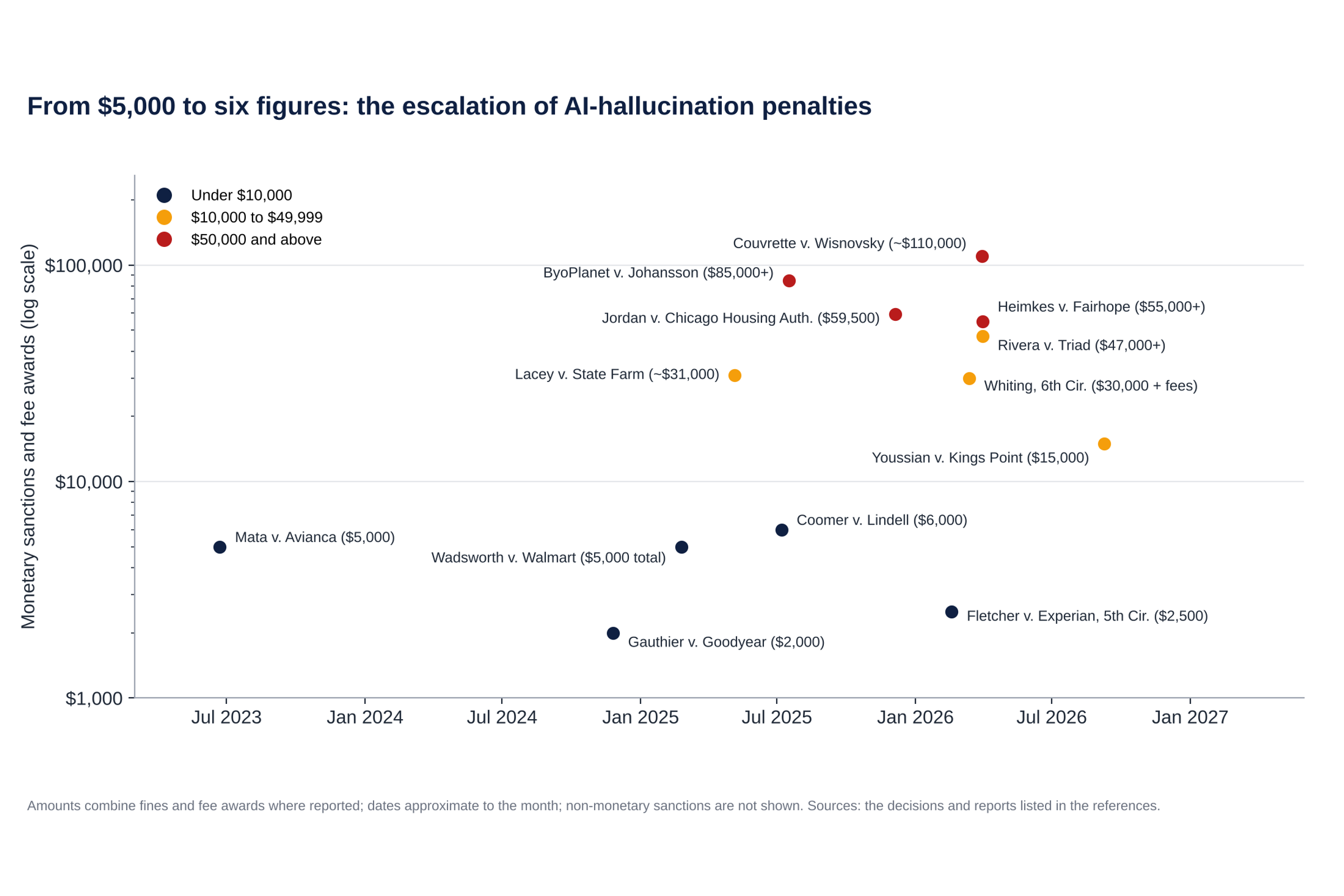
Note. Log scale. Amounts combine fines and fee awards where reported; non-monetary sanctions such as disqualification and suspension are not shown. Sources: the decisions and reports listed in the references.
Table 1
Selected AI-Hallucination Decisions and What They Teach Researchers
| Case (court, year) | What went wrong | Consequence | Lesson for researchers |
|---|---|---|---|
| Mata v. Avianca (S.D.N.Y., 2023) | ChatGPT invented cases; counsel asked ChatGPT to confirm them | $5,000; letters to the client and judges | A tool vouching for itself proves nothing |
| Park v. Kim (2d Cir., 2024) | Non-existent decision from ChatGPT in a reply brief | Referral to Grievance Panel | Read and confirm every source |
| Wadsworth v. Walmart (D. Wyo., 2025) | In-house AI platform produced fake citations | $3,000 for the drafter; $1,000 each for co-signers | Reviewers share the duty |
| Ayinde / Al-Haroun (Div. Ct., 2025) | Fictitious cases; 18 of 45 citations non-existent, from client research | Wasted costs; regulatory referrals | Relying on others doesn’t shift the duty |
| Kohls v. Ellison (D. Minn., 2025) | Expert declaration cited non-existent articles | Entire declaration excluded | Verify expert sources independently |
| Couvrette v. Wisnovsky (D. Or., 2025–26) | 15 fake cases, 8 fabricated quotes; quiet refiling | About $110,000; dismissal with prejudice | Hiding a mistake makes it far worse |
| Fletcher v. Experian (5th Cir., 2026) | 16 fabricated quotations; AI output described as public case text | $2,500 in a published opinion | An AI summary is not the underlying case text |
| Whiting v. City of Athens (6th Cir., 2026) | More than 24 fake citations and record misstatements | Full fees, double costs, $15,000 each | It doesn’t matter which tool you used |
| Nebraska Supreme Court (2026) | 57 of 63 citations defective; AI use first denied | Temporary license suspension | Denial makes it worse; candor helps |
Note. Amounts include fee-shifting awards where reported.
Why the Duty to Verify Cannot Be Delegated
None of this rests on new law. When you sign a court filing, you certify that you made a reasonable inquiry, and the U.S. Supreme Court decided decades ago that this duty belongs to the individual who signs (Pavelic & LeFlore v. Marvel Entertainment Group, 1989). AI hasn’t changed that rule. It has simply put it to the test.
Courts have heard just about every version of someone else did the research, and they haven’t accepted any of them. An English solicitor relied on research his own client had put together; 18 of the 45 citations turned out not to exist. The Divisional Court said the duty to check is no lighter when you rely on someone else’s work (R (Ayinde) v London Borough of Haringey, 2025). A supervising partner in Alabama relied on his team and his firm’s AI policy, and he was disqualified anyway (Johnson v. Dunn, 2025). Two federal judges traced AI errors in their orders to an intern and a law clerk, and both took responsibility (Reuters, 2025). And an expert witness who used AI while drafting a declaration watched the whole declaration get thrown out (Kohls v. Ellison, 2025).
The guidance on machines says the same thing. The American Bar Association’s Formal Opinion 512 tells lawyers who use generative AI to carry out “independent verification or review” suited to the task (American Bar Association Standing Committee on Ethics and Professional Responsibility, 2024, p. 4). An Ontario court described a duty to make sure a human reviews anything produced by non-human technology (Ko v. Li, 2025). The Sixth Circuit went a step further and said it didn’t matter whether AI caused the errors at all. A citation you haven’t personally read and checked is a breach, wherever it came from (Savino, 2026).
Asking AI to Check AI Is Not Verification
What people often forget about Mata is that counsel asked ChatGPT whether its cases were real, and it reassured them. That was circular confirmation, not independent evidence. A model’s assurance alone does not establish that a citation exists or supports a claim. Some systems can retrieve records through tools, but the underlying record and relevant passage still need inspection; confidence in generated text is not a substitute (Figure 2).
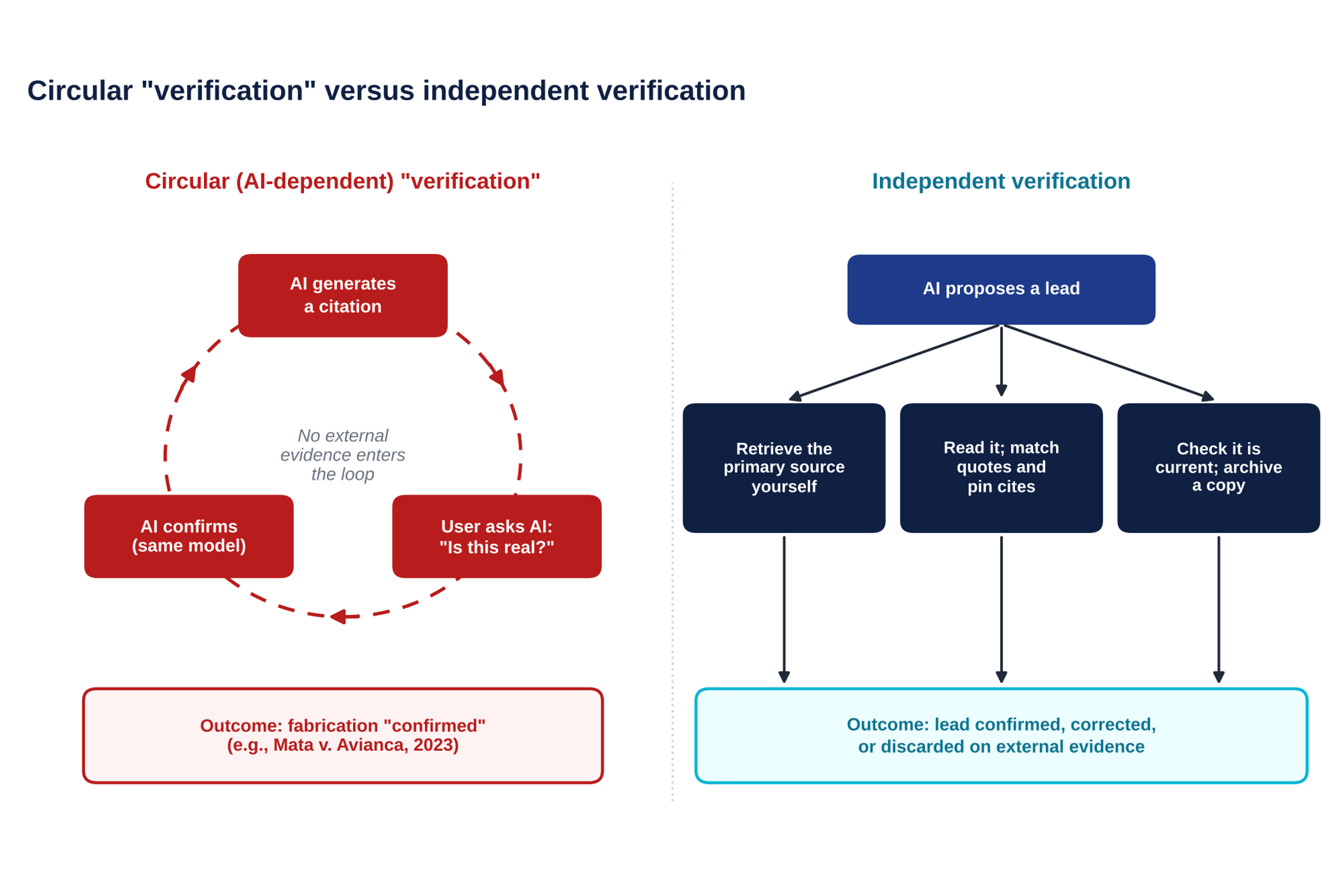
Note. Conceptual model. On the left, the loop closes without any outside evidence. On the right, AI output is treated as a lead, and confirmation comes only from sources outside the model.
There’s a quieter version of the same mistake: treating an AI-generated description of a source as if it were the source. In 2026 the Fifth Circuit sanctioned a lawyer whose brief contained sixteen fabricated quotations. She said she’d worked from publicly available versions of the cases. The court found those were generative-AI research products and made clear that new technology doesn’t come with new rules (Fletcher v. Experian Information Solutions, Inc., 2026). Summaries, snippets, AI overviews, and chatbot answers can point you toward a source. They are never the source.
The English Divisional Court summed up the standard in a single line:
“The critical safeguard is to check any output by reference to an authoritative source.”
R (Ayinde) v London Borough of Haringey (2025, para. 87)
Even Legal-Grade and Deep-Research AI Tools Hallucinate
It’s tempting to think this is just a free-chatbot problem. The research says otherwise (Figure 3). Stanford researchers found that general-purpose models hallucinated in 58% to 88% of their answers to checkable questions about federal cases (Dahl et al., 2024). Paid legal research tools built on retrieval did better, but they still hallucinated on about 17% (Lexis+ AI) and 33% (Westlaw AI-Assisted Research) of queries, and sometimes cited real sources for claims those sources didn’t make (Magesh et al., 2025). Outside law, ChatGPT made up 55% of its citations with GPT-3.5 and 18% with GPT-4 when asked to write literature reviews (Walters & Wilder, 2023). These are historical tests of particular models, products, prompts, and definitions. They do not establish the error rate of every current release or permit a direct ranking across the study groups.
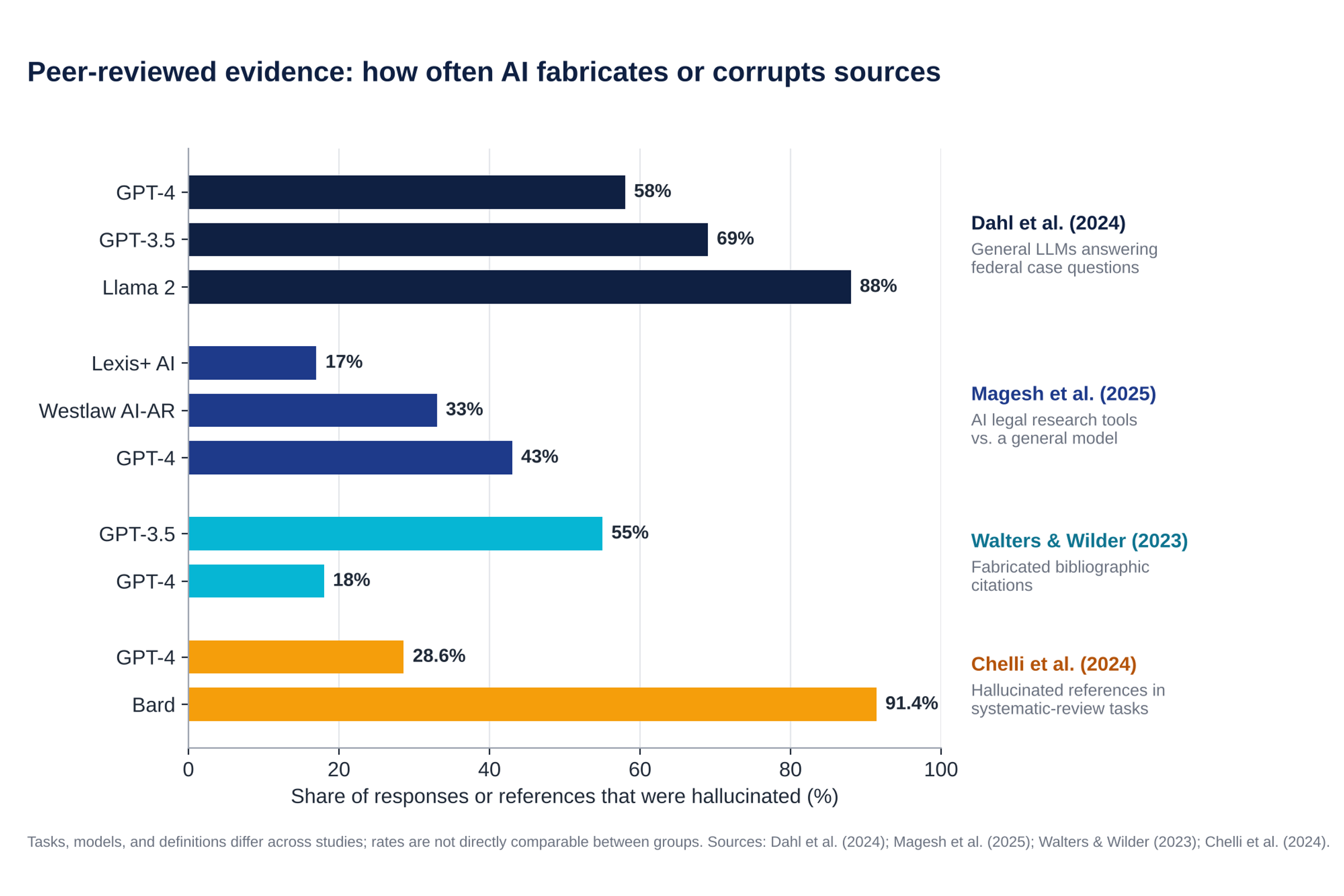
Note. Tasks, models, and definitions differ across studies, so rates are not directly comparable between groups. Sources: Dahl et al. (2024); Magesh et al. (2025); Walters and Wilder (2023); Chelli et al. (2024).
Deep-research agents produce more citations, not better ones. A 2026 study looked at more than 53,000 citation URLs from ten commercial AI systems and found that 3% to 13% of them were hallucinated outright. The deep-research agents produced fake URLs at more than twice the rate of the search-augmented models, 10.7% versus 4.8%. When the models were given a tool that checked each URL against live and archived records, broken citations dropped below 1% (Rao et al., 2026). So tools can help a great deal, but only when they check the output against something outside the model.
The last weak point is us. An audit of generative search engines found that only about half of the sentences they produced were fully supported by the citations attached to them (Liu et al., 2023). And in a 2026 survey, 87% of researchers said they always verify AI-generated citations, while 42% admitted they had pasted AI-supplied references without checking (Xu et al., 2026, as cited in Rao et al., 2026).
Lessons for Online Researchers and OSINT Professionals
A due-diligence report, OSINT attribution, or literature review also depends on accurate sourcing. Court rules do not automatically impose identical legal duties on every researcher, but these cases offer practical lessons about professional responsibility, review, and correction:
- Your name is your certificate. You own the accuracy of every report you deliver, whatever tools or helpers you used.
- Read what you cite. Making sure a source exists isn’t enough. Misquotes and misrepresentations turn up in hundreds of these cases, right alongside outright fakes.
- Don’t let a system grade its own homework. An AI confirming its own answer, or another AI agreeing with it, isn’t evidence.
- Treat “research-grade” as lower risk, not no risk. Specialized tools still get things wrong at meaningful rates.
- If you find a mistake, own it fast. The Fifth Circuit said it probably would have gone easier on counsel who had been upfront (Fletcher, 2026), while an attempted cover-up in Oregon helped push the total past $100,000 (Robert, 2026).
A Pre-Publication Verification Routine: The Six Gates
The six-gate checklist below synthesizes verification principles discussed in the cited cases and guidance (Figure 4). It is a proposed research workflow, not a universal court rule. Before publication, check each source supporting a consequential claim; resolve failures by correcting, replacing, or removing the affected material.
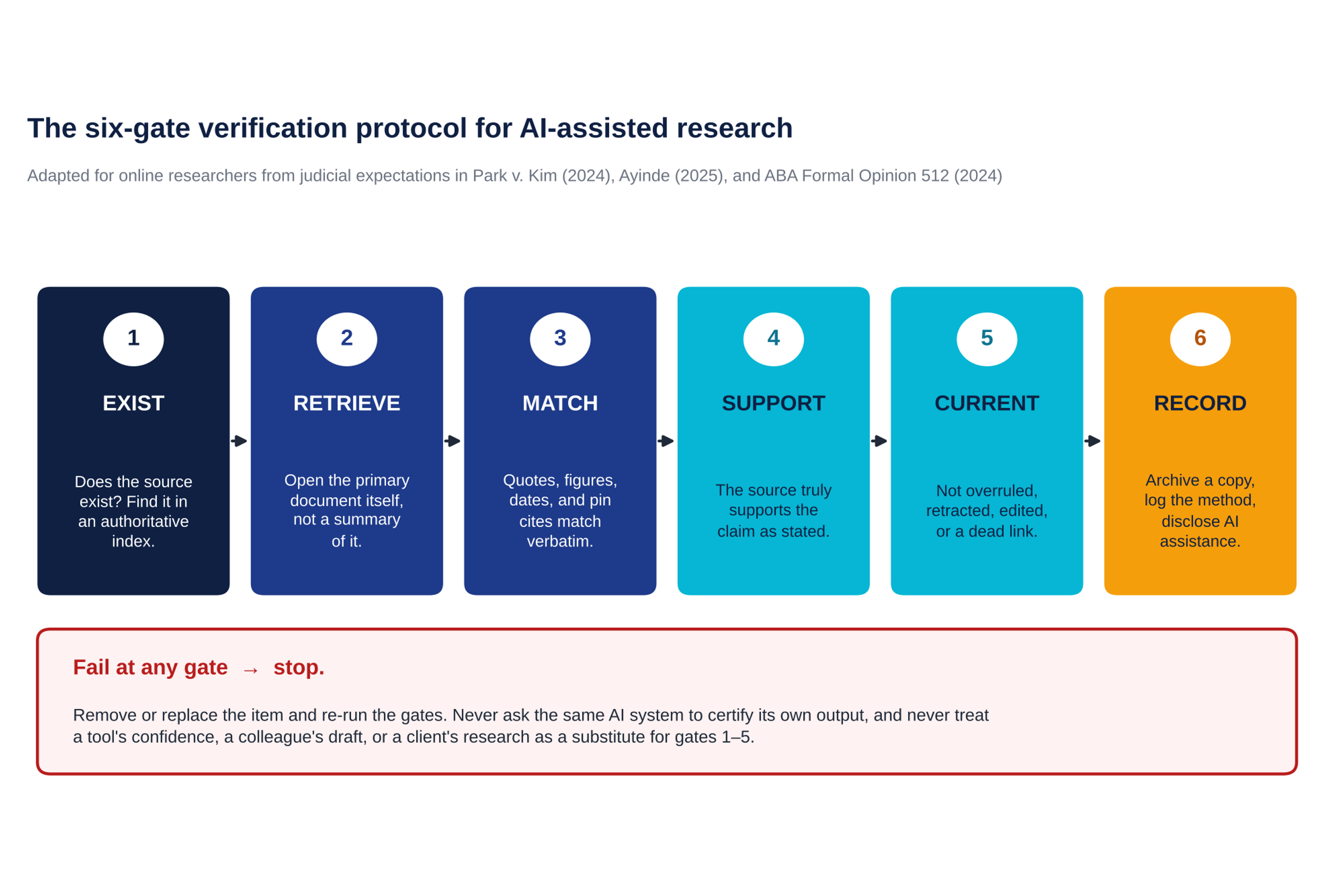
Note. Adapted from judicial expectations in Park v. Kim (2024), R (Ayinde) v London Borough of Haringey (2025), and ABA Formal Opinion 512 (2024).
- Exist: find the source in an index that has nothing to do with the AI tool, such as a publisher’s site, a DOI resolver, a library catalog, an official registry, or a court database.
- Retrieve: open the actual document, not an abstract, a snippet, or an AI summary.
- Match: check every quote, number, date, and name word for word, and note the page or paragraph.
- Support: make sure the source really backs up the point you’re using it for.
- Current: look for retractions, corrections, reversals, edits, and dead links.
- Record: save a copy, note how you checked it, and disclose any significant AI help.
None of this means giving up AI. Use it to find leads, draft, summarize, and spot gaps. Just do the verifying yourself, against sources that sit outside the model.
Building Verification Skills: CIRS™ and AOFIRS
Verification is a skill, and like any skill it has to be taught and tested. The Certified Internet Research Specialist (CIRS™) program from the Association of Internet Research Specialists (AOFIRS) puts source evaluation and verification at the core of professional online research. The court cases make a strong argument for training researchers on the specific ways AI fails: spotting fabricated, misquoted, and misrepresented sources, supervising agentic research workflows, auditing AI-generated bibliographies, and documenting verification well enough that it would hold up if someone challenged the work. Learn more through AOFIRS certifications and our AI citation verification guide.
Frequently Asked Questions
What is an AI hallucination in legal or research work?
It’s AI output presented as fact that is actually made up, distorted, or unsupported. The most common forms are cases or articles that don’t exist, real sources with invented quotes, and real sources cited for conclusions they never reached.
Can a professional be sanctioned if the AI tool made the error?
Yes. Courts keep coming back to the same point: the person who signs or submits the work is responsible for it. Fines, fee awards, disqualification, dismissal, and license suspensions have all followed errors that started in an AI tool.
Is it enough to ask the AI whether its sources are real?
No. In Mata v. Avianca (2023), ChatGPT vouched for cases it had invented. To verify a source, you have to look it up yourself in an authoritative index or database outside the AI system.
Are paid legal or research-grade AI tools safe to rely on?
Specialized tools reduced errors relative to a general model in the cited historical benchmark, but still produced hallucinations. Magesh and colleagues reported about 17% to 33% for the tested legal tools. That result is not a guarantee about present releases or a reason to skip verification (Magesh et al., 2025).
What should I do if I find a hallucinated source after delivering a report?
Move quickly and be open about it. Acknowledge the error, withdraw or correct the affected material, tell everyone who received it, and keep a record of what changed. Candor and corrective steps can matter, but they do not guarantee a particular legal outcome.
Conclusion
For three years, courts have been running an unplanned experiment in what happens when professionals let AI do their checking. The results are public, searchable, and expensive. My advice to researchers is simple: let AI help you move faster, but never let it be the last one to check your work. The duty to verify stays with the person whose name is on the report.
About the Author
Naveed Manzoor, MS, is the Founder and CEO of the Association of Internet Research Specialists (AOFIRS) and the creator of the Certified Internet Research Specialist (CIRS™) program. He has more than 25 years of experience in online research, OSINT, and search technology. This article draws on his AOFIRS research report The Courtroom Warning: What AI Hallucination Sanctions Teach Online Researchers About the Duty to Verify (2026).
References
American Bar Association Standing Committee on Ethics and Professional Responsibility. (2024, July 29). Formal opinion 512: Generative artificial intelligence tools. American Bar Association. View source
Charlotin, D. (2026). AI hallucination cases database [Data set; updated November 14, 2026]. CC BY 4.0. View source
Chelli, M., Descamps, J., Lavoué, V., Trojani, C., Azar, M., Deckert, M., Raynier, J.-L., Clowez, G., Boileau, P., & Ruetsch-Chelli, C. (2024). Hallucination rates and reference accuracy of ChatGPT and Bard for systematic reviews: Comparative analysis. Journal of Medical Internet Research, 26, Article e53164. View source
Couvrette v. Wisnovsky, No. 1:21-cv-00157-CL, 2025 WL 4109655 (D. Or. Dec. 12, 2025).
Dahl, M., Magesh, V., Suzgun, M., & Ho, D. E. (2024). Large legal fictions: Profiling legal hallucinations in large language models. Journal of Legal Analysis, 16(1), 64–93. View source
Fletcher v. Experian Information Solutions, Inc., No. 25-20086 (5th Cir. Feb. 18, 2026). View source
Johnson v. Dunn, 792 F. Supp. 3d 1241 (N.D. Ala. 2025).
Ko v. Li, 2025 ONSC 2766 (Ontario Superior Court of Justice).
Kohls v. Ellison, No. 24-cv-3754 (D. Minn. Jan. 10, 2025).
Lacey v. State Farm General Insurance Co., No. CV 24-5205 FMO (MAAx) (C.D. Cal. May 6, 2025).
Liu, N. F., Zhang, T., & Liang, P. (2023). Evaluating verifiability in generative search engines. In Findings of the Association for Computational Linguistics: EMNLP 2023 (pp. 7001–7025). Association for Computational Linguistics. View source
Magesh, V., Surani, F., Dahl, M., Suzgun, M., Manning, C. D., & Ho, D. E. (2025). Hallucination-free? Assessing the reliability of leading AI legal research tools. Journal of Empirical Legal Studies, 22(2), 216–242. View source
Manach, J.-M. (2025, July 1). Il génère des plaidoiries par IA, et en recense 160 ayant « halluciné » depuis 2023 [He generates pleadings with AI and lists 160 that have “hallucinated” since 2023]. Next. View source
Manzoor, N. (2026). The courtroom warning: What AI hallucination sanctions teach online researchers about the duty to verify [Research report]. Association of Internet Research Specialists.
Mata v. Avianca, Inc., 678 F. Supp. 3d 443 (S.D.N.Y. 2023). Court opinion
Park v. Kim, 91 F.4th 610 (2d Cir. 2024).
Pavelic & LeFlore v. Marvel Entertainment Group, 493 U.S. 120 (1989).
R (Ayinde) v London Borough of Haringey; Al-Haroun v Qatar National Bank QPSC [2025] EWHC 1383 (Admin). View source
Rao, D., Wong, E., & Callison-Burch, C. (2026). Detecting and correcting reference hallucinations in commercial LLMs and deep research agents (arXiv:2604.03173) [Preprint]. arXiv. View source
Reuters. (2025, October 23). Two federal judges say use of AI led to errors in US court rulings. Business Insurance. View source
Rivera v. Triad Properties Corp., No. 24-cv-01802, 2026 WL 915744 (N.D. Ala. Mar. 31, 2026).
Robert, A. (2026, April 17). Federal judge hands down $110K penalty against 2 lawyers for AI errors in court documents. ABA Journal. View source
Savino, C. (2026). Fake cases, real sanctions: The dangers of AI. Litigation News. American Bar Association Section of Litigation. View source
University of Illinois Chicago School of Law Library. (2026). Flood of AI-related sanctions persist. View source
Wadsworth v. Walmart Inc., 348 F.R.D. 489 (D. Wyo. 2025).
Walters, W. H., & Wilder, E. I. (2023). Fabrication and errors in the bibliographic citations generated by ChatGPT. Scientific Reports, 13, Article 14045. View source
Whiting v. City of Athens, 170 F.4th 455 (6th Cir. 2026). Court opinion
WOWT. (2026, April 16). Nebraska Supreme Court suspends Omaha attorney over AI use. View source