
FastPeopleSearch.com is a free people-search website that returns names, phone numbers, addresses and relatives compiled from public and commercial records. AOFIRS covers the site itself, and how to remove a listing from it, in Fast People Search: Overview, Opt-Out and Removal Guide. This article looks at the alternatives researchers use when a free lookup is not enough, or when a result needs a second source.
Whether you are reconnecting with someone, checking contact information or doing lawful background research, the choice of site affects what you find. No single site has every record, and many draw on overlapping data. The useful questions are what kind of data each service offers, what it costs, what its operator says it must not be used for, and how far its results can be trusted before you confirm them elsewhere.
This guide groups ten services by type and records what their official pages showed on 9 November 2026. It does not rank or score them. The emphasis is on verification. For a broader list of people-search engines, see 10 People Search Engines and Websites.
Before You Search: What People-Search Sites Cannot Be Used For
In the United States, a report used to decide whether someone gets a job, a tenancy, credit or insurance is a consumer report under the Fair Credit Reporting Act (FCRA). A consumer reporting agency may supply such reports only for permissible purposes listed in the law. These include credit, employment, insurance underwriting, certain government licences and a legitimate business need in a transaction the consumer started (Legal Information Institute). Employers that use background reports must notify the applicant in a stand-alone document, get written permission, and follow adverse-action steps if the report affects the decision ([Federal Trade Commission [FTC], 2020](https://www.ftc.gov/business-guidance/resources/using-consumer-reports-what-employers-need-know)).
Most consumer people-search sites say they are not consumer reporting agencies, so their results must not be used for those decisions. On 9 November 2026, for example, Spokeo’s homepage stated that it “is not a consumer reporting agency as defined by the Fair Credit Reporting Act” and told users not to use it for credit, employment, tenant screening or other FCRA purposes (Spokeo, 2026).
A disclaimer does not settle the matter. In 2023 the FTC said TruthFinder and Instant Checkmate operated as consumer reporting agencies despite disclaimers on their websites, because they marketed reports for employment and tenant screening. The companies agreed to a proposed $5.8 million civil penalty, subject to court approval (FTC, 2023).
FCRA notice. Do not use any service in this article to screen an employee, tenant, borrower or insurance applicant. Use an FCRA-compliant background screening company instead. AOFIRS explains the difference in People Search vs. FCRA Screening.
Why Researchers Look Beyond FastPeopleSearch
A free directory lookup is a starting point. Researchers usually need one or more of the following:
- More detailed background reports
- Reverse phone lookups for unknown numbers
- Court and other public-record references
- Property ownership information
- Email address searches
No people-search website has access to every available record. That is why professional researchers compare results from several sources, and then confirm the facts that matter in primary records, before drawing conclusions.
How This Comparison Was Made
AOFIRS tried to open the official homepage of each service named in the earlier version of this article, and the opt-out page where one was linked or known. For each service we recorded:
- whether the site was live;
- the search types the vendor itself lists;
- any price displayed before a search;
- any FCRA statement visible on the page;
- the opt-out route.
Six sites, FastPeopleSearch, TruePeopleSearch, BeenVerified, Whitepages, Intelius and ZabaSearch, blocked automated access on that date. Their entries below are kept short and marked “not re-verified”. An editor will check them in a browser before the next update. No site that could be opened displayed prices before a search began, so the table records that fact rather than a price.
No hands-on test searches were run for this revision, so the article reports no accuracy findings. The next update will follow this protocol:
- Recruit three to five volunteers who consent in writing to being searched.
- On one stated date, search each volunteer on every service with the same inputs: full name with city and state, then phone number, then address.
- Use the free tier first. Where a paid tier is tested, record the price at checkout, the plan length and the auto-renewal terms.
- Compare each returned field with what the volunteer confirms: current and correct, outdated, wrong person or missing.
- Publish the date, sample size, field-level results and limits, and repeat the test every six months.
The Ten Services at a Glance (checked 9 November 2026)
| Service | Type | Vendor-listed search inputs | Price shown, 9 Nov 2026 | FCRA statement seen | Opt-out route |
|---|---|---|---|---|---|
| TruePeopleSearch | Free directory | Not re-verified (site blocked) | Not checked | Not checked | Not checked |
| ZabaSearch | Free directory | Not re-verified (site blocked) | Not checked | Not checked | Not checked |
| Nuwber | Directory with paid reports | Name, phone, email, address, property, business | None; “affordable subscription plans” mentioned | None seen on homepage | Removal page could not be opened |
| BeenVerified | Subscription reports | Not re-verified (site blocked) | Not checked | Not checked | Not checked |
| Spokeo | Freemium reports | Name, email or username, phone, address | Free initial search; “additional fees may apply” | Yes, not a CRA; no FCRA uses | spokeo.com/optout |
| TruthFinder | Subscription reports | Homepage not checked | Not checked | Covered by FTC 2023 case | Online form; up to 48 hours |
| Instant Checkmate | Subscription reports, public-record focus | Criminal, traffic, arrest and court records; addresses, aliases | None shown | None seen on homepage | No link seen; member-care phone line listed |
| PeopleFinders | Free and premium reports | Name, phone, email, address, relatives, business, property | None shown | None seen on homepage or opt-out page | Profile URL into opt-out form, then email confirmation |
| Intelius | Subscription reports | Not re-verified (site blocked) | Not checked | Not checked | Not checked |
| Whitepages | Phone and identity lookups | Not re-verified (site blocked) | Not checked | Not checked | Not checked |
Free Directory-Style Sites
Directory-style services offer basic lookups. Confirm what access is free before using a service, and verify anything you plan to rely on.
TruePeopleSearch
TruePeopleSearch offers name, phone and address lookups similar to FastPeopleSearch’s. The earlier version of this article described it as free; that was not re-verified on 9 November 2026. AOFIRS reviews it separately in TruePeopleSearch review.
ZabaSearch
ZabaSearch offers name, phone and address lookups. Its site could not be opened on 9 November 2026, so no free-tier or pricing claim is made here. See ZabaSearch review and the ZabaSearch overview.
Nuwber
Nuwber’s homepage lists searches by name, phone number, email address and address. It also lists property, business, licence, criminal-record, judgment, lien and bankruptcy information. It mentions “affordable subscription plans” for fuller results but showed no prices on 9 November 2026, and no FCRA statement was visible on the homepage (Nuwber, 2026). Its removal page could not be opened. See Nuwber review.
Subscription Report Services
These services compile longer reports for a fee. They can save time, but their records still come from third-party suppliers and need confirming.
BeenVerified
BeenVerified sells background reports covering contact, property and vehicle information. Its website could not be opened on 9 November 2026. AOFIRS’s BeenVerified review records the in-app prices shown in its app-store listings.
Spokeo
Spokeo’s homepage lists searches by name, email or username, phone number and address. It offers a free initial search and notes that criminal court records are not included in all plans and that “additional fees may apply”. No prices were shown before a search on 9 November 2026. The page carries the FCRA disclaimer quoted above and links an opt-out page at spokeo.com/optout (Spokeo, 2026). See Spokeo review.
TruthFinder
TruthFinder sells background reports drawn from public and commercial records. Its opt-out page asks you to submit your details as they appear on your report, with a contact email. You must make a separate request for each name and report, and removal can take up to 48 hours (TruthFinder, 2026). The FTC’s 2023 complaint alleged that TruthFinder and Instant Checkmate presented traffic tickets as criminal or arrest records. It also alleged that their “Remove” button only hid information from the customer who clicked it (FTC, 2023). See TruthFinder review.
Instant Checkmate
Instant Checkmate replaces Radaris in this edition. Its homepage presents searches for criminal and traffic records, arrest records, court documents, addresses, ages and known aliases. On 9 November 2026 it showed no prices and no FCRA statement in the homepage text, and no opt-out link was visible; it lists a member-care phone line (Instant Checkmate, 2026). It is one of the two companies in the FTC’s 2023 case. An arrest record is not a conviction, so check any court match against the originating court’s record.
PeopleFinders
PeopleFinders’ homepage lists searches by name, phone number, email, address and relationship, plus relatives, business roles, professional licences and property records. It reports “120B” public records, “3M+” customers and “6,000+” data sources. These are the vendor’s own figures, not independently verified. No prices or FCRA statement were shown on 9 November 2026 (PeopleFinders, 2026a). To opt out, search for your name, open your profile, copy its URL into the opt-out form and confirm by the emailed link (PeopleFinders, 2026b). See PeopleFinders review.
Intelius
Intelius sells people-search and background reports. Its website could not be opened on 9 November 2026, so no current price or disclaimer is given here. See Intelius review.
Phone and Identity Lookups
Whitepages
Whitepages is known for reverse phone and address lookups, with paid premium reports. Its website could not be opened on 9 November 2026, so its current pricing and FCRA wording are not given here. See Whitepages review.
What Happened to Radaris
Earlier editions listed Radaris. On 9 November 2026 radaris.com displayed a notice that the domain had been transferred to Atlas Data Privacy Corporation by court order. The case was brought in the Superior Court of New Jersey, Law Division, Middlesex County (Docket No. MID-L-000847-24), under New Jersey’s Daniel’s Law. The notice gives 27 August 2026 as the date of the final default judgment against Radaris.com, Rehold.com and Trustoria.com (Atlas Data Privacy Corp. v. Radaris.com, 2026). Krebs on Security reported that 14 domains were transferred in the case (Krebs on Security, 2026). Old Radaris profile links and reports should no longer be relied on.
Where FastPeopleSearch Fits
FastPeopleSearch and the free directories are useful for a first pass: generating candidate addresses, phone numbers and relatives to test. Subscription services add more fields and history, but they do not turn unverified data into verified data. Paying more buys convenience and breadth, not proof.
Are People-Search Results Accurate?
People-search platforms collect information from many sources, including:
- Public records
- Property records
- Court filings
- Marketing databases
- Directory listings
- Social networks
Because these sources are updated at different times and matched by algorithm, records can be incomplete, outdated or merged with someone else’s. The FTC found that TruthFinder’s and Instant Checkmate’s data came from third parties that disclaimed its accuracy, and that the companies did not verify it (FTC, 2023). Treat every result as a lead until it is confirmed.
How Professional Researchers Verify People-Search Results
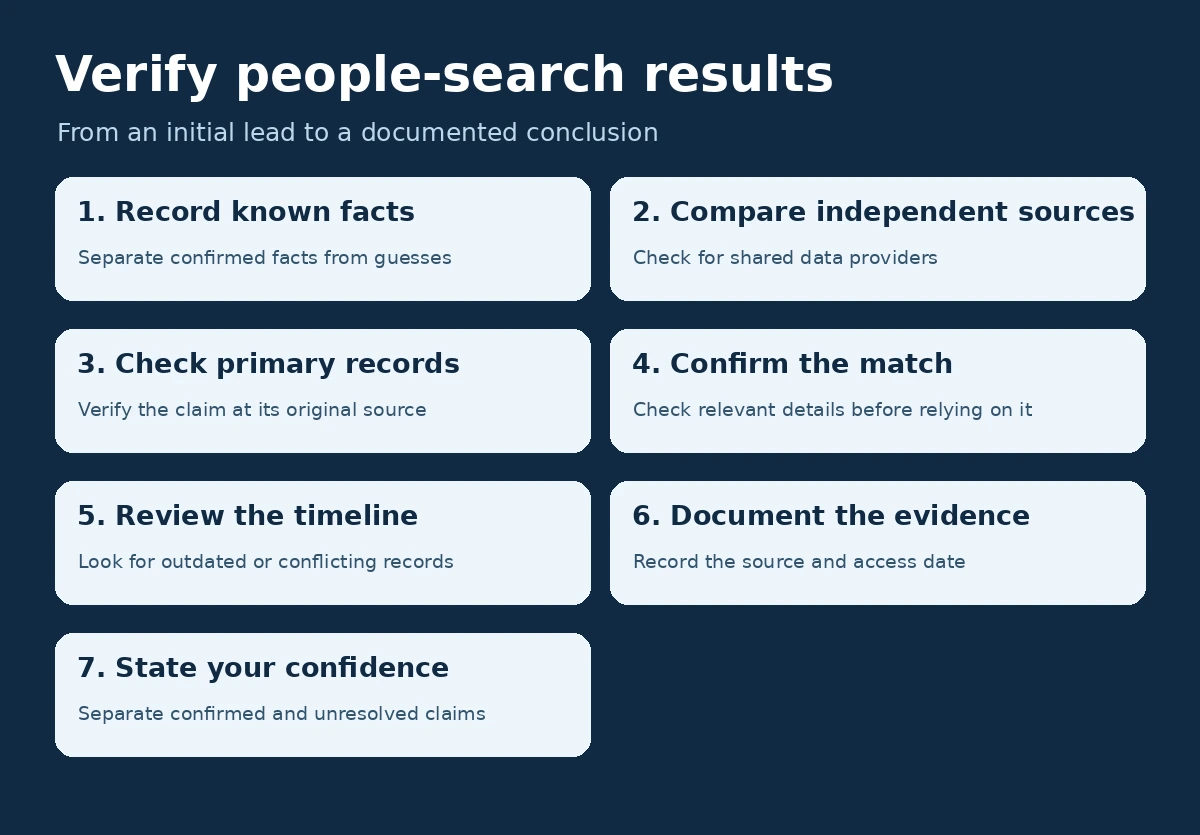
Professional researchers rarely rely on a single database. A defensible workflow looks like this:
- Fix the identifiers first. Write down what you already know for certain, such as full name, approximate age and a past city, and search on those, not on guesses.
- Cross-reference at least two independent services. Brands can share owners or data suppliers, so two services agreeing is not automatically independent corroboration. Note which source each fact came from.
- Confirm in primary records. Check addresses and ownership in the county assessor’s or recorder’s database. Check court matches in the relevant court’s own portal, and business roles in the state business registry.
- Check identity, not just name. Match at least two further identifiers, such as age range, middle initial or known relatives, before you treat a record as your subject.
- Test consistency over time. A current address should fit a sensible timeline of earlier ones; a sudden jump with no linking record needs explaining.
- Document as you go. Record the URL, date and time of each search, the inputs used and a screenshot, so another researcher can repeat the work.
- State confidence honestly. Report what is confirmed, what is probable and what is unresolved.
Worked example (illustrative). A free directory lists three possible current addresses for “J. Rivera, 40s, Orlando”. A subscription report shows the same three plus a fourth. Before choosing, the researcher checks the county property appraiser’s records and finds the fourth address was sold two years ago. One of the three remaining addresses matches a recent property-tax record in the subject’s name and middle initial. That address is reported as “confirmed in a primary record”. The others are reported as “unconfirmed leads”, with the date and source of each.
AI tools can help draft search strategies and summarise records, but they cannot confirm identity. Every AI-suggested match needs the same primary-record check. AOFIRS sets out the full method in How Professional Researchers Verify People-Search Results.
Removing Your Own Listing
The FTC describes people-search sites as data brokers that sell compiled reports to anyone who pays. Most offer an opt-out, which you can request yourself for free, one site at a time. Your details can reappear when public records change, so check again periodically. Opting out does not remove the underlying public records. If you use a paid removal service, check how many sites it covers, whether it reports what it removed and how often it rescans (FTC, 2024).
California residents can use the state’s free Delete Request and Opt-out Platform (DROP). It sends one deletion request to more than 600 registered data brokers. Requests opened on 1 January 2026, and brokers had to begin processing them from 1 August 2026, then check the platform at least every 45 days (California Privacy Protection Agency). AOFIRS’s FastPeopleSearch opt-out guide gives the steps for that site.
Frequently Asked Questions
Which FastPeopleSearch alternative should I use?
It depends on the data you need. For a quick free check, a directory-style site is enough. For a longer history, a subscription report can help. In both cases, confirm the facts that matter in primary records. This article does not rank services because no dated test has yet been run.
Which people-search websites are free?
Most sites offer a free initial search with paid reports behind it; Spokeo’s homepage, for example, offers a free search and notes that additional fees may apply. The free status of the directories that could not be opened on 9 November 2026 has not been re-verified.
How can I check an unknown phone number?
Search the number on two services, then look it up in the carrier’s or business’s own listings. Treat a name attached to a number as a lead, because numbers are reassigned.
Are People Search Websites Legal?
Many personal uses can be lawful in the United States, subject to applicable laws and site terms. Do not use the services in this guide to screen applicants for jobs, housing, credit, or insurance. If screening relies on a consumer report, use an FCRA-compliant provider and follow the applicable rules.
Which people-search website has the most accurate information?
No published, dated test supports naming one. The reliable approach is to compare several services and verify findings in primary records.
Bottom Line
FastPeopleSearch and its alternatives are lead generators, not evidence. Choose a service by the type of data you need. Read its FCRA statement and opt-out terms, and record the date and price of what you buy.
For the most accurate results, experienced researchers use several databases, compare findings and confirm them in primary records before acting on people-search data.
References
- Atlas Data Privacy Corp. v. Radaris.com. (2026). This domain has been transferred by court order [Notice of final judgment, Superior Court of New Jersey, Law Division, Middlesex County, Docket No. MID-L-000847-24]. Retrieved November 9, 2026, from View source
- California Privacy Protection Agency. DROP: Delete Request and Opt-out Platform. CalPrivacy. Retrieved November 9, 2026, from View source
- Federal Trade Commission. (2020). Using consumer reports: What employers need to know (last modified August 4, 2020). View source
- Federal Trade Commission. (2023, September 11). FTC says TruthFinder, Instant Checkmate deceived users about background report accuracy, violated FCRA while marketing reports for employee and tenant screening [Press release]. View source
- Federal Trade Commission. (2024). What to know about people search sites that sell your information (last modified November 15, 2024). Consumer Advice. View source
- Instant Checkmate. (2026). Instant Checkmate [Home page]. Retrieved November 9, 2026, from View source
- Krebs on Security. (2026, September 16). Data broker Radaris loses domains in privacy fight. View source
- Legal Information Institute. 15 U.S. Code § 1681b – Permissible purposes of consumer reports. Cornell Law School. Retrieved November 9, 2026, from View source
- Nuwber. (2026). Nuwber [Home page]. Retrieved November 9, 2026, from View source
- PeopleFinders. (2026a). PeopleFinders [Home page]. Retrieved November 9, 2026, from View source
- PeopleFinders. (2026b). Opt out. Retrieved November 9, 2026, from View source
- Spokeo. (2026). Spokeo [Home page]. Retrieved November 9, 2026, from View source
- TruthFinder. (2026). Opt out. Retrieved November 9, 2026, from View source