
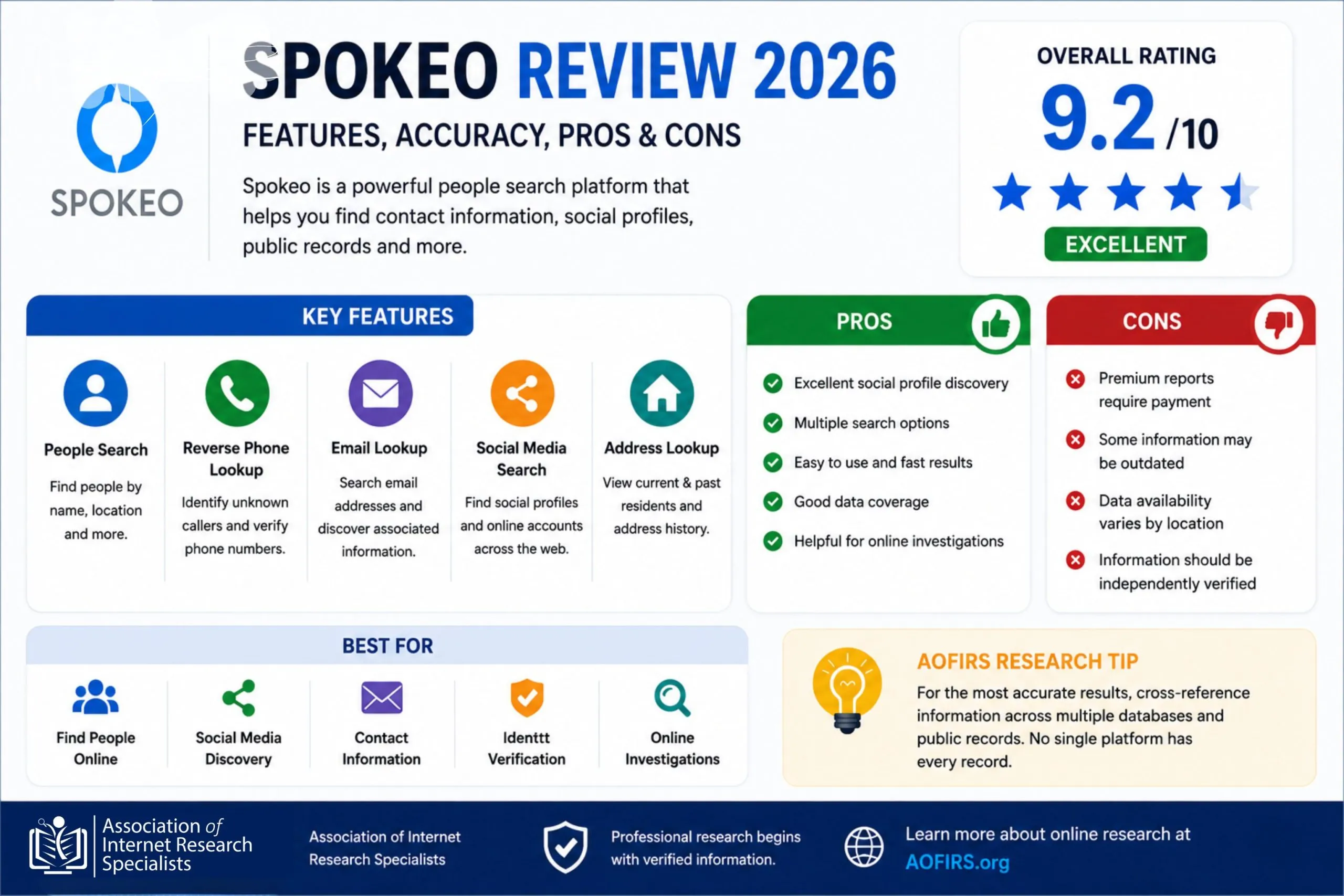
Spokeo is one of the most widely used people search platforms in the United States, known for combining public records, contact information, social media profiles, and online identity data into a single searchable database.
Unlike traditional people search websites that primarily focus on names, addresses, and phone numbers, Spokeo specializes in connecting information from multiple online sources, helping users build a broader picture of an individual’s digital footprint.
But is Spokeo worth using in 2026? How accurate are its reports? Is it safe and legitimate? And how does it compare to competitors like BeenVerified, Whitepages, TruePeopleSearch, and FastPeopleSearch?
This comprehensive review examines everything you need to know before using Spokeo.
Why Trust This Review?
This review was prepared using research principles promoted by AOFIRS (Association of Internet Research Specialists), an organization dedicated to advancing professional online research, source verification, digital investigation methodologies, and ethical internet intelligence practices.
Rather than relying solely on marketing claims, our evaluation considers the following:
- Search functionality
- Data coverage
- Accuracy
- User experience
- Transparency
- Privacy considerations
- Real-world research applications
AOFIRS promotes structured research methodologies that emphasize verification, source evaluation, and responsible use of publicly available information.
Quick Verdict
Category |
Rating |
| Ease of Use | 9.4/10 |
| Search Speed | 9.2/10 |
| Data Coverage | 9.0/10 |
| Search Accuracy | 8.9/10 |
| Social Profile Discovery | 9.8/10 |
| Overall Rating | 9.2/10 |
Bottom Line
Spokeo remains one of the strongest platforms for discovering online profiles, social media connections, contact information, and digital footprints. Its ability to aggregate information from multiple sources makes it a valuable tool for online research and identity discovery.
Best For
- Social media profile discovery
- Finding people online
- Contact information research
- Digital footprint analysis
- Identity verification
- Online investigations
What Is Spokeo?
Spokeo is a people search platform that aggregates publicly available information from numerous sources, including public records, social networks, contact databases, and online profiles.
Users can search by:
- Name
- Phone number
- Email address
- Address
- Username
Search results may include:
- Contact information
- Address history
- Social media profiles
- Family members
- Public records
- Online accounts
- Associated individuals
Unlike many competitors, Spokeo places significant emphasis on connecting online identities across multiple platforms.
For users trying to reconnect with former classmates, friends, coworkers, or relatives, you may also find this guide helpful:
Related Guide
Key Features
People Search
Users can search individuals by name and location.
Results often include:
- Full names
- Age ranges
- Current locations
- Relatives
- Contact information
Best For
Locating individuals and verifying identities.
Social Media Search
Spokeo’s standout feature.
The platform may identify:
- Social profiles
- Online accounts
- Digital footprints
- Associated platforms
Best For
Online identity discovery.
Reverse Phone Lookup
Users can search a phone number and identify possible owners.
Results may include:
- Names
- Addresses
- Relatives
- Associated records
Best For
Identifying unknown callers.
Email Lookup
Users can search email addresses to discover publicly available information associated with them.
Potential results include:
- Names
- Social profiles
- Contact information
- Online accounts
Best For
Digital identity verification.
Address Lookup
Address searches may reveal:
- Current residents
- Previous residents
- Historical associations
- Property-related information
Best For
Address verification and residency research.
How Accurate Is Spokeo?
Spokeo aggregates information from multiple data sources, allowing it to provide broader identity profiles than many traditional people search websites.
Accuracy depends on:
- Source quality
- Data update frequency
- Public record availability
- Social profile visibility
What It Usually Gets Right
- Contact information
- Social profiles
- Address histories
- Family associations
- Publicly available records
Potential Limitations
- Outdated records
- Incomplete profiles
- Missing information
- Delayed updates
No people search website should be considered a definitive source.
Professional researchers verify findings through multiple databases, public records, and independent verification methods.
Pros and Cons
Pros
✓ Excellent social profile discovery
✓ Email lookup functionality
✓ Strong people search capabilities
✓ Easy-to-use interface
✓ Comprehensive online identity discovery
✓ Multiple search options
Cons
✗ Premium reports require payment
✗ Some records may be outdated
✗ Data availability varies
✗ Information should be independently verified
Spokeo Pricing
Spokeo offers both free and premium services.
Users may encounter:
- Free basic searches
- Premium reports
- Subscription plans
- Enhanced search features
Always review current pricing directly through Spokeo before subscribing.
Spokeo vs BeenVerified
BeenVerified generally provides more comprehensive public records reports.
Spokeo excels at:
- Social profile discovery
- Online identity research
- Digital footprint analysis
Winner
Depends on your objective
Public Records – BeenVerified
Social Discovery – Spokeo
Spokeo vs Whitepages
Whitepages focuses heavily on reverse phone lookup and identity verification.
Spokeo offers stronger online profile discovery.
Winner
For social and online identity research.
Spokeo vs TruePeopleSearch
TruePeopleSearch is excellent for free people searches.
Spokeo provides broader digital identity information.
Winner
Spokeo vs FastPeopleSearch
FastPeopleSearch is best for quick free lookups.
Spokeo provides more detailed identity discovery capabilities.
Winner
Is Spokeo Legit?
Yes. Spokeo is a legitimate people search and identity discovery platform used by millions of users.
However, it should not be used for:
- Employment screening
- Tenant screening
- Credit decisions
- Insurance eligibility decisions
Users should always comply with applicable laws and regulations.
Is Spokeo Safe?
For most users, Spokeo is generally safe to use.
However:
- Public records can contain errors.
- Information may be outdated.
- Findings should be independently verified.
People search websites should always be treated as research tools rather than definitive evidence.
How to Remove Your Information from Spokeo
Many users choose to remove their information from people search websites.
The typical opt-out process involves:
- Finding your listing.
- Visiting the official opt-out page.
- Submitting a removal request.
- Completing verification steps.
- Waiting for processing.
Privacy-conscious users should periodically review major people search websites and submit opt-out requests where appropriate.
Best Alternatives to Spokeo
If Spokeo does not meet your needs, consider the following:
Platform |
Best For |
Review |
| BeenVerified | Comprehensive Reports | /beenverified-review/ |
| Whitepages | Reverse Phone Lookup | /whitepages-review/ |
| TruePeopleSearch | Free People Searches | /truepeoplesearch-review/ |
| FastPeopleSearch | Quick Free Searches | /fastpeoplesearch-alternatives/ |
| TruthFinder | Deep Background Reports | /truthfinder-review/ |
AOFIRS Research Tip
Professional researchers rarely rely on a single people-search database.
For the most accurate results, compare information from:
- Multiple people search platforms
- Public records
- Search engines
- Social media profiles
- Official databases
Combining sources significantly improves accuracy and reduces the risk of relying on incomplete information.
The AOFIRS Researcher’s Perspective
At AOFIRS, we teach that finding people online requires more than a simple database search.
Researchers should:
- Verify sources
- Cross-reference information
- Evaluate credibility
- Assess data quality
- Document findings
Spokeo can be an excellent starting point for discovering online identities and social profiles, but professional researchers still compare information against multiple sources before drawing conclusions.
For serious investigations, using multiple databases almost always improves accuracy.
Learn more at AOFIRS.org.
Who Should Use Spokeo?
Spokeo is particularly useful for:
- Journalists
- Researchers
- Legal professionals
- Private investigators
- Business professionals
- Genealogists
- Individuals conducting online identity research
Those conducting advanced investigations should supplement people search platforms with broader research methodologies and source verification practices.
Frequently Asked Questions
Is Spokeo Free?
Spokeo offers free basic searches, while detailed reports generally require payment.
Is Spokeo Accurate?
Spokeo is generally effective for discovering social profiles and contact information, but results should always be independently verified.
Is Spokeo Better Than Whitepages?
For social profile discovery, yes. For reverse phone lookup and identity verification, Whitepages remains stronger.
Can I Remove My Information from Spokeo?
Yes. Spokeo provides an opt-out process.
Is Spokeo Legal?
Yes. It aggregates publicly available information and operates within applicable legal frameworks.
About AOFIRS
AOFIRS (Association of Internet Research Specialists) promotes professional standards in online research, source verification, digital investigation, artificial intelligence-assisted research, internet law, ethics, and data analysis.
Through educational resources, research publications, and the Certified Internet Research Specialist (CIRS) framework, AOFIRS helps professionals develop structured methodologies for finding, verifying, and analyzing information online.
Visit AOFIRS.org to learn more.
Final Verdict
Spokeo remains one of the strongest online identity discovery platforms available in 2026.
Its ability to connect social profiles, public records, contact information, and digital footprints makes it particularly valuable for researchers, journalists, investigators, and anyone attempting to find people online.