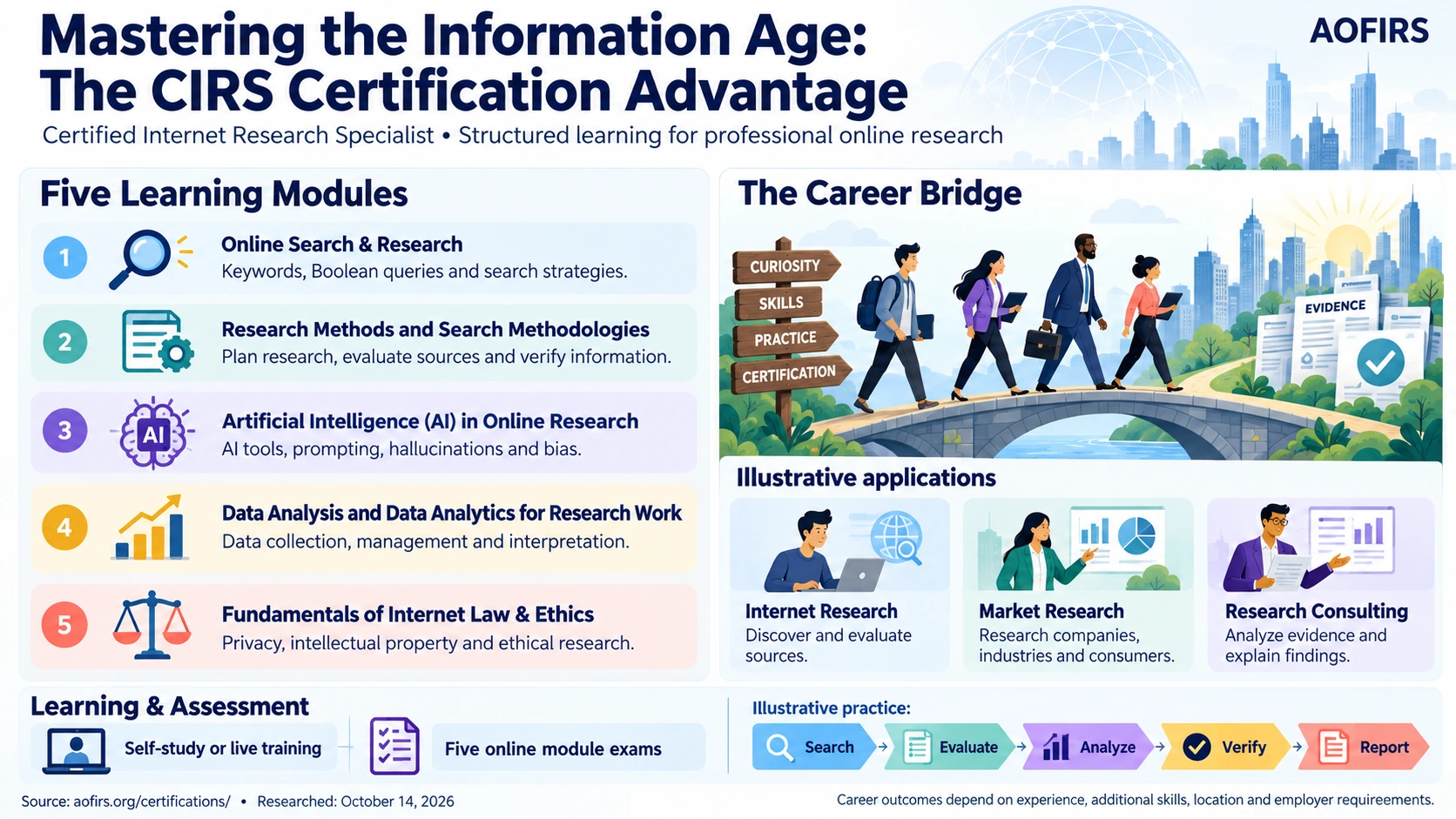
Every search result, every AI answer, every shared document now carries the same hidden question: can I trust this? For professional researchers, that question has become the job itself. The volume of information is no longer the bottleneck — machines find and summarize faster than any human. What machines cannot do is stand behind a claim. That is why trust, not access, has become the real currency of online research, and why the researcher’s role is shifting from gathering information to verifying it.
The 14-Slide Presentation
Browse the full presentation below, or download it to keep.
From Information Discovery to Strategic Verification
For two decades, the core skill of internet research was discovery: knowing which keywords, operators and databases would surface the right document. Generative AI has compressed that skill into a prompt. What it has not solved is accuracy. AI systems produce fluent, confident answers whether or not the underlying facts are true, and they rarely show their working.
The professional response is a pivot from discovery to strategic verification. The researcher’s value no longer lies in finding information quickly — anyone can do that now — but in answering three questions that AI cannot answer for itself:
- Provenance: Where did this claim originate, and can it be traced to a primary source?
- Corroboration: Do independent sources agree, or is every trace of the claim an echo of the same original?
- Risk: What is the cost if this claim is wrong, and how much verification does that cost justify?
The Information Gatherer vs. the Augmented Researcher
| Dimension | Traditional Information Gatherer | Augmented Researcher |
|---|---|---|
| Core activity | Searching, collecting, reading | Directing AI, verifying outputs, assessing risk |
| Relationship to AI | Occasional tool or competitor | Collaborative intelligence — a fast but fallible partner |
| Measure of quality | Volume and speed of results | Ground truthing: claims anchored to primary sources |
| Deliverable | A pile of links and excerpts | A verified, risk-assessed answer a client can act on |
| Source of value | Knowing where to look | Knowing what to trust — and proving why |
Three Practices That Build Trust
1. Collaborative intelligence
Use AI for what it does well — mapping a topic, drafting query strategies, extracting data from long documents — and reserve human judgment for what it does badly: evaluating credibility, detecting absence of evidence, and weighing context. The division of labor is deliberate, not accidental.
2. Ground truthing
Every load-bearing claim in a research deliverable should be anchored to a primary source: the original study, the court filing, the government dataset, the company’s own disclosure. If a claim cannot be traced to the ground, it is labeled as unverified — never silently passed along.
3. Risk assessment
Not every fact needs the same scrutiny. A date in a background summary and a figure in an investment memo carry different stakes. The augmented researcher grades claims by consequence and applies verification effort proportionally — deep verification where errors are expensive, lighter checks where they are not.
Watch: AI in Online Research
Become a Certified Internet Research Specialist
The CIRS program teaches the verification methods, search techniques and professional standards behind trustworthy research.
Related Publications
Frequently Asked Questions
Why is trust called the new currency of online research?
Because access to information is now nearly free and instant — AI can generate answers on demand. What is scarce, and therefore valuable, is information whose accuracy has been verified and can be defended.
Does AI make professional researchers obsolete?
No. It automates the gathering part of the job, but it cannot verify provenance, judge credibility, or take responsibility for a conclusion. Those tasks define the modern researcher’s role.
What is ground truthing?
Ground truthing means anchoring every important claim to a primary source — the original study, filing, dataset or disclosure — rather than trusting secondary summaries or AI-generated text.
How do I verify an AI-generated answer?
Ask for the claim’s origin, trace it to the primary source, check whether independent sources genuinely agree, and grade the claim by the cost of being wrong. Our companion guide on AI synthesis vs. web search walks through the full protocol.
What is collaborative intelligence?
A deliberate division of labor: AI handles speed tasks such as topic mapping and data extraction, while the human researcher handles judgment tasks such as credibility assessment and risk evaluation.