For related investigative frameworks, examine our comprehensive visual guide on AI in Online Research: A Researcher’s Guide to Power and Pitfalls, review our market intelligence report on Using AI Tools in Market Research: Opportunities, Pitfalls, and Critical Skills for Novice Analysts, or consult our workflow blueprint on Optimizing the Modern Research Workflow: Integrating Traditional Retrieval with Generative AI.
A Method, Not a Discipline: Demarcating Generative AI
The rapid integration of Large Language Models (LLMs) into corporate intelligence, legal discovery, and academic research has produced a dangerous category error: mistaking conversational interface fluency for genuine investigative competence. As outlined in the AOFIRS Integrity Blueprint for Generative AI, foundation models provide powerful linguistic transformation utilities, but they do not execute independent investigative inquiry.
True research is fundamentally an empirical process of source discovery, evidentiary cross-examination, falsification testing, and contextual inference. Language models, conversely, are probabilistic token predictors trained to produce plausible linguistic continuations based on static training weights. When researchers outsource critical thinking to statistical distributions, they compromise the integrity of their deliverables.
Covers technical and epistemic constraints: stochastic hallucinations, plausible fictions, knowledge cutoff boundaries, lack of real-time grounding, and mathematical calculation deficiencies.
Encompasses governance and legal liabilities: copyrighted training provenance, intellectual property exposure, algorithmic bias replication, and loss of institutional auditability.
Pillar I: Technical and Factual Risks Inherent in LLM Architecture
To deploy generative AI responsibly, intelligence practitioners must understand the structural mechanics that give rise to factual distortions:
1. The Risk of Plausible Fiction: How Models Fabricate Facts
Large Language Models do not possess an internal model of objective reality; they possess a statistical map of semantic syntax. Consequently, when a prompt requests citations, case law precedents, or biographical specifics that lie outside the model’s high-probability weight clusters, the system does not admit ignorance. Instead, it generates plausible fiction: fictitious scholarly articles complete with synthesized DOIs, nonexistent judicial precedents, and invented corporate transaction histories.
2. Operating Within a Closed System: Three Structural Limitations
Foundation models operate within closed computational boundaries that directly impair investigative utility:
- Knowledge Cutoffs & Temporal Blindness: Models rely exclusively on training weights finalized at an arbitrary cutoff date. Even when equipped with search plugins, retrieval latency and indexing bottlenecks prevent models from accessing breaking filings, corporate changes, or real-time jurisdictional updates.
- Absence of Deterministic Web Connectivity: Without explicit retrieval-augmented generation (RAG) pipelines tied to curated primary databases, standalone models cannot crawl the dynamic web, query gated registries, or parse deep web repositories.
- Incompatibility with Structured & Quantitative Data: LLMs process numbers as linguistic tokens rather than mathematical vectors. Consequently, models routinely miscalculate financial ratios, transpose balance sheet figures, and misinterpret tabular datasets.
Pillar II: Ethics, Authorship & Intellectual Property Liabilities
Beyond factual accuracy, the unmanaged adoption of generative AI introduces severe legal, regulatory, and ethical hazards:
| Risk Category | Underlying Structural Driver | Institutional Impact | Professional Mitigation Standard |
|---|---|---|---|
| Copyright Infringement | Models trained on copyrighted text, code, and proprietary research without explicit licensing. | Risk of secondary infringement claims or tainted intellectual property deliverables. | Ensure deliverables consist solely of primary empirical findings and researcher synthesis. |
| Confidentiality Breaches | Commercial AI interfaces routinely ingest user prompt queries into model optimization pipelines. | Leakage of sensitive client identities, trade secrets, or non-public investigation targets. | Mandate enterprise zero-data-retention APIs or localized air-gapped language models. |
| Systemic Bias Propagation | Training corpora over-represent dominant linguistic, cultural, and ideological viewpoints. | Unconscious distortion of sentiment analysis, competitive intelligence, and demographic profiling. | Conduct adversarial prompt testing and multi-perspective comparative verification. |
| Loss of Attribution Traceability | LLMs synthesize composite statements without preserving clear citation provenance. | Deliverables cannot survive courtroom scrutiny, regulatory audits, or peer review. | Maintain immutable citation ledgers tying every assertion directly to verified primary documents. |
The Researcher as Architect: The Primacy of Human Judgment
The definitive thesis of the 14-slide AOFIRS Integrity Blueprint is unambiguous: The researcher is the architect; human oversight is not merely recommended—it is indispensable.
Algorithms cannot bear legal liability, ethical responsibility, or professional reputation. They cannot navigate the geopolitical nuances of a cross-border asset trace, perceive the unspoken motive behind a regulatory filing, or evaluate the credibility of a human source. In professional research, AI serves exclusively as a subordinate tool for mechanical processing, while the human specialist retains absolute command over hypothesis formulation, verification, contextual interpretation, and strategic delivery.
Video Masterclass: Deconstructing the Competence Illusion
Watch this critical technical analysis examining why foundation models generate persuasive, authoritative-sounding explanations even when their underlying factual premises are entirely incorrect:
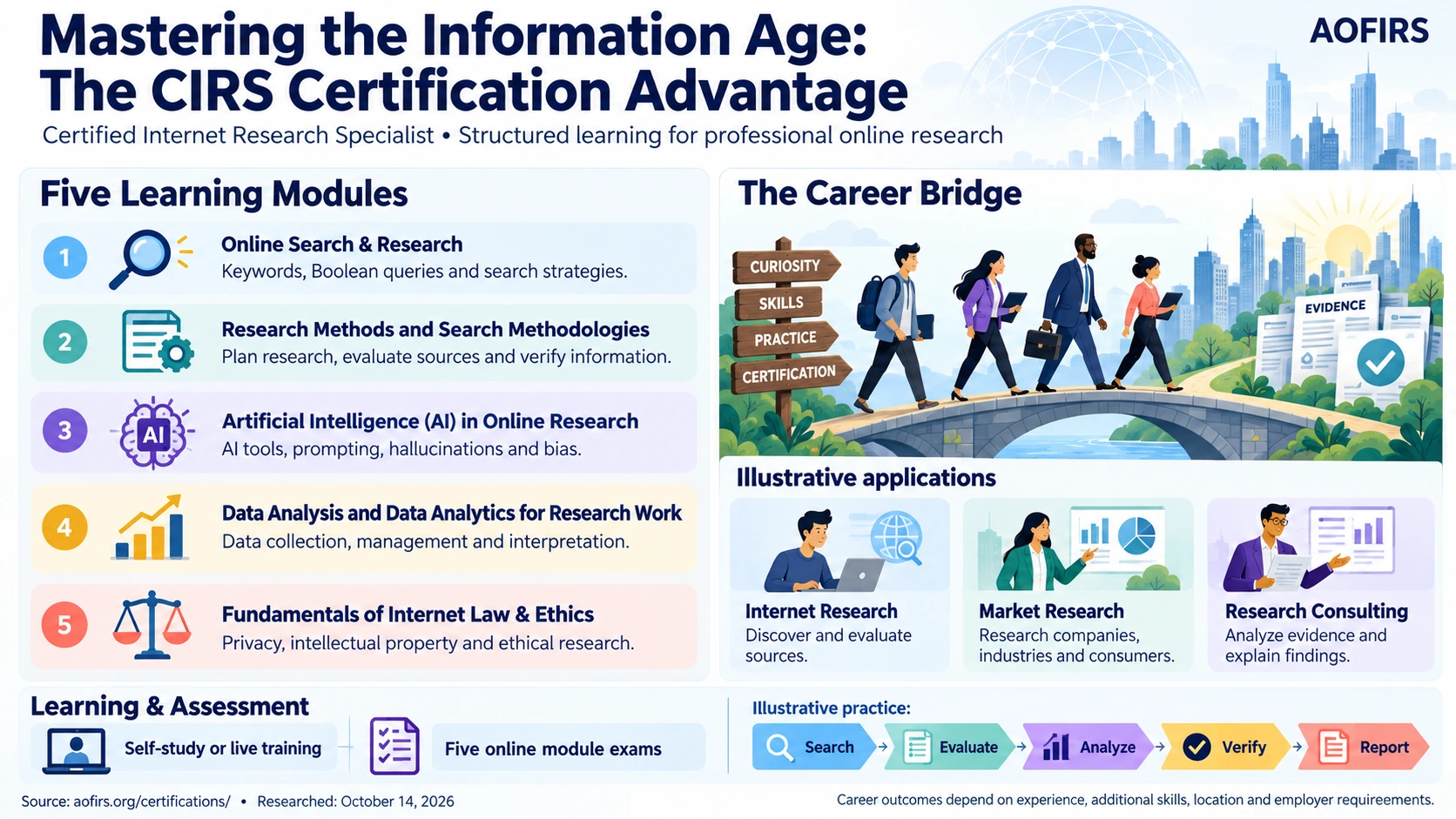
Master Professional Verification with CIRS Certification
Equip yourself with the rigorous methodology required to navigate the AI era. The Certified Internet Research Specialist (CIRS) designation provides elite training in advanced query engineering, deep web retrieval, evidentiary authentication, and algorithmic auditing.
Recommended Free Intelligence Resources
- AI in Online Research: Power and Pitfalls – Visual guide to LLM synthesis capabilities and the V.E.R. Protocol.
- AI and the New Rules of Influence – Why authentic human trust outweighs algorithmic content volume.
- The Search Architect’s Toolkit – Precision query engineering across commercial and open-source engines.
- Mastering the Information Age – The definitive professional roadmap for investigative researchers.
Frequently Asked Questions
Why is Generative AI defined as a method rather than a research discipline?
Research is fundamentally an empirical discipline grounded in hypothesis formulation, discovery of primary evidence, evidentiary verification, and logical deduction. Generative AI is a computational method for statistical token prediction and linguistic transformation. While it can assist in organizing prose or drafting queries, it does not possess empirical observation or deductive reasoning capabilities.
What causes Large Language Models to hallucinate nonexistent citations and precedents?
Language models operate by predicting the most statistically probable next word in a sequence based on training patterns. When prompted for specific citations or case law that the model cannot directly match, it constructs titles, author names, journal volumes, and DOIs that sound syntactically authentic, creating fluent fabrications without factual grounding.
Why do models struggle with quantitative calculations and tabular data?
Foundation models process numbers as linguistic tokens rather than mathematical values. Unless an external code execution sandbox or symbolic math interpreter is actively integrated into the model pipeline, LLMs cannot execute reliable multi-step arithmetic, making them prone to errors when analyzing financial reports or statistical spreadsheets.
What are the key copyright risks when using AI-generated text in formal reports?
Commercial models are trained on billions of copyrighted texts, sometimes producing outputs that closely reproduce verbatim phrases from underlying sources without proper attribution. Furthermore, in many jurisdictions, purely AI-generated text cannot be copyrighted, creating intellectual property vulnerabilities for client deliverables.
How does CIRS certification ensure research integrity when working with AI tools?
The CIRS curriculum enforces rigorous human-in-the-loop protocols. Certified specialists are trained to isolate AI to assistive tasks (such as query generation and text summarization), conduct independent primary-source verification for every factual assertion, and maintain full evidentiary audit trails that guarantee the validity of the final report.