To deepen your methodological framework, consult the companion 14-slide visual presentation on Generative AI in Professional Research: A Structural Analysis of its Core Constraints, examine our empirical study on Using AI Tools in Market Research: Opportunities, Pitfalls, and Critical Skills for Novice Analysts, or review our investigative benchmark on AI vs. The Hidden Web: The 2026 Reality Check.
The Dynamics of Augmented Inquiry
Modern information retrieval has evolved beyond pure keyword searching into a dual-track discipline known as Augmented Inquiry. On one track sits the deterministic rigor of traditional web search, corporate registers, academic repositories, and public filings. On the other sits the probabilistic reasoning and language processing power of Large Language Models (LLMs).
When deployed correctly, LLMs function as high-bandwidth cognitive coprocessors. They excel at mapping conceptual territories, drafting comparative outlines, and parsing dense unstructured prose. However, because LLMs operate purely on statistical token prediction rather than semantic understanding or empirical ground truth, uncritical reliance on their outputs introduces catastrophic vulnerabilities into investigative reports.
Deploy foundation models for rapid document synthesis, semantic entity extraction, thematic pattern recognition, language translation, and multi-angle query hypothesis formulation.
Erect defensive operational safeguards against fluent hallucinations, inherited dataset skews, ungrounded causal claims, intellectual property infringement, and data leakage.
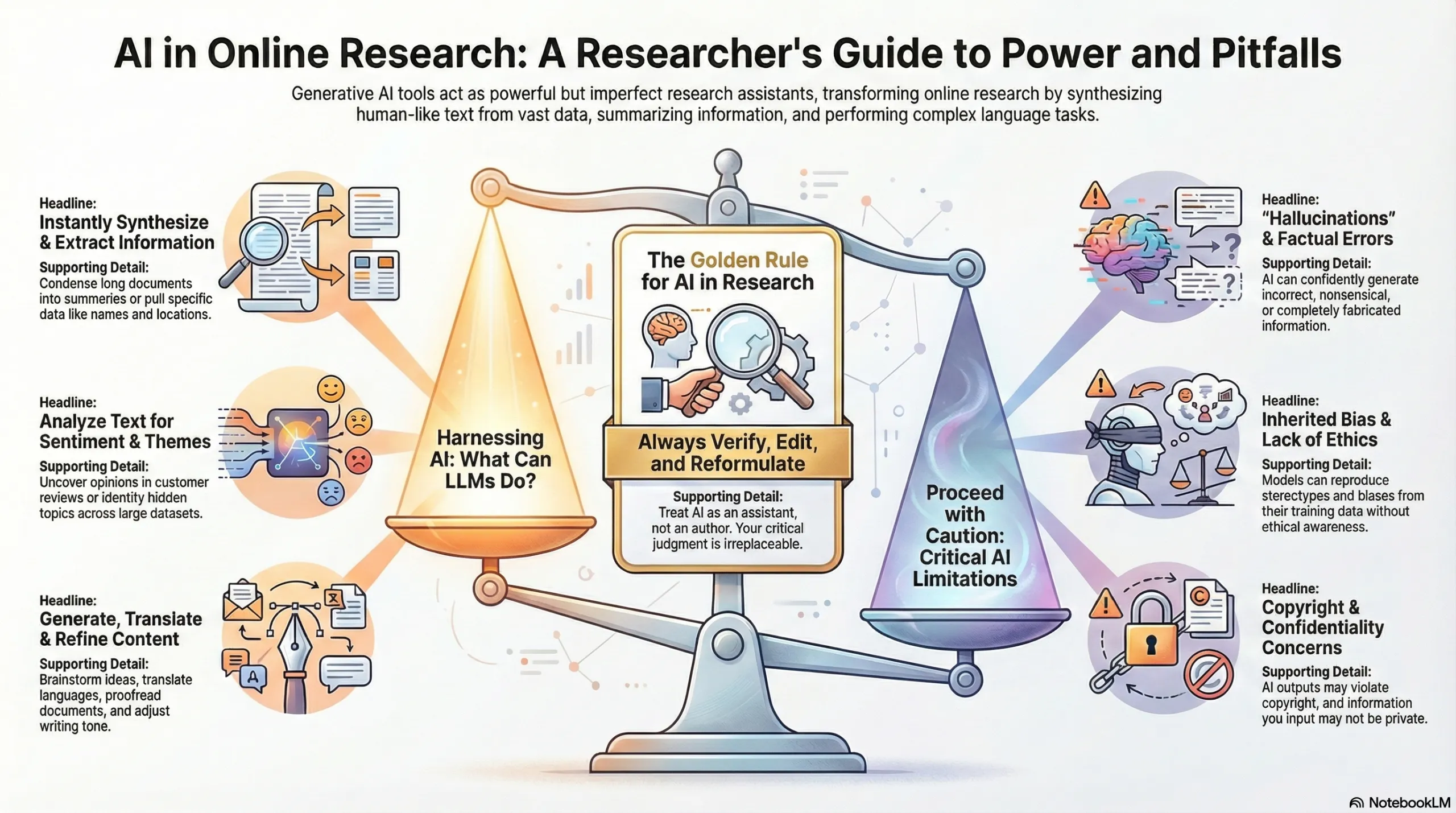
What Can LLMs Do? Harnessing the 3 Core Powers
The AOFIRS investigative research framework categorizes generative AI utility into three distinct operational domains:
1. Instant Synthesis & Information Extraction
Researchers routinely encounter regulatory dockets, corporate disclosures, and conference transcripts spanning hundreds of pages. Language models compress these voluminous corpora into structured executive summaries, extract tabular chronologies, and flag named entities (such as cross-border corporate subsidiaries, executive officers, and regulatory citations) with exceptional speed.
2. Thematic Analysis & Sentiment Mapping
LLMs identify underlying patterns across heterogeneous qualitative datasets. When applied to thousands of consumer reviews, public consultation submissions, or whistleblower testimonials, models surface recurring friction points, linguistic sentiment shifts, and latent thematic clusters that manual reading could overlook.
3. Generative Ideation, Translation & Linguistic Refinement
In cross-border investigations, language models provide immediate translation across dozens of languages, enabling researchers to parse foreign-language court records or regional media. Furthermore, models serve as brainstorming partners, suggesting alternative boolean query strings, technical synonymies, and lateral investigative hypotheses.
Critical AI Limitations: The 3 Structural Pitfalls
While LLMs offer extraordinary processing leverage, their foundational architecture imposes immutable constraints that every professional investigator must respect:
1. “Hallucinations” & Confident Factual Errors
Because language models generate text based on probabilistic word associations rather than factual verification, they frequently produce plausible fictions. An LLM will invent academic citations with authentic-sounding DOIs, reference nonexistent court precedents, or misattribute corporate acquisitions—all rendered with supreme grammatical authority. Accepting an unverified model assertion directly compromises professional credibility.
2. Inherited Bias & Absence of Ethical Discernment
Foundation models reflect the historical biases, geographic skews, and ideological assumptions embedded within their training corpora. Models possess no intrinsic moral awareness, ethical discernment, or legal accountability. When tasked with analyzing sensitive demographic, legal, or socioeconomic topics, they can unconsciously perpetuate discriminatory patterns or institutional blind spots.
3. Intellectual Property, Copyright & Confidentiality Exposures
Entering proprietary corporate data, unreleased financial statements, or sensitive client names into commercial AI interfaces poses severe privacy risks. Unless enterprise-grade zero-retention agreements are established, prompt inputs may be ingested into training loops, violating non-disclosure agreements and regulatory compliance standards.
Comparative Analysis: Capabilities vs. Verification Protocols
The following operational matrix details how professional analysts balance generative capabilities with systematic safeguards:
| Operational Task | Algorithmic Capability | Latent Structural Risk | Mandatory Verification Protocol |
|---|---|---|---|
| Corpus Summarization | Compresses 100+ page reports into concise key takeaways. | Omission of critical caveats, nuances, or anomalous data points. | Cross-check summary against primary tables, methodology sections, and appendices. |
| Entity Extraction | Identifies company names, executives, and dates across documents. | Conflation of similarly named entities across different jurisdictions. | Validate each extracted entity against official corporate registries (e.g., SEC EDGAR, Companies House). |
| Query Formulation | Generates boolean operator strings and domain-specific keywords. | Syntax errors or reliance on deprecated search engine parameters. | Test query syntax directly inside targeted databases using verification operators. |
| Foreign Translation | Instant translation of non-English legal and technical texts. | Subtle mistranslations of specialized legal or statutory terms. | Consult verified bilingual legal glossaries or native-speaking domain experts. |
| Hypothesis Generation | Proposes potential causal relationships and investigative angles. | Correlation mistaken for causation; circular reasoning loops. | Subject hypotheses to falsification testing using independent empirical datasets. |
The V.E.R. Protocol: A Step-by-Step Operating Workflow
To eliminate hallucination risks and enforce rigorous analytical standards, AOFIRS instructs all research professionals to execute the V.E.R. Protocol for every AI-assisted workflow:
- Verify (V): Every factual claim, statistic, date, quote, and citation produced by an LLM must be cross-referenced against an immutable primary source. If an asserted fact cannot be corroborated via an official register, academic repository, or verified public record, it must be expunged from the report.
- Edit (E): Strip out algorithmic filler, passive phrasing, and generic synthetic rhetoric. Scrutinize the text for subtle logical inconsistencies, ungrounded generalizations, and inherited biases that dilute the precision of the deliverable.
- Reformulate (R): Reconstruct the narrative in the researcher’s distinct analytical voice. Infuse the deliverable with professional context, jurisdictional nuances, strategic implications, and actionable recommendations that reflect human expertise.
Video Masterclass: Deploying AI as Your Professional Research Assistant
Watch this practical masterclass on integrating language models into your investigative pipeline without surrendering methodological control:
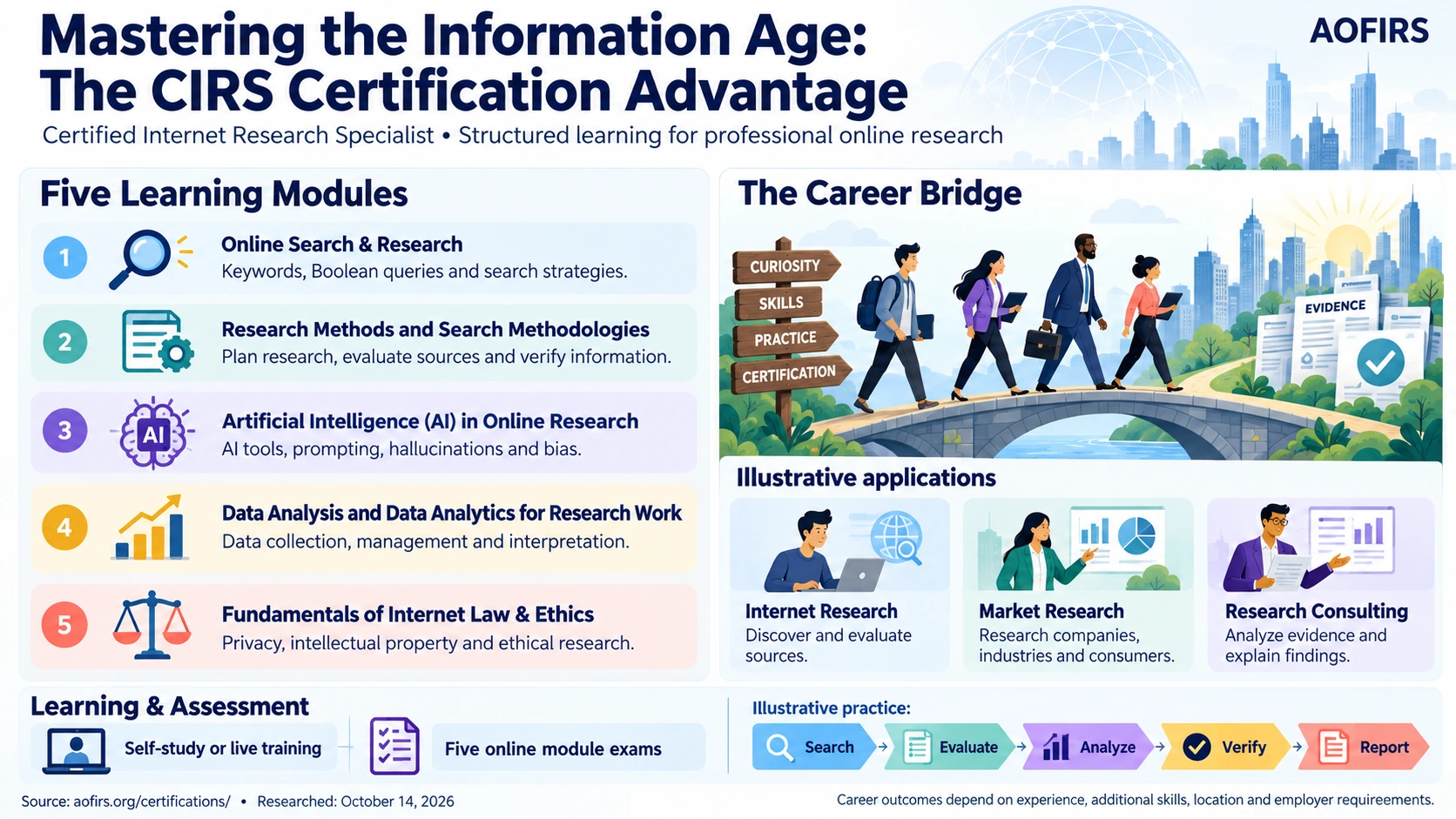
Become a Certified Internet Research Specialist
Elevate your investigative capabilities above algorithmic consensus. The globally recognized CIRS credential equips you with advanced open-source intelligence methodologies, precision query syntax, forensic digital verification, and AI-auditing techniques.
Recommended Free Intelligence Resources
- AI and the New Rules of Influence – Why earned trust and human connection outweigh automated volume.
- Generative AI in Professional Research: Core Constraints – In-depth slide presentation on accuracy, validity, and ethics.
- Optimizing the Modern Research Workflow – The Dual-Track Research Blueprint.
- The Search Architect’s Toolkit – Advanced search syntax and operator matrices.
Frequently Asked Questions
What is the single most dangerous mistake researchers make with generative AI?
The most dangerous mistake is treating generative AI as an author or search engine rather than an assistive text processor. Assuming that an LLM’s grammatically flawless output is factually accurate leads directly to the inclusion of hallucinated citations, fabricated case precedents, and erroneous data in critical deliverables.
How does the V.E.R. Protocol safeguard investigative deliverables?
The V.E.R. Protocol (Verify, Edit, Reformulate) creates a mandatory human-in-the-loop firewall. By requiring that every fact is corroborated against primary sources, edited for bias and clarity, and reformulated with domain context, researchers prevent AI-induced errors from reaching clients or decision-makers.
Why do Large Language Models hallucinate facts so convincingly?
LLMs do not query an internal database of established facts; they generate sequences of words based on probabilistic patterns learned during training. When asked about obscure topics or specialized citations, the model predicts words that syntactically match the query, creating plausible-sounding but entirely fictional information.
Are free public AI chat tools safe for corporate or legal investigations?
Generally no. Public free-tier AI tools often retain user inputs for model retraining, meaning that confidential client names, intellectual property, or sensitive investigation targets entered into prompts could be exposed. Professional researchers use enterprise environments with explicit zero-data-retention agreements.
How does CIRS training help researchers leverage AI effectively?
The Certified Internet Research Specialist (CIRS) curriculum teaches practitioners how to combine advanced boolean search and deep web excavation with AI prompt engineering. CIRS specialists learn how to construct adversarial prompts, audit algorithmic bias, and execute rigorous multi-source verification protocols.