Artificial intelligence has changed what it means to research online. Tasks that once consumed days—scanning sources, extracting data, synthesizing findings—now happen in minutes. But speed without discipline is just faster error. This strategic training report from the Association of Internet Research Specialists (AOFIRS) explains the mechanics of AI-driven research: how neural networks and transformer models actually process information, where they fail, and how the Human-AI Hybrid workflow lets professionals synthesize massive datasets while keeping verification, bias detection, and prompt discipline at the center of the process.
From Information Overload to Intelligent Insight
The modern researcher faces a paradox: never has more information been available, and never has it been harder to determine what is true. Search engines return millions of results; AI chatbots return one confident answer. Neither, on its own, is research. The professional advantage in 2026 belongs to those who can orchestrate both—using AI for scale and speed while applying human judgment for framing, verification, and synthesis.
AI excels at ingestion and pattern recognition across massive datasets. Humans excel at asking the right question, recognizing when an answer smells wrong, and understanding context that no model was trained on. The Human-AI Hybrid workflow is built on that division of labor.
How AI Actually Processes Information
To use these tools well, you need a working mental model of what happens under the hood. Modern research AI is built on neural networks—layered mathematical systems trained on enormous text corpora—and specifically on the transformer architecture, which uses attention mechanisms to weigh how words in a passage relate to one another. When you prompt a model, it does not look up an answer; it generates a statistically probable response based on patterns in its training data.
That single fact explains both the power and the danger. The model can summarize a hundred pages fluently because fluency is what it was trained to produce. It can also invent a citation, misattribute a quote, or state a falsehood with exactly the same confidence as a verified fact—because it has no internal concept of “true,” only of “likely.” Professionals who understand this stop treating AI output as an answer and start treating it as a draft that must earn trust.
Where AI Adds Real Leverage
- Scale: ingesting and clustering hundreds of sources, transcripts, or datasets that no human could read in the available time.
- Extraction: pulling entities, dates, figures, and claims out of unstructured text into structured form.
- Synthesis: drafting comparisons, summaries, and outlines that accelerate—rather than replace—analysis.
- Ideation: surfacing angles, counterarguments, and adjacent questions a single researcher might miss.
Where AI Fails
- Hallucination: fabricated sources, statistics, and quotations delivered with total confidence.
- Bias: training-data skews that quietly shape which perspectives appear and which disappear.
- Staleness: knowledge cutoffs and no inherent awareness of what changed yesterday.
- Opacity: no reliable citation chain unless you build one yourself.
The Human-AI Hybrid Workflow
The hybrid workflow assigns each stage of research to whoever does it best. The researcher frames the question, defines what evidence would settle it, and chooses sources. The AI handles volume—scanning, extracting, clustering, drafting. The researcher then verifies every load-bearing claim against primary sources before anything is published or acted on.
| Stage | Led By | What Happens | Failure It Prevents |
|---|---|---|---|
| Framing | Human | Define the question, scope, and what would count as evidence | Answering the wrong question fluently |
| Collection | AI-assisted | Search, ingest, and cluster large source sets | Missing relevant material at scale |
| Extraction | AI | Pull claims, entities, and data into structured notes | Manual-copy errors and oversight |
| Verification | Human | Trace every key claim to a primary source; check dates and context | Hallucinated or stale “facts” |
| Synthesis | Human + AI | Draft the narrative; human edits for judgment and nuance | Confident but shallow conclusions |
| Defense | Human | Stress-test the argument; document the evidence chain | Findings that collapse under scrutiny |
The V.E.R. Protocol: Verify, Edit, Reformulate
AOFIRS teaches a simple discipline for every AI-assisted output: V.E.R.—Verify, Edit, Reformulate.
- Verify. Treat every factual claim in an AI output as unproven. Check names, dates, figures, and quotations against primary sources. If the model cites a study, find the study. If it quotes a person, find the original statement. Discard anything you cannot trace.
- Edit. Remove what verification could not support. Correct bias, rebalance one-sided framing, and restore context the model flattened. Editing is where professional judgment re-enters the document.
- Reformulate. Rewrite the surviving material in your own analytical voice, structured around your original research question—not the model’s default outline. The final product should be defensible line by line, because you can show where every claim came from.
Applied consistently, V.E.R. converts AI from a liability into leverage: the machine does the heavy lifting, and the professional guarantees the truth of the result.
Prompt Discipline: Getting Reliable Raw Material
The quality of AI-assisted research is set before the first word is generated. Disciplined prompting means giving the model a role, a scope, constraints, and an output format—and explicitly instructing it to flag uncertainty rather than paper over it. Ask for claims with sources named, request counterarguments, and break big questions into staged prompts you can check incrementally. A vague prompt invites a fluent, confident, unverifiable answer; a precise prompt produces raw material worth verifying.
Watch: AI in Online Research — Processing Information at Lightning Speed
This AOFIRS training video walks through the same hybrid methodology in action—how AI compresses the mechanical work of research and where the professional’s verification discipline must take over.
Related AOFIRS Resources
- The AI Search Revolution: From Keywords to Conversations — a quick-glance infographic on how search behavior is shifting.
- Information Retrieval in the Age of AI — the companion research report on AI-era retrieval systems.
- The Architect of Truth: Training the Augmented Researcher — the four pillars of AI-augmented investigation.
- The Researcher’s Journey: From Raw Data to Actionable Insight — the analytics maturity model behind data-driven research.
- Professional Internet Research: The Mechanics of Search — how crawlers and indexes really work.
Master AI-Era Research with CIRS™ Certification
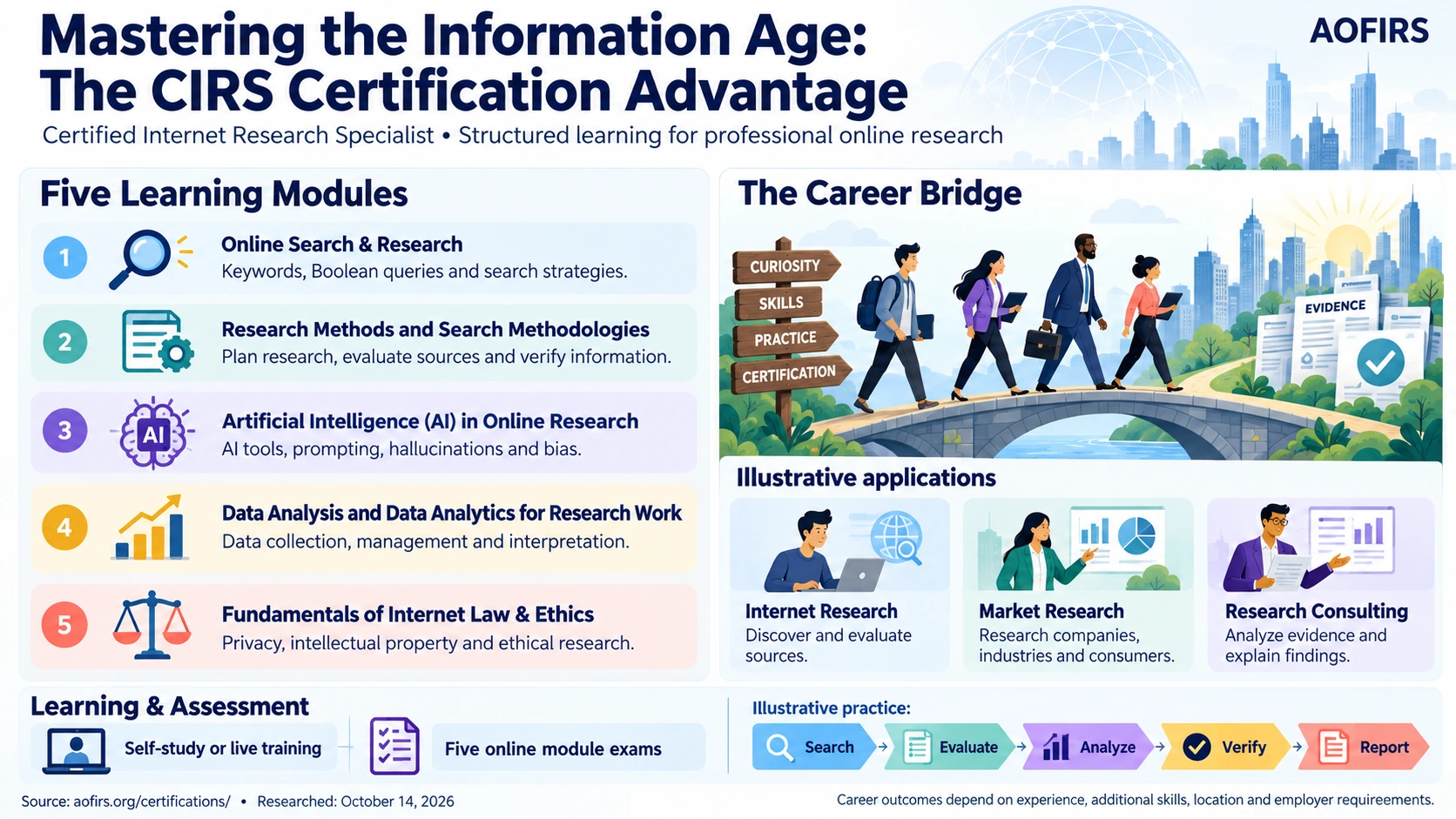
The Certified Internet Research Specialist (CIRS™) program trains you in the full hybrid methodology—advanced search mechanics, AI orchestration, verification protocols, and evidence defense—so your findings hold up under any scrutiny.
Frequently Asked Questions
Can I trust an AI chatbot’s answer if it sounds confident and cites sources?
No. Confidence is a property of the model’s language, not of its accuracy. AI systems routinely fabricate citations that look real—correct journal names, plausible authors, formatted DOIs—for studies that do not exist. Every source must be independently located and read before it is used.
What is the V.E.R. Protocol?
V.E.R. stands for Verify, Edit, Reformulate. It is the AOFIRS discipline for AI-assisted output: verify every factual claim against primary sources, edit out what cannot be supported and correct bias, then reformulate the surviving material in your own analytical voice so the final product is defensible line by line.
Will AI replace professional researchers?
It replaces the mechanical parts of research—scanning, extracting, first-draft summarizing—but not the professional core: framing the right question, judging source credibility, detecting bias, and defending conclusions. Researchers who orchestrate AI outperform both those who refuse it and those who trust it blindly.
How do I reduce hallucinations in AI research output?
Use precise, constrained prompts that ask the model to name sources and flag uncertainty; break large questions into staged, checkable prompts; and never let an unverified claim survive into your final work. Hallucination cannot be eliminated at the model level—it can only be caught at the verification level.
What skills matter most for AI-era research?
Three: advanced search mechanics (so you can find primary sources independently of any chatbot), prompt discipline (so AI output is worth verifying), and verification methodology (so errors never reach your audience). All three are core modules of the CIRS™ Certification program.