In an era where data is often described as the new oil, the real challenge for modern organizations isn’t finding information, it is verifying it. As we move deeper into 2026, the global “datasphere” is projected to exceed 180 zettabytes, a volume that has rendered basic digital literacy insufficient for strategic decision-making. This paradox of information overload has fueled a surge in online learning, yet a critical divide has emerged between generic course completion and professional certification.
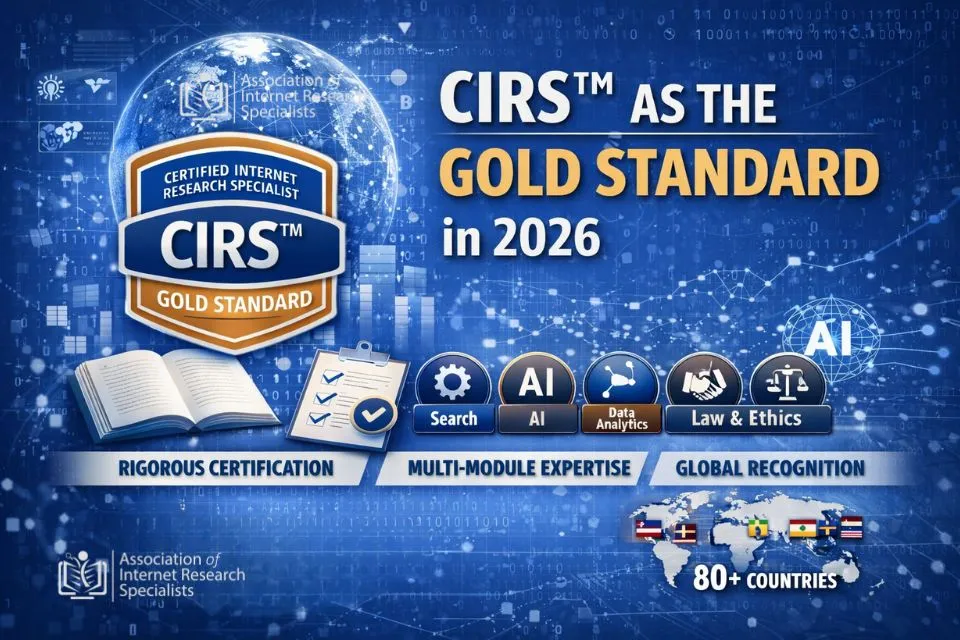
At the center of this evolution is the Certified Internet Research Specialist (CIRS™) designation. Offered by the Association of Internet Research Specialists (AOFIRS), the CIRS™ is positioned as a rigorous, association-backed credential that stands in stark contrast to the fragmented, skills based offerings found on popular Massive Open Online Course (MOOC) platforms like Udemy, Coursera, and edX.
The Institutional Foundation: Governance vs. Marketplace
The primary differentiator for the CIRS™ lies in its institutional roots. AOFIRS is not merely an educational provider; it is a self regulatory, non-profit professional body incorporated in Ontario, Canada, under a government granted Charter of Associations. This charter mandates that the organization sets global standards for research integrity and accuracy—a responsibility that generic marketplaces do not share.
While platforms like Udemy function as open marketplaces where anyone with expertise can sell a course, and Coursera acts as a distributor for university led programs, AOFIRS operates as a standard setting body. The CIRS™ designation is currently credentialed and recognized in over 80 countries, providing a level of global professional standing that academic “certificates of completion” rarely match.
A Holistic Architecture: The 5 Module Framework
Generic research courses often focus on isolated skills, such as “Advanced Googling” or “Intro to SQL.” In contrast, the CIRS™ curriculum is built on a cohesive five module framework designed to produce a “full-stack” intelligence professional:
- Online Search Mechanics: Mastering advanced Boolean logic, proximity operators like AROUND(#), and “dorking” techniques to access the hidden web.
- Research Methodology: Integrating qualitative and quantitative strategies with rigorous verification frameworks to mitigate information bias.
- AI Native Integration: Moving beyond basic chatbot use to master prompt engineering and Retrieval Augmented Generation (RAG) workflows while managing the risks of AI hallucinations.
- Data Analytics: Bridging the gap between raw data and actionable insights through descriptive, predictive, and prescriptive analytics.
- Law and Ethics: Providing a solid grounding in global privacy frameworks like GDPR and CCPA, as well as the ethical implications of data manipulation.
Comparative Analysis: CIRS™ vs. The Competition
The value proposition of the CIRS™ becomes clearest when compared directly to its competitors. The following table highlights the structural differences between a professional designation and standard online courses.
| Feature | AOFIRS CIRS™ | Coursera/edX Certificates | Udemy Courses |
| Credential Type | Professional Designation | Completion Certificate | Course Certificate |
| Governance | Non-profit Association | University/Corporate Partner | Individual Instructor |
| Curriculum Structure | Cohesive Integrated Framework | Isolated Specializations | Niche Skillsets |
| Examination Rigor | 5 Sequential Modules, No Partial Credit | Graded Assignments/Quizzes | Self paced Quizzes |
| Maintenance | Mandatory CPE every 24 months | None (Permanent) | None |
| Member Benefits | Certified Member Directory, References | Alumni Network (variable) | Lifetime Access |
The “Completion” vs. “Certification” Trap
A significant disadvantage of platforms like Coursera is that they primarily offer “certificates” which confirm a course of study was finished. The CIRS™, however, is a “certification” that validates a specific level of competency through rigorous standardized assessment. While a Google Data Analytics certificate on Coursera provides excellent foundational training for beginners, it lacks the specialized “search science” and legal/ethical depth required for professional grade investigation.
Economic ROI and Career Trajectory
The job market for research professionals is expanding at a remarkable rate. The U.S. Bureau of Labor Statistics projects a 23% increase in demand for data driven roles by 2032. This demand is reflected in the earning potential for certified specialists:
- Information Research Scientist: $140,910 (Median).
- Freelance Internet Researcher: $70,500 (Average in North America).
- Market Research Analyst: $70,200.
The return on investment for CIRS™ is exceptionally high. With a self study path costing approximately $200 (including exam vouchers), professionals can unlock roles that pay significantly higher than the initial investment. Internal data from AOFIRS indicates that 95% of their certified professionals are currently employed, with 81% receiving promotions shortly after earning the credential.
Balancing the Equation: Advantages and Disadvantages
While the CIRS™ is a powerful career accelerator, it is not without its challenges. Candidates must weigh the professional benefits against the commitment required.
Advantages:
- Interdisciplinary Mastery: Seamlessly combines search, AI, and analytics.
- Institutional Backing: Registration with a government recognized professional body adds significant resume weight.
- ISO Quality Standards: Aligned with ISO 29993 and 21001 for educational service quality.
Disadvantages:
- Exam Rigor: The sequential, five module exam process is intensive and allows no partial credit, requiring total mastery of the material.
- Maintenance Effort: The requirement for Continuing Professional Education (CPE) means the certification requires long term effort to keep active.
- Niche Recognition: While the “Gold Standard” in specialized research circles, generic HR filters may still prioritize massive brands like Google or IBM, requiring the candidate to advocate for the CIRS™ value during interviews.
Conclusion: The Strategic Value Proposition
For the professional navigating the complexities of the 2026 information landscape, the choice between a generic course and a CIRS™ designation is a choice between learning a tool and mastering a discipline. The CIRS™ provides a standardized, ethically grounded, and AI native framework that generic platforms cannot replicate. It transforms a researcher from a “number cruncher” into a strategic analyst capable of providing the actionable intelligence that modern organizations desperately require.