From Information Gathering to Strategic Intelligence
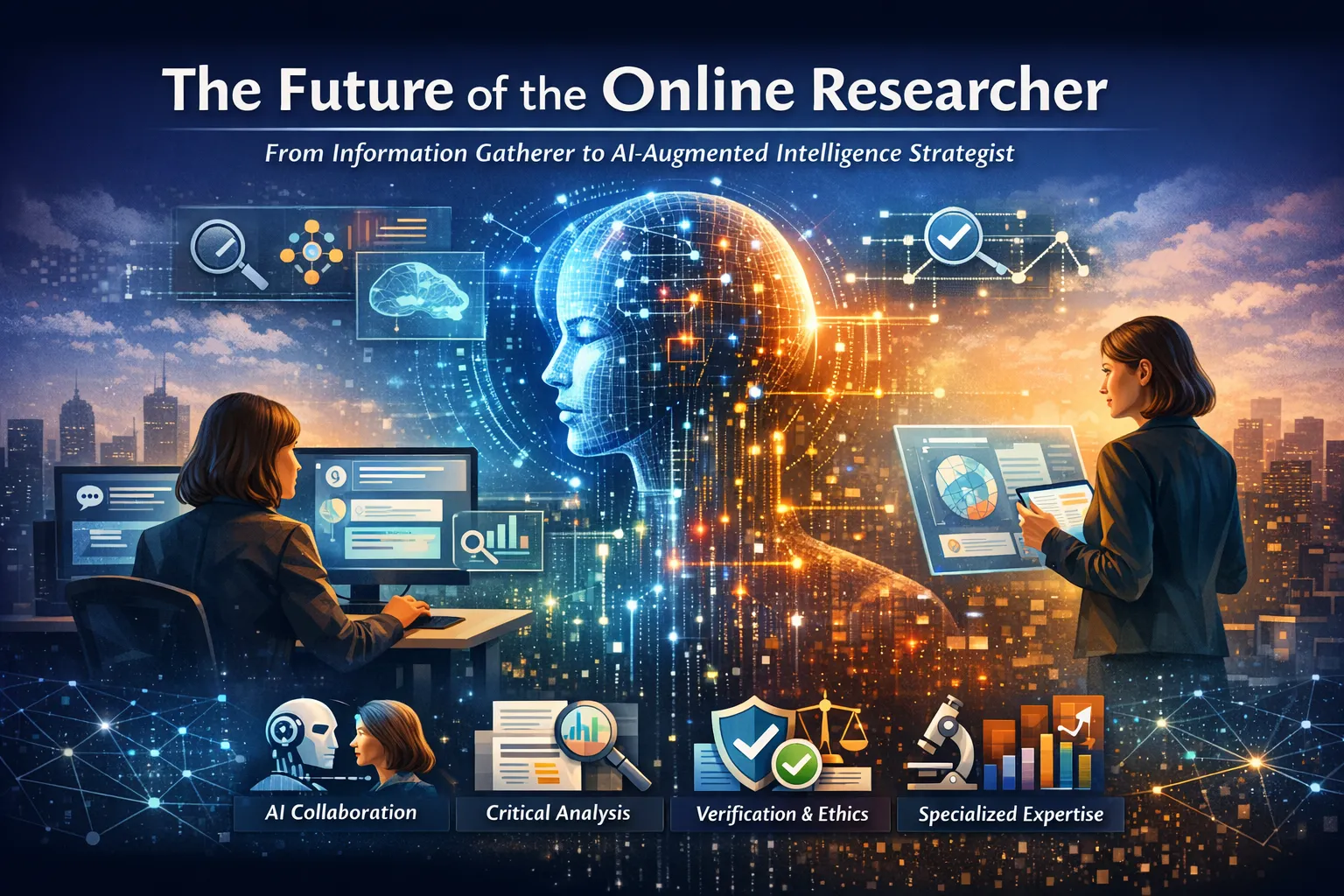
The role of the online researcher is rapidly evolving. No longer limited to searching and collecting information, today’s professionals are becoming information strategists, synthesists, and analysts. Artificial intelligence now automates data collection. At the same time, it increases the demand for high-level human skills: judgment, verification, synthesis, and strategic insight. This shift is creating a new professional class: the Augmented Researcher.
The Rise of the Augmented Researcher
AI tools such as ChatGPT, Claude, Perplexity, and specialized research agents now handle large-scale data gathering and summarization.
Human researchers create value by doing what AI cannot.
Key Human Skills in AI-Driven Research
- Asking the Right Questions
Designing precise, strategic prompts that guide AI systems toward meaningful results. - Critical Analysis and Synthesis
Connecting fragmented information, identifying patterns, and building real-world context. - Verification and Ground Truthing
Cross-checking AI outputs with primary sources to prevent hallucinations and misinformation. - Ethical and Strategic Judgment
Applying human reasoning, awareness of bias, and understanding social and business implications. - The future researcher is not a “searcher.”
They are a decision-support specialist.
Why Specialization Will Define High-Value Researchers
Generalist Google-based research is becoming obsolete. High-value professionals are moving into specialized intelligence roles.
High-Demand Research Specializations
- Competitive Intelligence
Monitoring markets with AI and translating signals into strategy. - Due Diligence and Investigative Research
Supporting legal, financial, and journalistic work with verified evidence. - Scientific and Academic Research Support
Managing AI-assisted literature reviews while maintaining academic rigor. - Business Intelligence Synthesis
Transforming raw data into actionable insights for leadership teams. - Specialists, not generalists, will command premium fees.
The New Research Toolkit and Methodologies
Modern research workflows now combine multiple advanced systems.
The Next-Generation Research Stack
- AI Agent Orchestration
Managing multiple AI tools across research phases. - Advanced Data Visualization
Turning complex findings into clear, persuasive visuals. - Closed and Proprietary Database Expertise
Accessing non-public sources unavailable to open AI systems. - Hybrid Human-AI Workflows
Designing efficient systems where humans supervise, validate, and interpret machine outputs. - Mastery of this stack is becoming a competitive advantage.
Future Earnings Potential for Research Training Providers
The market for teaching research skills is expanding, but only for providers that evolve.
1. Premium Certification Opportunities
Basic “internet research” courses are becoming commoditized.
High-value certifications will focus on:
- AI-Augmented Research Methodologies
- Verification and Digital Forensics
- Sector-Specific Intelligence (Finance, Healthcare, Legal, etc.)
Advanced credentials will command premium pricing.
2. Shift Toward Institutional Clients
The primary market is moving from individuals to organizations.
Key buyers include:
- Corporations
- Government agencies
- Universities
- Consulting firms
- Research institutions
Institutional contracts provide higher, more stable revenue.
3. Hybrid Training Models
Top providers will monetize through blended programs:
- Self-paced online courses
- Live workshops
- Prompt engineering bootcamps
- Executive coaching
- Project-based mentoring
This model supports long-term client relationships.
Target Market: Expanding, Not Shrinking
AI is creating more researchers, not fewer.
1. Core Professionals
Existing researchers, analysts, librarians, and academics upgrading their skills.
2. Adjacent Knowledge Workers
A fast-growing segment of professionals who now perform research informally.
This includes:
- Marketers and content strategists
- Startup founders and entrepreneurs
- Consultants and advisors
- Journalists and writers
- Legal and paralegal professionals
They need formal research and verification training.
3. Students and Early-Career Talent
New graduates are entering a workforce where AI literacy and synthesis skills are mandatory.
Institutions that certify these skills early will dominate this segment.
Strategic Recommendations for Organizations Like AOFIRS
To remain competitive, research training organizations must reposition and modernize.
1. Rebrand for the AI Era
Move beyond “Internet Research.”
Position around:
- Intelligence Synthesis
- AI-Augmented Research
- Strategic Information Analysis
- Human-AI Collaboration
This reframes the organization as future-ready.
2. Revamp the Curriculum
Modern research education must include:
Core Learning Modules
Prompt Engineering for Research
Mandatory foundation training.
AI Tool Stack Mastery
Hands-on use of multiple agents and platforms.
Information Integrity and Verification
Advanced fact-checking and audit techniques.
Ethics and Responsible AI
Bias, privacy, and compliance frameworks.
Data Communication and Storytelling
Turning insights into executive-ready narratives.
3. Offer Tiered Credentials
Create clear professional pathways:
- Digital Badge: AI-Assisted Research
- Professional Certificate: Intelligence Synthesis
- Master Certification: Strategic Intelligence
This supports long-term learner progression.
4. Build Strategic Partnerships
Partner with AI and analytics platforms to provide real-world training.
Examples:
- AI research tools
- Data visualization software
- OSINT platforms
- Analytics systems
Practical exposure increases program credibility.
Conclusion: The Future Belongs to Human-AI Intelligence
AI is not replacing expert researchers. It is replacing novice researchers.
The core value is shifting from:
Finding information → Understanding, verifying, and applying it strategically
Professionals who master this shift will become indispensable.
The Opportunity for Training Providers
Organizations that evolve beyond traditional search techniques and embrace human-AI collaboration will capture a critical segment of the knowledge economy.
Those who can excel in the following, will lead the next generation of research education:
- AI-Augmented Research
- Intelligence Synthesis
- Verification Systems
- Strategic Analysis
In 2026 and beyond, the future is bright for the augmented researcher, and for the institutions that prepare them.