Dogpile is one of the web’s longest-running metasearch engines. Instead of maintaining a large independent web index like Google, it collects results from external search providers, removes duplicates, and presents a combined list through one interface.
Dogpile remains active in 2026. Its consumer products include the Dogpile.com search website, a Chrome search extension, and mobile browser applications. System1 has also expanded the Dogpile brand into developer infrastructure through Dogpile Fetch, a search API and Model Context Protocol, or MCP, server designed for AI agents.
Dogpile can be useful when you want another view of the web without relying entirely on one search interface. However, it should be treated as a secondary discovery tool, not a complete replacement for a major search engine, privacy-first service, academic database, or AI research platform.
Dogpile at a Glance
| Fact | Dogpile in 2026 |
|---|---|
| Website | Dogpile.com |
| Search category | Metasearch engine |
| Launched | November 1996 |
| Original creator | Aaron Flin |
| Current corporate group | System1 |
| Copyright entity | InfoSpace Holdings LLC, a System1 company |
| Named search sources | Google and Yahoo; Bing is also named in the Apple browser listing |
| Independent general web index | 🔴 Not publicly documented |
| Consumer AI answers | 🔴 No general LLM answer layer verified |
| Search verticals | 🟢 Web, images, videos, news, and maps |
| Browser extension | 🟢 Chrome extension available |
| Mobile products | 🟢 Android and Apple browser applications |
| Account required | 🟢 No account required for basic search |
| Consumer price | 🟢 Free |
| Developer product | Dogpile Fetch API and MCP server |
| Best research role | 🟢 Secondary discovery and result comparison |
| Main limitation | 🟡 Limited transparency about provider configuration, ranking, and operator support |
Is Dogpile Right for You?
Dogpile is most useful when you want an additional set of conventional web results. It is not designed to replace specialist research databases, privacy-first search services, or conversational AI research tools.
| Your Priority | Dogpile Fit | Practical Recommendation |
|---|---|---|
| Finding additional webpages | 🟢 Good fit | Use Dogpile after searching a major engine to look for different domains and result ordering. |
| Traditional link-based search | 🟢 Good fit | Dogpile keeps conventional links central instead of replacing them with generated answers. |
| Exploratory research | 🟢 Useful | Use it to identify unfamiliar sources, terminology, and alternative discovery paths. |
| Private searching | 🟡 Limited fit | Review the applicable System1 privacy policy. Consider DuckDuckGo, Startpage, or Kagi if privacy is the main requirement. |
| Advanced search operators | 🔴 Poor fit | Run precision searches directly on an engine or database with documented operator support. |
| Academic research | 🔴 Poor fit | Use Google Scholar, Semantic Scholar, PubMed, Scopus, Web of Science, or a subject database. |
| AI-generated answers | 🔴 Poor fit | Use ChatGPT Search, Perplexity, Google AI Mode, or another answer engine when synthesis is required. |
| Primary search engine | 🟡 Situational | Dogpile can support everyday searching, but its strongest research role is as a secondary discovery layer. |
Bottom line: Choose Dogpile when you want a different view of conventional web results. Avoid relying on it alone when privacy, reproducibility, scholarly filtering, or AI-assisted synthesis is essential.
Editorial Update Record
This is a research-based editorial assessment, not a controlled search-engine benchmark.
- Research cutoff: August 12, 2026
- Last fact-check: August 12, 2026
- Products reviewed: Dogpile.com, Dogpile Search for Chrome, Dogpile mobile browser disclosures, and Dogpile Fetch
- Evidence used: Official Dogpile pages, System1 documentation, app-store disclosures, corporate announcements, and publicly available product information
- Directly verified: Product availability, official descriptions, named search providers, corporate ownership, developer-product announcement, and linked privacy documentation
- Not reproducibly tested: Live result relevance, duplicate-removal rate, ad density, freshness, advanced operators, and provider weighting
- Primary testing limitation: Dogpile’s JavaScript anti-automation verification prevented reliable inspection of live result pages in the research environment
- Major 2026 development: System1 launched Dogpile Fetch for developers and AI agents in July 2026
Features, provider relationships, prices, privacy terms, and app availability can change. Readers should confirm time-sensitive information on the relevant product page.
What Is Dogpile?
Dogpile is a metasearch engine. It sits between the user and external search providers.
When someone submits a query, Dogpile obtains information from other search systems, processes the returned results, removes some duplication, and presents a combined results page.
Dogpile’s current About page says its metasearch technology retrieves results from leading search engines, including Google and Yahoo. It also says Dogpile evaluates relevance and removes duplicate results before displaying the combined list. Read Dogpile’s About page.
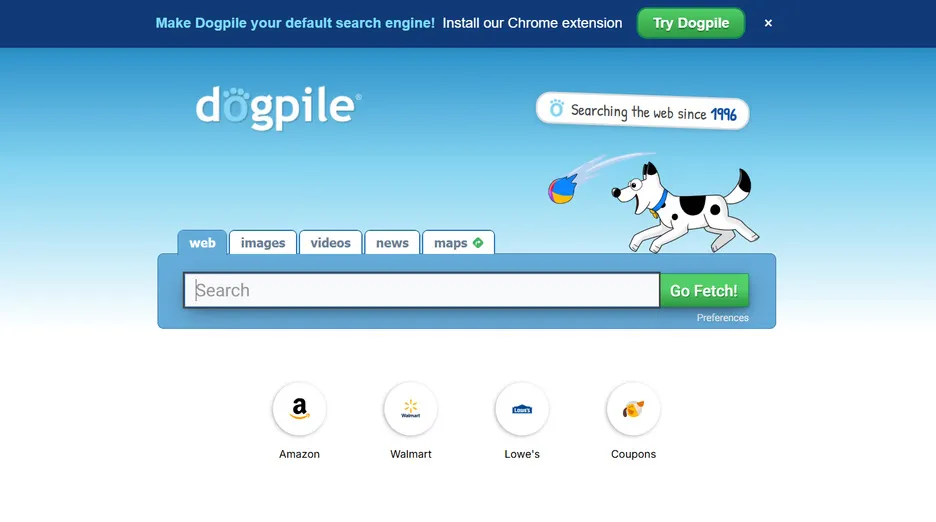
Dogpile’s simplified search process:
Query → external search providers → result collection → relevance processing → deduplication → combined results
How Dogpile Differs From a Conventional Search Engine
A conventional search engine generally:
- Discovers webpages with crawlers.
- Processes and stores information in an index.
- Ranks indexed documents.
- Serves results when a query is submitted.
Dogpile is positioned above external indexes rather than operating a publicly documented, comprehensive Dogpile-only index.
Search Engine, Metasearch Engine, and Answer Engine
| Search Type | How It Works | Examples |
|---|---|---|
| Crawler-based search engine | Crawls, indexes, and ranks webpages. | Google, Brave Search, Mojeek |
| Metasearch engine | Collects and combines results from external search systems. | Dogpile, MetaGer |
| Privacy-focused search engine | Prioritizes limiting search tracking and profiling. | DuckDuckGo, Startpage, Kagi |
| AI answer engine | Retrieves information and generates a direct response with sources. | Perplexity, ChatGPT Search |
| Academic search system | Focuses on scholarly publications and research evidence. | Google Scholar, Semantic Scholar |
Is Dogpile Still Available in 2026?
Yes. Dogpile remains operational in 2026.
Its current product family includes:
- Dogpile.com
- Dogpile Search Chrome extension
- Android Dogpile browser
- Apple Dogpile metasearch browser
- Dogpile Fetch API
- Dogpile Fetch MCP server
The Dogpile Search Chrome extension changes the browser’s default search engine to Dogpile and describes the service as retrieving results from multiple engines simultaneously.
Dogpile also provides instructions for setting it as the default search engine in Chrome, Firefox, Safari, and Microsoft Edge.
Who Owns Dogpile?
Dogpile is part of System1’s search portfolio. The consumer website identifies its copyright entity as InfoSpace Holdings LLC, a System1 company.
Dogpile Ownership Timeline
| Year | Development |
|---|---|
| 1996 | Aaron Flin launches Dogpile. |
| 1999 | Go2Net acquires Dogpile. |
| 2000 | InfoSpace acquires Go2Net. |
| 2016 | OpenMail acquires the InfoSpace search business. |
| Later | OpenMail becomes System1. |
| 2026 | System1 launches Dogpile Fetch for AI agents. |
Dogpile’s current About page says InfoSpace created Dogpile, but historical accounts identify Aaron Flin as its original creator. The InfoSpace relationship began after Dogpile had already launched.
Does Dogpile Have Its Own Search Index?
No independent, crawl-based Dogpile general web index is documented in the current official material reviewed for this guide.
Dogpile has its own aggregation, presentation, and relevance-processing technology. That should not be confused with maintaining a comprehensive independent index of the web.
An independent search index requires infrastructure for:
- Discovering URLs
- Crawling webpages
- Processing page content
- Storing searchable representations
- Recrawling changed pages
- Ranking indexed documents
Dogpile’s official description instead focuses on collecting and combining results from external search providers.
Dogpile operates metasearch and aggregation technology, but there is no current public evidence that Dogpile.com maintains a comprehensive independent web index comparable to Google, Brave Search, or Mojeek.
Which Search Engines Does Dogpile Use?
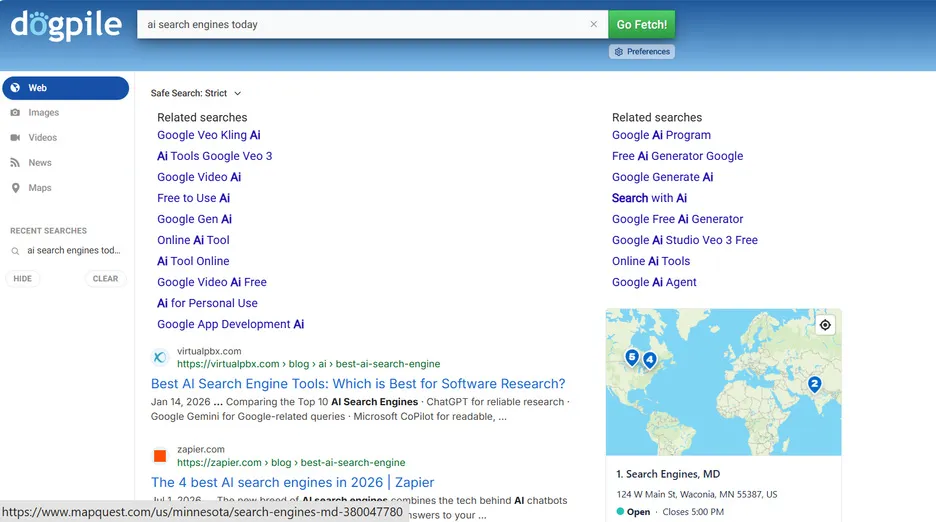
Dogpile does not publish a complete technical list covering every provider, product, region, and query type.
Publicly Named Sources
Dogpile’s main website names Google and Yahoo. The current Apple Dogpile browser listing names Google, Bing, and Yahoo.
The difference may indicate that provider configurations vary by product. It could also mean the shorter description on Dogpile.com is not exhaustive.
Historical Providers That Should Not Be Assumed
Older Dogpile articles have named providers such as Ask, MSN Search, AltaVista, HotBot, Lycos, WebCrawler, and Infoseek.
These historical relationships should not be presented as current without new evidence. Search partnerships change, and a provider named in an old review may no longer supply results to Dogpile.
Dogpile Products and Features
Dogpile now covers several products with different purposes. These should not be treated as one uniform service.
| Product | Intended User | Main Purpose | Evidence Status |
|---|---|---|---|
| Dogpile.com | General searchers | Combined web and vertical search | 🟢 Confirmed |
| Chrome extension | Desktop Chrome users | Makes Dogpile the default search engine | 🟢 Confirmed |
| Android browser | Android users | Browser with Dogpile search integration | 🟢 Confirmed through listing |
| Apple browser | iPhone and iPad users | Mobile browser and metasearch interface | 🟢 Confirmed through listing |
| Dogpile Fetch | Developers and AI agents | Search API and MCP infrastructure | 🟢 Confirmed by System1 |
Web, Image, Video, News, and Map Search
Dogpile’s central product remains conventional web search. The consumer interface also includes image, video, news, and map search. Its map functionality is connected with MapQuest, another System1 property.
Auto Fetch
Auto Fetch supplies direct information for selected structured queries, including weather, definitions, currency, translation, and stock information. This is closer to a traditional instant-answer feature than an open-ended generative AI system.
Bang Shortcuts
Dogpile supports shortcuts that send searches to designated websites or search destinations. A Bang begins with an exclamation mark followed by a supported trigger.
Search Preferences
Available preferences can include Safe Search, language, region, recent-search behavior, and link-opening behavior. Availability may vary by product and region.
Does Dogpile Support Advanced Search Operators?
Dogpile does not currently provide comprehensive documentation confirming reliable support for the advanced operators commonly associated with Google or specialist databases.
Researchers should not automatically assume that quotation marks, site:, filetype:, intitle:, OR, excluded terms, or date restrictions will behave consistently.
Dogpile depends on upstream search systems, so query interpretation may vary according to the provider and Dogpile’s processing.
Research recommendation: When an operator is important to a reproducible research method, run the query directly on a search engine or database that documents the operator.
Is Dogpile Private?
Dogpile should not be classified as a strict privacy-first search engine.
Some Dogpile browser marketing uses privacy-focused language. However, the System1 privacy policy linked from Dogpile products permits broader collection and processing across applicable services.
The policy says applicable services may collect information such as IP addresses, device information, browser and operating-system information, identifiers, location information, traffic and referral data, browsing history, viewing history, search history, and interactions with services.
The policy also discusses cookies, web beacons, analytics, advertising, personalization, marketing, and sharing with service, advertising, analytics, search, and monetization partners.
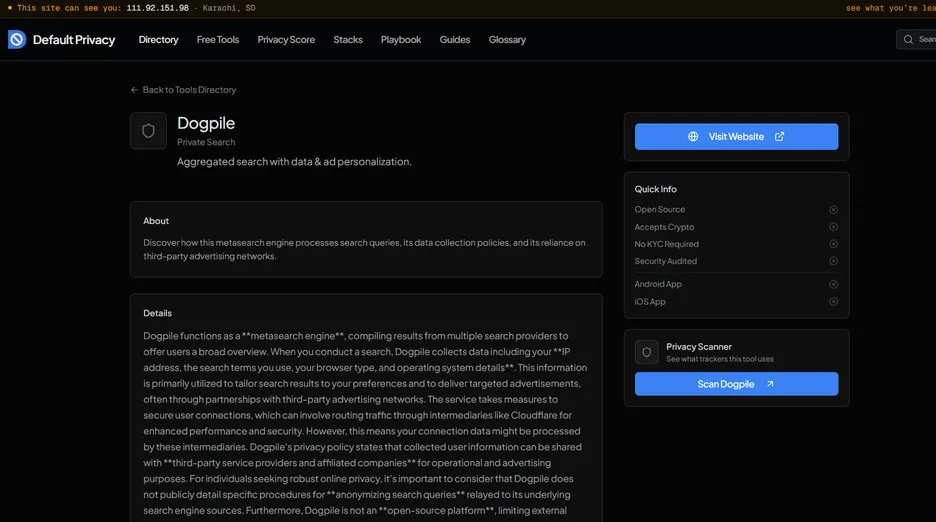
Practical Privacy Assessment
| Privacy Question | Assessment |
|---|---|
| Account required for basic search | 🟢 No |
| Search-history collection categorically ruled out | 🔴 No |
| IP collection categorically ruled out | 🔴 No |
| Advertising-supported environment | 🟡 Yes |
| Tracking technologies discussed in linked policy | 🟡 Yes |
| Query proxying clearly documented | 🔴 Documentation not found |
| Privacy-first classification recommended | 🔴 No |
Privacy practices may vary by product, location, device, consent settings, and applicable law. Users should review the disclosure for the specific Dogpile product they use.
Is Dogpile Safe and Legitimate?
Dogpile is a legitimate, actively operated search service. It has operated since 1996 and is currently associated with System1. Its website, extension, mobile products, and developer platform remain available.
However, legitimate, secure, private, and accurate are not interchangeable.
Website Security
The official Dogpile website uses HTTPS. This encrypts normal traffic between the user’s browser and Dogpile. HTTPS does not prove that every search result is trustworthy or safe.
Result Safety
Appearing in a Dogpile result does not certify that a website is accurate, current, unbiased, authoritative, malware-free, academically credible, or authentic. Users should inspect the destination, publisher, author, evidence, and publication date before relying on a result.
How Popular Is Dogpile?
Dogpile remains active, but it is a niche search service rather than a major global search platform.
No audited first-party figure for active Dogpile users was identified in the research used for this guide. Third-party traffic platforms may publish estimated visits or rankings, but those figures should be treated as directional rather than exact.
Dogpile has an active audience, but it is not a major competitor to Google, Bing, or other globally dominant search platforms.
Claims about millions of daily users should not be published without current first-party evidence.
Dogpile Pros and Cons
| Advantages | Limitations |
|---|---|
| 🟢 Collects results from more than one search source | 🔴 Complete provider configuration is not disclosed |
| 🟢 Removes some duplicate results | 🔴 No independent general web index is documented |
| 🟢 Keeps conventional links central | 🔴 No general consumer generative-answer layer verified |
| 🟢 Useful for secondary discovery | 🟡 Advanced operator support is poorly documented |
| 🟢 No account required for basic search | 🟡 Privacy disclosures are complex |
| 🟢 Offers web, image, video, news, and map search | 🔴 No academic filters or citation analysis |
| 🟢 Dogpile Fetch supports AI-agent workflows | 🟡 Dogpile.com and Dogpile Fetch are separate products |
Dogpile Compared With Other Search Tools
Dogpile vs. Google
Dogpile and Google represent different search architectures. Google operates large crawling and indexing infrastructure. Dogpile primarily retrieves and combines results from external providers.
| Factor | Dogpile | |
|---|---|---|
| Search model | Metasearch aggregation | Crawler-based search with AI features |
| Own general web index | 🔴 Not publicly documented | 🟢 Yes |
| Consumer AI answers | 🔴 No general LLM layer verified | 🟢 AI Overviews and AI Mode |
| Advanced operators | 🟡 Limited documentation | 🟢 Extensive documented syntax |
| Best use | Secondary discovery | Broad primary web search |
Dogpile’s advantage is not a larger index. Its potential value comes from offering a different aggregation and ranking layer.
Dogpile vs. Privacy-Focused Search Engines
Dogpile, DuckDuckGo, Startpage, and Kagi are sometimes grouped together as Google alternatives, but they address different needs.
- Choose Dogpile for secondary result discovery.
- Choose DuckDuckGo for privacy-focused everyday search.
- Choose Startpage for mainstream results through a privacy intermediary.
- Choose Kagi for paid, ad-free search.
- Choose MetaGer for a more explicitly documented metasearch model.
Dogpile vs. AI Search Engines
Dogpile’s consumer search primarily finds and organizes links. AI search systems retrieve information and generate an answer from the material they find.
Traditional metasearch: Query → external providers → combined links → user evaluates sources
AI-powered search: Question → retrieval → source selection → model synthesis → cited answer → follow-up
Traditional metasearch gives users more direct access to links with less model-generated interpretation. It also requires more manual reading and synthesis.
AI search accelerates comparison and explanation but introduces risks such as hallucinated claims, citation mismatch, omitted sources, oversimplification, and incorrect synthesis.
What Is Dogpile Fetch?
System1 launched Dogpile Fetch on July 23, 2026. It is a web-search API and MCP server designed for developers and AI agents.
According to the System1 announcement, Dogpile Fetch can:
- Classify a query
- Route it to an appropriate backend
- Return ranked results
- Return knowledge-graph information
- Return related questions
- Break difficult questions into multiple searches
- Deduplicate results in its deeper search mode
- Connect with MCP-compatible clients
System1 announced pricing beginning at $2 per 1,000 calls, with a free monthly credit at launch.
AI agent → Dogpile Fetch → multiple search operations → ranked and deduplicated results
Dogpile Fetch does not mean the ordinary Dogpile.com consumer page has become a generative answer engine.
Is Dogpile Useful for Research?
Yes, but mainly as a supplementary discovery tool.
Dogpile may help researchers find a different ordering of web results after searching a larger engine. It can expose a source that was not prominent in the first interface used.
Where Dogpile Can Help
- Broad exploratory searches
- Finding additional webpages
- Comparing result ordering
- Discovering unfamiliar domains
- Reducing dependence on one search interface
- Conventional link-based research
Where Dogpile Is Limited
- Reproducible advanced searching
- Academic filtering
- Citation-network analysis
- Systematic literature reviews
- Source authentication
- Conversational evidence synthesis
- Research-project management
- Transparent provider weighting
Dogpile discovers sources. It does not independently validate everything it returns.
Testing Limitations for This Review
AOFIRS attempted to examine Dogpile using navigational, informational, and specialist queries.
Dogpile’s JavaScript anti-automation verification repeatedly prevented reproducible inspection of live results in the testing environment.
This guide therefore does not assign unsupported scores for result relevance, duplicate-removal accuracy, advertising density, exact-phrase support, site: support, filetype: support, Boolean handling, result freshness, query interpretation, or provider attribution.
Feature descriptions are based on current official pages, application listings, corporate documentation, and other publicly verifiable material.
This article evaluates Dogpile’s documented architecture, positioning, products, and research role. It does not claim to provide a controlled result-quality benchmark.
How to Use Dogpile in a Research Workflow
1. Start With a Broad or Independent Search Engine
Use Google, Bing, Brave Search, or another general engine to identify core terminology, organizations, experts, important websites, and likely primary sources.
2. Repeat the Query on Dogpile
Look for different domains, alternate rankings, older pages, additional terminology, and sources that did not appear in the first search. A different result is not automatically a better result.
3. Move to a Specialist System
Choose the database that matches the evidence you need. Examples include Google Scholar, Semantic Scholar, PubMed, government databases, legal databases, and company registries.
4. Use AI Search for Query Expansion
AI search can help identify missing terminology, competing explanations, follow-up questions, and potential primary sources. Always open and inspect the cited source.
5. Verify the Original Evidence
Whenever possible, open the original research paper, government document, corporate filing, court judgment, official policy, regulatory notice, primary dataset, or direct statement.
6. Triangulate Important Claims
Compare important information across independent sources. Several websites repeating the same original report do not provide independent confirmation.
7. Record the Research Trail
Save the source title, author, publisher, publication date, access date, URL, relevant evidence, conflicting evidence, and known limitations.
A search result, metasearch listing, snippet, or AI-generated answer is a discovery aid. It is not automatically verified evidence.
Best Dogpile Alternatives by Need
| Need | Consider | Why |
|---|---|---|
| Independent general web index | Brave Search or Mojeek | Both emphasize independent crawling and indexing. |
| Everyday private search | DuckDuckGo | Privacy-focused general search. |
| Mainstream results with privacy intermediation | Startpage | Provides partner results through a privacy-oriented service. |
| Paid, ad-free search | Kagi | Uses a subscription-funded model. |
| Transparent traditional metasearch | MetaGer | Offers more explicit metasearch documentation. |
| Conversational web research | ChatGPT Search | Provides cited answers and conversational follow-up. |
| AI answer engine | Perplexity | Combines retrieval with sourced synthesis. |
| Scholarly discovery | Google Scholar or Semantic Scholar | Focuses on academic literature. |
| AI-assisted literature analysis | Consensus or Elicit | Provides research-oriented evidence workflows. |
Where Dogpile Fits in Modern Search
Dogpile was created during an era when many independent search indexes competed. Its original value proposition was simple:
Search several engines instead of one.
Modern search increasingly follows a different model:
Ask → retrieve → reason → synthesize → cite → act
Dogpile.com remains closer to the traditional metasearch model. Dogpile Fetch extends the underlying multi-source idea into the AI-agent ecosystem.
Dogpile has not become a consumer AI answer engine. It has modernized through browser products, shortcuts, and developer infrastructure while retaining conventional link search at the center of its consumer experience.
Final Verdict: Is Dogpile Worth Using in 2026?
Dogpile is worth using as a secondary discovery tool. It is not the strongest choice as a researcher’s only search engine.
Choose Dogpile when you want to compare conventional result rankings, search beyond one interface, discover additional webpages, or avoid having every question summarized by an AI model.
Do not rely on Dogpile alone when you require a documented independent index, reproducible advanced operators, strict privacy protections, academic filtering, citation analysis, conversational AI synthesis, or a complete research workspace.
Dogpile’s practical value is straightforward: it provides another lens on the web.
That lens can help with discovery, but credible research still requires primary sources, source evaluation, triangulation, and a documented evidence trail.
Frequently Asked Questions
1. What Is Dogpile?
Dogpile is a metasearch engine that combines results obtained from external search providers instead of relying solely on a Dogpile-owned web index.
2. Is Dogpile Still Active in 2026?
Yes. Dogpile.com, its browser products, Chrome extension, and Dogpile Fetch developer platform remain available in 2026.
3. Who Owns Dogpile?
Dogpile is part of System1’s search portfolio. The website identifies InfoSpace Holdings LLC as a System1 company.
4. Which Search Engines Does Dogpile Use?
Dogpile’s website names Google and Yahoo. Its Apple browser listing also names Bing. A complete provider configuration for every Dogpile product is not publicly documented.
5. Does Dogpile Have Its Own Search Index?
No independent Dogpile general web index is publicly documented. Dogpile is described as retrieving and combining results from external search providers.
6. Is Dogpile Private?
Dogpile should not be treated as a strict privacy-first search engine. System1’s applicable privacy policy allows collection and processing that may include IP information, device data, browsing activity, and search history.
7. Is Dogpile Safe to Use?
The official Dogpile website uses HTTPS and is a legitimate service. Users must still evaluate the security, accuracy, and credibility of third-party websites appearing in its results.
8. Is Dogpile Better Than Google?
Not generally. Google has much larger independent search infrastructure and broader local, multimedia, and AI features. Dogpile’s advantage is providing an alternative aggregated view of results.
9. Does Dogpile Use AI?
Dogpile.com does not currently document a general consumer LLM answer experience. Dogpile Fetch is a separate API and MCP product designed to provide search infrastructure to AI agents.
10. Is Dogpile Useful for Research?
Yes, primarily for supplementary discovery and result comparison. It should be combined with major search engines, specialist databases, primary-source verification, and other research tools.