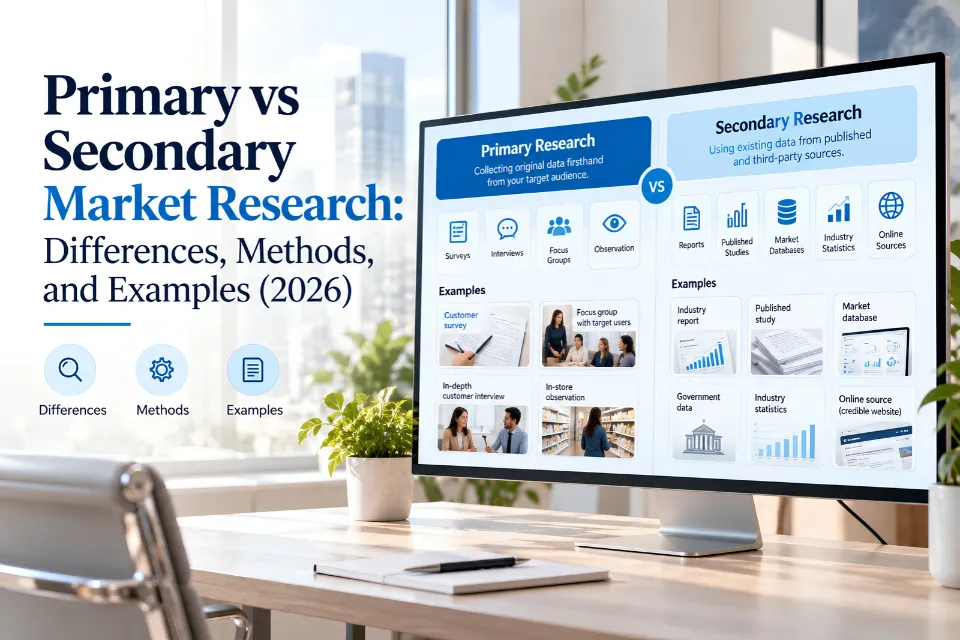
Market research involves industry reports, competitor websites, survey data, and direct customer research. ChatGPT can help organize this material, surface questions, and prepare analysis for review.
Remember that increased analytical speed doesn’t necessarily lead to improved research quality.
ChatGPT prompt engineering for market research is the process of writing clear instructions for research assistance. Prompts define the question, data, comparison criteria, and expected output. They can guide analysis, but cannot create verified evidence or replace appropriate research methods.
The quality of the research output is not just a function of how quickly you can come up with a hypothesis. Good research also requires reliable data sources, appropriate methods, careful checking of sources and the application of professional judgment.
ChatGPT can support web search, uploaded-file analysis, and multistage research when those tools are available. Access depends on the plan, account, workspace, and configuration. Its output still requires independent source and calculation checks.
See the ChatGPT search guide, ChatGPT data analysis, and Deep research guide.
This guide covers five key prompting techniques, some more advanced ones, 15 reusable market research prompts and a practical workflow for taking your research questions and turning them into defensible business recommendations.
What is ChatGPT prompt engineering for market research?
Prompt engineering specifies what you want to learn, what evidence to use, how to analyze it, and how to present the result.
Consider two requests.
Basic prompt:
Analyze the US skincare market.
Improved research prompt:
Act as a market research assistant and carry out research into the US skincare market with a specific focus on the independent brands that sell facial moisturizers. The research should identify the key consumer segments, the positioning of the competitors and any new product claims that are emerging. Use only sources published between January 2024 and October 2026 and cite these with the date of publication. Make it clear which of the findings are actual and which are your own assumptions. Identify any gaps in the information and produce a comparison table as well as five research priorities.
The second prompt is better as it defines the market, defines the period of research, states what evidence is required, defines the scope and makes clear what is expected as the output.
It also sets out very clear instructions for what to do in the event that reliable information is not available.
OpenAI recommends clear context, specific tasks, and iterative refinement in its OpenAI prompting guide.
The Five Elements of an Effective Market Research Prompt
Define five elements: context, task, evidence, method, and output. Add geographic scope, customer segment, time period, exclusions, and instructions for missing or contradictory evidence.
Clear instructions improve relevance. They do not guarantee factual accuracy.
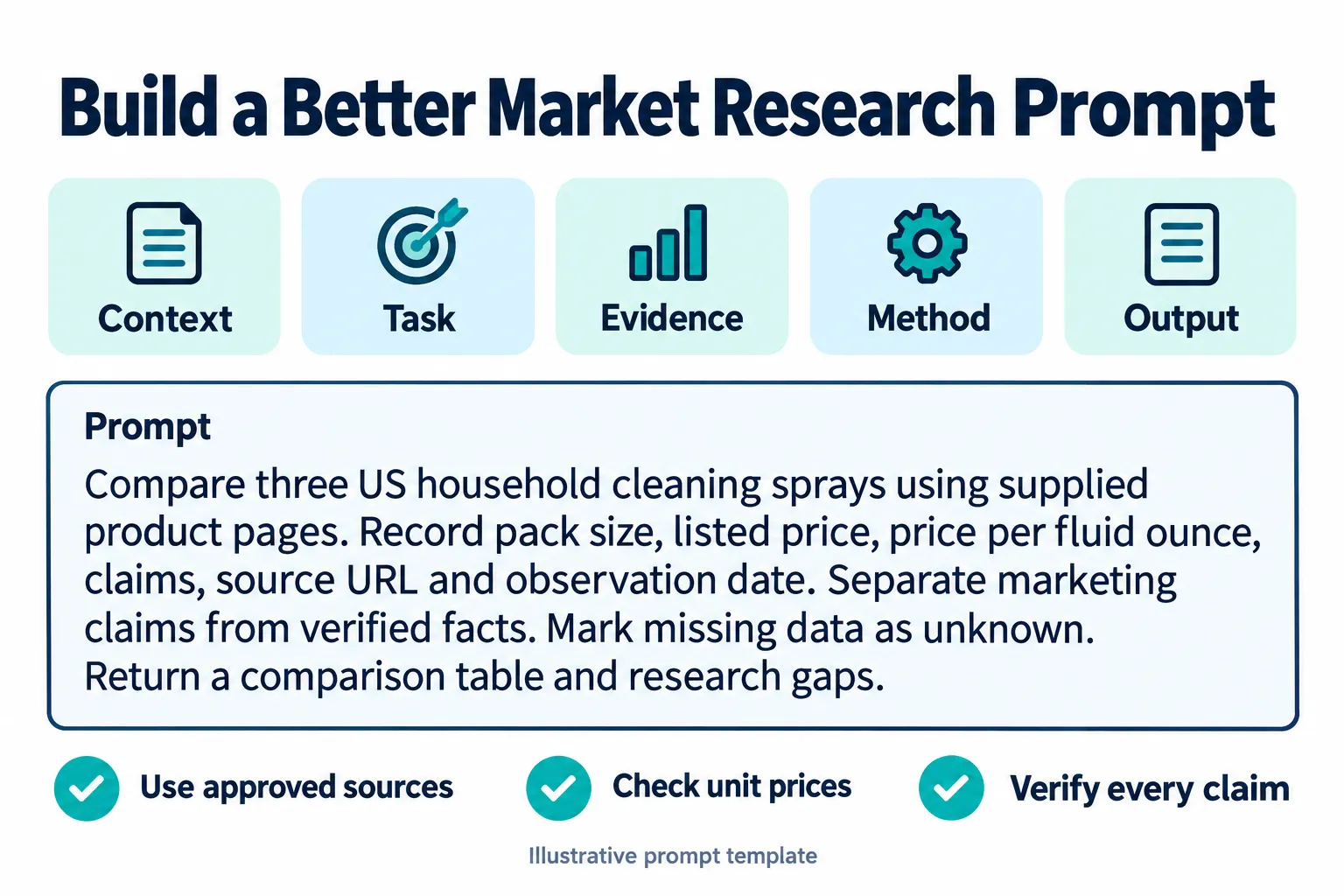
It is important to bear in mind that a prompt can produce a perfectly well-structured response without in any way guaranteeing that the response is correct. The researcher is still ultimately responsible for assessing the evidence.
Why Prompt Engineering Matters in Market Research
Professional market research helps an organization to understand its customers, the business environment, its competition and the demand for its products and services.
The US Bureau of Labor Statistics describes market research analysts as professionals who gather and analyze data on consumers and competitors to assess potential product or service sales.
Source: BLS analyst profile.
ChatGPT can help researchers perform supporting activities, such as:
- Turning broad business questions into structured research plans.
- Summarizing the market reports and the documents supplied.
- Organizing the competitor information into comparison tables.
- Exploring patterns in the survey responses and customer feedback.
- Developing interview questions and questionnaires.
- Drafting of evidence summaries and research reports.
The difference between primary and secondary research is important. Primary research is the collection of new data directly from the participants or from observation. Secondary research is the analysis of existing records, publications and datasets.
ChatGPT can help design primary and secondary research, but simulated responses do not constitute representative consumer evidence.
For methods, see our primary research guide.
Five Essential ChatGPT Prompt Engineering Techniques for Market Research
1. Research Data Summarization and Synthesis
Market research projects will invariably involve reports, interview transcripts, spreadsheets, presentations and customer feedback.
ChatGPT can be used to structure the material, identify the key themes and concepts and produce a summary of the findings across the documents.
It is important to provide the source material rather than just relying on general knowledge that you don’t have any basis in.
Example prompt:
Please go through the market research reports that have been uploaded. Extract from them the findings on consumer purchase behavior, price sensitivity and unmet needs. For each of those findings, note down which document it comes from and which page/section. Flag any contradictory evidence and any gaps in the information. Nothing in the report that isn’t in the uploaded materials should be assumed or invented.
Professional application: A researcher looking at a number of different reports in the industry could use the output to build up an evidence matrix prior to writing their market assessment.
Verification: Check every material conclusion against the original document from which it is taken.
2. Identifying Market Trends and Emerging Opportunities
Trend analysis requires us to separate temporary attention from actual changes in consumer behavior or market conditions.
ChatGPT can help with that by pulling the information together from the various publications, public datasets and so on.
Example prompt:
Look at the trends in the US plant-based food market from 2024 through October 2026. What are the shifts in consumer preferences, product positioning, distribution and pricing? Use whatever primary or authoritative source data you can find that is dated. For each trend you identify, classify it as supported, emerging or insufficiently evidenced. Explain what further information would be required to establish commercial significance.
This is better than just asking for a list of trends without any supporting evidence or explanation.
For instance an increase in online discussion doesn’t necessarily equate to an increase in purchase behavior.
3. Competitive Analysis and Benchmarking
Competitor research looks at the tangible differences between businesses, products, pricing, positioning and customer experience.
ChatGPT can take the publicly available competitor data and put it into a standardized comparison.
Example prompt:
Compare [Competitor A], [Competitor B] and [Competitor C] in [Market]. Look at the publicly available product specs, listed prices, target market, distribution and value proposition for each. Use the same comparison framework throughout. Sources and dates of observation must be cited. Any information which is not available should be noted as such. Do not make any assumptions about private sales figures, profitability or internal strategy.
This is particularly useful for establishing an initial competitor landscape.
However the claims made on the website and the advertised prices may not reflect the true value of the transaction or the level of customer satisfaction.
4. Consumer Sentiment and Voice-of-Customer Analysis
Customer reviews, interviews, open-ended surveys and support interactions can all provide insight into the common experience.
ChatGPT can be used to group the responses thematically and to identify the statements that relate to satisfaction, frustration, product quality and purchase barriers.
Example prompt:
Analyze the customer feedback dataset provided. For each response classify it by sentiment and primary topic. Identify the key complaints, the key positives and the key feature requests. Include the response ID with each classification. Explain any ambiguous cases and don’t generalize from the sample at all.
Sentiment analysis must not be confused with the measurement of preference across the market as a whole.
Datasets made up of customer reviews will tend to over-represent those customers who have had particularly positive or particularly negative experiences.
5. Survey Design and Questionnaire Improvement
Surveys can be a source of useful quantitative or qualitative evidence. The problem arises if the questions are badly worded as this can introduce bias.
ChatGPT can be used to help draft the actual survey instrument and can help you to spot issues such as leading questions, double-barred questions and poorly defined response scales.
Example prompt:
Design a 10 question survey to gauge customer satisfaction with your online grocery delivery service. The survey should include screening questions, questions around how often you purchase, questions on your delivery experience, questions around perceived value and finally questions on what you would like to see improved. Use neutral language and appropriate response options. Identify potential sources of response bias and recommend steps you would take to pilot test the survey.
Pilot-test survey questions with people similar to the intended participants. Review comprehension, response options, and sampling separately before fielding the survey.
ChatGPT can be used to write the questionnaire but it cannot in any way establish the validity of the instrument just by writing the questions.
Advanced Prompt Engineering Methods for Market Researchers
The five core applications are all significantly more effective when used in conjunction with some form of structured prompting.
| Method | Purpose | Practical use |
|---|---|---|
| Context-rich prompting | Defines the research situation | Specify industry, audience, region, and objective |
| Role-based prompting | Frames the task | Request a competitor analyst’s comparison approach |
| Task decomposition | Breaks complex work into stages | Research plan, collection, analysis, verification |
| Structured output | Standardizes findings | Evidence matrices, tables, research summaries |
| Evidence-grounded prompting | Limits unsupported conclusions | Require source references and uncertainty labels |
| Iterative refinement | Improves incomplete responses | Revise scope, criteria, and requested evidence |
| Constraint-based prompting | Controls boundaries | Specify dates, geography, and exclusions |
| Few-shot prompting | Demonstrates desired classification | Provide examples of correctly coded reviews |
| Multi-step prompting | Connects research activities | Plan, gather, analyze, evaluate, report |
| Critical-review prompting | Tests assumptions | Request alternative explanations and weaknesses |
Why Iterative Prompting Is Important
A first cut might be that the research question is too wide, that the relevant data isn’t available or that the criteria for comparison are inconsistent.
Rather than just going round and round asking for more detail, the researchers should identify the problem.
For instance an initial competitor analysis might involve comparing businesses across different price brackets. A refined prompt would then be to limit the sample to those brands within a specific price bracket and within a particular geographic market.
The aim isn’t to produce longer answers, it’s to produce analysis that is more focused and more amenable to audit.
15 Practical ChatGPT Market Research Prompt Templates
The following prompts are for actual use. Fill in the bracketed bits with the appropriate details for your project.
Any prompts which require external evidence should be run through an appropriate retrieval tool or with source material supplied by the researcher.
Each template states its purpose, what it’s intended to achieve and the key verification requirement.
Prompt 1: Market Size and Growth Analysis
Use when: Estimating market demand or assessing industry growth.
Research the size and growth of [Industry] in [Country] over the [Time Period]. Establish what the market is (definition), what the market figures are (revenue or volume estimates), what the key segments are and what the historical trends have been. Use good primary or authoritative sources. For every figure you come across you must state its source, date, geography and method of measurement. Explain why there may be differences between the various estimates. Do not make up any missing figures. Present an evidence table and finish with a statement of the research gaps.
Expected output: Market estimates, segment comparisons and documented uncertainties.
Verification: Check the original statistical tables, market definitions and reporting periods. Proprietary estimates may not provide sufficient methodology.
Prompt 2: Industry Trends and Emerging Opportunities
Use when: You’re looking for changes which may impact product development or marketing strategy.
Look at the developments in [Industry] in [Country] over the [Time Period]. Look at the consumer side, the technology side, the regulatory side and the distribution side. Back up your findings with sources that are dated and with some kind of measurable indicator if possible. Rate each trend on the strength of the evidence. Where appropriate describe the opportunities that may be present and also consider alternative explanations. Be clear as to what is an observation of the market and what is a prediction.
Expected output: Evidence-ranked trends and potential business implications.
Verification: look at the changes over time rather than just at individual news stories. Media coverage in itself is not evidence of consumer demand.
Prompt 3: Competitor Research and Benchmarking
Use when: When comparing competing businesses or product offerings.
Compare [Competitors] in [Market] on the following basis: product range, publicly available pricing (if any), target customer base, positioning, distribution and any documented differentiators. Use only information available by [Cutoff Date]. Produce a comparison table with source URLs and observation dates. Clearly separate out what is claimed in the marketing from what is independently verifiable. Clearly flag any fields which are unknown and identify any potential competitive gaps.
Expected output: Competitor comparison matrix and evidence-based positioning opportunities.
Verification: go to the original product pages and check the current pricing, features and availability. Internal company performance is generally not visible.
Prompt 4: Target Audience Segmentation
Use when: To develop customer segments for further investigation.
Develop a preliminary segmentation framework for potential buyers of [Product] in [Country]. Think about needs, purchase behavior, use cases, price sensitivity and the relevant demographic variables. Use the research we have or other credible existing data. Be clear about which segments are data-driven and which are purely hypothetical. For each segment describe its key characteristics, the evidence for it and a recommended method of validation. Don’t make up any segment sizes.
Expected output: Segmentation hypotheses and a validation plan.
Verification: Test the proposed segments against actual purchase behavior or appropriately sampled audience research. AI-generated personas are not real respondents.
Prompt 5: Customer Pain Points and Unmet Needs
Use when: looking at opportunities for product improvement.
Analyze the customer reviews, interview notes and support feedback for [Product]. Look for the common problems, the unmet needs and the good things. Cluster the comments into themes and attach the relevant response IDs. Report on the frequency of each theme in the sample provided, explain the ones that are a bit ambiguous and distinguish between the actual complaints and the inferred needs. Recommend questions for the follow-up customer interviews.
Expected output: Theme frequency table, customer issues and follow-up questions.
Verification: check the original comments and the sampling constraints. The frequency of a complaint in a review sample is not necessarily indicative of the prevalence of that complaint in the wider customer population.
Prompt 6: Customer Interview Guide
Use when: Preparing qualitative research interviews.
Create a semi-structured interview guide for [target audience] to explore [research question]. Include appropriate introductory consent language for researcher review, a series of warm-up questions, questions around the purchasing experience, unmet needs, the factors that influenced the decision and some neutral follow-up probes. Avoid leading and double-barreled questions. Structure the questions in a way that would make sense as a real interview and explain what evidence each question is intended to elicit.
Interview guide with research objectives and neutral probes.
Verification: pilot test the guide and check the consent and privacy requirements. Interviews add depth but don’t necessarily give you representative prevalence estimates.
Prompt 7: Survey Questionnaire Development
Use when: Preparing quantitative consumer research.
Design a survey for [Target Audience] to measure [Research Objectives]. It should include an eligibility screen, a number of behavioral questions, appropriately worded rating scales and an optional open-ended question. Avoid any leading language, assumptions, overlapping response categories, double-barreled items. Provide a full question table with response options, measurement purpose, potential bias and pilot test recommendations.
Draft survey instrument and bias review.
Verification: test the comprehension, the sampling design and the questionnaire performance prior to fielding. A polished questionnaire in itself will not prevent selection bias.
Prompt 8: Product-Market Fit Hypotheses
Use when: To assess whether the product is solving a real customer problem.
Using the evidence we have regarding [Product], [Target Audience] and [Market] develop 5 testable product-market fit hypotheses. For each hypothesis you should state the customer problem, the proposed value proposition, the evidence for it, the evidence against it, the measurable success indicators and a low-cost validation experiment. Clearly delineate the facts from the assumptions.
Testable hypotheses with proposed experiments.
Verification: check the results against actual customer behavior, interviews or trials. Hypotheses are not evidence of product-market fit.
Prompt 9: Evidence-Based SWOT Analysis
Use it when assessing the strategic strengths, weaknesses, opportunities and threats.
Prepare a SWOT analysis for [Business] in [Market] using only the internal docs and verified external sources provided. Split the internal factors (strengths and weaknesses) from the external (opportunities and threats). For each point you make, provide evidence, a confidence level and a measure of business relevance. Don’t make any generic statements that aren’t supported. Finish off with a list of strategic questions which would require further research.
Expected output: Supported SWOT matrix and research priorities.
Verification: check the internal factors against business records and the external factors against reliable market evidence. Otherwise the SWOT categories can become entirely subjective.
Prompt 10: Pricing and Product Positioning Research
Use when: Comparing price positioning or designing pricing research.
Compare pricing and positioning for [Product Category] in [Country] using supplied competitor records and publicly listed prices. Normalize sizes, subscription terms, discounts, and currencies where appropriate. Group offerings by observable features and price range. Explain why listed prices do not establish willingness to pay. Propose customer research to test price acceptance.
Expected output: Comparable pricing table and positioning questions.
Verification: Check the price dates, the package and the transaction terms. Competitor prices in themselves don’t tell you what the right price is.
Prompt 11: Voice-of-Customer Analysis
Use when: looking at large volumes of customer statements.
Treat the [Source Data] as a VoC dataset. Start by describing the size of the dataset, how it was collected and what fields are missing. Then produce a clear coding framework for topics, sentiment, urgency and requested improvements. Classify the responses and keep the response IDs for audit. Provide only representative short quotes from the actual records. Flag any classifications that are in any doubt and recommend a sample be reviewed by a human.
Coding framework, categorized responses and evidence-linked themes.
Verification: audit a subset manually and check coding consistency. Sentiment models can struggle with sarcasm, mixed feelings or domain-specific language.
Prompt 12: Geographic Market Comparison
Use when: When looking at possible regional expansion markets.
Compare [Locations] for the potential expansion of [Business]. Define the criteria (target population, affluence, relevant competition, operating conditions, distribution etc). Identify the appropriate official datasets and other authoritative local sources. Create a comparison matrix with data years, definitions of the measures, missing fields and limitations. Don’t assign any opportunity scores unless you have a transparent method for doing so.
Expected output: Regional comparison matrix and outstanding research questions.
Verification: make sure the geographic boundaries and reporting periods are the same. Regional averages can mask significant differences at the neighborhood level.
Prompt 13: Consumer Trend Identification
Use when: Studying changes in consumer attitudes and behavior over time.
Assess the changes in consumer behavior with respect to [Product Category] over the [Time Period]. Use the available survey data, purchase data and the relevant consumer research from that period. Be very clear about the difference between what consumers say they will do and what they actually do. Look at the sampling differences and any changes to the questions over time before attempting any comparison. Identify the changes that are supported by the data, the likely reasons for those changes and the gaps which will require primary research.
Expected output: Time based consumer behavior assessment.
Verification: check the datasets are comparable and the research methodologies are the same. A change in the survey sample can look like a change in consumer behavior.
Prompt 14: Market Entry and Expansion Feasibility
Use when: Assessing entry into a new product category or country.
Develop a preliminary market entry research plan for [Business] entering [Market] with [Product]. Look at demand indicators, competitors, distribution requirements, customer segments, regulatory issues and operational risks. Build an evidence matrix, identify the key unknowns and suggest validation activities. Don’t jump to any legal or financial conclusions without the appropriate qualified review.
Expected output: Preliminary feasibility assessment and research plan.
Verification: Validate the key commercial assumptions and obtain the requisite professional advice on the jurisdictional obligations.
Prompt 15: Executive Market Research Report
Use when: Preparing a research deliverable for stakeholders.
Prepare a decision-ready market research report on [Business Objective] using only the approved research materials. The report should contain an executive summary, research questions, scope, methodology, source inventory, key findings, competitor insights, customer insights, limitations, conclusions and recommendations. All material findings must be linked to the relevant supporting evidence. Assumptions and uncertainties must be clearly identified. No unverified stats, invented quotes or unsupported forecasts are to be included.
Expected output: Structured research report with traceable conclusions.
Verification: Check the citations, the methods, the calculations and the link between the findings and the recommendations. Executive summaries should not hide material uncertainty.
A Nine-Step ChatGPT Market Research Workflow
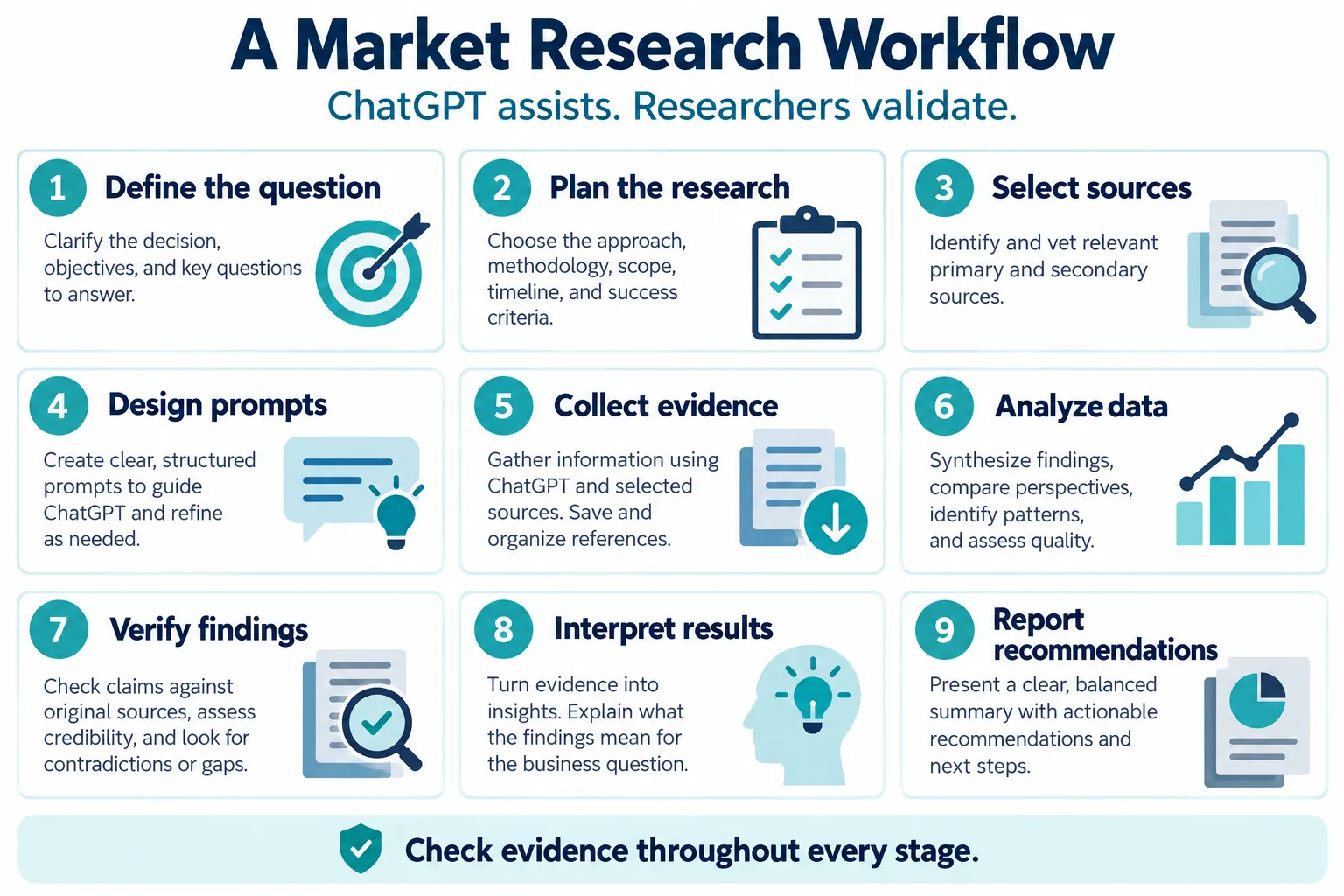
Verification is presented as a separate stage, but the evidence should be checked at all times through the workflow.
| Stage | ChatGPT assistance | Human responsibility |
|---|---|---|
| 1. Define question | Refine scope and objectives | Approve business decision and research boundaries |
| 2. Plan research | Suggest methods and information needs | Select appropriate methodology |
| 3. Identify sources | Discover possible publications and datasets | Assess provenance and suitability |
| 4. Design prompts | Draft instructions and output formats | Check scope, assumptions, and constraints |
| 5. Collect data | Extract and organize supplied records | Ensure permissions, completeness, and integrity |
| 6. Analyze | Summarize, code, calculate, and visualize | Validate methods and numerical results |
| 7. Verify | Flag contradictions and unsupported claims | Inspect original evidence |
| 8. Interpret | Draft explanations and alternatives | Judge significance and feasibility |
| 9. Report | Organize results and draft summaries | Approve findings and recommendations |
Steps 1–3: Establish the Research Foundation
Start with a decision rather than a generic topic.
Rather than ‘what’s going on in the health food market?’ ask ‘is there sufficient evidence to support a trial of a premium low sugar snack with working adults in a specific US metro area?’
Then work out what the evidence needs to be (this could be category demand, competitor pricing, distribution, consumer interviews and product testing).
Source selection should be in line with the question. Government data can be used to describe the population, interviews can be used to find out what people are actually motivated to buy.
Steps 4–6: Structure Prompts, Collect Data, and Analyze
Develop separate prompts for discovery, extraction, comparison and interpretation. Note the materials used at each stage.
For suitable uploaded spreadsheets, ChatGPT can assist with calculations, tables, and charts. Use clear headers and one record per row; inspect cleaning steps, assumptions, formulas, and source records before accepting the result.
A good evidence log should contain the source title, publisher (or URL/file ID), publication date, collection date, geographic scope, the finding and any known methodological limitations.
Steps 7–9: Verify, Interpret, and Report
Verification should involve opening the sources cited and checking that they support the claims ascribed to them.
A useful final report separates three layers:
Finding: What the evidence as a whole shows.
Interpretation: What that finding means in relation to the research question.
Recommendation: What is the appropriate course of action (subject to uncertainty, cost and risk)?
This separation ensures that suggestions generated by the AI aren’t going to appear as if they are actual verified business facts.
Worked Example: Using ChatGPT to Evaluate a New Product Opportunity
Think of a small business that’s planning to launch an eco-friendly household cleaning spray in the US.
The central research question is:
Is there enough evidence of customer demand and competitive opportunity to warrant a limited product launch?
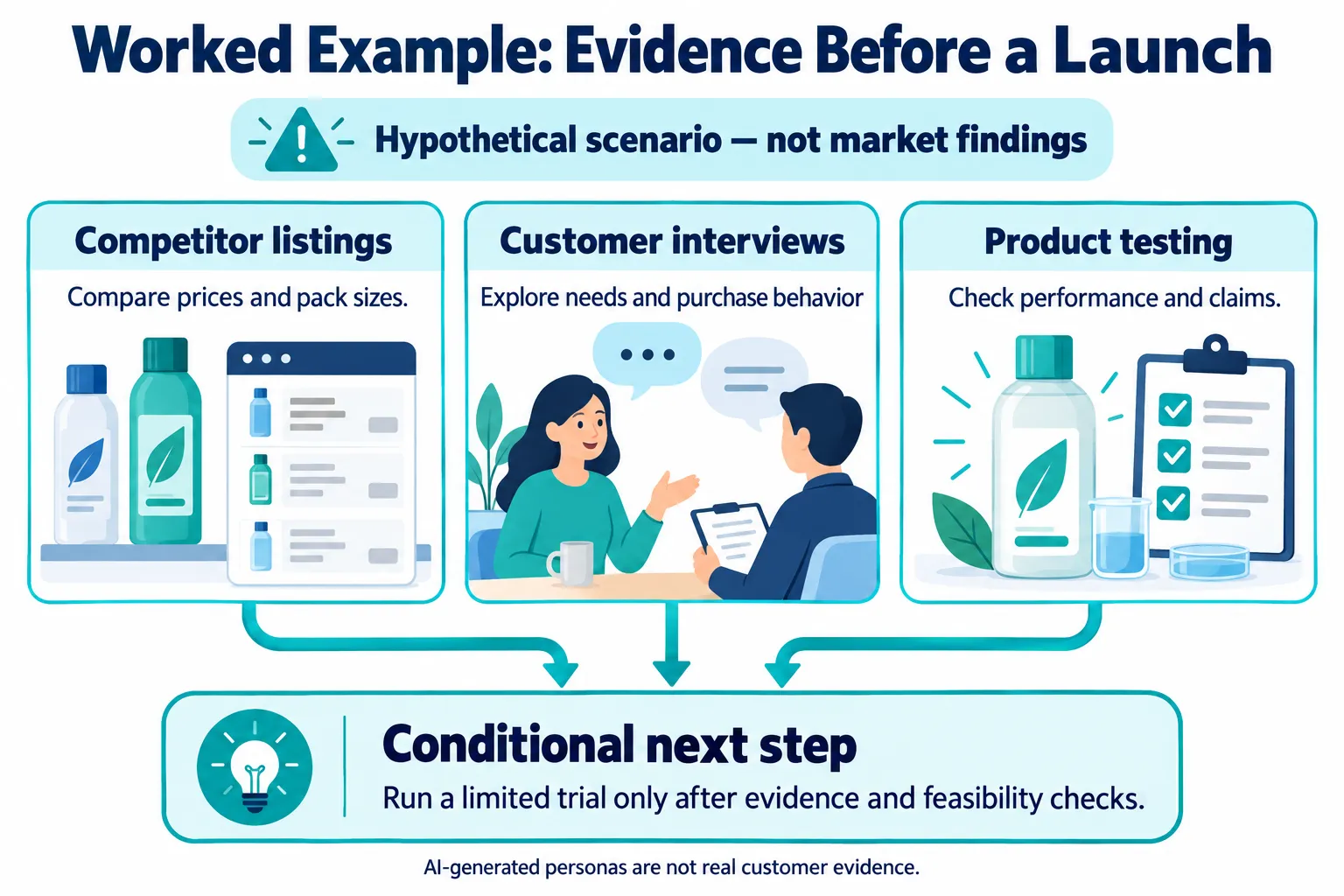
This is purely an illustrative exercise, not a full commercial feasibility study. There has been no consumer survey or product testing carried out in the course of this example.
Stage 1: Begin With a Research Plan
A weak initial prompt might be:
Is an ‘eco-friendly’ cleaning product a good business idea?
This request is far too broad. It gives ChatGPT no market, no sources and no decision criteria whatsoever.
A stronger prompt is:
Develop a research plan to assess the potential launch of an eco-friendly household cleaning spray in the US. The plan should cover consumer needs, competitor products, retail pricing, environmental claims, distribution and the customer’s willingness to pay. Identify appropriate sources of secondary research available up to October 27, 2026. Clearly separate the secondary research questions from those which will require original customer interviews or product testing. Don’t assume there is any demand.
The improved prompt leads to a research design rather than a premature recommendation.
Stage 2: Identify Evidence Requirements
The business could structure its research around five questions.
| Question | Potential evidence |
|---|---|
| Who might purchase the product? | Consumer interviews, surveys, household characteristics |
| What alternatives already exist? | Verified product listings, manufacturer descriptions, retailer catalogs |
| What price might customers accept? | Competitive pricing and original pricing research |
| Which product claims matter? | Customer interviews, relevant product standards, documented preferences |
| Can the business compete? | Cost estimates, distribution analysis, and product testing |
A researcher could obviously go to the official US statistical sources, check the relevant environmental and product labeling guidance and look at what the competition are currently doing.
The existence of sources does not remove the need to assess their scope and methodology.
Stage 3: Compare Competitors
The next prompt could be to have ChatGPT compare a number of cleaning products using the same evidence framework.
For example:
Compare the product pages for the competing household cleaning sprays. Take note of the pack sizes, the publicly stated prices, the positioning of the product, any claims relating to the ingredients and the distribution channels. Include the source URL and the date of observation. Don’t treat the marketing claims as evidence in themselves of any environmental performance.
The result should be a comparison matrix rather than a confident assertion as to which of the competitors is the most successful.
Stage 4: Investigate Customer Needs
The business could then conduct interviews with potential customers.
ChatGPT might help develop neutral questions such as:
- What factors influence your choice of household cleaning products?
- Tell me about a recent cleaning product purchase.
- Which product features are most important to you?
- Have you experienced problems with products you currently use?
- How do you evaluate environmental claims when shopping?
These questions explore actual behavior rather than assuming customers are already willing to pay more for environmentally positioned products.
Stage 5: Analyze and Validate the Evidence
Once collected, anonymized customer interviews could be coded for themes such as price, product performance, scent, packaging, and ease of use.
Suppose respondents mention both affordability and cleaning effectiveness. That would provide a basis for further investigation, but not proof of market-wide preferences.
Researchers would need to review the coding, examine contradictory responses, and consider how interview recruitment affected the findings.
Stage 6: Develop a Conditional Recommendation
Without verified data, the appropriate result is not an immediate launch recommendation.
Instead, the research could recommend:
- Completing a documented competitor price and feature comparison.
- Conducting exploratory interviews with relevant customers.
- Testing a prototype for performance and usability.
- Evaluating product costs, environmental claims, and distribution feasibility.
- Using a limited trial to measure actual purchase behavior.
This example illustrates an important principle: a useful AI-assisted market research report can identify what a business must learn before committing resources, even when the available evidence cannot yet support a definitive decision.
ChatGPT vs. Traditional Market Research Methods
ChatGPT can assist with research planning and analysis, but its strengths differ from those of established research methods.
| Research activity | ChatGPT’s potential contribution | Why traditional methods remain important |
|---|---|---|
| Research planning | Draft objectives and frameworks quickly | Method selection needs expert review |
| Source discovery | Suggest and retrieve relevant materials | Provenance and completeness require checking |
| Primary research | Draft surveys and interview guides | Real participants and appropriate sampling are essential |
| Secondary research | Summarize publications and datasets | Original sources must support conclusions |
| Competitive intelligence | Standardize observable comparisons | Commercial intelligence may be incomplete |
| Qualitative analysis | Suggest codes and identify themes | Human coding checks reduce misinterpretation |
| Statistical analysis | Assist with calculations and visualization | Statistical assumptions and data quality need validation |
| Research reporting | Organize evidence into readable reports | Researchers remain responsible for conclusions |
| Cost and speed | May reduce some drafting and processing effort | Sampling, data access, verification, and specialist work still have costs |
The strongest approach is often a combination: use AI to assist with repeatable research activities while retaining established methods for data collection, measurement, interpretation, and validation.
How Reliable Is ChatGPT for Market Research?
ChatGPT can help analyze evidence, but users should not treat its output as authoritative merely because it appears detailed or includes citations.
OpenAI advises checking important information and reviewing sources because generated answers can contain errors. A citation is a route to verification, not proof that a claim is supported.
Hallucinated Statistics and Sources
ChatGPT can generate plausible but incorrect information, including market sizes, growth rates, citations, and quotations.
Researchers should verify important figures against their original sources. A useful prompt can instruct the model not to fabricate data, but that instruction does not guarantee accuracy.
Unrepresentative Consumer Evidence
Online reviews, social media conversations, and convenience samples may not accurately represent an entire target market.
AI-generated personas and simulated customer responses are particularly unsuitable as substitutes for real participant evidence. They may help generate hypotheses, but they do not demonstrate how actual consumers think or behave.
Confirmation Bias
Prompts can introduce bias by assuming a product will succeed or asking only for favorable evidence.
For example, “Explain why our product will succeed” encourages a different response from “Evaluate the evidence for and against launching our product.”
Researchers should deliberately search for contradictory findings.
Confidentiality, Privacy, and Copyright
Market research can involve customer information, unpublished business documents, interview transcripts, and licensed industry reports.
Before uploading information to AI tools, researchers should assess confidentiality, applicable privacy obligations, contractual restrictions, and available data controls.
Remove unnecessary personal identifiers, minimize sensitive information, and avoid providing materials that are not authorized for the intended use.
The 2025 ICC/ESOMAR International Code addresses professional accountability, transparency, data protection, and human oversight. It also calls for disclosure to clients when AI is used in relevant research activities, including synthetic data or personas.
Source: ICC/ESOMAR research code.
Prompt Injection and External Content
Research assistants may encounter web pages or documents containing instructions unrelated to the user’s research task.
Such content should be treated as evidence to inspect, not as authority to change the researcher’s instructions or disclose confidential information.
Reproducibility and Documentation
AI-assisted analyses can change when prompts, models, sources, or tool configurations change.
Researchers should preserve enough information to reconstruct important analytical decisions, including prompt versions, datasets, source dates, coding instructions, calculations, and human corrections.
A professional research report should explain how AI was used when that information is relevant to evaluating the methods or results.
A Practical Checklist for Verifying AI-Generated Market Research
- Every important numerical claim has a traceable source.
- The cited source actually supports the associated claim.
- Data definitions, dates, and geographic boundaries are clear.
- Original evidence is distinguished from AI interpretations.
- Sampling limitations and potential biases are documented.
- Important calculations and classifications have been checked.
- Contradictory evidence and unresolved questions are included.
- Recommendations do not exceed what the evidence supports.
Emerging AI Technologies for Market Research in 2026
Several developments extend AI-assisted research beyond basic text generation.
AI Agents and Multi-Step Research
AI agents can support workflows involving multiple stages, such as discovering sources, organizing findings, comparing documents, and drafting reports.
The important question is not whether an agent can complete several actions. It is whether those actions remain transparent, authorized, and verifiable.
High-impact decisions should include human checkpoints.
Deep Research Systems
ChatGPT’s deep research capabilities are designed for more extensive research questions that require combining information from multiple sources.
Depending on available tools and permissions, deep research can combine public websites, uploaded files, and eligible connected sources into a documented report. Source access and limits vary.
Researchers should still review source coverage and verify conclusions.
See the Deep research guide.
Retrieval-Augmented Generation
Retrieval-augmented generation, or RAG, is an approach in which a language model uses information retrieved from selected documents or repositories while generating an answer.
In market research, this can help an AI assistant work with approved company documents, research archives, or authorized datasets.
Retrieval does not guarantee that the source is accurate or that the model interprets it correctly. Source quality and evidence checking remain essential.
Multimodal Market Research
Multimodal systems can assist with different information formats, including text, images, charts, and documents.
For example, a researcher might use image analysis to compare visible packaging features or ask a document-analysis tool to inspect a market report.
Visual interpretation still requires verification, especially where extracted figures or labels are important.
Automated Qualitative Coding
AI-assisted coding can help categorize large collections of open-ended responses.
To produce defensible findings, researchers need clear coding definitions, consistency checks, examples of ambiguous responses, and documented review procedures.
Synthetic Respondents
Simulated respondents can be useful for brainstorming questions, examining hypothetical scenarios, and testing an interview guide’s wording.
However, a language model’s simulated answers are not direct evidence of real customer preferences.
Synthetic participants should not be presented as equivalent to independently recruited consumers.
AI-Assisted Competitive Monitoring
Research tools may help organize changes in competitor websites, product information, and public announcements.
Where monitoring is authorized and technically supported, researchers can track changes over time. Automated collection should respect applicable law, platform conditions, and data access restrictions.
These developments reinforce the same principle: increasingly capable tools make research oversight more important, not less.
Frequently Asked Questions
What is ChatGPT prompt engineering for market research?
It is the process of creating structured instructions that guide ChatGPT in research planning, evidence analysis, competitor comparisons, consumer feedback interpretation, and reporting. Effective prompts specify the task, context, source requirements, methodology, and expected output.
How can ChatGPT help with market research?
ChatGPT can help design research plans, analyze uploaded datasets, summarize existing publications, draft surveys, code qualitative feedback, compare competitors, and prepare research reports. Its output must be checked against reliable sources and appropriate research methods.
What are the best ChatGPT prompts for competitor analysis?
Effective competitor prompts define the market, list the companies, specify comparison criteria, require dated sources, and distinguish verified information from assumptions. A standardized comparison table makes findings easier to evaluate.
Can ChatGPT provide reliable market size estimates?
ChatGPT can help locate and compare market size estimates when suitable sources are available. It should not be relied upon to invent missing figures. Researchers must verify definitions, calculations, source methodologies, and reporting periods.
Can ChatGPT replace traditional market research?
No. ChatGPT can assist with several research activities, but it cannot automatically replace valid sampling, direct customer research, field observation, controlled product testing, or professional interpretation.
How should researchers verify ChatGPT-generated insights?
Researchers should inspect original sources, check important numerical claims, review sample characteristics, test calculations, consider contradictory findings, and document relevant uncertainty. AI outputs should be treated as analytical assistance rather than unquestionable evidence.
Can ChatGPT analyze surveys and interview transcripts?
Yes. With suitable features and authorized files, ChatGPT can help organize survey responses, identify themes, classify comments, and calculate statistics. Researchers must review extraction accuracy, methodology, coding consistency, and privacy requirements.
What are the main limitations of AI-assisted market research in 2026?
Key limitations include fabricated information, outdated sources, selection bias, incomplete data access, misinterpreted consumer responses, confidentiality concerns, and inconsistent outputs. Prompt engineering can improve task clarity but cannot eliminate these risks.
Conclusion: Better Prompts and Verified Market Research
ChatGPT prompt engineering offers market research professionals practical ways to structure research tasks, summarize evidence, compare competitors, examine customer feedback, and prepare reports. The five fundamental techniques of research synthesis, trend identification, competitive analysis, sentiment analysis, and survey design remain useful. More advanced methods, including evidence-grounded prompting, structured outputs, and multi-step workflows, can make these activities easier to evaluate. The most important skill is knowing how to distinguish an AI-generated answer from a verified research finding. Researchers who combine effective prompts with credible sources, appropriate sampling, transparent analytical methods, and human judgment are better positioned to produce useful business intelligence.
For professional researchers, ChatGPT should function as a research assistant within a documented methodology, not as a substitute for collecting evidence or making accountable decisions. Related guides: market research agents, research tool comparison, and AI search privacy.