Type a question into Google and you get one of two honest outcomes: an answer, or a shrug. Ask the same question of an AI search assistant, and you might get neither. You might get a third thing entirely, a fluent, well-formatted, completely wrong answer, footnoted with a source that doesn’t actually exist.
That gap isn’t about one tool being smarter than the other. It comes down to architecture: how each system reaches web pages in the first place, and just as importantly, how it behaves the moment it can’t. Every research query passes through an access layer the researcher never sees, and understanding it has quietly become a core professional skill. The newer system fails in a way the older one never did: silently, fluently, and with citations attached.
How Does Google Search Actually Work? Inside the Crawl-and-Index Pipeline
Traditional search engines don’t work from a master directory of the web. There is no master registry to consult. Discovery happens almost entirely through traversal: a crawler starts from pages it already knows, seed URLs and submitted sitemaps, and finds new content by following hyperlinks outward, page after page.
Picture a librarian who can only find a book if another book’s footnotes happen to mention it. Whatever no footnote points to may as well not exist to that librarian and the same is true of a search crawler.
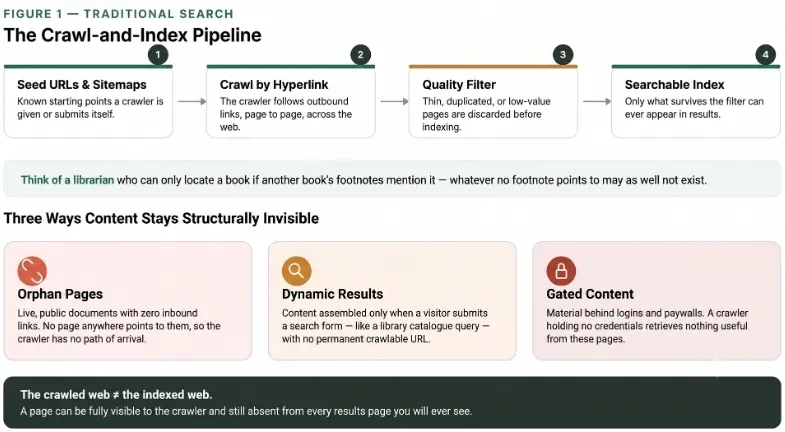
Figure 1. Discovery depends entirely on hyperlinks; content with no link path into it is structurally invisible, and even crawled pages must pass a quality filter before entering the searchable index.
This dependence on links produces three categories of content that stay structurally invisible no matter how good the content itself is. Orphan pages are live and public, but nothing links to them, so the crawler has no path of arrival. Dynamically generated pages the results a library catalogue assembles only after a visitor submits a search form, for instance exist for a moment and carry no permanent, crawlable URL. And gated content sitting behind logins or paywalls returns nothing useful to a crawler holding no credentials.
There’s a second, less appreciated constraint that kicks in after crawling. Search engines do not index everything they fetch: Google’s own documentation on how search works confirms that indexing is a distinct stage in which a page’s content is analyzed and a decision is made about whether it belongs in the index at all [1]. A quality filter discards thin, duplicated, or low value pages, which means the crawled web and the indexed web are genuinely different sets. A page can be completely visible to the crawler and still never appear on a single results page.
Does AI Search See More of the Web? The Truth About RAG
Here’s the assumption most people carry into an AI search box: that it “sees more” of the web than Google does. At the architectural level, that assumption is mostly wrong.
The dominant design behind AI search is Retrieval Augmented Generation, or RAG. When a question arrives, the system retrieves candidate documents from an index that already exists, and a language model synthesizes them into a conversational, cited answer. The retrieval step inherits the crawler’s blind spots wholesale. RAG retrieves from an index, it does not expand one. The genuine innovation lives in the synthesis layer, in how information gets composed and presented, not in how far the system can reach.
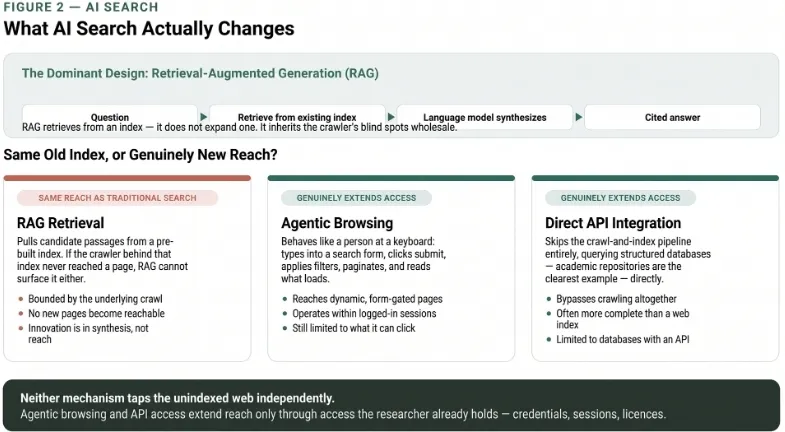
Figure 2. The RAG spine retrieves from an existing index with the same blind spots as traditional search; only agentic browsing and direct API integrations reach past the old boundaries.
Two newer mechanisms do extend access, and they’re worth knowing by name. Agentic browsing behaves like a person at a keyboard rather than a link follower: it can type a query into a search form, click submit, apply filters, paginate, and read dynamically generated results a crawler could never reach. Direct API integrations skip the crawl-and-index pipeline altogether, querying structured databases academic repositories are the clearest example through their own interfaces, often surfacing records completer and more current than anything a general web index holds.
Neither mechanism taps the hidden web independently, though both operate through access the researcher already holds, such as a login, a session, or a licensed connection. Recent AOFIRS research on the state of the hidden web puts sharper numbers on this: something like 90–96% of the web remains outside standard search indexes, and in a genuine reversal the share of the web visible to AI crawlers has actually started shrinking relative to what Google can reach, as publishers increasingly block AI bots by default while continuing to allow traditional search crawlers. On heavy document analysis tasks, that same retrieval shortcut can also show up as a reliability gap: some AI assistants lean on RAG in ways that trade grounded accuracy for conversational fluency once the underlying material runs thin.
The AI Search Citation Trap: Why Confident Answers Can Be Wrong
The most consequential difference between the two paradigms isn’t what they can access it’s how they behave at the boundary of what they can’t.
When a keyword engine hits a structural limit, it returns zero results. That’s frustrating, but it’s honest: a legible signal marking exactly where the tool’s reach ends, and a clear cue for the researcher to try another route.
AI search tools rarely decline to answer at all. Independent testing from Columbia Journalism Review’s Tow Center for Digital Journalism put real numbers on this: across 1,600 test queries run against eight AI search engines, the tools were wrong more than 60% of the time overall, and every single one got a meaningful share of citations wrong the best performer, Perplexity, still answered incorrectly 37% of the time, while the weakest, Grok-3, was wrong 94% of the time [2]. When these engines couldn’t retrieve a source, they tended to produce incorrect or speculative answers delivered with striking confidence inventing dead or fabricated URLs and attributing information to the wrong sources rather than admitting the gap. The failure never announces itself. It arrives formatted exactly like a success.
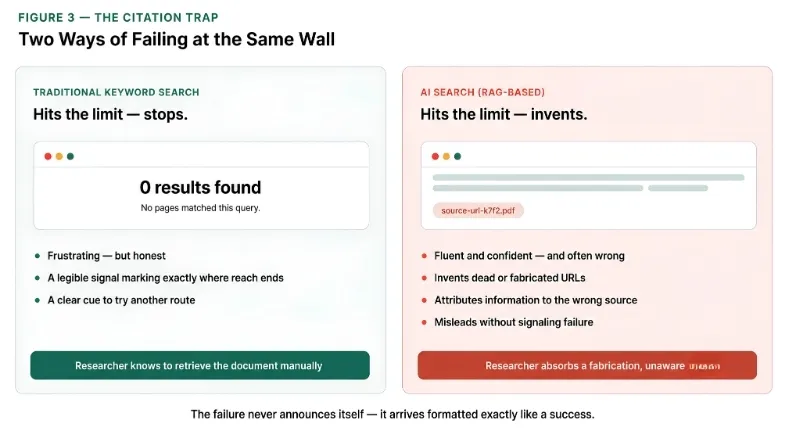
Figure 3. A traditional engine’s weakness is visible as a null result; an AI engine’s weakness is disguised by the fluency and formatting of a successful answer.
Picture an investigator asking an AI tool to summarize a specific court filing sitting behind a login. Google would simply return nothing useful, and the researcher would know immediately to retrieve the document by hand. The AI tool, unable to reach the filing, might instead stitch together a plausible-sounding summary from loosely related coverage, attach a URL that doesn’t resolve, and present the whole package fluently no hedge, no asterisk. A researcher who trusts that output hasn’t just failed to obtain the document. They’ve absorbed a fabrication about it, and may go on to repeat it elsewhere as fact.
Google Search vs AI Search: A Quick Comparison for Researchers
The two architectures diverge in almost every dimension that matters to a professional researcher not just in what they can reach, but in how honestly they admit the limits of that reach.
| Key Difference | Traditional Search (Google) | AI Search (RAG-based) |
|---|---|---|
| Discovery mechanism | Hyperlink traversal from seed URLs and sitemaps | Retrieval from a pre-built index using the same underlying crawl |
| What extends reach beyond the index | Nothing on its own; only new links or submitted sitemaps | Agentic browsing and direct API integrations, where credentials allow |
| Behavior at a structural limit | Returns zero results | Frequently generates a fluent, plausible sounding answer |
| Failure signature | Visible and honest: a null result | Invisible, formatted exactly like a success |
| What the researcher must do | Try another query, source, or route | Verify every citation resolves and supports the claim |
A Verification Protocol for Professional Researchers
The practical discipline follows directly from the architecture:
- Treat AI search as a synthesis layer, not an access layer its reach is largely the same index traditional search draws on, extended only where agentic browsing or an API connection genuinely operates.
- Require named, checkable references when an AI tool points to a specific registry, archive, or document, confirm that source actually exists before relying on it hallucinated databases are a known, recurring risk
- Locate entry points the old fashioned way search operators such as site:, filetype:, and inurl: remain the most reliable tools for finding the gateway page or exact document once a source is confirmed real.
- Cross-check AI answers against a keyword search not the other way around because the AI-visible web is generally a subset of what a thorough keyword search can reach, an AI answer’s silence on a topic proves nothing either way
- Verify every citation resolve the link and confirm it actually supports the claim attached to it, not just that a citation is present at all.
- Treat any confidently delivered answer about gated, dynamic, or obscure content as a prompt to check access directly not as retrieved fact.
Conclusion: The Null Result Was Never the Real Risk
A search engine that comes back empty handed has never been the worst outcome a research tool can hand you. It tells you where to look next. A confident fabrication, dressed in the formatting of a successful answer, tells you nothing is wrong right up until it costs you the accuracy of your work.
The architecture behind each kind of search hasn’t just changed how researchers find information. It’s changed what “trustworthy” has to mean when the answer arrives already footnoted.