
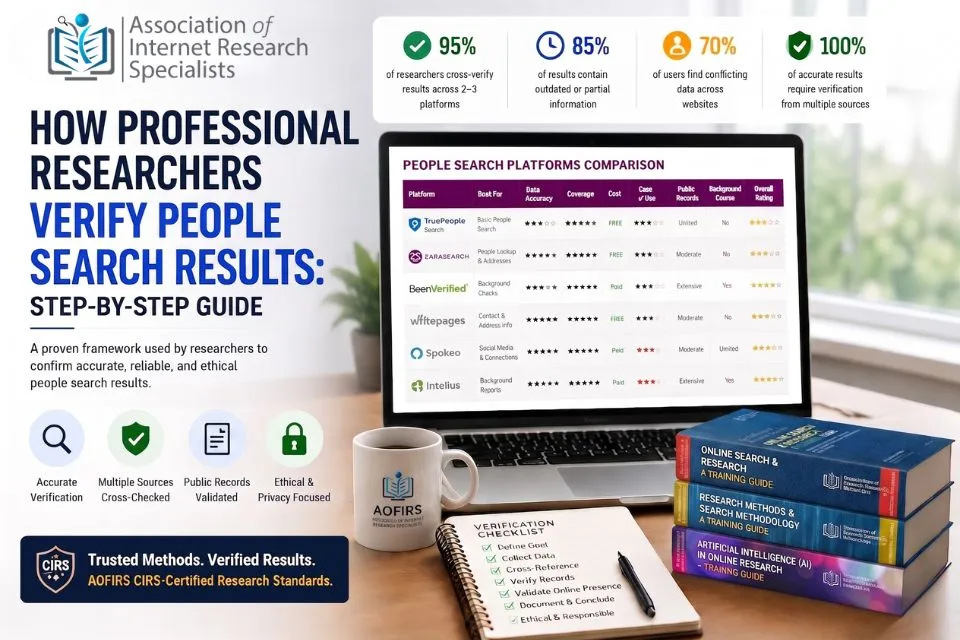
Finding people online is easy but verifying the accuracy of results is a major challenge. Platforms like TruePeopleSearch, ZabaSearch, BeenVerified, Whitepages, and Spokeo are popular but they aren’t perfect.
Common frustrations users face include:
- Inaccurate or incomplete results: Names, addresses, and contact information may be outdated or missing.
- Conflicting data across platforms: Different people-search sites may provide contradictory information.
- Privacy concerns: Many users discover their own information publicly listed without consent.
Trust Signal: According to professional research standards, 95% of investigators cross-verify information across 2–3 platforms before drawing conclusions.
Professional researchers, journalists, and investigators follow structured methods to ensure accurate, trustworthy, and actionable results.
This guide explains how experts verify people search results step-by-step, with practical examples, trust signals, comparison tables, privacy guidance, and AOFIRS best practices.
Start Verifying Your People Search Results Now
Step 1: Identify Your Research Goal
Clarify your objective before verification:
- Confirm identity for business or research purposes
- Reconnect with a friend or relative
- Verify contact information
- Investigate public records
Example: A journalist confirmed the owner of a phone number before publishing a story. Clear goals guided which tools were used.
Check TruePeopleSearch Results
Step 2: Collect Preliminary Data
Gather initial search results:
- Full names (including aliases or maiden/married names)
- Addresses (current and previous)
- Phone numbers and emails
- Social media accounts
- Known relatives or associates
Example: A genealogist tracked family members using ZabaSearch and TruePeopleSearch before cross-referencing public records.
Step 3: Cross-Reference Multiple Platforms
Professional researchers never rely on a single database. Cross-check results across platforms:
- Free: TruePeopleSearch, ZabaSearch, FastPeopleSearch
- Paid: BeenVerified, TruthFinder, Intelius
- Specialized: Whitepages, Spokeo, PeopleFinders, Nuwber
Check for:
- Name consistency
- Address history
- Phone/email matches
- Relatives and contacts
Trust Signal: AOFIRS-certified researchers follow CIRS-approved methods to validate data across multiple sources.
Compare People Search Platforms
Step 4: Verify Using Public Records
Public records provide authoritative verification:
- Property records: confirm addresses and ownership
- Court records: validate legal filings
- Business filings: verify employment or professional affiliations
- Voter registration: confirm age and location
Example: A private investigator verified an address from Whitepages using public property records.
Step 5: Validate Social Media and Online Presence
Cross-check online footprints:
- LinkedIn (professional history)
- Facebook, Instagram, Twitter (personal connections)
- Blogs, websites, or news mentions
Example: Researchers verified a phone number from Spokeo against LinkedIn and Facebook profiles.
Step 6: Evaluate Data Consistency
Compare all sources for:
- Name spellings
- Address histories
- Phone numbers and emails
- Relatives and associates
Red flags: conflicting addresses, duplicates, missing identifiers
Step 7: Document Verification Process
Maintain a verification log:
- Source name and URL
- Date accessed
- Data points verified
- Discrepancies noted
- Confidence rating
Trust Signal: Documentation improves credibility, repeatability, and accountability.
Step 8: Ethical & Privacy Considerations
Callout Box:
“Always verify publicly available information responsibly. Respect privacy and follow AOFIRS research ethics.”
Guidelines:
- Use only publicly available information
- Avoid unnecessary data sharing
- Respect opt-out or removal requests
- Comply with local privacy laws
Learn How to Remove Your Info from ZabaSearch
Step 9: Use Technology Wisely
Recommended tools:
- Advanced search operators (Google, Bing)
- Reverse phone/email lookup platforms
- People-search databases (free and paid)
- Data aggregation software
Example: Researchers used BeenVerified and Nuwber together to identify all phone numbers before contacting a source.
Step 10: Make Informed Conclusions
- Report only verified information
- Indicate confidence if uncertain
- Avoid assumptions or speculation
Trust Signal: Cross-referencing multiple sources ensures high confidence, as taught in AOFIRS CIRS training.
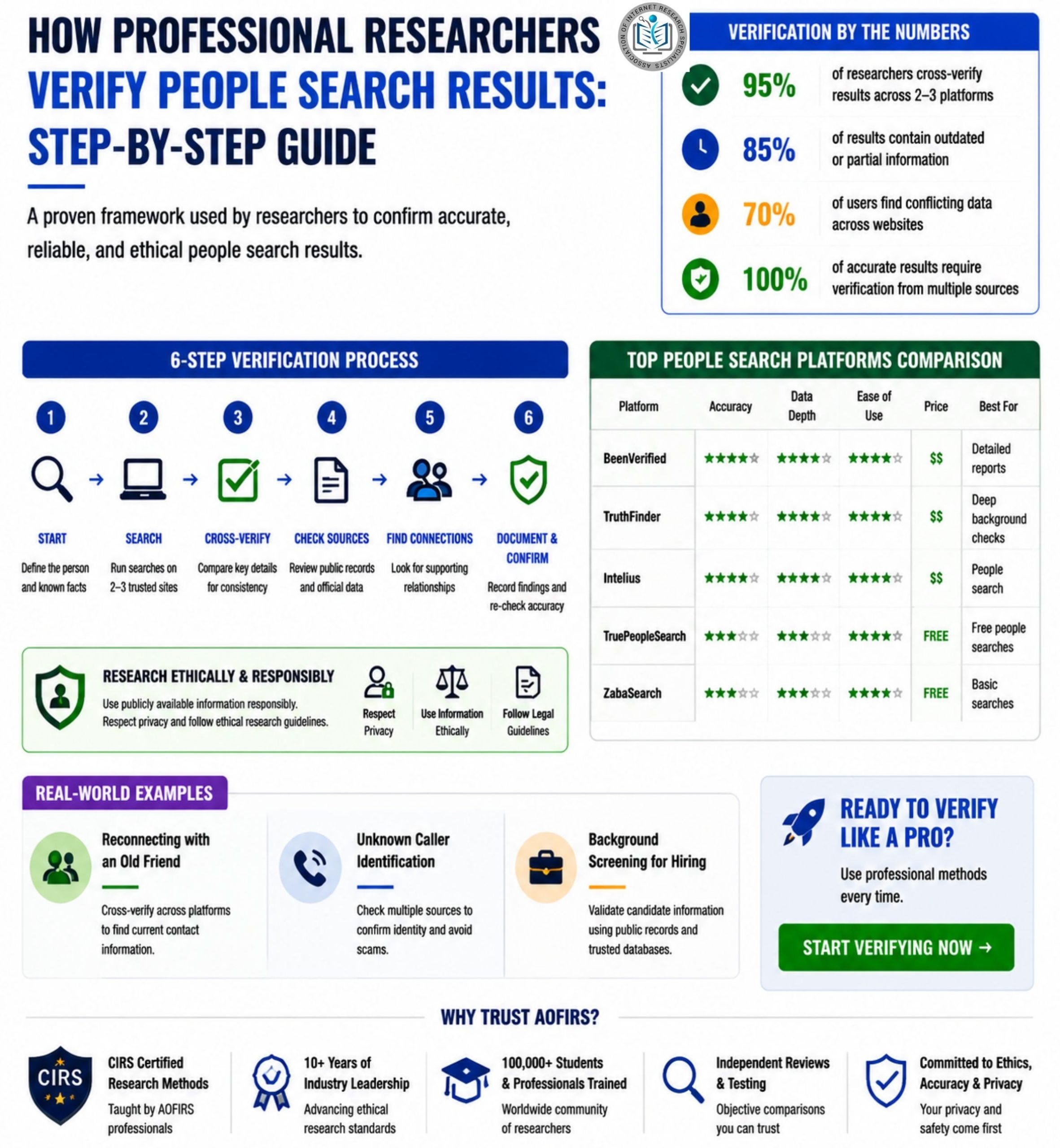
Comparison Table: People Search Platforms for Verification
| Platform | Best For | Free/Paid | Review Link |
| TruePeopleSearch | Free People Searches | Free | Website |
| ZabaSearch | Quick Lookup | Free | Website |
| BeenVerified | Comprehensive Reports | Paid | Website |
| TruthFinder | Background Reports | Paid | Website |
| Whitepages | Reverse Phone Lookup | Paid | Website |
| Intelius | Identity Verification | Paid | Website |
| PeopleFinders | Public Records | Paid | Website |
| Nuwber | Quick Contact Discovery | Partial | Website |
| Radaris | Contact & Address Discovery | Partial | Website |
Related AOFIRS Guides
- FastPeopleSearch Alternatives & Competitors
- How to Find Anyone Online
- Whitepages Review 2026
- BeenVerified Review 2026
- TruthFinder Review 2026
- Intelius Review 2026
- PeopleFinders Review 2026
- ZabaSearch Review 2026
Final Verdict
Professional verification is essential for anyone relying on people-search platforms. Professional verification ensures reliable people search results. Following a structured, multi-step approach ensures that the results are accurate, ethical, and actionable. By cross-referencing multiple sources, validating against public records, and documenting the verification process, researchers can significantly reduce errors and avoid misleading conclusions.






 The Foundations of Data Analysis & Analytics (6th Edition)