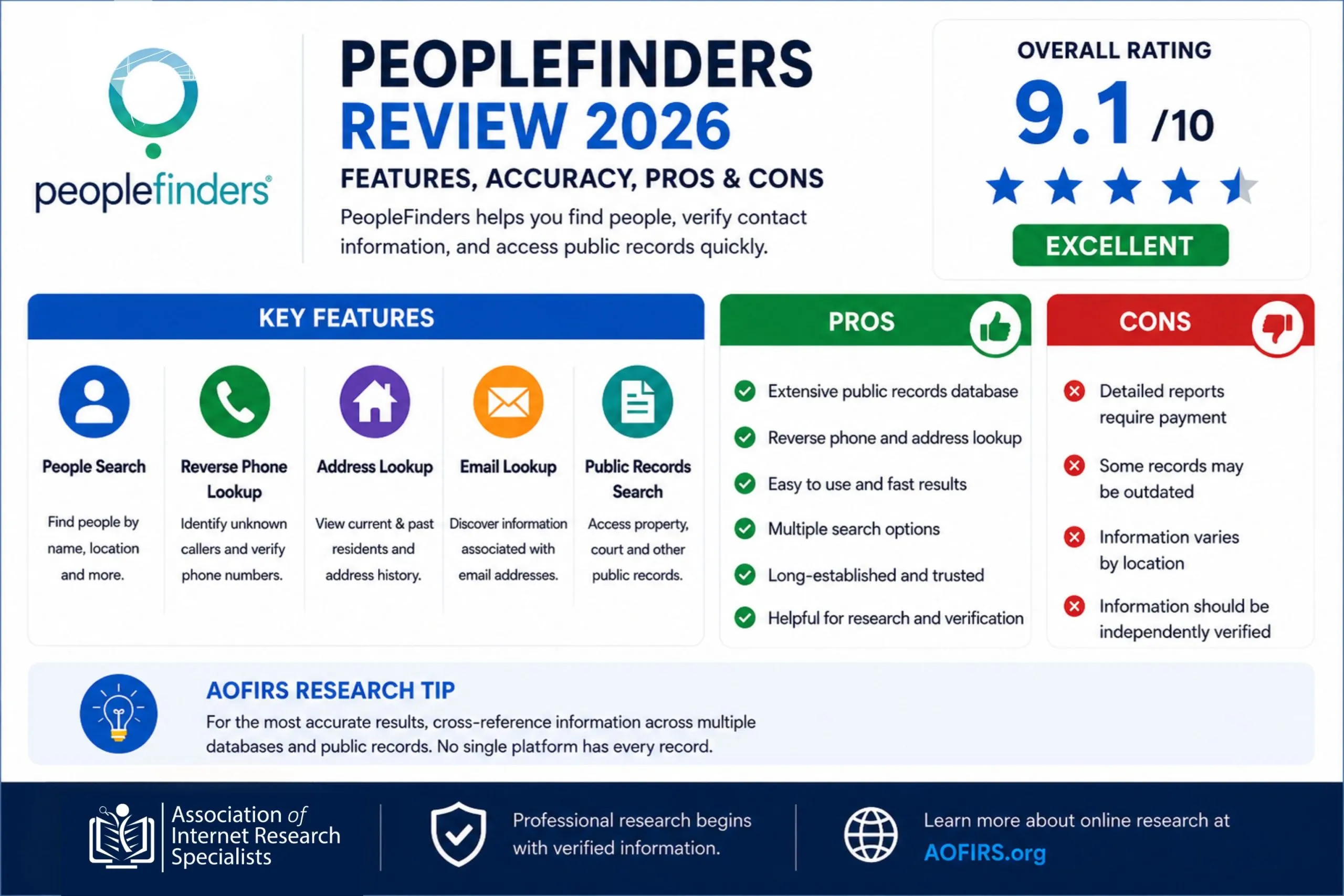
PeopleFinders is a long-running U.S. people-search service. It sells access to aggregated public-record and contact data through its website and an iPhone app. This review is written for researchers who need to know three things before using it: what the service actually lists and charges, what the law says it cannot be used for, and how a person can remove their own listing.
How this review was prepared. No test searches were run, so this review gives no accuracy scores. The facts below come from sources opened on 9 November 2026: PeopleFinders’ home page and opt-out page, its listing in Apple’s App Store, the Fair Credit Reporting Act (FCRA), a Federal Trade Commission (FTC) enforcement action against two other people-search companies, a Consumer Financial Protection Bureau (CFPB) rulemaking record and California’s data-broker deletion platform. PeopleFinders’ terms, pricing and FAQ pages refused automated access on that date and should be read in a browser before you buy.
Who Operates PeopleFinders
PeopleFinders describes itself on its home page as “the original people finder site” and says it has delivered people data to customers “since 1999” (PeopleFinders). That is the company’s own account; this review found no independent record of the founding date.
Its iPhone app is published under the seller name Confi-Chek Inc, and the listing’s copyright line reads PeopleFinders LLC (Confi-Chek Inc, 2026). When you pay for a report or file a privacy request, those are the company names to record.
What PeopleFinders Searches
The home page groups its tools under people search and public records, offering contact information, family members, business contacts and property details (PeopleFinders). The App Store description adds two specific uses. A phone lookup is meant to “identify who’s calling or texting you”, and an address search is described as finding ownership history from public property records, including property values (Confi-Chek Inc, 2026).
The earlier version of this review also listed email lookup and court-record searches. Those could not be confirmed from the pages available on 9 November 2026, so they are not listed here.
Prices Listed in the App Store
PeopleFinders’ website did not display prices on its home page. Its App Store listing, read on 9 November 2026, showed these in-app purchases (Confi-Chek Inc, 2026):
| In-app purchase (as named in the listing) | Price (USD) |
|---|---|
| People Search Report | $1.99 |
| Background Check Report | $9.99 |
| Upgrade To Background Report | $9.99 |
| PeopleFinders Membership | $24.99 |
| Premium Membership | $29.99 |
| Professional Membership | $64.99 |
| Pro 500 Membership | $119.99 |
| Pro 1000 Membership | $219.99 |
The listing does not state the billing period or renewal terms for the memberships, so do not assume these are monthly prices. Prices on the PeopleFinders website may differ from in-app prices. Before buying, record the plan name, price, billing period, renewal terms and cancellation method from the checkout page, with the date.
PeopleFinders and the FCRA
The App Store listing states that “PeopleFinders is not a Consumer Reporting Agency (CRA) as defined by the Fair Credit Reporting Act (FCRA)” and that its reports cannot be used for employment, credit or tenant screening, or related purposes (Confi-Chek Inc, 2026).
That disclaimer has a precise legal meaning. Under the FCRA, a consumer reporting agency is any person that, for a fee, regularly assembles or evaluates consumer information to furnish consumer reports to third parties, and a consumer report is information used, or expected to be used, to decide a person’s eligibility for credit, insurance, employment or another purpose the Act allows (15 U.S.C. § 1681a). Consumer reporting agencies may furnish reports only for permissible purposes listed in the Act (15 U.S.C. § 1681b), and the Act imposes accuracy and dispute duties on those agencies.
A disclaimer does not settle the question on its own. In 2023 the FTC said two other people-search companies, TruthFinder and Instant Checkmate, operated as consumer reporting agencies despite website disclaimers, because they marketed reports for employment and tenant screening; they agreed to pay $5.8 million (FTC, 2023). The CFPB proposed broader FCRA coverage of data brokers in December 2024 but withdrew the proposal on 15 May 2025 (CFPB, 2025), so the statute and FTC enforcement remain the main guide.
For researchers the rule is simple. Do not use a PeopleFinders report to decide whether someone gets a job, a tenancy, credit or insurance. Use an FCRA-compliant screening provider for those decisions; AOFIRS explains the difference in people search vs FCRA background screening.
What the App Store Rating Shows
On 9 November 2026 the app had an average rating of 3.4 out of 5 from 176 ratings, at version 3.3.9 (Confi-Chek Inc, 2026). That is a small sample from app users only, and ratings measure satisfaction, not data accuracy. Some written reviews on the listing describe billing and cancellation problems. Those are individual user reports, not verified findings, but they are a reason to read the renewal terms closely before subscribing.
Checking a PeopleFinders Result

A people-search report is a set of leads. Consider a typical task: you need to check whether a supplier’s published business address matches a record. A sensible approach is:
- Fix the identity first. Match the full name, age range and at least two locations in the report against what you already know. If several profiles share the name, stop and narrow the search before using any field.
- Confirm the address at source. PeopleFinders says its address search draws on public property records. Go to that source: the county assessor or recorder for the property, which shows the owner of record and transfer dates. A tenant will not appear in ownership records, so a missing match is not proof the person does not live there.
- Treat phone numbers and relatives as unconfirmed. Check a phone number against a source the person controls, such as a business listing or a public profile. Relatives in aggregated reports are often inferred, so confirm any relationship before you mention it.
- Write down what you did. Record the report date, the plan used and which fields you confirmed and how. Say in your notes and any report that the starting point was a commercial aggregator.
AOFIRS describes this method in more depth in How Professional Researchers Verify People-Search Results.
Opting Out of PeopleFinders
PeopleFinders publishes its own opt-out instructions (PeopleFinders). As described on that page on 9 November 2026:
- Run a person search for your own name on PeopleFinders.
- In the results, find your listing and click “View Profile”.
- Copy the profile’s web address from your browser’s address bar.
- Submit that address in the opt-out form and follow the on-screen steps.
- Open the verification email PeopleFinders sends and click the link to confirm the request.
The page says the opt-out controls visibility only on PeopleFinders’ own site; it has no control over websites owned by others. It does not state how long removal takes, so check again after a few weeks. A separate “manage” page describes the same opt-out feature (PeopleFinders).
California residents can also use the state’s free Delete Request and Opt-out Platform (DROP), open to consumers since 1 January 2026. It sends one deletion request to more than 600 registered data brokers; brokers began processing on 1 August 2026 and must check the platform at least every 45 days (California Privacy Protection Agency, 2026). Public records such as property and voting records, and information covered by the FCRA, can be exempt (California Privacy Protection Agency).
How PeopleFinders Compares
The earlier version of this review declared “winners” against five competitors without any test. Those verdicts have been removed. When comparing services, use the same documented points this review uses: the operating company, the service’s own FCRA statement, the published price and renewal terms, the search types it confirms, and the opt-out route. AOFIRS reviews other services separately: our BeenVerified review, our Spokeo review, our TruePeopleSearch review, our TruthFinder review and our Whitepages review. For a free-site overview, see FastPeopleSearch alternatives.
What a Fair Test Would Need
Accuracy claims for a people-search service should rest on a documented test. A future update of this review should:
- search for at least ten consenting adults with a mix of common and uncommon names in several states;
- check five fields per person (current address, a previous address, current phone, age range and one relative) against a primary record or the person’s own confirmation;
- record the date, plan and price paid, and classify each field as correct, outdated, wrong or missing;
- run the opt-out process for one consenting subject and record how long removal took;
- publish the counts rather than a single score.
Verdict
PeopleFinders is a long-established people-search service by its own account, with low-cost single reports and several memberships listed in its app, and a clear statement that it is not a consumer reporting agency. Its published opt-out process is straightforward but covers only its own site. No accuracy rate is published or was tested here. Use it for leads, confirm every field you rely on at the original source, and keep it out of any eligibility decision covered by the FCRA.
References
- California Privacy Protection Agency. (2026). DROP: Delete Request and Opt-out Platform. Retrieved 9 November 2026, from View source
- California Privacy Protection Agency. Personal information and data brokers. Retrieved 9 November 2026, from View source
- Confi-Chek Inc. (2026). PeopleFinders: People Search (Version 3.3.9) [Mobile app listing]. Apple App Store. Retrieved 9 November 2026, from View source
- Consumer Financial Protection Bureau. (2025, May 15). Protecting Americans from harmful data broker practices (Regulation V); withdrawal of proposed rule. Federal Register, 90(93), 20568–20569. View source
- Definitions; rules of construction, 15 U.S.C. § 1681a. Legal Information Institute, Cornell Law School. View source
- Federal Trade Commission. (2023, September 11). FTC says TruthFinder, Instant Checkmate deceived users about background report accuracy, violated FCRA while marketing reports for employee and tenant screening [Press release]. View source
- PeopleFinders. PeopleFinders: People search and public records [Home page]. Retrieved 9 November 2026, from View source
- PeopleFinders. Opt out. Retrieved 9 November 2026, from View source
- PeopleFinders. Manage your public records. Retrieved 9 November 2026, from View source
- Permissible purposes of consumer reports, 15 U.S.C. § 1681b. Legal Information Institute, Cornell Law School. View source