AI-integrated web search tools such as Perplexity Deep Research, ChatGPT and Gemini Deep Research, and Grok DeepSearch now run dozens to hundreds of searches and assemble cited reports in minutes. For independent researchers and research analysts, this does not erase the profession; it moves the value of human work away from gathering data and toward designing inquiries, verifying evidence, overseeing ethics, and producing original insight.

Learn more: watch the Using AI as Your Research Assistant masterclass page, see the quick-glance infographic Research Redefined: The AI-Augmented Era, or read the full research report Information Retrieval in the Age of AI.
From Keyword Searching to AI Orchestration
Traditional research depended on manual keyword queries, library databases, and slow iterative reading. AI-integrated search combines real-time web retrieval with large language models, so a conversational question returns a synthesized, cited answer. Independent researchers, including freelance scholars, consultants, and citizen scientists, now have low-cost, high-speed access that was once reserved for institutions. Analysts see routine aggregation and drafting automated.
The central question is no longer whether AI can find information. It is whether the person using it can direct, test, and take responsibility for what it produces.
What the 2024–2026 Evidence Shows
Individual output rises
Large-scale analyses of published papers find that researchers using AI tools publish more and receive more citations, and early-career scientists advance faster.
Collective diversity narrows
The same research shows AI concentrates attention on “well-lit,” data-rich problems, reducing topical diversity and concentrating citations among fewer papers.
Quality pressure grows
A UC Berkeley Haas and Cornell study of preprints confirmed productivity gains, especially for non-native English speakers, but found lower quality in AI-assisted manuscripts, straining peer review.
The AI-Integrated Research Toolset
| Tool | Core capability | Best research use |
|---|---|---|
| Perplexity AI Deep Research | Runs dozens of searches and reads hundreds of sources | Comprehensive, cited literature mapping |
| ChatGPT Deep Research | Autonomous agent that browses, summarizes, and structures findings | Structured reports and multi-step reasoning |
| Google Gemini Deep Research | Agentic browsing with complex multimodal inputs | Synthesis across text, images, and documents |
| Grok DeepSearch | Fast retrieval with real-time integration | Current events and breaking developments |
These tools treat a search query as a prompt for multi-step reasoning, which shifts the researcher’s burden from discovery to interpretation.
How the Roles Are Changing
Independent researchers become orchestrators
Independent researchers gain the most from democratized access: rapid literature mapping, data extraction, and draft generation free time for hypothesis building and fieldwork. Success depends on query design and source verification. They must design inquiries, cross-validate outputs, and guarantee originality, because over-reliance invites hallucinations, amplified bias, and weaker critical thinking.
Research analysts become AI-augmented strategists
Analysts in equity, market, and policy work once spent much of their time aggregating data and drafting reports. With those tasks automated, they focus on strategic interpretation, stakeholder communication, and nuanced forecasting. They validate machine outputs, integrate proprietary data, and supply the context and judgment that models cannot.
New Competencies Required
- Prompt engineering and query design – framing questions that return balanced, relevant evidence.
- Critical verification – checking every citation against the primary source and detecting fabricated claims.
- Ethical oversight – disclosure, accountability, bias control, intellectual property, and privacy.
- High-level synthesis – managing hybrid human-AI workflows and turning outputs into original insight.
Watch the Masterclass: Using AI as Your Research Assistant
Ethical Oversight Framework
| Principle | What the researcher must do |
|---|---|
| Transparency and disclosure | Declare which AI tools were used, for what purpose, and how much human oversight applied. The ICMJE Recommendations (January 2026) require this, and AI cannot be listed as an author. |
| Human accountability | Keep a human in the loop for prompt design, critical review, editing, and ownership of every conclusion. |
| Hallucination control | Cross-reference claims against primary sources, validate citations, triangulate across tools, and document limitations. |
| Bias detection and mitigation | Audit outputs for underrepresented perspectives, uniform language, and citation clusters caused by training data and SEO-favoring retrieval. |
| Intellectual property | Attribute synthesized sources correctly and verify and cite the originals. |
| Data privacy | Never upload sensitive data to public tools; use enterprise solutions or anonymization to meet GDPR and similar rules. |
Bias mitigation in practice
- Prompt for diversity: ask for synthesis from diverse geographic, cultural, and ideological sources with multiple perspectives cited per claim, then follow up for counterexamples.
- Triangulate across tools: cross-validate Perplexity, Grok, and Gemini against non-AI sources such as PubMed, Google Scholar, and primary documents, and keep a bias audit log.
- Audit after generation: measure citation diversity, check for stereotyping, use fairness rubrics, and document limitations such as missing non-English sources.
Risks to Manage
- Lower quality and reproducibility in AI-assisted outputs.
- Equity gaps for researchers who lack AI literacy.
- Deskilling caused by over-reliance.
- Amplified bias and misinformation.
- Shrinking entry-level roles that once trained new researchers.
Outlook to 2030
By 2030, AI agents may work as collaborative teammates while humans keep veto power over originality and ethics. AI-integrated search elevates the researcher’s role: routine work is automated, and people become the conductors of insight and the guardians of rigor. That outcome depends on deliberate skill-building, standard disclosure templates, AI interaction logs, ethical checkpoints, and responsible AI training.
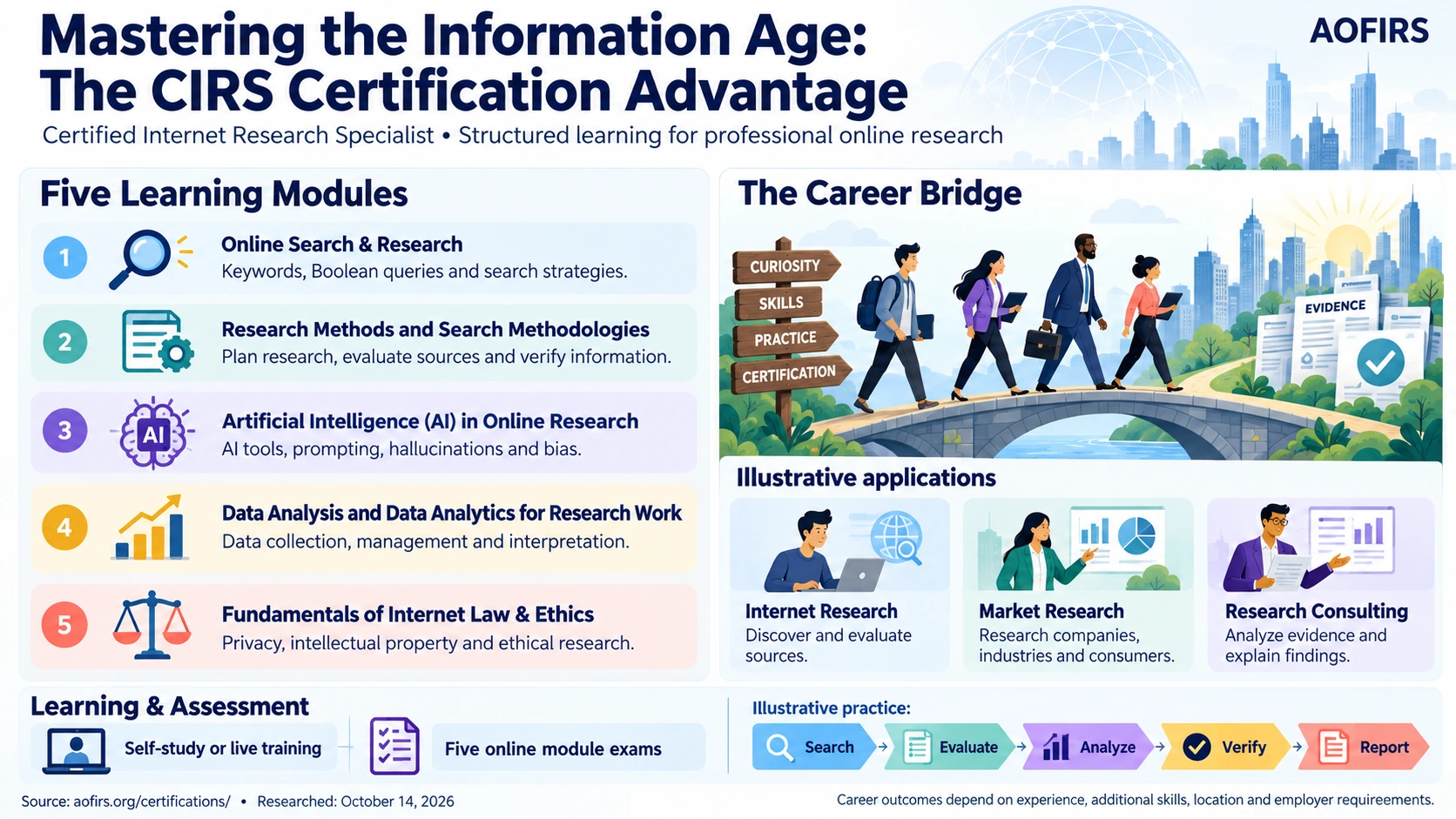
Become a Certified Internet Research Specialist
Build the verification, query engineering, and ethical AI research skills this new role demands with the CIRS™ certification.
Essential Resources
- Research Redefined: The AI-Augmented Era
- The AI Search Revolution: From Keywords to Conversations
- The AI Trust Illusion
- Information Retrieval in the Age of AI (Research Report)
- CIRS™ Program Overview
Frequently Asked Questions
Will AI search tools replace independent researchers?
No. They automate retrieval and drafting, but verification, ethical oversight, contextual judgment, and original insight remain human responsibilities.
What does “research orchestrator” mean?
An orchestrator designs the inquiry, directs multiple AI tools, cross-validates their outputs against primary sources, and takes ownership of the final conclusions.
Do I have to disclose AI use in research?
Yes. Under the ICMJE Recommendations (January 2026), authors must state which AI tools were used, for what purpose, and the extent of human oversight. AI cannot be an author.
How can I reduce bias in AI-generated research?
Prompt for diverse sources, triangulate across several AI tools and non-AI databases, keep a bias audit log, and document limitations after each output.
Which skills matter most for researchers in 2026?
Query design, critical citation verification, ethical oversight, and high-level synthesis within hybrid human-AI workflows.