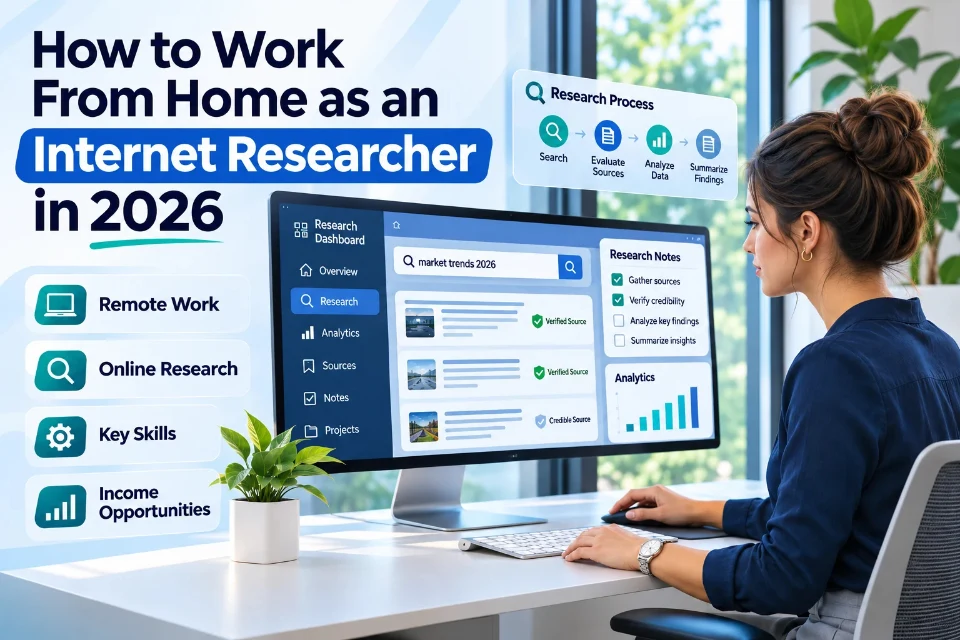
Working from home as an internet researcher is a career option for people who can find reliable information, verify sources, analyze evidence, and present useful findings. In 2026, research work extends beyond traditional web searches to include AI-assisted investigation, market intelligence, digital fact-checking, and data analysis.
Businesses, consulting firms, researchers, and independent clients need information they can trust. Although artificial intelligence can accelerate information gathering, professional researchers remain responsible for evaluating evidence and delivering accurate results.
This guide explains what internet researchers do, the skills they need, where to find remote opportunities, and how to build a professional research career.
What Does an Internet Researcher Do?
An internet researcher collects, evaluates, organizes, and analyzes online information to answer specific questions or support decisions.
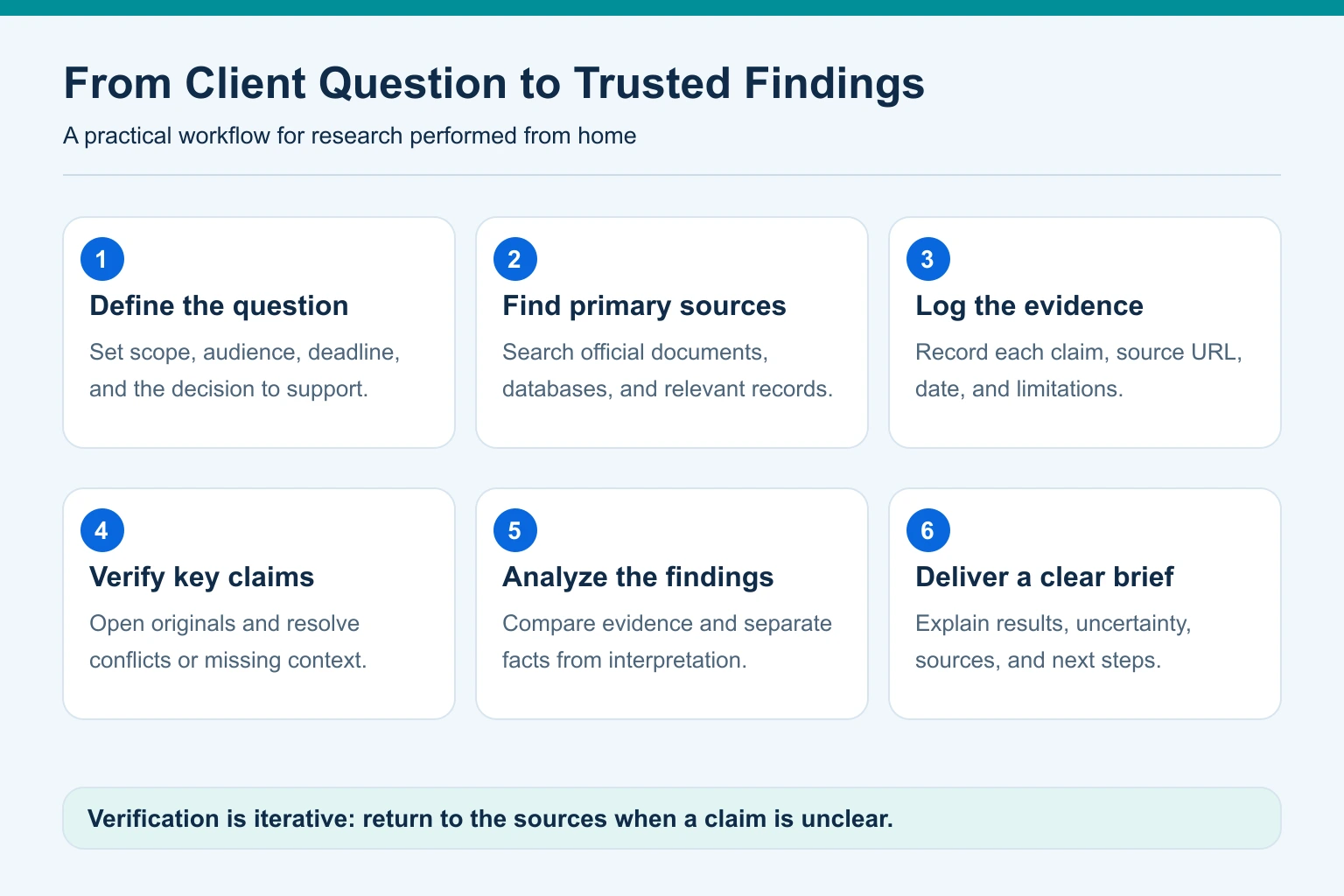
Unlike someone performing a quick Google search, a professional researcher follows a structured process. This includes defining the research question, identifying appropriate sources, checking accuracy, comparing evidence, and documenting findings.
Common responsibilities include:
- Researching companies, competitors, industries, and market trends.
- Finding information in government, academic, and professional databases.
- Verifying facts, statistics, and online claims.
- Collecting and organizing data in spreadsheets.
- Reviewing reports, publications, and public records.
- Preparing research summaries and client reports.
- Using AI tools to assist with research while independently checking results.
For example, a business might hire a remote researcher to investigate competitors’ pricing, identify industry trends, or evaluate potential markets. The researcher’s responsibility is to produce an evidence-based report, not simply a collection of website links.
Can You Work From Home as an Internet Researcher in 2026?
Yes. Many internet research tasks can be completed remotely because the required information, research tools, and communication systems are available online.
Opportunities include freelance assignments, contract projects, research assistance, and eligible remote analyst positions. However, not every job involving research is available from home. Some employers require office attendance, access to restricted databases, or specialized qualifications.
Remote research opportunities generally fall into three categories:
Freelance research: Independent researchers complete projects for businesses, agencies, consultants, and individual clients.
Remote employment: Organizations hire researchers or analysts to collect and interpret information as part of an ongoing role.
Specialized research consulting: Experienced professionals provide expertise in areas such as competitive intelligence, financial research, market analysis, or investigative research.
The best option depends on your skills, experience, location, and preferred working arrangement.
Types of Remote Internet Research Jobs
Internet research skills apply to several occupations, although their qualifications and responsibilities differ.
| Research role | Typical responsibilities | Experience level |
|---|---|---|
| Internet Research Assistant | Online information gathering, source organization, basic reports | Beginner |
| Freelance Internet Researcher | Client research, competitor analysis, information verification | Beginner to intermediate |
| Market Research Analyst | Consumer research, market data analysis, business insights | Often requires a degree |
| Competitive Intelligence Researcher | Competitor monitoring, industry analysis, strategic findings | Intermediate |
| OSINT Research Analyst | Investigation using publicly available information | Specialized training |
| Research Data Specialist | Data collection, cleaning, validation, and organization | Intermediate |
| AI Response Evaluator | Assessing AI outputs for accuracy, relevance, and quality | Requirements vary |
Essential Skills for Professional Internet Researchers
Successful internet research requires more than familiarity with search engines. Employers and clients value researchers who can solve information problems independently.
Advanced Online Search
Researchers should understand:
- Boolean operators and exact-phrase searching.
- Search engine operators such as
site:andfiletype:. - Government, academic, and industry databases.
- Search query development and refinement.
- Specialized search tools.
- Finding primary sources and original documents.
These techniques help researchers locate relevant information efficiently.
Source Verification and Critical Thinking
Not every online source is reliable.
Researchers must evaluate authorship, publication dates, supporting evidence, potential conflicts of interest, and the context in which information appears.
Cross-checking important claims against independent sources reduces the risk of relying on inaccurate or misleading information.
Data Organization and Analysis
Basic spreadsheet skills help researchers organize records, identify patterns, compare findings, and communicate results.
More advanced positions may require statistical analysis, visualization tools, SQL, or programming.
Research Writing and Communication
Clients need clear answers rather than unorganized information.
A useful research report explains the question, methods, key findings, evidence, limitations, and conclusions.
AI Literacy
Modern researchers should understand how AI systems assist with searching, document analysis, data extraction, and synthesis.
Equally important is recognizing AI-generated errors, incomplete citations, and unreliable conclusions.
How to Become an Internet Researcher: Step-by-Step
You can begin developing professional research skills without immediately pursuing a specialized degree. However, many advanced research occupations require formal education or relevant experience.
Step 1: Learn Professional Search Techniques
Start with advanced search operators, structured search queries, and specialized information sources.
Practice finding original reports instead of relying exclusively on summaries.
Step 2: Understand Research Methodology
Learn how to define a research question, select sources, establish evaluation criteria, collect evidence, and document results.
A consistent process makes findings easier to verify.
Step 3: Develop Practical Digital Skills
Build confidence using spreadsheets, online databases, document management tools, and AI research assistants.
Prioritize tools relevant to the research services you intend to offer.
Step 4: Choose a Research Specialization
Beginners may explore business research, competitor research, information verification, or research assistance.
With additional training, researchers can pursue specialized work in market intelligence, data analysis, or OSINT.
Step 5: Build a Research Portfolio
Create two or three independent projects demonstrating your abilities.
For example:
- Competitor analysis: Compare three businesses using documented public information.
- Industry research brief: Investigate a market trend using credible reports and statistics.
- Fact-checking report: Examine several public claims and explain the supporting or conflicting evidence.
Include your research question, methodology, sources, findings, and limitations.
Step 6: Pursue Professional Development
Training in advanced searching, information verification, research methodology, AI, and data analysis can help develop more structured research skills.
Professional certifications may also demonstrate completion of a defined learning program.
Step 7: Apply for Research Projects
Search for roles matching your abilities. Customize each application and include relevant portfolio samples.
Explain what research question you can solve and what deliverable the client will receive.
Professional Training: AOFIRS Certified Internet Research Specialist (CIRS™)
For individuals seeking structured professional development, the Certified Internet Research Specialist (CIRS™) certification offered by the Association of Internet Research Specialists (AOFIRS) provides training and assessment in modern internet research.
The program covers five major subject areas:
- Online Search and Research: Advanced search strategies, Boolean logic, search operators, and precise information retrieval.
- Research Methods and Methodology: Research planning, information evaluation, source reliability, and verification.
- Artificial Intelligence in Online Research: AI-assisted research, prompt engineering, language models, and their limitations.
- Data Analysis and Analytics: Data collection, organization, interpretation, and analytical methods.
- Fundamentals of Internet Law and Ethics: Copyright, privacy, intellectual property, and responsible online research practices.
According to AOFIRS, the certification can be pursued through self-study or instructor-led training, with assessments completed online.
The curriculum is relevant to aspiring researchers, freelancers, research assistants, and professionals seeking to strengthen their digital research capabilities.
CIRS certification is not a universal employment requirement and does not guarantee a job or higher earnings. Its value should be considered alongside practical experience, a strong portfolio, and the requirements of individual employers.
Explore the CIRS certification program for curriculum information and certification requirements.
Where to Find Legitimate Internet Research Jobs
Research opportunities appear under different job titles, making a broad search strategy useful.
Common platforms include:
| Platform | Best used for |
|---|---|
| LinkedIn Jobs | Research assistant, analyst, and employer-posted positions |
| Indeed | Remote and hybrid research employment searches |
| Upwork | Freelance research assignments |
| Freelancer | Project-based research opportunities |
| Guru | Independent research and information-gathering projects |
| FlexJobs | Remote and flexible employment listings |
| Remote.co | Exploring remote employment opportunities |
Availability varies, and listings on these platforms are not guaranteed to include dedicated internet research positions. Try searching for phrases such as remote internet researcher, freelance online researcher, research assistant remote, and competitive intelligence researcher.
How Much Do Internet Researchers Earn?
Internet researcher earnings vary considerably because the term covers different responsibilities, employment arrangements, and skill levels.
There is no single reliable salary benchmark that represents all internet researchers.
For comparison, the US Bureau of Labor Statistics reported a median annual wage of $78,760 for market research analysts in May 2025.
The BLS also projects 7% employment growth for market research analysts from 2025 to 2035.
These figures describe the market research analyst occupation, not entry-level freelance internet researchers. Market research analysts typically need a bachelor’s degree and perform more extensive analytical work.
Freelance researchers may charge hourly or per project. Their earnings depend on project complexity, experience, research specialization, client budgets, and time spent on nonbillable activities.
Before accepting a project, estimate the hours required for research, verification, documentation, and revisions (BLS occupation data).
How AI Is Changing Internet Research Work
Artificial intelligence is changing how researchers discover, organize, and interpret information.
Tools such as ChatGPT, Claude, Gemini, and Perplexity offer capabilities that can assist with research planning, information discovery, document summaries, and evidence organization. Available features differ by service, subscription, and account configuration.
AI can help researchers:
- Break complex assignments into smaller questions.
- Develop alternative search queries.
- Summarize documents.
- Extract information from supplied files.
- Organize research tables.
- Identify possible gaps or conflicting findings.
- Draft reports from verified evidence.
However, AI-generated answers may contain incorrect facts, fabricated citations, or incomplete interpretations.
A professional researcher must open original sources, verify important claims, and document uncertainties before presenting findings to a client.
The most useful approach combines efficient AI assistance with independent human judgment.
For a detailed workflow, read AOFIRS’s AI research workflow.
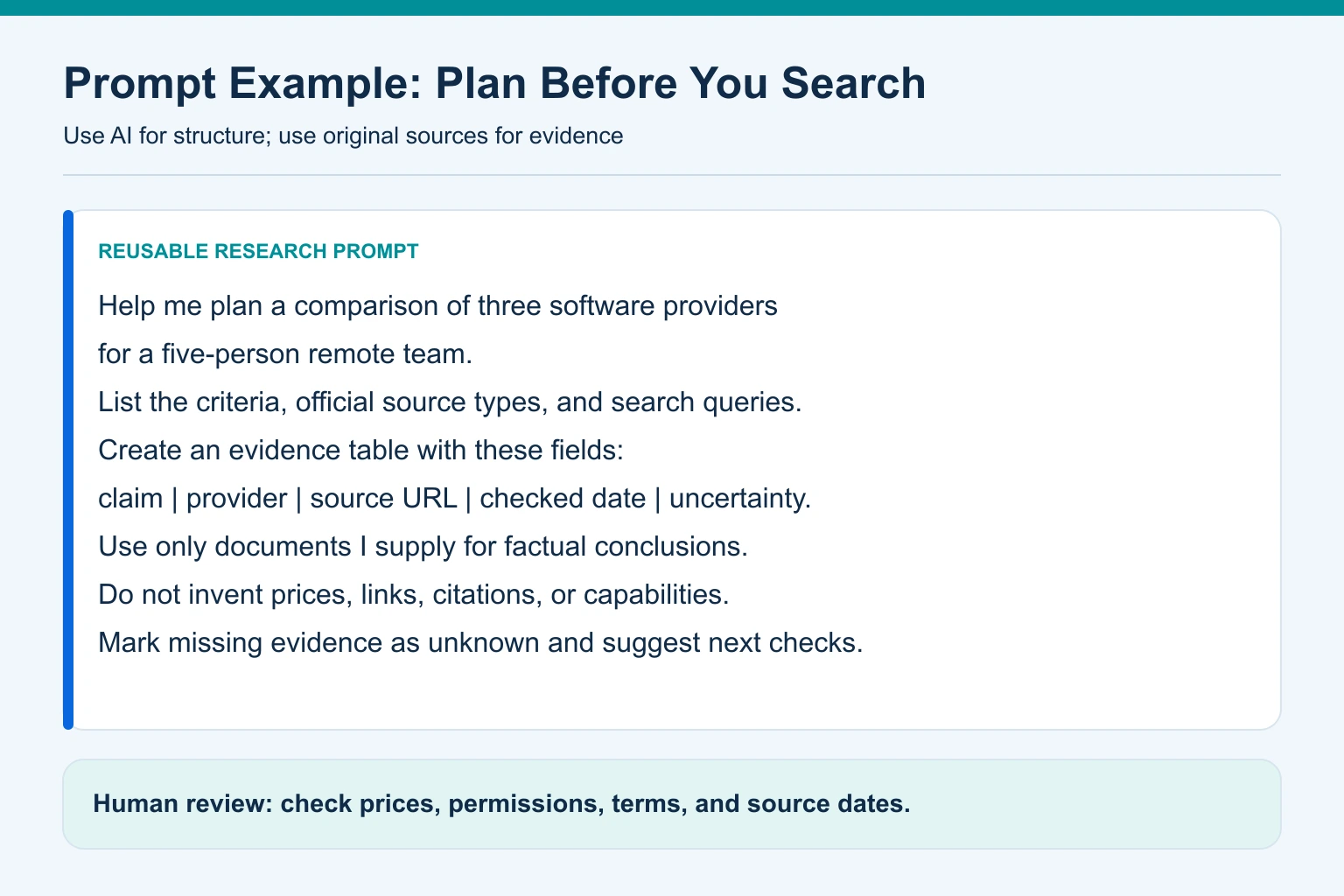
AI Prompt Example: Plan a Research Assignment
Use the following prompt to organize a software-comparison assignment. Replace the team size and criteria with the client’s actual requirements.
Help me plan a comparison of three software providers for a five-person remote team. List the criteria, official source types, and search queries. Create an evidence table containing the claim, provider, source URL, check date, and uncertainty. Use only documents I supply for factual conclusions. Do not invent prices, links, citations, or capabilities. Mark missing evidence as unknown and suggest next checks.
Do not upload confidential client data unless you have the necessary permission and suitable data controls. Review the plan, open the original sources, and verify the findings before delivery.
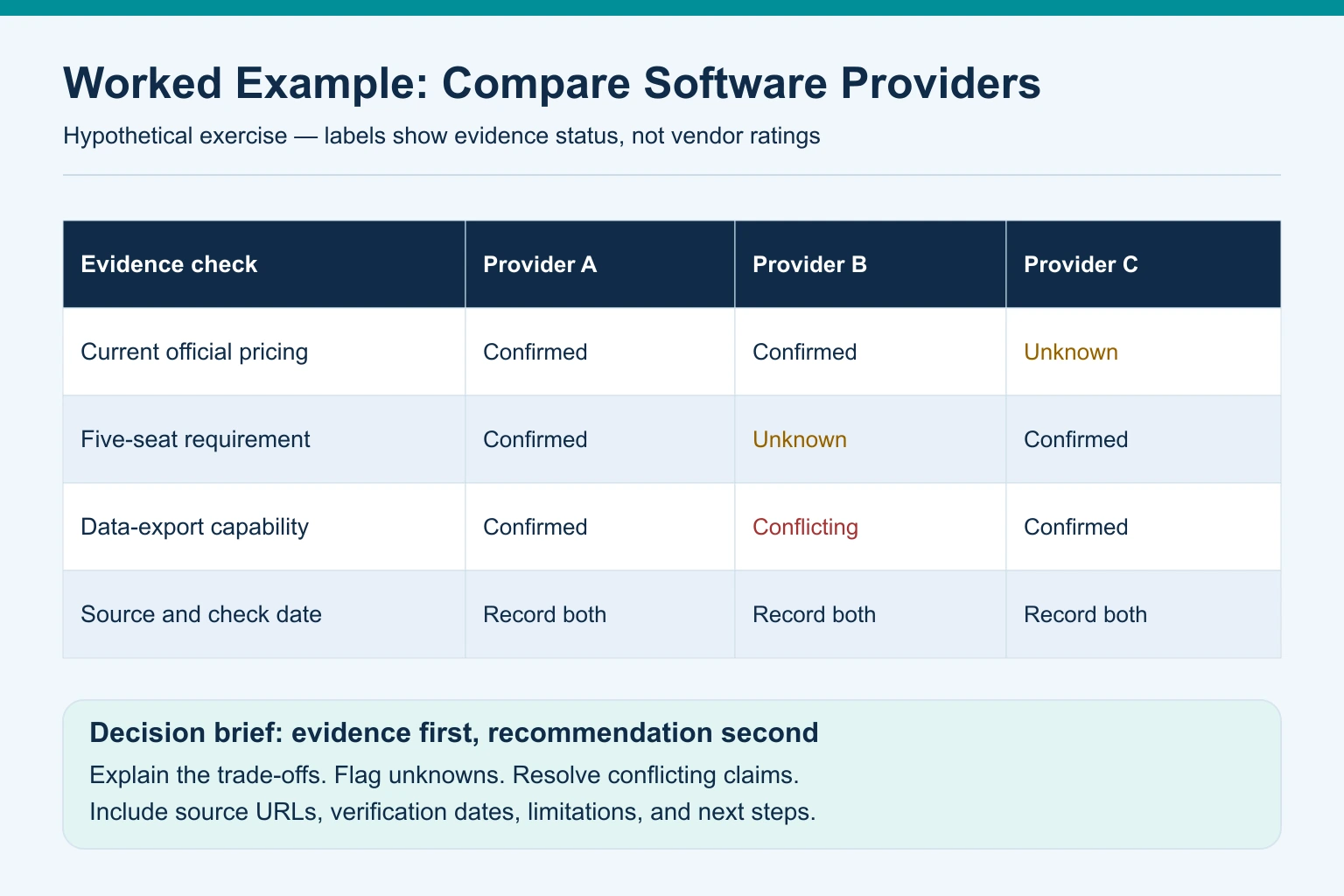
Example: Completing a Research Assignment From Home
Consider a hypothetical client who wants to compare three software providers before choosing a subscription.
A professional researcher could complete the assignment through the following process:
1. Define the question. Identify the features, pricing, security requirements, and support options that matter to the client.
2. Identify sources. Review official product documentation, published terms, technical specifications, and other relevant evidence.
3. Build a comparison table. Record each finding alongside its source and verification date.
4. Use AI selectively. Ask an AI assistant to help organize verified notes or identify missing comparison categories.
5. Verify important claims. Check prices, technical capabilities, and contractual information against original documentation.
6. Prepare the report. Present the main differences, limitations, unresolved questions, and evidence supporting each conclusion.
The deliverable might be a concise decision brief and spreadsheet rather than a lengthy collection of links.
This example illustrates how research quality depends on methodology, not simply the number of sources collected.
How to Avoid Work-From-Home Research Job Scams
Remote job seekers should carefully evaluate employers and project offers.
The Federal Trade Commission warns that fraudulent job advertisements may promise substantial earnings for minimal effort or request payment before employment.
Warning signs include:
- Requests to pay a fee to obtain a job.
- Promises of unusually high earnings without clear responsibilities.
- Unsolicited messages requesting sensitive personal information.
- Requests to deposit checks and transfer money elsewhere.
- Supposed research tasks requiring cryptocurrency payments to unlock earnings.
- Employers whose identity or company details cannot be verified.
Confirm the employer’s identity through official channels and establish written project terms before beginning paid work.
Professional training purchased independently is different from an employer demanding payment as a condition of receiving a supposed job.
Frequently Asked Questions
Can beginners work from home as internet researchers?
Yes. Beginners can pursue suitable research assistant or freelance assignments after developing basic search, verification, organization, and reporting skills. More specialized roles may require additional education or experience.
Do internet researchers need a university degree?
Not every freelance assignment requires a degree. However, occupations such as market research analyst commonly require formal education, and employers may set their own qualification requirements.
Is internet research still a useful skill in the AI era?
Yes. AI can assist with information discovery and analysis, but researchers still need to evaluate sources, assess evidence, recognize errors, and produce accountable findings.
What equipment do remote internet researchers need?
Most basic assignments require a reliable computer, internet connection, browser, spreadsheet software, and document management tools. Specialized projects may require licensed databases or additional software.
Is CIRS certification required to become an internet researcher?
No. The AOFIRS Certified Internet Research Specialist (CIRS™) credential is an optional professional certification. It provides structured learning and assessment in internet research, AI-assisted research, methodology, data analysis, and ethics.
How can I get my first freelance research client?
Begin with a portfolio containing realistic research samples. Apply to projects matching your skills, explain your research process, and propose a clearly defined deliverable.
Final Thoughts: Building a Professional Internet Research Career
Working from home as an internet researcher requires curiosity, discipline, technical competence, and the ability to distinguish reliable evidence from misleading information. In 2026, the strongest foundation combines advanced online searching, structured research methods, AI literacy, data organization, and clear reporting.
Start by mastering the fundamentals, creating practical portfolio projects, and pursuing assignments appropriate to your abilities. As your experience grows, additional training and specialization can help you take on more demanding research work. The goal is not simply to find information faster. It is to deliver research that other people can understand, verify, and use with confidence.