Finding information is no longer the hardest part of student research. The harder task is deciding what deserves to be trusted, cited, and used.
Search engines, academic databases, social platforms, AI assistants, and research agents can now produce useful leads in seconds. They can also return outdated claims, weak summaries, duplicated reporting, fabricated references, or answers that sound more certain than the evidence allows.
This is not a minor change in study habits. In the HEPI Student Generative AI Survey 2026, 95% of 1,054 full-time UK undergraduates surveyed in December 2025 said they used AI in at least one way, and 94% said they used generative AI to help with assessed work. Yet only 48% felt that teaching staff were helping them develop the AI skills needed for their future careers.
The practical lesson is simple: students need more than the ability to search or prompt. They need a repeatable method for framing questions, finding appropriate evidence, checking sources, comparing findings, and documenting how the work was done.
Quick Answer: The Six Skills Students Need
| Skill | Why it matters | Start with this action |
|---|---|---|
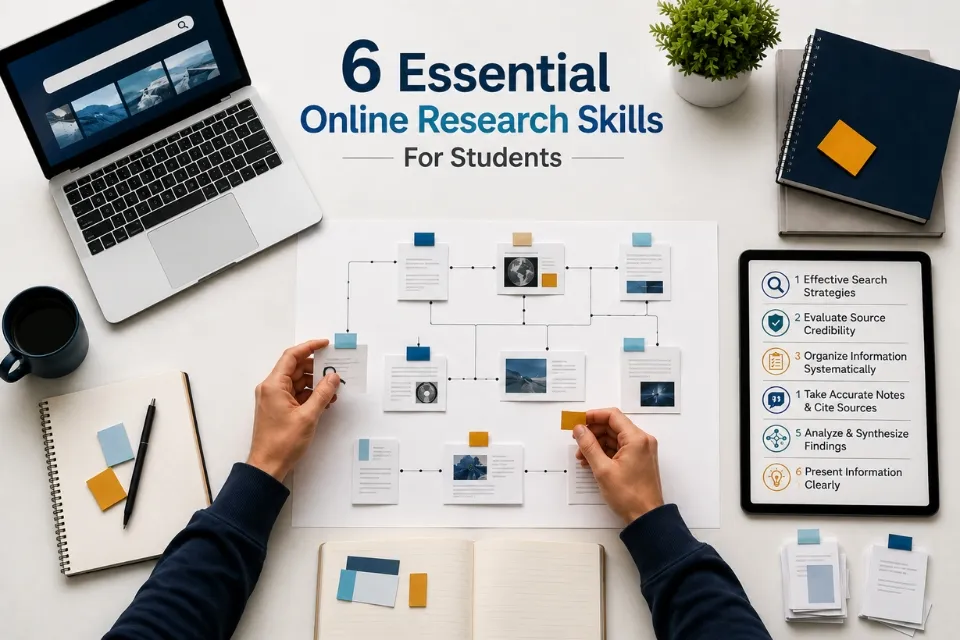
| 1. Research question framing | Prevents a broad topic from becoming an unfocused search | Define the population, issue, location, time period, and outcome |
| 2. Advanced multi-platform searching | Reduces dependence on one ranking system or database | Search at least two complementary discovery systems |
| 3. AI research literacy | Helps students benefit from AI without mistaking generated text for evidence | Ask for a research plan, then verify every important claim yourself |
| 4. Source and claim verification | Tests who is behind information and whether the evidence supports it | Read laterally and trace the claim to its original context |
| 5. Evidence synthesis and critical thinking | Turns collected sources into a defensible conclusion | Compare methods, findings, limitations, and conflicting evidence |
| 6. Citation, ethics, and provenance | Keeps the research traceable, honest, and reproducible | Record source details and permitted AI use as you work |
The key principle: AI may help with discovery and organization, but the student remains responsible for evidence selection, interpretation, citation, and disclosure.
What Are Online Research Skills?
Online research skills are the abilities used to locate, evaluate, verify, organize, interpret, and cite digital information.
They include conventional search techniques, such as keyword planning and database filters, but they now extend much further. A capable student researcher should be able to:
- turn a broad topic into a workable research question;
- choose the right search environment for the task;
- use AI without outsourcing intellectual responsibility;
- distinguish a useful lead from acceptable evidence;
- assess the quality of a study, dataset, article, image, or video;
- trace claims to original sources;
- compare independent evidence and explain uncertainty;
- protect personal, confidential, and copyrighted material;
- cite sources and disclose AI assistance when required.
These skills apply to essays, presentations, literature reviews, market research, fact-checks, data projects, and everyday decisions.
Why Online Research Skills Matter in 2026
AI has made research faster, but speed is not the same as reliability.
The 2026 HEPI survey found that students were divided about AI’s effect on learning. Some described time savings and improved understanding, while others worried about dependence and skill loss. A separate Jisc study of student perceptions, based on discussions with 173 students and analysis of seven surveys covering 1,274 responses, found demand for clearer course-specific rules, practical AI training, fair access, and stronger guidance on misinformation, privacy, bias, and intellectual property.
UNESCO’s AI Competency Framework for Students similarly treats critical judgement, ethics, human agency, and responsible use as core competencies rather than optional extras.
Students therefore face three connected challenges:
- Discovery is fragmented. Useful evidence may sit in search engines, library databases, repositories, government portals, archives, social platforms, or AI-generated reports.
- Authority is harder to see. A polished answer may combine strong evidence, weak commentary, and unsupported inference without clearly separating them.
- Research decisions are increasingly automated. Ranking, summarization, source selection, and query expansion may happen before the student sees the result.
Good research in 2026 means knowing how to use these systems while retaining control of the reasoning.
The Six Essential Online Research Skills
1. Research Question Framing and Search Planning
A vague topic produces vague research. Before opening a search engine or AI assistant, convert the assignment into a focused question.
Suppose the topic is:
Generative AI and university learning
That topic is too broad. A more useful question is:
How does regular use of generative AI affect measured critical-thinking outcomes among first-year university students?
The revised version defines:
- Population: first-year university students
- Intervention or issue: regular use of generative AI
- Outcome: measured critical-thinking performance
- Evidence needed: studies measuring outcomes, not only opinions
Break the question into concepts
Build a short concept map before searching:
| Main concept | Alternatives and related terms |
|---|---|
| Generative AI | GenAI, large language model, LLM, ChatGPT, AI assistant |
| University students | undergraduates, higher education, college students |
| Critical thinking | reasoning, evaluation, analytical skills, learning outcomes |
This produces better searches than typing the full assignment title repeatedly.
Set the scope
Decide what the assignment requires:
- What years should the evidence cover?
- Is the question local, national, or international?
- Does it require scholarly research, official statistics, current reporting, or primary documents?
- Are opinion sources useful, or are measured outcomes required?
- How much evidence can be reviewed within the deadline?
Practical rule: If you cannot describe the evidence needed, the question is not ready for searching.
2. Advanced Search and Multi-Platform Discovery
No single search system covers the entire information environment. Search engines, library databases, academic indexes, social platforms, and AI tools have different collections, ranking rules, access limits, and strengths.
Start broadly, then move into the systems best suited to the claim.
Use precise search techniques
Useful techniques include:
- quotation marks for an exact phrase:
"critical thinking" site:to search a domain:site:who.int adolescent sleepfiletype:to find documents:filetype:pdf annual report- minus signs to remove unwanted meanings:
jaguar speed -car - date, language, publication-type, and subject filters;
- Boolean operators in databases that support them:
AND,OR, andNOT; - title, author, journal, and DOI searches for known works.
Database syntax varies. Check the help page instead of assuming that every operator works the same way everywhere.
Search more than one environment
A sensible discovery sequence might be:
- Use a general search engine or AI assistant to learn terminology.
- Search a university library database or subject database for scholarly evidence.
- Use a scholarly discovery tool to find related papers and citation links.
- Search an official government or institutional source for statistics, laws, policies, or technical documentation.
- Use an archive when the original webpage has changed or disappeared.
Google Scholar searches across articles, theses, books, abstracts, court opinions, repositories, and other scholarly material. Semantic Scholar provides free AI-assisted discovery across a large scholarly index. Neither replaces subject-specific databases or careful source evaluation.
Follow citations in both directions
When you find a useful paper:
- Backward citation searching: examine the sources it cited.
- Forward citation searching: find later works that cited it.
- Related-paper searching: identify work using similar concepts or methods.
This helps locate foundational research, newer criticism, replication attempts, and disagreements that a keyword search may miss.
Keep a search log
A search log makes the process reproducible and prevents repeated work.
| Date | Platform or database | Exact query and filters | Useful results | Notes |
|---|---|---|---|---|
| July. 17, 2026 | Library database | ("generative AI" OR ChatGPT) AND "critical thinking" AND undergraduates |
14 results screened | Two studies measured outcomes; most were perception surveys |
Record unsuccessful searches too. They show how the strategy changed and may be required in formal reviews.
3. AI Research Literacy and Prompting
AI literacy is not simply knowing how to write a detailed prompt. It means understanding what an AI system can contribute, what it cannot establish, and how its output must be checked.
Use AI for the right tasks
AI can be useful for:
- clarifying unfamiliar terminology;
- turning a topic into subquestions;
- suggesting synonyms and search strings;
- identifying possible source types and databases;
- comparing documents the student has already selected;
- organizing notes or building an evidence table;
- generating counterarguments or identifying missing perspectives;
- explaining a difficult passage after the original has been read.
Higher-risk uses include asking AI to generate quotations, references, factual claims, a final literature review, or an argument the student cannot independently explain.
Use a verification-oriented prompt
Instead of:
Research everything about AI and learning.
Try:
Help me plan research on how generative AI affects measured critical-thinking outcomes among university students. Separate background questions from empirical questions. Suggest search terms, relevant source types, and databases. Do not invent citations. Mark any claim that requires verification and identify what evidence would confirm or challenge it.
The stronger prompt defines the task and asks the system to expose uncertainty. It does not make the output trustworthy by itself.
Treat AI reports as maps, not final evidence
Agentic research features can search, compare, and summarize many sources. They may save time during discovery, but students should still:
- open every source supporting a major claim;
- confirm that the source exists;
- locate the exact passage or data supporting the claim;
- check the publication date and version;
- compare independent evidence;
- cite the source actually read, not merely the AI report.
This matters because convincing references can still be wrong. A 2026 study evaluating the free versions of eight chatbots found that only 26.5% of generated bibliographic references were fully correct, while 39.8% were erroneous or fabricated. The authors concluded that none of the systems tested was fully accurate. See the published study, “Assessing the performance of 8 AI chatbots in bibliographic reference retrieval”.
Verification rule: A valid title or DOI proves that a work exists. It does not prove that the work supports the AI-generated statement.
4. Source Evaluation, Claim Verification, and Lateral Reading
Source evaluation asks two different questions:
- Is this source suitable for the task?
- Does its evidence support the specific claim being made?
A reputable publisher can publish a weakly supported claim. A source with a clear viewpoint can still provide useful primary evidence. Judge the source and the claim separately.
Investigate the source
Check:
- Who created or published it?
- What relevant expertise do they have?
- What is the purpose of the page or document?
- Who funded the work?
- Are conflicts of interest disclosed?
- Is the evidence visible and traceable?
- Has the work been corrected, updated, withdrawn, or retracted?
- Is it current enough for the claim?
Do not rely on design quality, follower counts, a verification badge, a familiar domain ending, or a confident writing style.
Read laterally
Lateral reading means leaving the page to investigate the source in other tabs. The Digital Inquiry Group describes it as a strategy used by fact-checkers and skilled internet searchers.
A fast version uses three questions:
- Who is behind the information?
- What is the evidence?
- What do independent sources say?
This is usually more effective than staying on the page and studying its “About” section in isolation.
Trace claims to their original context
Follow links backward until you reach the best available source, such as:
- the original study rather than a news summary;
- the dataset rather than a chart copied into a post;
- the law or court judgment rather than commentary about it;
- the full speech or transcript rather than a short clip;
- the official technical document rather than a marketing claim;
- the earliest identifiable upload of an image or video.
The original source is not automatically the most reliable interpretation, but it lets you see what was actually said, measured, or published.
Evaluate research quality
For empirical research, ask:
- Is the design experimental, observational, qualitative, or a survey?
- Is the sample large and relevant to the population in the claim?
- Were outcomes measured or self-reported?
- Were comparison groups appropriate?
- Are effect sizes and uncertainty reported, not only statistical significance?
- Could correlation be mistaken for causation?
- Were the measures defined before the analysis?
- Do funding or conflicts affect interpretation?
- Is the article a preprint, peer-reviewed publication, review, or commentary?
- Have corrections or retractions appeared since publication?
Crossmark can show corrections, retractions, and other status updates when publishers supply the relevant metadata. Crossref also integrated Retraction Watch data into its API in 2025, making retraction information easier to check. Still, no single database is complete, so inspect the publisher’s page as well.
Verify images and video
For visual evidence:
- Reverse-search the image or extract keyframes from the video.
- Find the earliest credible upload.
- compare captions, dates, landmarks, language, weather, and shadows;
- look for the full recording rather than a cropped clip;
- inspect available metadata and provenance information;
- seek independent reporting from the claimed location or event.
Content Credentials can provide useful provenance information, but the C2PA specification is explicit that valid credentials do not prove that content is true. Credentials can also be absent or removed. Treat them as one signal, not a verdict.
5. Evidence Synthesis, Triangulation, and Critical Thinking
Research is not a contest to collect the largest number of links. It is the process of deciding what the combined evidence supports.
Check source independence
Five articles repeating the same press release are not five independent confirmations. Trace each claim to determine whether the sources rely on:
- the same dataset;
- the same interview;
- the same institutional statement;
- the same wire-service report;
- one original study summarized many times.
Count evidence streams, not webpages.
Compare methods before conclusions
Two credible studies can disagree because they examined different populations, periods, definitions, or outcomes.
Use an evidence table:
| Source | Population and method | Main finding | Strengths | Limitations | Supports which claim? |
|---|---|---|---|---|---|
| Study A | 300 students; controlled comparison | Small improvement in quiz performance | Measured outcome | One course and short duration | Short-term performance may improve |
| Survey B | 2,000 students; self-report | Students report saving time | Broad sample | Does not measure learning | Students perceive efficiency gains |
| Study C | Interview study | Some students report dependence | Rich context | Cannot estimate prevalence | Overreliance may affect study habits |
This prevents a common mistake: treating different kinds of evidence as if they answer the same question.
Handle disagreement honestly
When evidence conflicts:
- check whether the studies asked the same question;
- compare populations, definitions, dates, and methods;
- identify which evidence is more direct and appropriate;
- consider whether both findings can be true under different conditions;
- state what remains uncertain.
The goal is not to force a simple answer. A defensible conclusion may be conditional: “The intervention appears helpful in short, structured tasks, but evidence for long-term learning remains limited.”
Write from the evidence
Do not draft a conclusion first and search only for support. Instead:
- record the claim each source can support;
- note contradictory evidence;
- distinguish findings from interpretation;
- use cautious language when evidence is limited;
- avoid extending a result beyond its population or context.
6. Citation, Research Ethics, AI Disclosure, and Privacy
Good citation practice begins during research, not after the draft is finished.
For every source, save:
- author or responsible organization;
- title;
- publication or publisher;
- publication and update dates;
- DOI or stable URL;
- access date when appropriate;
- page, paragraph, timestamp, table, or section supporting the claim;
- notes on how the source was used.
Reference managers such as Zotero can reduce clerical work, but imported metadata still needs checking.
Follow the assignment’s AI policy
Rules can differ by institution, course, instructor, and assessment. Before using AI, determine:
- whether it is permitted;
- which tasks are allowed;
- whether prompts or outputs must be retained;
- whether the tool must be named;
- how assistance should be acknowledged;
- whether AI-generated text, translation, code, or images are restricted.
If the rules are unclear, ask before submitting. Jisc found that students continued to report uncertainty about permitted use even where institutional guidance existed.
Use a clear disclosure when required
An appropriate statement might be:
I used [tool name] to brainstorm search terms and organize my evidence table. I independently selected and read the sources, verified all claims and citations, and wrote the final analysis. No confidential or personal data was uploaded.
Adapt the wording to the actual work performed and the institution’s rules. Do not claim independent work if AI generated material that was directly used.
Protect data and intellectual property
Do not upload the following to a public AI service unless the institution has approved the tool and the data-handling arrangement:
- personal or sensitive information;
- unpublished research;
- interview transcripts or participant data;
- confidential institutional or workplace documents;
- assessment materials not intended for sharing;
- copyrighted works beyond permitted use;
- credentials, private links, or security information.
Check account settings, retention policies, training controls, institutional agreements, and local law. The UK Department for Education’s 2026 safe-use materials specifically identify data, intellectual property, safeguarding, and ethics as risks that need active controls.
Ethical rule: If you would not post the material publicly or send it to an unknown third party, do not paste it into an unapproved AI tool.
Choose the Right Research Path
Before selecting a tool, answer three questions.
What are you creating?
| Assignment | Evidence to prioritize | Useful starting point |
|---|---|---|
| Short fact-check | Original statement, authoritative records, independent confirmation | General search plus official sources |
| Academic essay | Scholarly books and articles, supported by appropriate primary material | Library databases and Google Scholar |
| Literature review | Reproducible searches, review protocols, multiple scholarly databases | Subject databases and citation searching |
| Current-affairs report | Recent reporting, primary documents, transcripts, official data | News databases, official websites, archives |
| Data project | Dataset documentation, definitions, methodology, version history | Statistical agencies and data repositories |
| Visual investigation | Earliest upload, context, reverse search, independent reporting | Reverse-image search, archives, provenance tools |
What kind of evidence does the claim require?
- A legal claim requires the law, regulation, case, or official guidance.
- A medical claim requires appropriate clinical or public-health evidence.
- A claim about attitudes may be supported by a well-designed survey.
- A causal claim needs stronger evidence than a correlation.
- A historical interpretation may require primary records plus scholarly analysis.
- A product feature should be checked against current official documentation.
Is AI permitted, and what role should it play?
Use AI only within the assignment’s rules. Decide whether it will support brainstorming, discovery, document analysis, organization, or editing. Record that decision before starting so the boundary does not shift unnoticed during the work.
Useful Research Tool Categories in 2026
The best tool depends on the task. These examples are starting points, not endorsements, and features or access can change.
| Research need | Tool category | Examples | What still requires checking | Manual verification needed |
|---|---|---|---|---|
| Learn terminology and generate leads | General search or AI assistant | Google, Bing, ChatGPT, Gemini, Claude, Perplexity | Claims, dates, omissions, and source quality | ★★★★★ |
| Find scholarly literature | Library or scholarly search | University databases, Google Scholar, Semantic Scholar, PubMed | Coverage, study type, relevance, and access | ★★★★☆ |
| Search literature with AI assistance | Academic AI discovery | Elicit, Consensus, Scite | Whether summaries and citation contexts match the papers | ★★★★★ |
| Verify a publication record | Metadata and status services | Crossref, DOI resolver, Crossmark | Correct version, corrections, retractions, and claim support | ★★★☆☆ |
| Find official statistics | Government and institutional portals | National statistics agencies, ministries, international organizations | Definitions, methodology, release date, and revisions | ★★★☆☆ |
| Organize sources | Reference manager | Zotero | Imported metadata, duplicates, and citation style | ★★☆☆☆ |
| Recover changed webpages | Web archive | Internet Archive Wayback Machine | Capture date, missing media, and whether the archived page is complete | ★★★★☆ |
| Check visual context | Image, video, and provenance tools | Reverse-image search, keyframe search, Content Credentials | Original source, chronology, location, edits, and independent confirmation | ★★★★★ |
How to read the stars: More yellow stars mean more independent checking is normally required. They rate verification effort, not overall tool quality.
For paywalled research, first check your library’s subscriptions, “all versions” links in scholarly search, institutional repositories, author manuscripts, open-access tools, or interlibrary loan. Do not assume an abstract contains enough detail to support a methodological claim.
A Practical Research Workflow
Use one workflow from beginning to end:
- Define the question. State the population, issue, outcome, geography, and period where relevant.
- Identify the evidence needed. Decide whether the claim requires scholarship, statistics, primary documents, reporting, or a combination.
- Build a concept map. List synonyms, related terms, exclusions, and likely source types.
- Search across complementary systems. Use at least two environments with different coverage.
- Screen results. Review titles, abstracts, dates, authorship, publication type, and relevance.
- Open and evaluate the sources. Do not rely on snippets or generated summaries.
- Trace high-value claims. Move toward original studies, datasets, laws, records, or documentation.
- Compare and synthesize. Record methods, findings, limitations, independence, and disagreement.
- Organize citations and disclose AI use. Preserve the research trail while working.
- Write only what the evidence supports. State uncertainty and limits explicitly.
Practical Example: Researching AI and Student Learning
Suppose the assignment asks:
Does generative AI improve student learning?
The question is too broad because “learning” could mean satisfaction, speed, grades, recall, critical thinking, or long-term retention.
A stronger question is:
How does structured use of generative AI affect measured critical-thinking outcomes among undergraduate students?
The student could then:
- search for
("generative AI" OR ChatGPT) AND "critical thinking" AND undergraduate*; - search at least one library database and one broader scholarly index;
- separate experiments from surveys and opinion pieces;
- distinguish measured learning from students’ perceptions of learning;
- follow citations to earlier and later studies;
- record contradictory findings in an evidence table;
- check whether the results apply beyond one institution, subject, or short intervention;
- write a conditional conclusion rather than a universal claim.
A responsible conclusion might say:
Current evidence suggests that structured AI support may improve performance on some short-term tasks, but findings vary by study design, subject, and type of AI use. Self-reported time savings should not be treated as proof of deeper learning, and evidence about long-term critical-thinking development remains incomplete.
That conclusion is useful because it explains both what the evidence supports and what it cannot yet establish.
Final Research Checklist
Before submitting, ask:
- Is the research question specific and answerable?
- Did I use the right source types for each claim?
- Did I search more than one discovery environment?
- Have I opened every source I cite?
- Does each source support the exact sentence attached to it?
- Have I distinguished measured evidence from opinion or self-report?
- Did I check source independence?
- Did I investigate conflicting evidence?
- Did I check dates, versions, corrections, and retractions?
- Did I verify AI-generated facts, quotations, and references?
- Did I protect personal, confidential, and copyrighted material?
- Can another person reproduce my important searches?
- Are citations complete and accurate?
- Did I follow the assignment’s AI policy and disclose assistance where required?
- Can I explain and defend every conclusion in my own words?
If several answers are “no,” the research is not finished.
Conclusion
The defining research skill of 2026 is not getting an AI system to produce an answer. It is knowing how to test that answer, locate better evidence, and decide what the evidence genuinely supports.
Students who can frame precise questions, search across appropriate systems, use AI critically, verify claims, compare evidence, and document their work are better prepared for both academic study and professional research.
AI can accelerate discovery. It cannot accept responsibility for the conclusion.
Frequently Asked Questions
What are the six essential online research skills for students?
The six essential skills are research-question framing, advanced multi-platform searching, AI research literacy, source and claim verification, evidence synthesis, and responsible citation and research ethics.
Can students use ChatGPT or other AI tools for academic research?
Yes, if the institution, course, and assignment permit it. AI can help with terminology, planning, search terms, source discovery, comparison, and organization, but students should verify important claims and cite the underlying sources they actually read.
Is an AI-generated answer a source?
An AI answer is usually better treated as a lead or synthesis than as authoritative evidence. Use it to identify questions and possible sources, then verify the claim against appropriate primary, scholarly, or official evidence.
How should students verify an AI-generated citation?
Search the exact title, author, journal, and DOI in a scholarly database or Crossref. Then open the work and confirm that the relevant passage supports the claim. Existence and relevance are separate checks.
What is lateral reading?
Lateral reading means leaving a webpage to investigate its publisher, author, evidence, reputation, and claims through independent sources. It is more reliable than judging a page only by its appearance or what it says about itself.
Can TikTok, Reddit, YouTube, or other social platforms be used for research?
They can be useful for discovery, firsthand perspectives, terminology, demonstrations, or locating a claim. For academic or factual use, trace important information to the original context and support it with evidence appropriate to the assignment.
Does peer review guarantee that a study is correct?
No. Peer review is a quality-control process, not a guarantee. Students should still examine the study design, sample, measures, limitations, conflicts of interest, corrections, retractions, and later research.
Do Content Credentials prove that an image or video is true?
No. Content Credentials may help establish provenance and editing history, but they do not prove that the depicted event or claim is true. They should be combined with contextual verification and independent evidence.