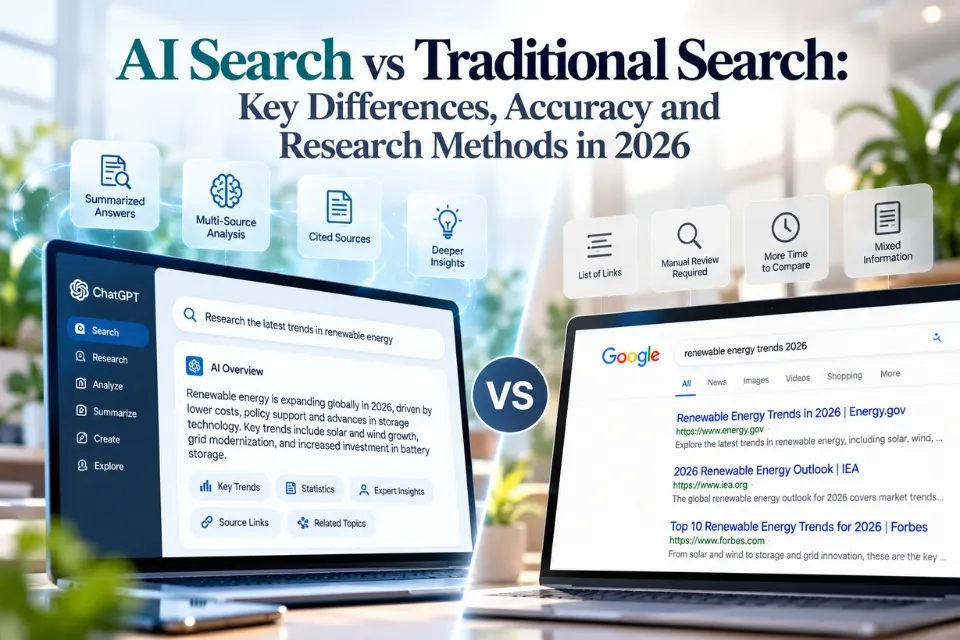

The traditional keyword search that dominated the internet for decades is officially dead. Today, information specialists, data analysts, and professional researchers are moving fast, relying on large language models (LLMs) like OpenAI’s ChatGPT, Anthropic’s Claude, and Google’s Gemini to cut through massive mountains of data. These conversational engines have completely supercharged literature reviews, data aggregation, and document synthesis.
However, using generative AI for high-stakes research presents a frustrating paradox: these models possess incredible processing speed, but they don’t actually understand objective truth. Because LLMs run on probabilistic text generation essentially predicting the next most likely word they are notoriously prone to “hallucinations.” They can fabricate facts, historical dates, statistics, and citations with absolute linguistic confidence. For information specialists whose entire professional reputation relies on flawless accuracy, trusting raw AI outputs is a massive liability.
To bypass these systemic flaws, researchers must master prompt engineering the precise science of structuring inputs to enforce strict constraints, logical rigor, and absolute traceability. This article delivers practical, field-tested prompt frameworks designed to kill hallucinations, force primary source citation, and extract clean, actionable data arrays from the world’s leading AI engines.
1. The Core Architecture of a Research Prompt
A common mistake among casual users is treating an LLM like an advanced Google search bar, typing in short, open-ended questions. For professional research, you have to treat a prompt like a structured piece of code.
A bulletproof research prompt always consists of four essential pillars:
The Advanced Prompt Matrix
| Matrix Element | Function |
| 1. Role Definition | Establishes expert persona |
| 2. Context & Task | Outlines boundaries & objectives |
| 3. Constraints | Eliminates guessing/hallucination |
| 4. Output Format | Dictates data array / Markdown |
By explicitly defining each of these pillars, you immediately box in the model’s creative freedom, forcing it to work inside a rigid, predictable framework optimized for factual accuracy.
2. Frameworks to Eliminate Hallucinations
The most effective way to stop an AI from making things up is to give it a logical “escape hatch.” By default, an LLM will almost always try to answer your question, even if its training data or search index doesn’t have the proof. You have to explicitly give the model permission to say, “I don’t know.”
The Negative Constraint Framework
When querying ChatGPT or Gemini for historical details or real-time data, bake strict negative boundaries right into the prompt. This forces the model to stop guessing.
System Prompt Layout:
“Act as an elite legal and historical archivist. Analyze the following query: [Insert Query]. You must adhere to this absolute constraint: If you lack verifiable, primary-source documentation for any claim, date, or statistic, you must state ‘Data unverified in source material’ rather than estimating or extrapolating. Do not attempt to smooth over data gaps with plausible narrative text.”
Chain-of-Thought (CoT) Auditing
Before an AI spits out its final answer, force it to show its work. By making the model break down its reasoning step-by-step before delivering a conclusion, you can easily read through the logic and spot exactly where a false premise tried to sneak in.
Operational Prompt:
“Evaluate the market consolidation patterns of the renewable energy sector between 2022 and 2026. Before providing your final summary, write out a chronological step-by-step log of the regulatory changes and acquisitions you are analyzing. Only after this logical breakdown is complete may you synthesize your final conclusion.”
3. Enforcing Primary Source Citation and Traceability
An unreferenced claim is completely useless in professional research. When extracting information, your prompts need to turn the AI into a literal indexer rather than a creative writer.
The Verification-Gate Framework
Different models handle citations differently. For example, Google’s Gemini leverages its live search index via Retrieval-Augmented Generation (RAG), whereas Claude AI excels at analyzing massive uploaded documents (like 500-page PDFs) with incredible contextual memory.
To maximize these strengths, use a prompt that builds a strict verification gate:
[User Query] ──> AI Searches/Parses Text ──> Matches to Specific Anchor Text ──> Outputs Factual Claim with Inline URL/Page CitationUniversal Citation Prompt:
“Extract the core findings regarding carbon capture efficiency from the provided text/live web. For every single factual claim, statistic, or quote you present, you must insert an explicit, inline citation linking directly to the source URL or specific page number (e.g., [Page 42] or [Source Link]). If an assertion cannot be directly mapped back to a specific sentence in the reference material, omit the claim entirely from your output.”
4. Extracting Clean Data Arrays and Schemas
Information specialists rarely need long, rambling paragraphs of text. Usually, the goal is to clean up messy data, pull out specific metrics, or build a structured database. To do this, you must command the AI to output information in clean data arrays (like Markdown tables or JSON blocks) while completely stripping away conversational fluff.
The Zero-Fluff Data Extraction Framework
This framework completely strips the AI of its conversational persona, stopping it from writing introductions (“Sure, I can help with that!”) or conclusions.
Data Array Prompt:
“Act as a programmatic data extraction pipeline. Parse the following corporate earnings reports and extract all mentions of capital expenditure. Your output must be formatted exclusively as a Markdown table using the exact columns specified below. Do not include any conversational introductions, post-text summaries, or explanatory remarks. Output only the raw table data.
Columns:
| Quarter & Year | Company Name | Reported CapEx (USD) | Primary Strategic Initiative Mentioned | Source Document Page Ref |”
Multi-Model Benchmarking Matrix
To verify highly complex data points, enter the exact same structured prompt across ChatGPT, Claude, and Gemini. If all three models extract identical data arrays, the likelihood of a localized machine error drops significantly. If they diverge, you can instantly pinpoint the discrepancy for a quick manual review:
| Data Variable | ChatGPT Output | Claude AI Output | Gemini AI Output | Human Audit Action |
| Metric Extraction | $4.2B | $4.2B | $4.5B | Flagged: Manual verification required for Gemini’s source. |
| Chronological Date | Oct 12, 2024 | Oct 12, 2024 | Oct 12, 2024 | Passed consensus. |
| Citation URL | Matches Portal A | Matches Portal A | Matches Portal B | Flagged: Audit Portal B for data variations. |
5. Tailoring Prompts to Specific AI Architectures
To get elite results, your prompt engineering needs to adapt to the unique architectural strengths of the specific AI tool you are using:
OpenAI ChatGPT (Advanced Voice & Code Interpreter)
- Strengths: Exceptional at running real-time Python scripts to audit numbers, parse complex file formats, and execute heavy mathematical calculations on raw datasets.
- Prompting Tip: Instruct the model to write and execute code to verify its own answers. Example: “Write a Python script to verify the statistical variance in the attached CSV file before listing the final metrics in your table.”
Anthropic Claude (Long-Context Window & Analytical Nuance)
- Strengths: Phenomenal reading comprehension, massive context windows, and highly articulate, neutral reasoning over massive document sets.
- Prompting Tip: Use structured XML tags (<source_text>, <instructions>, <constraints>) to separate your prompt elements. Claude responds beautifully to clean, visual boundaries.
Google Gemini (Deep Web Integration & RAG Engine)
- Strengths: Direct integration into Google’s live, global search engine index, making it the absolute premier tool for breaking, real-time web data tracking.
- Prompting Tip: Explicitly command Gemini to cross-reference multiple top-tier live search results and actively look for conflicting coverage across independent news or academic domains.
Conclusion: The Expert in the Loop
Prompt engineering isn’t about typing clever phrases into a chatbox; it’s about establishing systematic, rigorous control over probabilistic machines. By transforming your inputs into structured frameworks enforcing negative constraints, mandating strict source traceability, and demanding clean data arrays you effectively turn ChatGPT, Claude, and Gemini from unpredictable text generators into high-precision research engines.
Ultimately, these tools are built to optimize your workflows, not to replace your judgment. The defining hallmark of a professional information specialist remains a dedicated, highly skeptical human-in-the-loop. By employing advanced prompt engineering, you can safely exploit the immense speed and synthesizing power of generative AI while maintaining the flawless, bulletproof accuracy required by professional research standards.