
The proliferation of digital media has fundamentally transformed the way information travels. What once required editorial boards, printing presses, and distribution networks can now be accomplished by a single individual with a smartphone and a social media account. While this democratization of information has undeniable benefits, it has simultaneously opened the floodgates to fake news, manipulated video, biased reporting, and coordinated disinformation campaigns that spread with alarming speed.
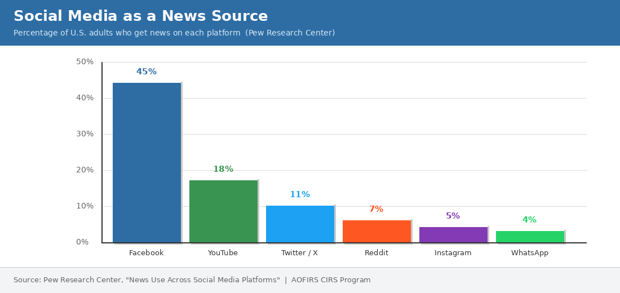
According to a landmark Pew Research Center survey, 62% of U.S. adults get news on social media, with 18% doing so frequently (Pew Research Center, 2017). Facebook alone reaches approximately 45% of the U.S. adult population as a news source, while YouTube, Twitter, Reddit, and WhatsApp each play significant roles. This staggering reach makes the integrity of social media news not just a media question, but a civic one.
This article draws on research from the AOFIRS Certified Internet Research Specialist (CIRS) program and integrates the latest findings from 2025–2026 to equip readers with practical, evidence-based strategies for detecting news bias and identifying fake news — including increasingly sophisticated AI-generated deepfakes.
Section 1: Understanding News Bias
What Is News Bias?
Media bias refers to the perceived or actual slant in the reporting of news, influenced by political affiliations, economic pressures, and social or cultural influences. Unlike outright falsehoods, selection and framing bias can subtly mislead readers, making these forms particularly difficult for traditional fact-checking tools to detect. Research published at the 2025 CHI Conference on Human Factors in Computing Systems confirms that experimental evidence shows it is remarkably easy to mislead a reader without making any explicitly false statements.
Because factually accurate but biased news tends to be consumed by far larger populations than categorically fake news, its potential societal impact may actually be greater. Understanding the taxonomy of media bias is therefore a critical first step in becoming a more informed news consumer.
Six Types of News Bias

- Confirmation Bias: Occurs when news outlets selectively report stories that align with their ideological stance. This reinforces existing beliefs and can polarize public opinion. A news channel might focus on stories that support its political leaning while ignoring opposing viewpoints.
- Omission Bias: Happens when certain facts or viewpoints are deliberately left out of news coverage, creating an incomplete or skewed representation. The story may be technically accurate, yet deeply misleading through what it does not say.
- Framing Bias: Involves presenting information in a way that influences its interpretation. Research has shown that labeling choices such as “rioters” vs. “protesters” or “illegal” vs. “undocumented” immigrants systematically reflect ideological positioning.
- Source Selection Bias: Journalists and editors choose which experts to quote and which perspectives to amplify. Consistently selecting sources from one ideological perspective creates a skewed information environment even when quotes are accurate.
- Sensationalism Bias: The tendency to exaggerate or dramatize news events to attract audiences. Sensational headlines may accurately reflect a fact but present it in a way that distorts its significance or context.
- Echo Chambers & Filter Bubbles: Social media algorithms amplify like-minded content, hiding alternative perspectives and creating a falsely homogeneous information diet that reinforces existing beliefs.
How to Detect News Bias: Practical Strategies
- Compare coverage of the same story across outlets with different known political leanings (AllSides.com shows left/center/right perspectives side-by-side).
- Identify emotionally charged language. Words designed to provoke strong emotional reactions are often signals of editorial bias rather than neutral reporting.
- Ask what is missing. Bias frequently reveals itself through omission. Who was not quoted? What facts were left out? What context was ignored?
- Check the headline against the article body. Misleading headlines often overstate or misrepresent the content of the story itself.
- Examine the choice and range of expert sources. A genuinely balanced piece will seek voices from multiple perspectives.
- Be aware of your own confirmation bias. We tend to view news that aligns with our beliefs as balanced and news that challenges them as biased.
Use Media Bias/Fact Check (mediabiasfactcheck.com) to look up the documented bias rating and factual reporting history of any outlet.
🔍 AP STYLE NOTE: Attribution of Research Data
When referencing research or survey data, AP Style requires that the source be named and attribution be clear:
“According to a 2025 Pew Research Center survey…” (not “a survey found…”)
“Researchers at the 2025 CHI Conference reported…” (not “Studies show…”)
Avoid vague attribution such as “experts say” or “sources report” without naming them specifically.
Section 2: The Fake News Ecosystem
Social Media as the Primary Vector
Fake news has become an integral part of the social media landscape, spreading like wildfire across platforms via mobile devices. Research from Barracuda Labs examining 2,884 active Facebook accounts found notable differences between authentic and fake accounts: 97% of fake profiles use women’s names, fake profiles averaged 726 friends compared to 130 for authentic profiles, and 43% of fake profiles had no status updates versus 15% for real accounts (Barracude Labs, 2026).
Categories of False Information
- Misinformation — False or inaccurate information shared without deliberate intent to deceive.
- Disinformation — Deliberately false information created and distributed with the intent to deceive and cause harm.
- Malinformation — Genuine information used out of context or weaponized to cause harm.
- Manipulated Content — Genuine information or imagery manipulated to deceive (includes deepfakes and altered video).
Red Flags: Warning Signs of Fake News
- Shocking or emotionally provocative headlines that seem designed to outrage rather than inform.
- The story is only being covered by one unfamiliar outlet and not confirmed by established news organizations.
- No author byline, or the author name returns no credible journalism history when searched.
- The website URL mimics a legitimate news brand (e.g., ABCnews.com.co instead of ABCnews.com).
- The article is undated or uses old dates to make historical events appear current and urgent.
- Quotes from public figures that cannot be verified through any other reliable source.
- Images that reverse image search reveals are from different events, countries, or time periods.
- Exaggerated or excessive use of ALL CAPS and exclamation points in headlines or body text.
Section 3: The Deepfake Crisis
What Are Deepfakes?
A deepfake is fabricated media typically video, audio, or images created using artificial intelligence that can portray individuals as saying or doing things they never actually said or did. The technology relies on Generative Adversarial Networks (GANs) and increasingly on diffusion models and transformer architectures, all of which have made synthetic content dramatically more convincing and harder to detect.
The Scale of the Threat: Key 2025–2026 Data
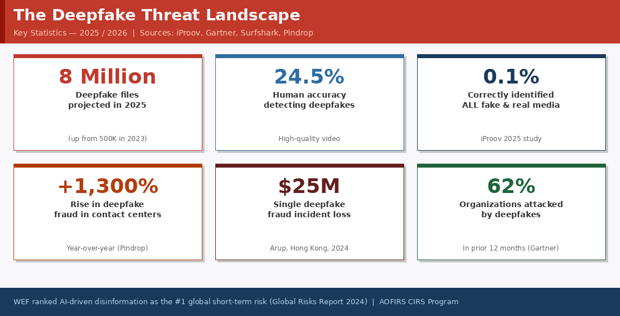
| Deepfake Metric | Data Point (2025–2026) |
|---|---|
| Total deepfake files shared online | Est. 8 million (up from 500K in 2023) |
| Human accuracy detecting high-quality video deepfakes | Only 24.5% |
| Participants who correctly identified ALL fake & real media | Just 0.1% (iProov, 2025) |
| Average detection accuracy across 56 studies | 55.54% — barely above chance |
| Organizations that experienced a deepfake attack | 62% in prior 12 months (Gartner) |
| Growth in deepfake fraud attempts in contact centers | +1,300% year-over-year (Pindrop) |
| Single largest deepfake fraud incident | US $25 million — Arup, Hong Kong, 2024 |
The World Economic Forum ranked AI-driven misinformation and disinformation as the most severe short-term global risk in its 2024 Global Risks Report. The UNESCO report “Deepfakes and the Crisis of Knowing” notes that our response must go beyond technical detection; these synthetic media challenge the very epistemological foundation of how humans establish truth and knowledge.
Key Deepfake Production Technologies
Image & Video Manipulation
Nvidia researchers demonstrated an Image Translation AI using Generative Adversarial Networks (GANs) capable of changing day to night, winter to summer, and house cats to cheetahs with minimal training data (Nvidia Research, 2017). University of Washington researchers created a neural network that takes audio files, converts them into realistic mouth movements, and grafts those onto existing video, requiring just 17 hours of training footage. The “Face2Face” system can make a public figure’s facial expressions mimic a live actor in real time. CycleGAN technology enables video image-to-image translation without paired training examples.
Voice Cloning & Audio Manipulation
Adobe’s VoCo technology ingests approximately 20 minutes of voice data, breaks it into phonemes, and creates a voice model of the speaker, allowing users to edit transcripts and hear entirely new sentences spoken in that voice (Arstechnica, 2026). Lyrebird AI allows anyone to create a digital voice clone with just one minute of audio sample. Combined with face-swapping and lip-sync technology, these tools can produce seemingly authentic video of public figures saying things that never happened (The Verge, 2017).
Types of Video Tampering
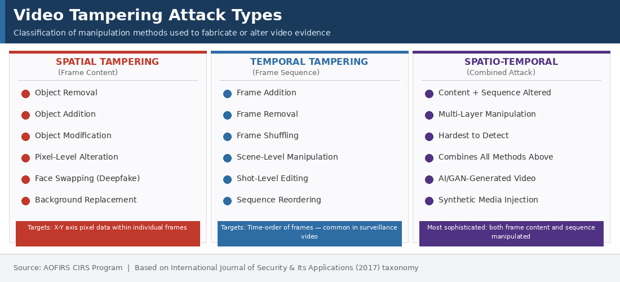
Spatial Tampering — Malicious alterations to the content of video frames (X-Y axis), including object removal, addition, modification, face-swapping, and pixel-level manipulation.
Temporal Tampering — Manipulation of the sequence or timing of frames. Includes frame addition, removal, and shuffling. Commonly used against surveillance footage.
Spatio-Temporal Tampering — The most sophisticated combination: both frame sequence and visual content are simultaneously altered. This is the hardest form to detect forensically.
How to Detect Deepfakes: Warning Signs
- Unnatural blinking or eye movement, particularly at the edges of the face.
- Mismatched lighting between the face and the surrounding environment.
- Blurry or inconsistent borders around the hair and facial perimeter.
- Unnatural skin tone or smoothness inconsistent with the person’s age or the scene lighting.
- Audio that does not perfectly synchronize with lip movements.
- Background elements that appear warped or “glitching,” especially during motion.
- Frame-wise unrealistic trajectories: if motion lacks constant vertical acceleration and horizontal velocity, the video may be tampered.
- Use the YouTube Frame-by-Frame extension (< and > keys while paused) to inspect individual frames for tampering artifacts.
- Examine video metadata: recording format, date/time stamp, GPS data, and bitrate can all help authenticate source recordings.
Section 4: Video & News Authentication Methods
The SIFT Method
S — Stop. Pause before sharing. Resist the impulse to share based on emotional reaction.
I — Investigate the Source. Use lateral reading — open other tabs to see what others say about the source before reading the article.
F — Find Better Coverage. If the original source is unknown or poor, find a better source covering the same claim.
T — Trace Claims, Quotes & Media. Trace images, quotes, and claims to their original context using reverse image search and video thumbnail tools.
Social Media Source Verification Checklist
- Check the account creation date, post history, and engagement patterns for inconsistencies.
- Establish whether the person reporting lives in the location they claim, with genuine connections there.
- Review previous posts and group affiliations for patterns of political, religious, or ideological bias.
- Verify geo-location against the claimed video location using mapping tools and satellite imagery.
- Verify upload time and date using the Amnesty International YouTube Data Viewer (citizenevidence.amnestyusa.org).
- Look for sudden spikes in video views paired with low comments/likes — a hallmark of purchased fake views.
Video Authentication Techniques
Source Verification: Establish the identity and credentials of the videographer or journalist who captured the footage.
Device Metadata Analysis: Examine operational metadata (format, GPS, frame rate, bitrate, date/time) and match it to the claimed recording device. Proprietary device formats (e.g., iPhone-specific) are harder to forge.
Corroborative Evidence: Cross-reference against maps, satellite imagery, historical weather data, local news, and eyewitness interviews.
Digital Signature Verification: Cryptographic signatures embedded in video files can confirm no tampering has occurred after recording. Systems like the Johns Hopkins APL authenticator generate unique per-frame signatures for video, audio, and control data.
Watermarking: Digital watermarks embedded in video frames are modified when content is tampered, allowing authentication systems to detect and localize manipulation.
⚠️ CRITICAL THINKING REMINDER
A correct earlier verification does not authorize future trust. Each piece of content must be independently evaluated.
A source that was reliable in the past should still be evaluated in the present. Trust is earned continuously, not permanently granted.
— Julie Posetti, Reuters Institute for the Study of Journalism
Section 5: Tools for Detection & Verification
Fact-Checking Platforms
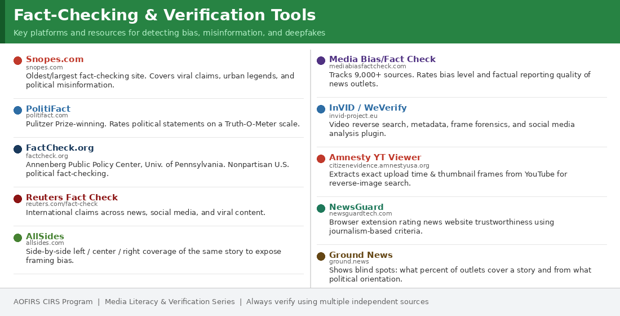
- Snopes (snopes.com): Oldest and largest fact-checking site. Covers viral claims, urban legends, and political misinformation.
- PolitiFact (politifact.com): Pulitzer Prize-winning, Poynter Institute-owned. Rates political statements on a “Truth-O-Meter” scale.
- FactCheck.org: Annenberg Public Policy Center, Univ. of Pennsylvania. Nonpartisan and nonprofit, focused on U.S. political claims.
- Reuters Fact Check (reuters.com/fact-check): International claims across news, social media, and viral content.
- AllSides (allsides.com): Presents the same news story as covered by left, center, and right-leaning outlets side-by-side.
- Media Bias/Fact Check (mediabiasfactcheck.com): Tracks 9,000+ sources worldwide, rating bias level and factual reporting quality. A go-to tool as of 2025.
- AFP Fact Check (factcheck.afp.com): Global fact-checking from Agence France-Presse, covering claims in multiple languages and dozens of countries.
- NewsGuard (newsguardtech.com): Browser extension that uses journalism-based ratings to flag the trustworthiness of news websites in real time.
- Ground News (ground.news): Shows what percentage of outlets are covering a story and from what political orientation, revealing blind spots in your news diet.
Video & Image Verification Tools
- InVID / WeVerify (invid-project.eu): Browser plugin providing reverse video search, thumbnail analysis, metadata extraction, and frame-level forensic inspection.
- Amnesty International YouTube Data Viewer (citizenevidence.amnestyusa.org): Extracts the exact upload time and thumbnail frames from YouTube for reverse-image search.
- TinEye Reverse Image Search (tineye.com): Searches billions of images to identify whether a photo has appeared previously in different contexts.
- Google Reverse Image Search: Available through Google Images. Upload or paste a URL to check origin and prior usage of any image.
- VidIQ (vidiq.com): Chrome extension revealing why YouTube videos are promoted and detailed analytics about video performance.
- YouTube Frame-by-Frame: Use comma (<) and period (>) keys while a paused YouTube video plays to advance one frame at a time for visual inspection.
Section 6: Step-by-Step Verification Workflow
Verifying a News Article
- Check the source: What outlet published this? Look it up on Media Bias/Fact Check or NewsGuard.
- Check the date: Is this current or is an old story being recirculated as news?
- Read beyond the headline: Does the article body support what the headline actually claims?
- Check the author: Does this person exist? Do they have a credible journalism history?
- Cross-reference: Are other established outlets reporting the same story?
- Verify quotes: Can the attributed quotes be found in other reliable sources?
- Check your emotional reaction: Strong outrage or disbelief is precisely when you should be most skeptical.
Verifying a Social Media Video
- Extract upload date and time using the Amnesty International YouTube Data Viewer.
- Run video thumbnails through Google Reverse Image Search to check prior usage.
- Install and run InVID / WeVerify on the video for comprehensive forensic analysis.
- Check the metadata: recording device, format, frame rate, and GPS coordinates.
- Analyze the account history: creation date, posting patterns, and engagement consistency.
- Check engagement ratios: sudden view spikes with low likes/comments signal purchased fake views.
- Cross-reference the location using satellite imagery, historical weather records, and local reporting.
- Conduct frame-by-frame visual inspection for anomalies: lighting, blurring, and unnatural motion.
- Use InVID’s advanced video forensic filters for professional-level technical analysis.
Section 7: Legal Considerations for Video Evidence
As video manipulation technology becomes more accessible, traditional standards for admissibility of video evidence in legal proceedings are being challenged. Courts are increasingly scrutinizing video evidence and may exclude it entirely if even a hint of falsification exists.
According to legal authority Jordan Gruber, foundational requirements for video evidence include: materiality; relevance to a material issue; competency and qualifications of the foundational witness; accuracy and authenticity of the representation; continuous chain of custody; confirmation by a photographic expert that the video was not altered; and disclosure of all editing performed.
As the ability to manipulate audio-visual evidence continues to advance, it is likely that future video evidence may be categorically excluded if the slightest suggestion of falsification exists, underscoring the urgent need for authenticated and provenance-tracked recording practices from the moment of capture.
Conclusion
The information landscape of 2025 and 2026 is defined by extraordinary complexity: AI-generated deepfakes indistinguishable to the naked eye, algorithmically amplified bias in mainstream media, coordinated disinformation campaigns at industrial scale, and a social media ecosystem that rewards speed over accuracy. In this environment, media literacy is not a luxury — it is a survival skill.
The tools and strategies outlined in this article form a practical toolkit for any internet researcher, journalist, educator, or digital citizen. No single method is sufficient; effective verification demands a layered approach combining critical thinking, source investigation, technical analysis, and cross-referencing across multiple platforms.
Above all, cultivating what Reuters Institute researcher Julie Posetti calls a “trust network” — a community of reliable sources, colleagues, and fact-checkers who can serve as sounding boards for contentious information, remains among the most powerful defenses against the manipulation of reality in the digital age.
AP Style Quick Reference
| Guideline | Details |
|---|---|
| ATTRIBUTION | Always name sources. “According to a 2025 Pew Research Center survey…” not “a survey found…” |
| NUMERALS | Spell out one through nine; use figures for 10 and above. Always use figures with percentages (62%, not sixty-two percent). |
| CAPITALIZATION | “fake news” is lowercase unless starting a sentence. “Deepfake” is one word, lowercase. |
| TITLES | Capitalize formal titles before names (Research Analyst Jane Smith), not after. |
| WEBSITES | Capitalize the proper name (Snopes, PolitiFact). Do not include “www.” unless needed for clarity. |
| DATES | Month, day, year format (June 20, 2026). Abbreviate months with six or more letters. |
| ABBREVIATIONS | Spell out full name on first reference, then abbreviation in parentheses: Association of Internet Research Specialists (AOFIRS). |
| ACCURACY | Every claim must be attributable and verifiable. When in doubt, leave it out. |