The architecture of media bias is not merely a collection of overt partisan leanings or deliberate fabrications; it is a structured, multidimensional system of narrative engineering. Through deliberate information selection, linguistic and visual framing, syntactic agency assignment, and placement hierarchy, news organizations shape public perception while operating under commercial pressures, deadline constraints, and algorithmic distribution incentives.
For researchers, intelligence analysts, and critical media consumers, decoding modern news requires moving beyond partisan accusations of “fake news” to deconstruct the systematic editorial mechanisms that govern how events are transformed into published reality.

Figure 1: CIRS™ Advanced Media Intelligence Framework — The Architecture of Media Bias (15-Slide Interactive Deck)
Learn more: For a quick-glance view, see the companion infographic on The Architecture of Media Bias: How News is Framed, read our in-depth research report on Online News Search & Verification, and consult our intelligence guide on The AI Trust Illusion: Automated Systems and Cognitive Bias.
Beyond “Fake News”: The Structural Drivers of News Selection
Public discourse frequently conflates media bias with outright falsification. However, outright fabrication represents only a fraction of informational distortion. Far more pervasive are structural biases baked directly into news production systems:
- Commercial & Attention Economics: Modern digital publications rely on programmatic advertising and social traffic. Engagement algorithms systematically reward headlines triggering high-arousal emotions (anger, moral indignation, tribal validation) over measured context.
- The Inverted Pyramid Under Deadline Pressure: Wire reporters face relentless 24-hour publishing cadences, forcing reliance on pre-packaged public relations releases, institutional briefings, and standardized narrative templates.
- Gatekeeping & Access Journalism: When access to high-level officials depends on cordial relationships, journalists face implicit pressure to adopt official terminology and avoid challenging foundational assumptions.
- The Production of “Pseudo-Events”: As historian Daniel Boorstin noted, much modern news does not occur spontaneously; it is manufactured through press conferences, orchestrated leaks, staged demonstrations, and policy summits designed specifically to be reported.
The Three Operational Layers of Editorial Influence
Every news story passes through three distinct filters before reaching an audience. Analyzing news through these layers allows investigators to isolate deliberate editorial slant from objective event reporting.
Layer 1: Information Control
Selection & Gatekeeping:
- Commission Bias: Selecting which specific events, statistics, or sources are deemed newsworthy.
- Omission Bias: Systematically ignoring counter-narrative developments, historical precedents, or conflicting data.
- Source Authority: Elevating anonymous “officials” or partisan think tanks while ignoring grassroots witnesses.
Layer 2: Linguistic & Visual Framing
Perceptual Priming:
- Linguistic Agency: Shifting responsibility through active versus passive sentence constructions.
- Loaded Terminology: Employing emotive adjectives (“reckless,” “historic,” “draconian”) to steer moral judgments.
- Visual Hierarchy: Curating photographic angles, facial expressions, and cropping to evoke sympathy or contempt.
Layer 3: Structural Hierarchy & Placement
Architectural Prominence:
- Positioning: Leading homepages or prime-time broadcasts versus burying articles deep in specialized sections.
- Headline Divergence: Writing sensationalized headers that contradict nuanced caveats in lower paragraphs.
- Temporal Timing: Releasing damaging findings late on Friday afternoon (“the document dump”) to minimize pickup.
Linguistic Manipulation: Syntactic Agency and Word Choice
Language is never neutral. The grammatical structure of a sentence determines who is perceived as an active participant and who is perceived as a passive recipient of action.
Syntactic Agency and Responsibility Laundering
Consider how identical real-world events can be linguistically reframed through grammatical voice:
- Active Agency: “Company Executives Dumped $50 Million in Stock Before Bankruptcy.” Here, the executives are explicitly accountable for intentional action.
- Passive Voice: “$50 Million in Stock Was Sold Prior to Restructuring.” Agency is erased; the transaction appears as an inevitable, anonymous market phenomenon.
- Nominalization: “Corporate Restructuring Led to Fund Realignment.” Verbs are transformed into abstract nouns, stripping human actors of moral or legal responsibility.
Euphemism versus Dysphemism
Newsrooms frequently select terminology that carries implicit value judgments. In conflict reporting, combatants are labeled “freedom fighters,” “rebels,” “insurgents,” or “terrorists” depending on geopolitical alignment. In domestic policy, identical fiscal measures are described as “tax relief” (framing taxes as an affliction) or “underfunding public services” (framing cuts as systemic deprivation).
Visual Framing: The Semiotics of News Imagery
Visual elements bypass rational cognitive defenses and communicate directly with intuitive perception. Photo editors exercise enormous narrative power through image curation:
Camera Angle & Power Dynamics
A low-angle shot forces the viewer to look upward, conferring authority, dominance, or intimidation upon the subject. Conversely, an extreme high-angle shot looking downward diminishes the subject, rendering them vulnerable, isolated, or diminished.
Lighting, Saturation & Expression
Subjects aligned with editorial policy are depicted in natural, warm, balanced lighting with confident, smiling expressions. Adversaries or controversial figures are frequently captured mid-grimace, under harsh overhead fluorescent shadows, or desaturated to create sinister visual undertones.
A photograph of a protest can be cropped tightly around a single burning wastebasket to depict a city in violent insurrection, or zoomed out to reveal two dozen tranquil observers on a wide, orderly street. Always verify full-field footage before accepting still-frame visual narratives.
Watch: The AB Reality Split in Media
Watch this masterclass exploring how parallel media ecosystems construct completely divergent versions of consensus reality through framing, selective omission, and echo-chamber amplification:
Case Studies: Media Architecture in Action
Examining historical and modern case studies illustrates how structural bias operates in practice:
The 1960 U-2 Incident: Official Sourcing Traps
When an American U-2 reconnaissance aircraft was downed over Soviet airspace in 1960, NASA and the State Department released an official cover story claiming a civilian weather research aircraft had drifted off course after the pilot reported oxygen difficulties. Major American newspapers printed the official release as verified fact. Only when Premier Nikita Khrushchev produced the living pilot, Francis Gary Powers, along with intact surveillance equipment, was the narrative shattered. The case remains a textbook example of access dependence blinding press scrutiny.
Economic Metric Triangulation
When the Bureau of Labor Statistics publishes monthly jobs reports, partisan outlets construct inverted realities from identical raw data. One publication leads with: “Economy Adds 250,000 Jobs in Robust Display of Resilience,” focusing entirely on headline payroll expansion. Simultaneously, an opposing outlet headlines: “Labor Participation Stagnates as Full-Time Positions Plummet,” focusing exclusively on household survey details. Neither headline is factually untrue, yet each constructs an irreconcilable macroeconomic impression.
The 6-Point Media Literacy Diagnostic Protocol
To systematically evaluate any news publication, professional researchers apply the following diagnostic matrix:
| Dimension | Diagnostic Question | Red Flag Indicator | Verification Technique |
|---|---|---|---|
| 1. Sourcing | Are empirical claims attributed to primary documents or anonymous sources? | Pervasive reliance on “officials familiar with the matter” with no named witnesses. | Lateral reading; search for primary docket filings, transcripts, or data releases. |
| 2. Headline Integrity | Does the headline reflect the body text or distort its primary caveats? | Sensational assertion disproven or heavily walk-backed in paragraphs 6–8. | Read the full article first; verify whether evidence supports headline claims. |
| 3. Linguistic Agency | Who is grammatically assigned active responsibility for outcomes? | Passive voice shielding institutional actors (“errors were made”). | |
| 4. Visual Framing | Does photography flatter or vilify subjects relative to baseline portraits? | Mid-blink grimaces, high-contrast shadows, or extreme low-angle intimidation. | Reverse image search to inspect the full uncropped wire photograph sequence. |
| 5. Placement & Timing | Where is critical contextual nuance positioned in the layout? | Exculpatory evidence buried at the bottom; news dumped late Friday. | Check paragraph depth of opposing perspectives and exact timestamp of publish. |
| 6. Omission & Scope | What crucial statistical baselines or historical precedents are missing? | Absolute numbers presented without per-capita rates or multi-year trend baselines. | Cross-reference raw tables in national statistical portals or global repositories. |
Advance Your Media Intelligence Capabilities with CIRS™
Certified Internet Research Specialists (CIRS™) are trained in information verification, narrative deconstruction, open-source intelligence (OSINT), and deep-web investigative research methodologies.
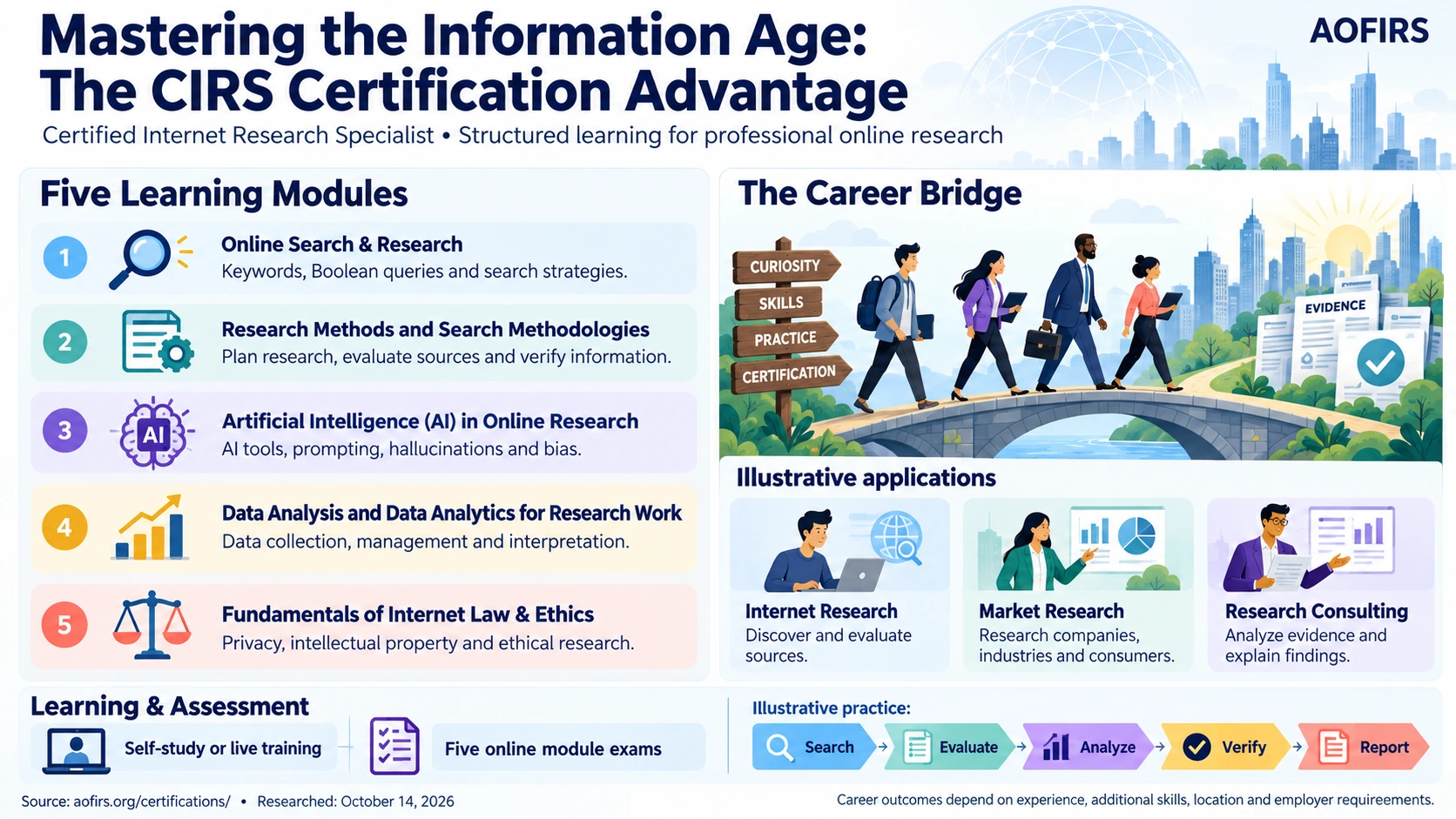
Explore complete curriculum details in our syllabus overview: The CIRS™ Certification Advantage.
Professional Research Resources
AOFIRS maintains an open directory of professional research tools, investigative guides, and technical intelligence papers:
- AI Research Tools — Curated directories of intelligent search systems, scraping utilities, and analytical platforms.
- Research Reports — Comprehensive white papers and technical threat assessments on emerging investigation trends.
- Research Papers — Peer-reviewed studies on information verification, prompt engineering, and OSINT methodologies.
- Webinars & Videos — Technical lectures, case breakdowns, and step-by-step investigative walkthroughs.
Frequently Asked Questions
Can a media organization be 100% factually accurate yet deeply biased?
Yes. Factual accuracy pertains only to whether individual assertions are true. Bias operates through selective omission, unequal emphasis, framing, and placement. An outlet can publish ten completely accurate negative stories about one political figure while deliberately ignoring ten equally accurate positive accomplishments, creating profound bias without uttering a single factual falsehood.
How does algorithmic curation amplify editorial bias?
Social media and search ranking algorithms prioritize user retention, click-through rates, and social shares. Empirical studies demonstrate that content eliciting high-arousal moral outrage spreads up to six times faster than neutral, balanced analysis. Consequently, editors and automated distribution systems iteratively calibrate headlines and story framing to feed engagement metrics.
What is the difference between editorial bias and corporate ownership bias?
Editorial bias refers to the operational perspectives, cultural assumptions, and professional conventions of working journalists and newsroom editors. Corporate ownership bias arises from the financial interests, advertising dependencies, and political lobbying goals of media conglomerates and proprietors, which set editorial boundaries regarding what topics are investigated or suppressed.
How can researchers effectively counteract personal confirmation bias when reading news?
Professional investigators employ the principle of “lateral reading” (evaluating external consensus and documentation before reading the primary piece) and deliberately seek out the strongest opposing arguments (steel-manning). Additionally, applying structured analytic techniques such as the Analysis of Competing Hypotheses (ACH) prevents prematurely anchoring on intuitive conclusions.