International money laundering and foreign asset concealment siphon between $800 billion and $2 trillion annually (2% to 5% of global GDP), according to the United Nations Office on Drugs and Crime (UNODC). Illicit actors exploit fragmented cross-border jurisdictions, nominee corporate veils, discretionary offshore trusts, trade misinvoicing, and pseudonymous cryptocurrency rails to disguise the criminal origin of capital.
Modern forensic investigation counters these tactics not through guesswork, but through systematic multi-jurisdiction entity resolution, beneficial ownership verification, corporate reverse engineering, and blockchain forensics.
Figure 1: CIRS™ Advanced Financial Intelligence Training Framework — Global Money Laundering Architecture & Foreign Asset Tracing (15-Slide Interactive Deck)
Learn more: For a quick-glance view, see the companion infographic on Tracing the Shadow Economy: Global Money Laundering & Detection, explore our comprehensive technical report on International Money Laundering Schemes & Foreign Assets Detection, and read our intelligence analysis on AI vs. The Hidden Web: What Automated Systems Can’t Reach.
The Macro Threat: Scale, Scope, and Global Impact
The scale of illicit financial flows poses systemic risks to financial market integrity, sovereign taxation bases, and geopolitical security. Financial action task force (FATF) evaluations repeatedly show that illicit proceeds originate across three major predicate offenses:
- Organized Crime & Narcotics Trafficking: Generates massive physical cash volumes requiring rapid domestic or cross-border integration.
- Grand Corruption & Kleptocracy: State resources embezzled by Politically Exposed Persons (PEPs), diverted into offshore wealth structures.
- Transnational Fraud & Tax Evasion: Complex corporate invoice manipulation, investment scams, and undeclared offshore bank accounts.
While retail compliance programs focus heavily on routine customer due diligence (CDD), sophisticated syndicates deliberately structure transactions to bypass traditional automated banking filters.
The Foundational Cycle: Placement, Layering, and Integration
Every money laundering operation moves through three distinct operational phases. Understanding how each stage functions enables investigators to identify critical vulnerability points where illicit trails become visible.
Stage 1: Placement
Objective: Introducing illicit cash into the legitimate financial system.
Primary Typologies:
- Structuring (“Smurfing”): Breaking cash into deposits below statutory reporting thresholds ($10,000 / €10,000).
- Cash-Intensive Businesses: Blending illicit proceeds with legitimate retail revenues.
- Physical Bulk Cash Smuggling: Transporting banknotes across borders into lax border zones.
Stage 2: Layering
Objective: Concealing the audit trail through convoluted financial transactions.
Primary Typologies:
- Offshore Wire Transfers: Churning funds across multiple jurisdictions with bank secrecy.
- Fictitious Loan Agreements: Creating sham intra-company loan arrangements between shells.
- Conversion of Assets: Buying bearer shares, precious gems, bonds, or high-value crypto.
Stage 3: Integration
Objective: Reintroducing laundered wealth into the mainstream economy as legitimate capital.
Primary Typologies:
- Commercial & Luxury Real Estate: Purchasing luxury estates through anonymous holding entities.
- Venture Investments: Injecting clean capital as equity or seed debt into operating enterprises.
- Luxury Goods & Fine Art: Acquiring private aircraft, superyachts, or high-end collectibles.
Bypassing the Formal Banking Perimeter
Advanced financial syndicates increasingly avoid domestic banking systems altogether through two primary non-bank mechanisms:
- Trade-Based Money Laundering (TBML): The exploitation of international commercial trade transactions to justify value transfers. Tactics include over-invoicing (charging above-market rates to transfer wealth out), under-invoicing, double invoicing, and phantom shipping (generating customs paperwork and letters of credit for goods that never exist).
- Informal Value Transfer Systems (IVTS / Hawala / Fei Chien): Trust-based ledger systems operating without physical currency movement across borders. A broker in Dubai accepts funds from a client, while a corresponding broker in London distributes equivalent local currency, balancing their net positions through commercial trade invoices or secondary settlements.
The Architecture of Concealment: Shell Companies and Offshore Havens
When bad actors seek to insulate illicit fortunes from judicial discovery and forfeiture, they build layered legal structures designed to frustrate civil asset recovery, court subpoenas, and law enforcement requests.
Key Legal Components of Concealment:
- Shell Companies & Special Purpose Vehicles (SPVs): Corporate entities that possess no physical office, employees, or legitimate commercial operations, existing exclusively on paper to hold bank accounts and real property.
- Nominee Directors and Shareholders: Professional “straw persons” who sign incorporation documents, corporate minutes, and bank mandates in exchange for an annual retainer, masking the true Ultimate Beneficial Owner (UBO).
- Bearer Shares: Negotiable equity certificates conferring ownership to whoever physically holds the paper certificate. While heavily restricted worldwide under FATF Recommendation 24, grandfathered structures and private unregistered bearer-equity variants remain a vulnerability.
Offshore Trust Typologies & Asset Protection Features
Asset Protection Trusts (APTs) established in specialized offshore financial centres provide statutory firewalls against foreign court judgments and creditor claims:
| Trust Type | Control Structure | Creditor Protection | Investigative Challenge |
|---|---|---|---|
| Revocable Trust | Settlor retains power to alter or revoke the deed. | Low (courts can compel settlor to revoke). | High correlation with direct settlor control. |
| Irrevocable Discretionary Trust | Trustee possesses sole discretion over distributions; settlor cedes title. | Extremely High (settlor has no legal property rights). | Must prove trust is a “sham” or uncover secret “Letter of Wishes”. |
| Fixed Trust | Beneficiaries hold predetermined, fixed rights to capital/income. | Moderate (creditors can attach beneficiary interests). | Beneficiary rights are legally attachable upon identification. |
| Cook Islands / Nevis APT | Foreign judgments non-recognized; statutory 1–2 year limitation periods. | Maximum (requires re-litigating locally with criminal proof burden). | Prohibitive local litigation costs; high security bonds required. |
| Hybrid / Protector Trust | Trust protector holds veto power over trustee decisions and appointments. | High, unless protector is proved to be an agent of the settlor. | Tracing the protector’s identity and communication records. |
In offshore asset protection trust deeds, a flee clause (also called an involuntary change of situs provision) automatically terminates the existing trustee, relocates governing law, and transfers all trust assets to a new jurisdiction the moment an investigation, court subpoena, or foreign charging order is detected. For financial investigators, uncovering a flee clause establishes conscious intent to evade judicial attachment.
Watch: Corporate Fraud & Legal Investigation Series
Watch this in-depth masterclass on piercing the corporate veil, forensic entity deconstruction, and reverse engineering fraudulent offshore structures:
The Four Primary Laundering Blueprints
Financial intelligence analysis identifies four recurring operational blueprints used across international laundering and corrupt asset dissipation schemes:
Blueprint 1: Corporate Vehicles & Multi-Tier Trusts
Illicit actors establish operating shell companies in tier-one financial centres (such as the UK, Delaware, or Singapore), owned by intermediate holding entities in secrecy jurisdictions (BVI, Cayman, Belize), which are in turn held by discretionary offshore trusts in the Cook Islands or Liechtenstein. This nesting forces investigators to seek mutual legal assistance treaties (MLATs) across three or four disparate legal systems simultaneously.
Blueprint 2: Intermediaries & Family Networks
To insulate PEPs from direct asset holding, legal title is registered under children, distant relatives, or trusted associates. A classic precedent is the Bo Xilai and Gu Kailai case, where a luxury villa in Cannes, France was held via a French real estate company (SCI), owned by a Luxembourg entity, funded by a Chinese businessman, and managed successively by foreign trusted facilitators, entirely obscuring the political family on corporate registers.
Blueprint 3: Professional Facilitators & Enablers
Modern laundering operations cannot function without specialized gatekeepers: corporate service providers (CSPs), notary publics, offshore banking specialists, and boutique law firms. These enablers draft formation deeds, maintain client trust accounts (IOLTA/escrow), provide virtual office addresses, and supply compliant paperwork to satisfy bank compliance queries.
Blueprint 4: Fund Splitting & Conduit Hops
Launderers fragment single large balances into dozens of non-round wires dispatched across unrelated intermediary bank accounts over several weeks. By interspersing legitimate business payments with fraudulent conduits, the funds blend into aggregate clearinghouse traffic before reconverging in private wealth management accounts.
Emerging Vectors: Crypto Peel Chains and Professional Networks
While traditional offshore jurisdictions remain fundamental, criminal syndicates have modernized their tactics around digital assets and specialized B2B criminal services:
- Cryptocurrency Peel Chains: Chainalysis reports indicate that while illicit cryptocurrency volume surpassed $40.9 billion, bad actors rarely move large balances in single transfers. Instead, they execute automated “peel chains,” where a wallet sends a small amount to an exchange or mixer while returning the balance to a newly generated address, peeling off value hundreds of times in minutes. Furthermore, over 63% of illicit transaction volume has migrated from volatile Bitcoin to stablecoins (USDT/USDC) due to dollar-pegged price stability and instantaneous high-liquidity cross-border settlement.
- Professional Money Laundering Networks (PMLNs): Organized crime has largely outsourced laundering to dedicated criminal business service providers. Networks such as Chinese underground banking brokers operate parallel liquidity pools, swapping drug cash in North America and Europe with trade capital needed by importers in Asia, eliminating the need to move physical funds across international boundaries.
The Four-Step Forensic Investigator Playbook
To pierce corporate veils and trace hidden foreign assets, forensic investigators deploy a four-phase methodology:
- Phase 1: Entity Resolution & Corporate Registry Deconstruction: Retrieve certified articles of association, shareholder filings, registered agent records, and annual accounts from national registries (e.g., UK Companies House, Singapore ACRA, Luxembourg RCS, Delaware Division of Corporations). Check for common nominee service providers and identical registered office addresses.
- Phase 2: Global Leaks & Offshore Database Cross-Referencing: Interrogate structured leak repositories—including the ICIJ Offshore Leaks Database encompassing more than 810,000 offshore entities across Panama Papers, Pandora Papers, Paradise Papers, and FinCEN Files—to map concealed intermediary relationships and beneficial owners.
- Phase 3: Real Property & Asset Tracing: Search land registries, cadastral filings, municipal tax records, yacht and private aviation databases (e.g., FAA aircraft registry, MarineTraffic, Equasis) to correlate corporate vehicle ownership with real-world physical assets.
- Phase 4: Open Source Intelligence (OSINT) & Human Inquiry: Correlate digital footprints, corporate press releases, social media connections of PEP associates, bankruptcy filings, and court litigation records to prove actual control and secure freezing orders.
Advance Your Forensic Capabilities with CIRS™
Certified Internet Research Specialists (CIRS™) are trained to master corporate intelligence, deep web investigative protocols, financial tracing, and forensic verification across global public and private record systems.
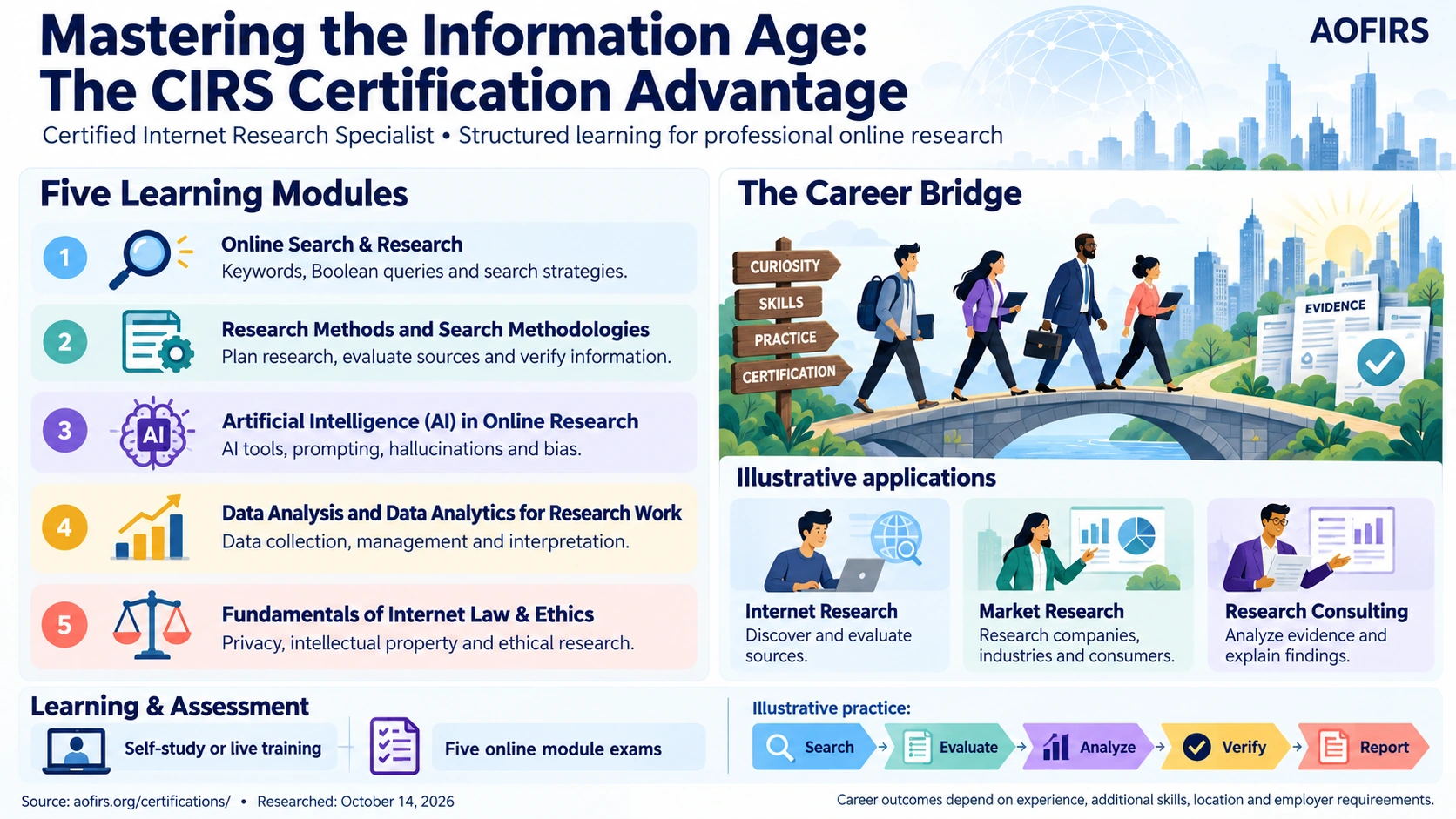
Explore complete curriculum details in our syllabus overview: The CIRS™ Certification Advantage.
Professional Research Resources
AOFIRS maintains an open directory of professional research tools, investigative guides, and technical intelligence papers:
- AI Research Tools — Curated directories of intelligent search systems, scraping utilities, and analytical platforms.
- Research Reports — Comprehensive white papers and technical threat assessments on emerging investigation trends.
- Research Papers — Peer-reviewed studies on information verification, prompt engineering, and OSINT methodologies.
- Webinars & Videos — Technical lectures, case breakdowns, and step-by-step investigative walkthroughs.
Frequently Asked Questions
What is the legal difference between tax avoidance, tax evasion, and money laundering?
Tax avoidance is the legal arrangement of financial affairs using statutory loopholes to minimize tax liabilities. Tax evasion is the intentional, illegal non-payment or underreporting of taxes owed, which is a criminal offense. Money laundering is the active disguise of illicitly gained proceeds (whether originating from tax fraud, corruption, narcotics, or sanctions violations) to make them appear legitimate within the financial system.
How do investigators pierce nominee director structures?
Investigators pierce nominee director veils by cross-referencing corporate registry filings, identifying mass incorporation addresses, examining bank account authorized signatories, subpoenaing registered agent correspondence, and locating the Ultimate Beneficial Owner (UBO) via shareholder agreements, power-of-attorney mandates, and international data leaks.
Why are stablecoins preferred over Bitcoin in modern peel chains?
While Bitcoin was historically popular, its public transparent ledger and extreme volatility make it suboptimal for large-scale operations. Dollar-pegged stablecoins (such as USDT and USDC) offer price stability, massive trading volume across decentralized exchanges (DEXs), and rapid cross-border liquidity without immediate fiat conversion friction.
Can assets held in an irrevocable discretionary offshore trust be seized?
Yes, but it requires overcoming severe jurisdictional barriers. Courts in the creditor’s home country can issue contempt sanctions against settlors who retain effective control. In offshore havens like the Cook Islands or Nevis, creditors must prove beyond a reasonable doubt that the trust was established with fraudulent conveyance intent, typically within strict 1–2 year statutory limitation windows.