Radaris is one of the most widely known people-search websites in the United States. It aggregates publicly available information from various online sources and allows users to search for people by name, phone number, address, or email.
Many users discover Radaris while trying to:
- Find someone’s contact information
- Verify an identity
- Research a person online
- Locate relatives or associates
- Conduct public-record searches
At the same time, thousands of people search for Radaris every month because they discover their own information listed on the platform and want it removed.
So is Radaris legitimate? Is it accurate? Is it safe to use? And how does it compare to competitors like Whitepages, BeenVerified, TruthFinder, Intelius, and PeopleFinders?
This AOFIRS review provides a complete analysis.
Quick Verdict
Best For
✓ Finding people online
✓ Contact information discovery
✓ Address history research
✓ Public-record research
✓ Identity verification
Not Ideal For
✘ Employment screening
✘ Tenant screening
✘ Credit decisions
✘ Official legal investigations
AOFIRS Verdict
Radaris is a useful people-search platform that provides broad access to publicly available information. Its greatest strength is helping users discover contact information, historical addresses, relatives, and online profiles.
However, because Radaris aggregates information from multiple sources, users should independently verify important findings before relying on them.
What Is Radaris?
Radaris is a people-search and public-information aggregation platform.
The website collects and organizes publicly available data from numerous sources to create searchable profiles.
Users can search using:
- Name
- Phone number
- Address
- Email address
Search results may include:
- Current addresses
- Previous addresses
- Phone numbers
- Email addresses
- Relatives
- Associates
- Social profiles
- Public-record references
The goal is to make publicly available information easier to discover and analyze.
Why Is My Information on Radaris?
This is one of the most frequently searched questions about the platform.
Radaris does not typically create information itself.
Instead, it aggregates information from:
- Public records
- Property records
- Court records
- Public databases
- Online directories
- Social profiles
- Other publicly available sources
As a result, many individuals discover their information appearing on Radaris without ever creating an account.
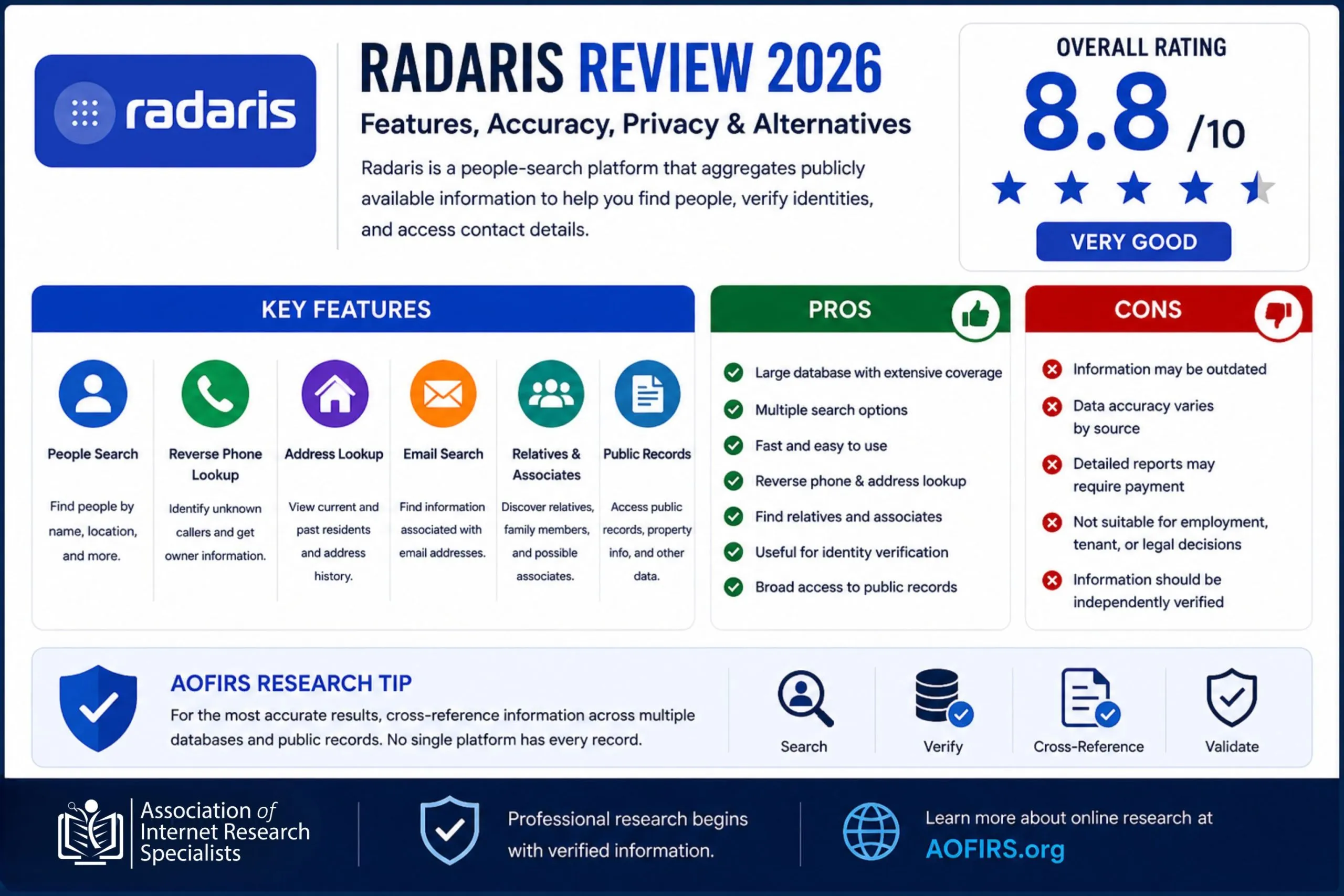
Key Features
People Search
The primary Radaris feature.
Users can search by name and location.
Results may reveal:
- Full names
- Age ranges
- Current addresses
- Previous addresses
- Relatives
Best For
Finding people online.
Reverse Phone Lookup
Users can search a phone number to identify possible owners.
Results may include:
- Names
- Addresses
- Associated individuals
Best For
Unknown caller identification.
Address Lookup
Users can search addresses to identify:
- Current residents
- Historical residents
- Associated individuals
Best For
Address verification.
Email Search
Users can search email addresses and discover associated information.
Best For
Identity verification.
Relative & Associate Discovery
Radaris frequently displays:
- Family members
- Relatives
- Known associates
Best For
Relationship research.
How Accurate Is Radaris?
The accuracy of Radaris depends on:
- Data source quality
- Record availability
- Jurisdiction
- Update frequency
Generally Accurate For
- Historical addresses
- Family associations
- Public-record references
- Contact information
Potential Limitations
- Outdated records
- Incomplete profiles
- Delayed updates
- Duplicate records
At AOFIRS, we teach that no people-search database should be treated as a definitive source.
Professional researchers verify findings through:
- Multiple databases
- Public records
- Search engines
- Social media verification
- Independent source analysis
Pros and Cons
Pros
✓ Large searchable database
✓ Fast search results
✓ Multiple search options
✓ Reverse phone lookup
✓ Address history research
✓ Relative discovery
✓ Useful verification tool
Cons
✗ Information may be outdated
✗ Privacy concerns for listed individuals
✗ Data quality varies by source
✗ Detailed reports may require payment
✗ Findings should be independently verified
Is Radaris Legit?
Yes. Radaris is a legitimate people-search platform that aggregates publicly available information.
However, users should understand that it is not a Consumer Reporting Agency (CRA).
Therefore, Radaris should not be used for:
- Employment decisions
- Tenant screening
- Credit eligibility
- Insurance decisions
Is Radaris Safe?
Generally yes.
However:
- Public records may contain errors.
- Information may not be current.
- Profiles should be independently verified.
Professional researchers use people-search databases as discovery tools, not final evidence.
How to Remove Your Information from Radaris
Many users search for:
- Radaris Opt Out
- Remove My Information from Radaris
- Delete Radaris Profile
The typical process includes:
- Locate your profile.
- Visit the Radaris opt-out page.
- Submit a removal request.
- Complete verification steps.
- Wait for confirmation.
AOFIRS recommends periodically checking major people-search databases to ensure information remains removed.
Radaris vs Competitors
| Platform | Rating | Best For |
|---|---|---|
| BeenVerified | 9.5/10 | Comprehensive Reports |
| TruthFinder | 9.4/10 | Deep Background Reports |
| Whitepages | 9.3/10 | Reverse Phone Lookup |
| Intelius | 9.2/10 | Identity Verification |
| PeopleFinders | 9.1/10 | Public Records |
| TruePeopleSearch | 9.1/10 | Free Searches |
| Radaris | 8.8/10 | Contact Discovery |
Best Alternatives to Radaris
| Platform | Best For | Free Search | Background Reports | Reverse Phone Lookup | Overall Rating | Review |
|---|---|---|---|---|---|---|
| BeenVerified | Comprehensive Reports | Partial | ★★★★★ | ★★★★★ | 9.5/10 | Read Review |
| TruthFinder | Deep Background Reports | No | ★★★★★ | ★★★★☆ | 9.4/10 | Read Review |
| Whitepages | Reverse Phone Lookup | Partial | ★★★☆☆ | ★★★★★ | 9.3/10 | Read Review |
| Intelius | Identity Verification | Partial | ★★★★☆ | ★★★★☆ | 9.2/10 | Read Review |
| PeopleFinders | Public Records Research | Partial | ★★★★☆ | ★★★★☆ | 9.1/10 | Read Review |
| TruePeopleSearch | Free People Searches | ★★★★★ | ★★☆☆☆ | ★★★★☆ | 9.1/10 | Read Review |
| Nuwber | Quick Contact Discovery | ★★★★☆ | ★★★☆☆ | ★★★★☆ | 8.9/10 | Read Review |
| Radaris | Contact & Address Discovery | ★★★★☆ | ★★★☆☆ | ★★★★☆ | 8.8/10 | Current Review |
Related AOFIRS Guides
- FastPeopleSearch Alternatives & Competitors
- How to Find Anyone Online
- Whitepages Review 2026
- BeenVerified Review 2026
- TruthFinder Review 2026
- Intelius Review 2026
- PeopleFinders Review 2026
AOFIRS Research Tip
The most common mistake researchers make is relying on a single database. Professional online researchers use multiple sources and compare findings before reaching conclusions. A structured research process involving verification, source evaluation, and cross-referencing significantly improves accuracy and reduces misinformation. AOFIRS promotes these modern internet research methods as part of the Certified Internet Research Specialist (CIRS) framework.
Frequently Asked Questions
1. Is Radaris Free?
Radaris provides limited free information, while more detailed information may require payment.
2. Is Radaris Accurate?
Radaris can provide useful information, but all findings should be independently verified.
3. Can I Remove My Information from Radaris?
Yes. Radaris provides an opt-out process for individuals who wish to remove their information.
4. Is Radaris Better Than Whitepages?
Whitepages generally performs better for reverse phone lookup, while Radaris is useful for broad contact discovery.
5. Is Radaris Legal?
Yes. Radaris aggregates publicly available information and operates within applicable legal frameworks.
About AOFIRS
AOFIRS (Association of Internet Research Specialists) promotes professional standards in online research, source verification, AI-assisted research, internet law, ethics, and data analysis. The organization teaches structured methodologies for finding, verifying, and analyzing online information in an era of information overload and AI-assisted research.
Final Verdict
Radaris remains a useful platform for discovering publicly available contact information, address histories, relatives, and online identities. While it may not provide the depth of reporting available through BeenVerified or TruthFinder, it serves as a useful starting point for identity verification and people-search research.