
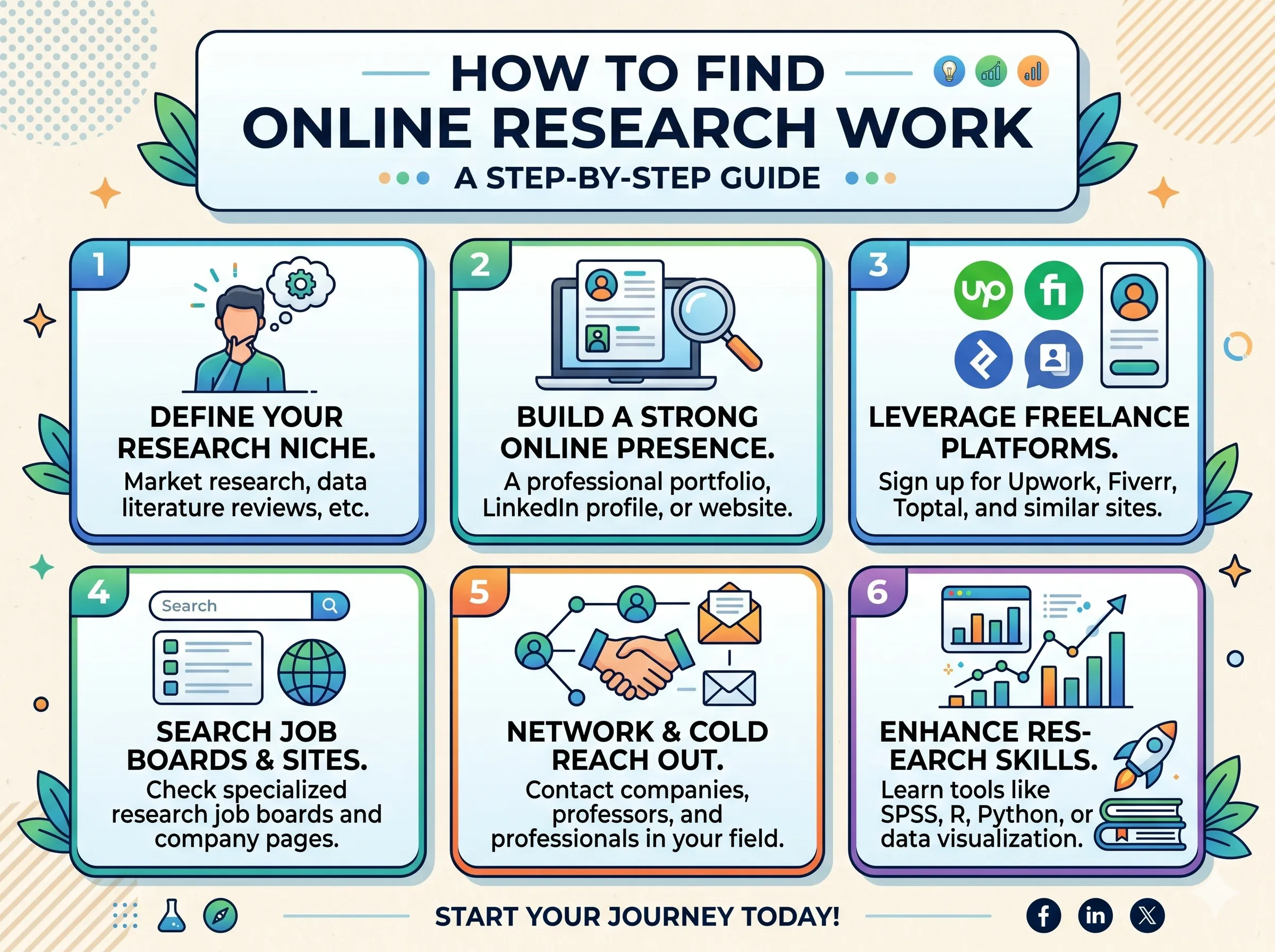
If you’re an academic, a freelancer, or just someone who likes exploring information, online research work can be a flexible and rewarding career. The need for skilled researchers has grown a lot in many fields, including market analysis, academic studies, competitive intelligence, and content development. This guide will help you find and secure online research jobs.
1. Understand What Online Research Work Involves
Before you start looking for jobs, it’s useful to understand the different types of online research work. These usually fall into a few main categories:
- Academic research assistance – helping scholars gather sources, compile literature reviews, or summarise findings.
- Market research – analysing industry trends, consumer behaviour, and competitor activity for businesses.
- Data collection and analysis – sourcing structured data sets, surveys, and statistical reporting.
- Fact-checking and verification – reviewing content for accuracy, especially for media and publishing companies.
- SEO and content research – identifying keywords, topics, and sources for content marketing teams.
- Legal and medical research – supporting law firms or healthcare organisations with background research.
Figuring out which area matches your skills will make your job search more focused and effective.
2. Build the Right Skill Set
Clients and employers look for specific qualities in researchers. To stand out, work on building these skills:
- Strong analytical thinking – the ability to assess sources critically and draw meaningful conclusions.
- Information literacy – knowing how to navigate databases, academic journals, government portals, and other credible sources.
- Clear written communication – most research work requires presenting findings in a readable format.
- Familiarity with tools – Google Scholar, JSTOR, Statista, SEMrush, Excel, and citation managers like Zotero or Mendeley are commonly used.
- Attention to detail – accuracy is non-negotiable in research work.
If you need to improve any of these skills, you can find great free courses on research methods, data analysis, and academic writing on sites like Coursera, edX, and YouTube.
3. Explore Freelance Platforms
Freelance marketplaces are one of the easiest places to find research work, especially if you’re just starting.
Upwork is a major platform for freelance researchers. You can make a profile that shows your skills, apply for jobs, or have clients contact you directly. Categories such as “Internet Research,” “Market Research,” and “Data Analysis” often have new listings.
Fiverr lets you list specific research services — such as literature reviews, competitor analysis, or survey design — as “gigs” clients can purchase directly.
Freelancer.com and PeoplePerHour operate similarly to Upwork, with a mix of project-based work. Guru.com usually attracts more experienced professionals and offers longer-term research contracts.
When you create your profile, be clear about your specialty, include examples of your work or case studies, and ask happy clients for reviews as soon as possible.
4. Check Academic and Specialised Job Boards
If you have experience in academic or scientific research, it’s a good idea to check out these dedicated job boards:
- ResearchGate Jobs – tailored to researchers and scientists across disciplines.
- com – lists research assistant and associate positions at universities worldwide.
- Indeed and LinkedIn – search terms like “remote research assistant,” “online researcher,” or “research analyst” regularly yield remote listings.
- JSTOR Labs and similar organisations occasionally post research fellowship or contract opportunities.
- org – a strong source for research roles at nonprofits and think tanks.
If you’re interested in market or business research, check job boards run by industry associations in fields like finance, healthcare, or technology.
5. Register with Research Panels and Survey Companies
If you want easier or more flexible research tasks, online survey and research panel sites offer paid options:
- UserTesting – pay users to research and evaluate websites and apps.
- io – connects professional respondents with research studies, often paying $50–$200 per session.
- Prolific – an academic-focused platform where researchers recruit participants for studies.
- Survey Junkie and Swagbucks – lower-paying but consistent survey opportunities.
These platforms won’t provide a full-time income, but they’re good for earning extra money or getting early experience.
6. Network in Research Communities
Some of the best research jobs, especially the higher-paying ones, come from personal connections instead of job boards. Networking can lead to referrals, tips about jobs that aren’t advertised, and long-term client relationships. All of this can really boost your chances of finding good research. LinkedIn is extremely useful. Update your profile with keywords like “qualitative researcher,” “competitive intelligence,” or “research analyst.” Connect with people in your target industries and interact with research-related posts.
- Twitter/X and Reddit both have active groups focused on academic research, data journalism, and open-source intelligence (OSINT). Joining these communities helps you get noticed.
- Academic and professional conferences, even online ones, are great places to meet potential clients or collaborators.
- Alumni networks from your university or online courses can also help you find research contract work.
Don’t overlook the value of reaching out directly. Contacting think tanks, consulting firms, or media organizations to offer your services has helped many researchers land long-term work.
7. Approach Organisations Directly
Many companies need research help but don’t always post job ads. Try reaching out to:
- Management consulting firms (e.g., boutique strategy or market research firms)
- Publishing houses and media companies that need fact-checkers or research editors
- Law firms requiring legal research support
- Startups that need competitive or market research but don’t have their own research teams
A short, well-written cold email that describes your skills and includes a sample of your work can open doors that job boards can’t.
8. Create a Portfolio
A portfolio is a powerful tool for getting research jobs. It doesn’t have to be fancy, but it should clearly show what you can do. including:
- A sample literature review or annotated bibliography
- A competitive analysis or market overview (anonymised if necessary)
- A written research summary from a personal or volunteer project
- Links to any published work, reports, or articles you’ve contributed to
You can host your portfolio on a personal website like WordPress or Squarespace, or even use a well-organized Google Doc. Notion is also popular with researchers and knowledge workers.
9. Set Competitive and Fair Rates
Setting the right price for your research work is important. Rates can vary a lot depending on the type of work, your experience, and the platform. Here are some general guidelines:
- Entry-level online research: $15–$30/hour
- Market or competitive research: $40–$80/hour
- Specialised academic or legal research: $60–$120+/hour
- Project-based work (e.g., a 10-page market report): $300–$1,500+
Check industry standards on sites like Upwork or ask freelancer communities on Reddit (r/freelance, r/forhire) to help set your rates.
10. Stay Consistent and Keep Learning
The world of online research is always changing. New tools, platforms, and client needs appear all the time. Stay competitive by subscribing to newsletters in your field, taking refresher courses, and staying active in professional groups.
Finding online research work takes some upfront effort, but researchers who combine genuine expertise with proactive outreach and a clear portfolio typically find no shortage of opportunities. Start with one or two of the strategies above, build momentum, and expand from there.
With the right approach, online research work can grow from a side job into a full and rewarding career. It’s a path built on curiosity, careful work, and making sense of a complex world.