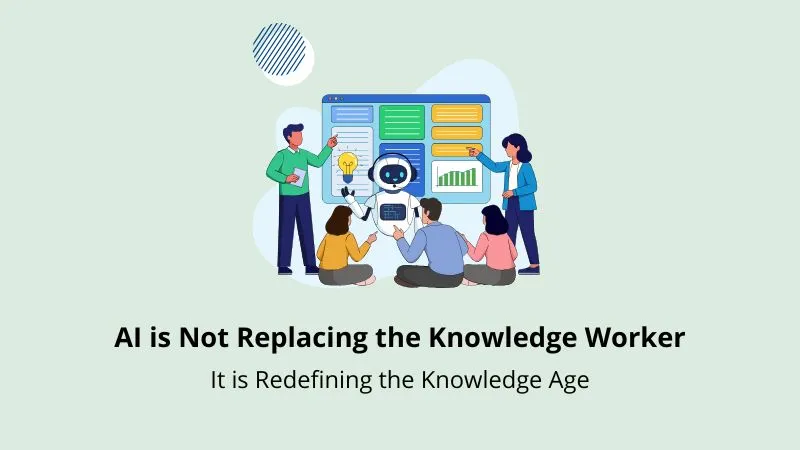
For decades, every major technology shift has triggered the same fear: replacement. The personal computer was once expected to eliminate office jobs. The internet was supposed to automate entire industries out of existence. Instead, both became foundations for new forms of work, new professions, and massive economic expansion.
Artificial intelligence is following the same historical pattern. It is not a weapon aimed at the knowledge worker. It is the next foundational technology, as transformative as the personal computer and the internet before it.
What is changing is not the existence of the knowledge industry, but its orientation.
From Cognitive Labor to Cognitive Leverage
The knowledge economy was built on human memory, research speed, calculation, and documentation. These were once scarce abilities. Today, AI performs much of this “cognitive heavy lifting” instantly. It can scan millions of documents, generate drafts, analyze datasets, and surface insights in seconds.
This does not remove the human from knowledge work. It changes the role of the human within it.
Instead of being the processor, the knowledge worker becomes the director. The strategist. The editor. The ethical judge. The communicator.
Organizations that understand this shift are moving faster than those that resist it. Companies like Microsoft and IBM now position AI not as automation alone, but as “co-intelligence”, a system that augments decision-making rather than replacing it. The worker does not disappear. The leverage increases.
The Knowledge Industry will not Disappear. It will Reorient.
Research, law, marketing, education, finance, and health care are not shrinking because of AI. They are being reorganized around distinct human strengths.
AI can:
- Summarize massive research libraries.
- Generate first drafts.
- Detect patterns across impossible data volumes.
- Simulate outcomes.
But AI cannot:
- Define human values.
- Understand lived context.
- Make moral trade-offs.
- Build trust.
- Inspire belief.
- Interpret meaning with emotional and cultural depth.
This is why the knowledge industry does not vanish. It pivots. The technical layer accelerates. The human layer becomes more valuable, not less.
The Real Risk is not Unemployment. It is an Unequal Transition.
The greater societal risk is not mass job loss. There is uneven access to AI tools and poor preparation for the shift in skill demand.
The World Economic Forum consistently reports that future job growth will concentrate in hybrid roles. These are jobs where human judgment works alongside machine intelligence. The divide will not be between “tech” and “non-tech” workers. It will be between those who can work with AI and those who are excluded from it.
If access to AI remains limited to elite firms and wealthy systems, inequality will deepen. If, however, education systems, governments, and employers treat AI literacy as basic infrastructure, the transition becomes stabilizing rather than disruptive.
Education Must Shift from Memory to Meaning
For over a century, education rewarded recall, repetition, and standardized answers. AI now performs these tasks better than any human ever could. As a result, the most valuable future skills are not technical alone. They are deeply human.
Three abilities now matter more than ever:
- Creativity is the power to generate what does not yet exist.
- Critical thinking is the ability to challenge outputs rather than accept them.
- Emotional intelligence is the capacity to understand people, conflict, nuance, and trust.
AI produces content. Humans determine meaning.
AI generates options. Humans choose direction.
AI accelerates output. Humans define purpose.
Education systems that continue to train students for jobs based on memorization will struggle. Those who train creators, analysts, leaders, and ethical thinkers will thrive.
The Most Successful Workers Will Be AI Integrators, Not AI Competitors
The winners of the next decade will not be those who try to outperform AI at its own strengths. They will be those who know how to integrate it into their workflows.
The emerging professional model is not:
“I do what the machine does.”
It is:
“I do what only humans can do, faster and better because the machine handles the rest.”
This applies to:
- Researchers who move from data collection to insight generation.
- Marketers who move from manual content production to strategy and storytelling.
- Lawyers who move faster on analysis and deeper on judgment.
- Educators who shift from information delivery to human development.
Redefinition, Not a Replacement
Every foundational technology reshapes labor. The personal computer eliminated typists but created software engineers, digital designers, analysts, and entire industries that did not exist before. The internet removed physical distribution barriers but produced creators, platforms, and global digital markets.
AI is not different in direction, only in speed.
The knowledge economy is not ending. It is evolving into a higher-leverage, more human-centered system. The real question is not whether AI will replace workers. It is whether workers will be empowered to grow alongside it.
Those who adapt will not become obsolete. They will become amplified.