

The internet has never contained more accessible information, yet finding information is no longer the hardest part of research. The harder problem is deciding what to search, where to search, which sources deserve attention, whether a claim is supported, and how much confidence to place in the result.
That is why advanced internet search skills have become a professional competency.
In 2026, effective research no longer consists of entering a few keywords into Google and reviewing the first page of results. Professionals increasingly move between conventional search engines, specialist databases, academic indexes, archives, AI search systems, research agents, primary documents, spreadsheets, and verification tools.
Understanding these processes is part of modern internet research, where finding information is only the beginning. Researchers must also evaluate, verify, organize, analyze, and communicate what they discover.
AI has accelerated that process, but it has not removed the need for research judgment. In many ways, it has made that judgment more important.
What Are Advanced Internet Search Skills?
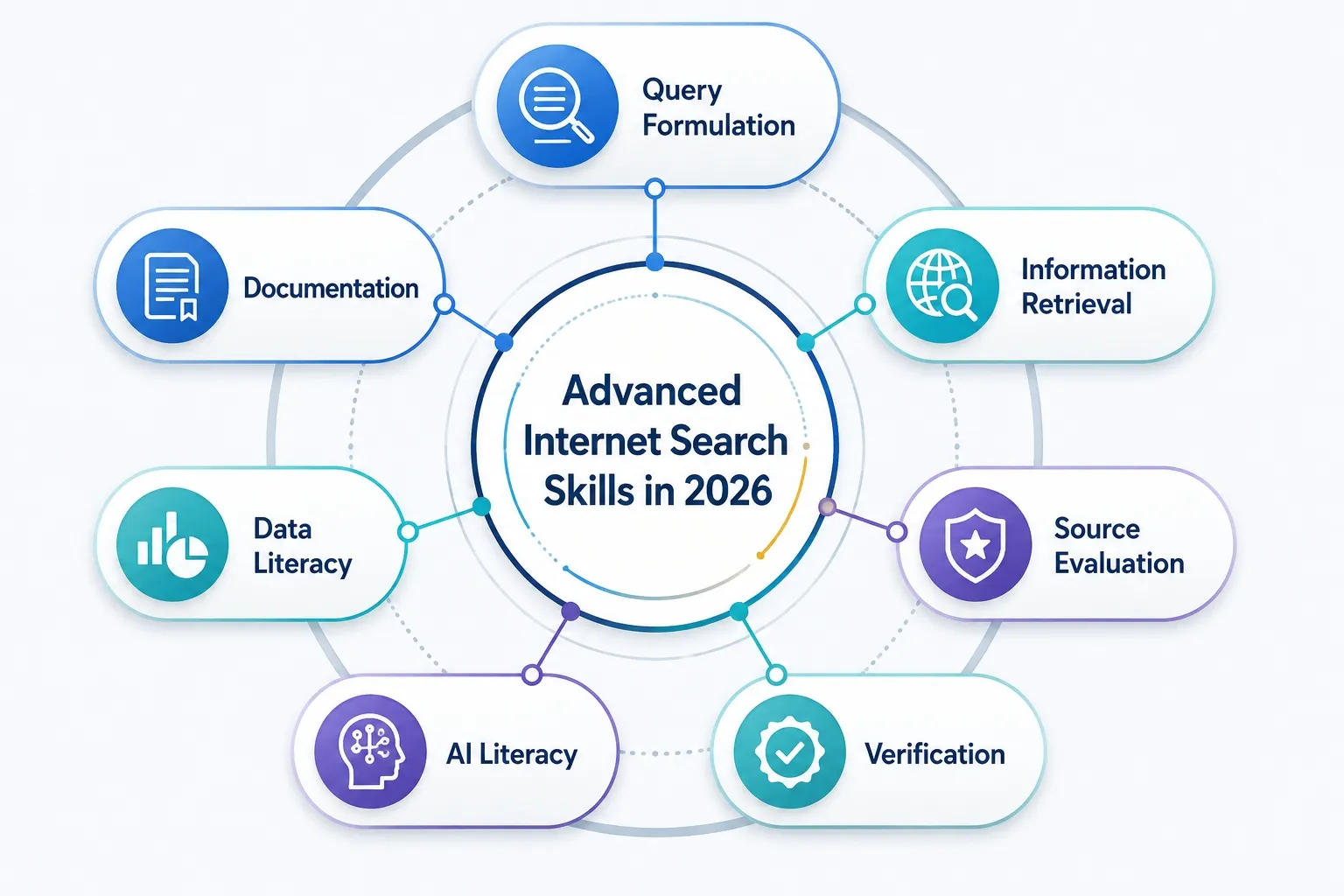
They go well beyond memorizing Google search operators.
Modern search literacy combines information retrieval, information literacy, critical evaluation, AI literacy, data literacy, and research methodology.
Why Search Literacy Is Now a Professional Competency
A journalist checking a public claim, a market analyst evaluating a competitor, a lawyer locating a regulatory document, a student researching a thesis, and an SEO professional investigating an industry trend face different questions, but they share one fundamental problem:
Search engines rank information. AI answer engines synthesize it. Research agents can search and summarize it. None of those functions automatically establish that the final conclusion is correct.
Google’s current Search experience illustrates how dramatically retrieval has changed. According to Google’s explanation of AI Mode, the system can break a complex request into subtopics, run multiple related searches through query fan-out, combine information, and support follow-up questions.
ChatGPT Search takes a similar conversational approach. It can search the web when current information is useful, reformulate questions into targeted searches, and present sources alongside an answer.
The result is a major change in professional search behavior.
Previously, researchers primarily had to decide which links to open.
Increasingly, they must also decide whether a synthesized answer accurately represents the sources behind it.
That distinction makes search literacy more valuable, not less.
Searching Is Not the Same as Researching
A search retrieves possible information.
Research builds justified knowledge from evidence.
Consider the difference.
A search may answer:
What is the global market for a particular technology?
Professional research asks additional questions:
- Who produced the market estimate?
- What methodology did they use?
- Which geographic markets were included?
- Is the figure historical or forecast?
- What year does it represent?
- Has another independent organization produced a comparable estimate?
- Is the original dataset available?
- Are multiple articles repeating the same underlying source?
A search result is therefore an entry point, not necessarily evidence.
The same applies to AI-generated answers. An AI system can identify useful sources, explain terminology, summarize documents, compare claims, or uncover research directions. But you should still check consequential findings against the underlying evidence.
OpenAI’s guidance for using ChatGPT Search encourages users to inspect important sources rather than assuming every generated interpretation or citation is sufficient on its own.
The 8 Core Internet Research Skills Professionals Need in 2026
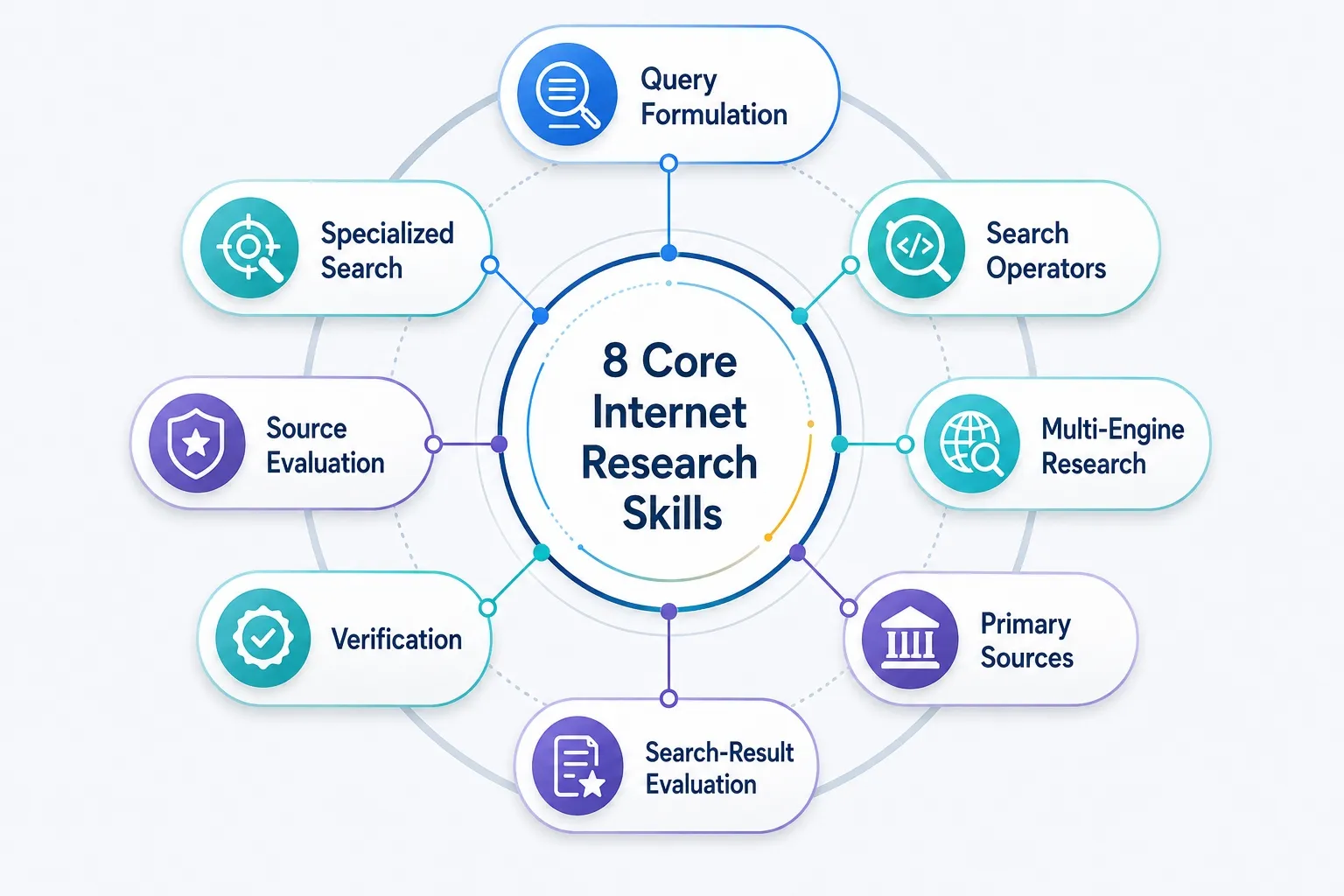
1. Research Question and Query Formulation
Professional searching starts before the search box.
A researcher first needs to define the problem.
Useful questions include:
- What exactly am I trying to establish?
- What period matters?
- Which geography matters?
- What type of evidence would answer the question?
- Which organizations, people, products, laws, technologies, or events are relevant?
- What would disprove my current assumption?
Then build a search vocabulary.
Include:
- Main concepts
- Synonyms
- Alternative terminology
- Acronyms
- Product or organization names
- Previous names
- Industry terminology
- American and British spellings
- Technical terminology
- Relevant dates
A weak query often produces a weak research trail because the researcher has failed to define the information problem.
2. Search Operator Literacy
Operators remain useful when a researcher needs tighter control over conventional search.
Google’s official Search Help documents several practical operators and filters, including:
- “exact phrase”
- site:
- – for exclusion
- before:
- after:
- filetype:
Google also provides Advanced Search interfaces for filtering by language, region, site or domain, file type, and other criteria.
Examples:
site:gov “artificial intelligence” filetype:pdfafter:2025-01-01site:who.int “artificial intelligence” filetype:pdfOperators should be treated as retrieval controls, not guarantees. Search behavior changes, indexing is incomplete, and different search platforms implement different syntax.
For database research, Boolean logic, subject headings, proximity searching, truncation, and controlled vocabularies may be equally or more important. The Open University’s guidance on advanced search techniques also emphasizes that search techniques differ between databases, which is why researchers should understand the system they are actually using.
3. Multi-Engine Research
Professional researchers should avoid assuming that one search engine represents the entire searchable web.
Different systems may:
- Index different material
- Rank sources differently
- Emphasize different formats
- Provide different privacy models
- Integrate different AI features
- Interpret ambiguous queries differently
A research project may therefore use Google, Bing, Brave Search, DuckDuckGo, Startpage, Kagi, Mojeek, specialist databases, archives, academic indexes, and AI answer engines for different purposes.
The goal is not to search every platform.
The goal is to understand why a different retrieval system might reveal evidence that the first one did not.
4. Specialized and Vertical Search
General web search is powerful, but it is not always the best starting point.
Professional researchers should know when to move into specialized systems such as:
- Google Scholar
- PubMed
- Crossref
- Semantic Scholar
- Government databases
- Regulatory repositories
- Securities filings
- Patent databases
- Court databases
- Statistical agencies
- News archives
- Web archives
- Library databases
Researchers who regularly work with scholarly material can also explore AOFIRS’ guide to academic search engines, scholarly databases, and AI research tools when general-purpose web search is no longer sufficient.
5. Primary-Source Discovery
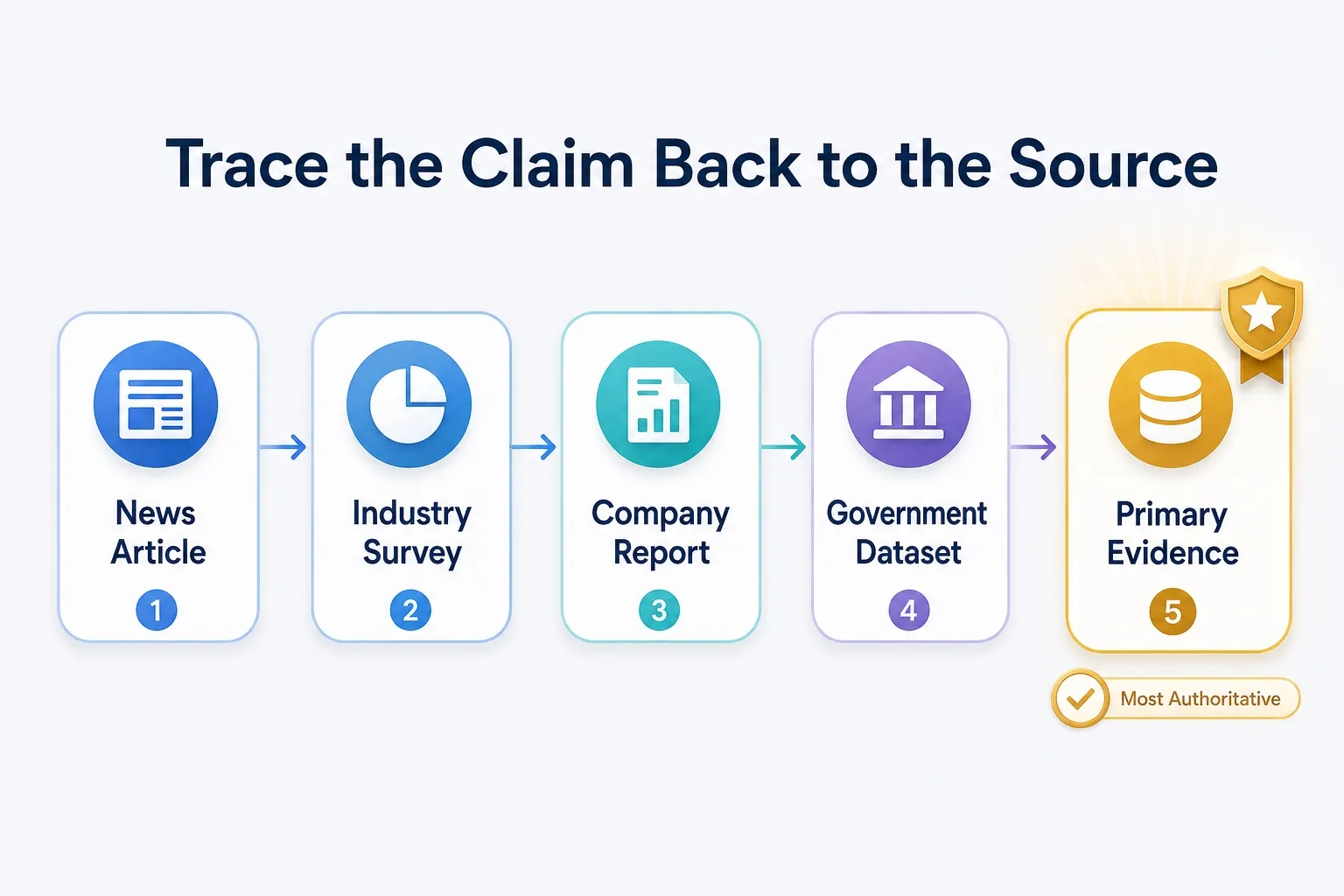
One of the most important research habits is learning to move backward through the information chain.
A news report may cite an industry survey.
The survey may summarize a company report.
The company report may rely on a government dataset.
The government dataset may be the strongest source for the claim.
Whenever possible, move toward:
- Original research
- Official datasets
- Regulatory filings
- Government publications
- Court documents
- Technical documentation
- Official announcements
- Transcripts
- Original interviews
- Company filings
- Archived versions of original pages
Secondary sources remain useful for context, but they should not automatically replace the underlying evidence.
6. Source Evaluation
Ask more than, “Does this website look professional?”
Evaluate:
- Authority: Who created it?
- Expertise: What qualifies the author or organization to address the subject?
- Evidence: What information supports the claim?
- Currency: When was it published or updated?
- Methodology: How was the evidence collected?
- Originality: Is this the original source or a repetition?
- Commercial interest: Does the publisher benefit from a particular conclusion?
- Provenance: Can the evidence be traced?
- Editorial process: Is there meaningful review or accountability?
- Corroboration: Do independent sources support the claim?
Professional fact-checkers often use lateral reading instead of judging a website’s credibility from its appearance alone. Research highlighted by Stanford University on evaluating online information shows why checking what independent sources say about a publisher or claim can produce a more reliable assessment.
7. Verification and Triangulation
One source may be sufficient to establish that an organization made an announcement.
One source is rarely enough to establish that the announcement is objectively true.
For consequential research, triangulate.
A practical verification process is:
- Identify the precise claim.
- Find the original source.
- Check the date.
- Check who produced the evidence.
- Examine the methodology.
- Look for independent confirmation.
- Search for contradictory evidence.
- Separate confirmed facts from interpretation.
Verification should become more rigorous as the consequences of being wrong increase.
8. Search-Result Evaluation
A high ranking is not the same as high credibility.
A result may rank because it is relevant to the query, useful to many users, recent, well structured, authoritative within a domain, or well matched to the search system’s ranking signals.
The researcher’s job is different from the ranking system’s job.
A search engine determines:
A researcher must determine:
That distinction should guide every professional search.
How AI Has Changed Internet Research
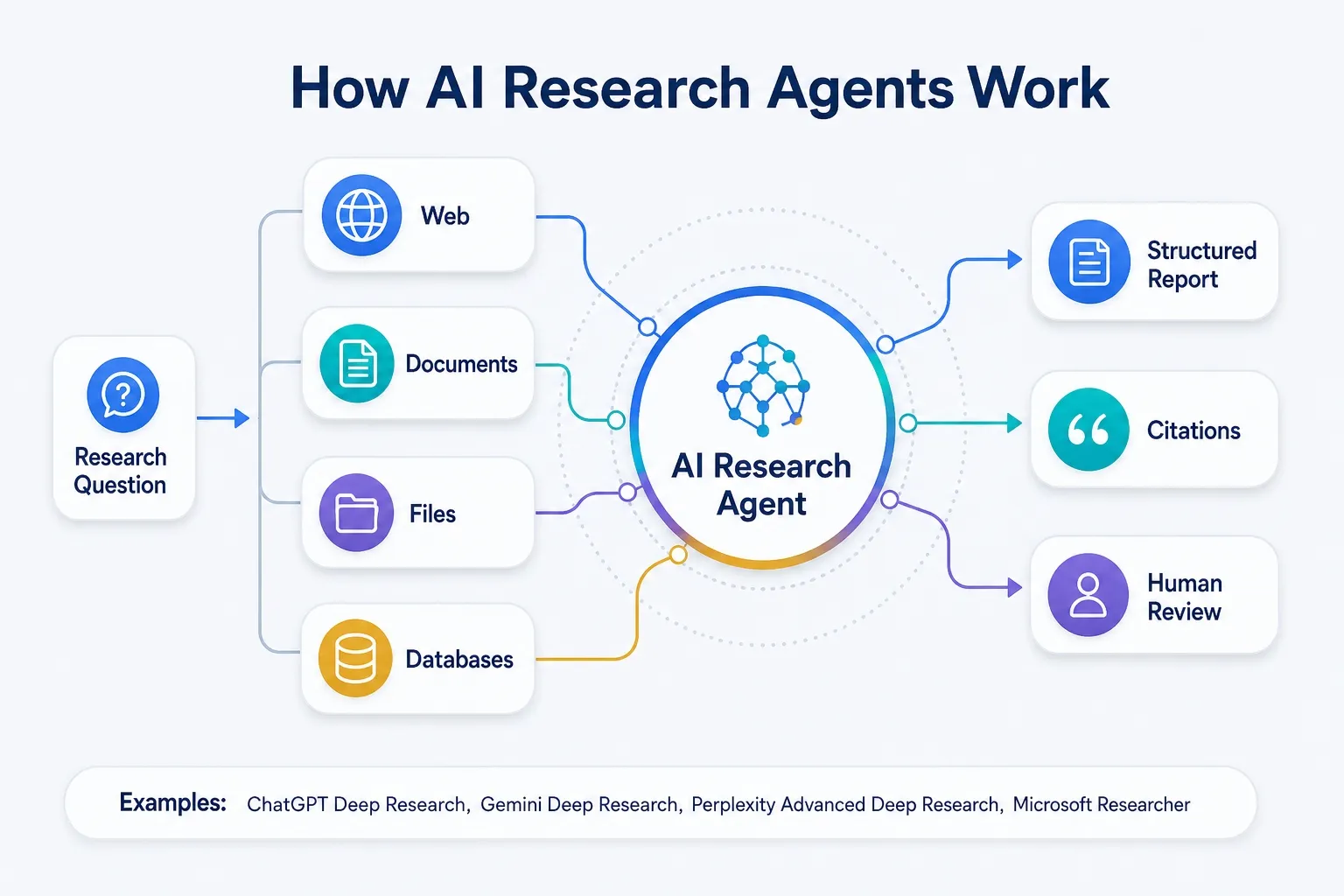
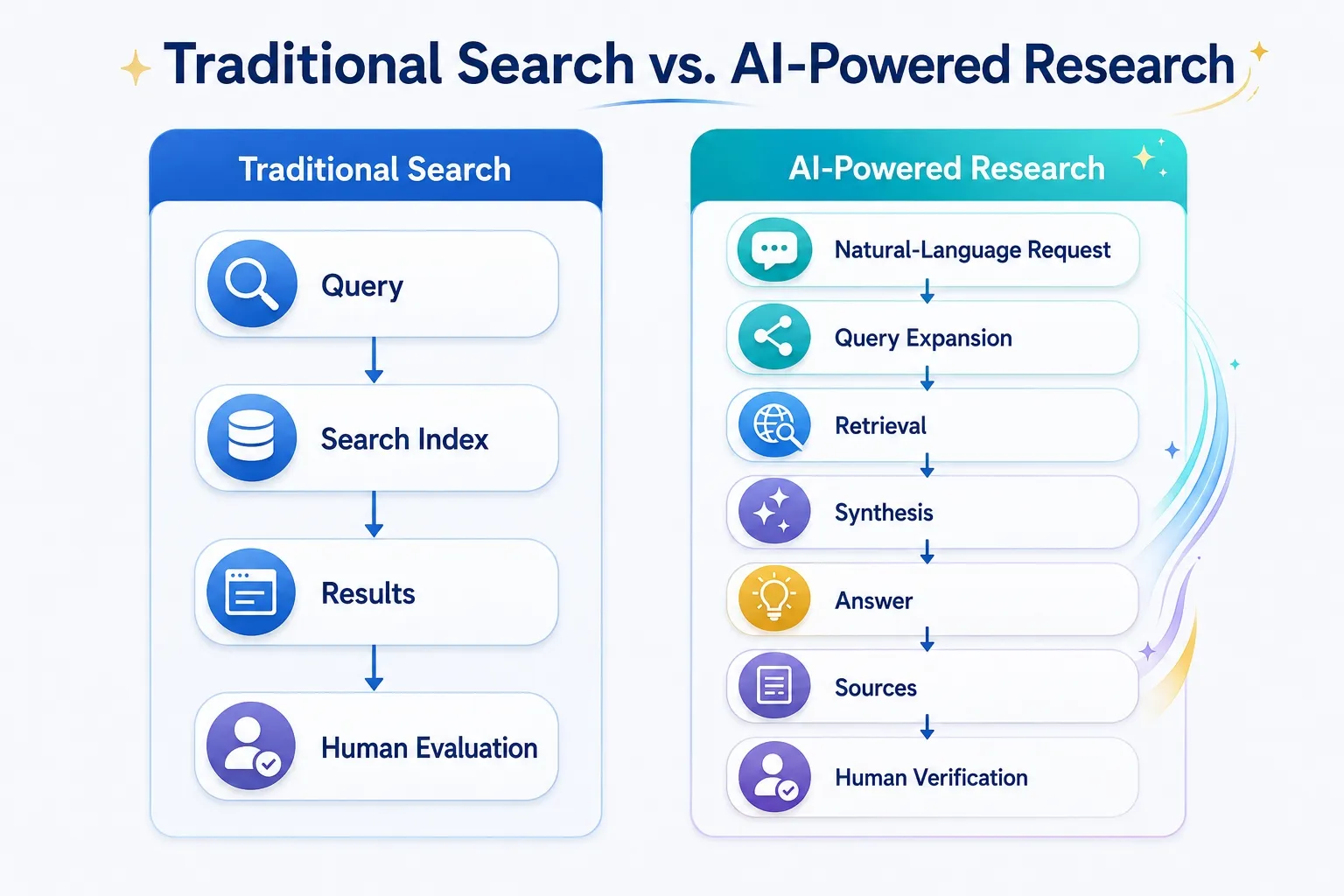
Traditional search could be simplified as:
AI-mediated research increasingly looks like:
Google explains that AI Mode uses query fan-out to break complex questions into subtopics and conduct multiple related searches. Likewise, ChatGPT Search can reformulate a user’s question into targeted searches before synthesizing an answer.
The researcher therefore no longer controls every query that contributes to the final response.
That creates both an advantage and a responsibility.
The advantage is scale.
The responsibility is verification.
Research Agents Have Added Another Layer
Modern research platforms increasingly offer long-running research agents.
ChatGPT Deep Research can work with the public web, uploaded files, specific websites, and connected sources, develop a research plan, conduct a multi-step investigation, and return a structured report.
Gemini Deep Research similarly allows users to create a research plan and work with Google Search, uploaded material, and selected sources.
Perplexity expanded its research capabilities through Advanced Deep Research, including broader web research, document processing, calculations, and source cross-checking.
Microsoft has also shifted its research tooling. According to Microsoft’s current Deep Research and Researcher guidance, Microsoft has replaced consumer Deep Research in relevant Microsoft 365 workflows with Researcher, which can generate structured research reports using web and work information with citations.
These systems make sophisticated research assistance widely accessible.
They do not eliminate the need to understand research methodology.
Traditional Search Engines vs. AI Answer Engines
| Research Need | Conventional Search | AI Search / Answer Engine |
|---|---|---|
| Find a known website or exact document | Usually excellent | Useful, but indirect |
| Locate primary sources | Excellent when queried well | Useful for discovery; verify |
| Explore an unfamiliar topic | Requires more manual browsing | Excellent for orientation |
| Compare terminology | Manual | Very useful |
| Summarize many sources | Manual | Strong |
| Run follow-up questions | Requires new searches | Strong conversationally |
| Trace exactly why a source appeared | More transparent | Often less transparent |
| Complex synthesis | Researcher performs synthesis | AI can accelerate synthesis |
| Citation checking | Directly inspect result | Open every important citation |
| Breaking information | Strong when indexed | Strong when live retrieval is available |
| Reproducible search strategy | Easier to document manually | Requires recording prompts, sources, and outputs |
The strongest professional workflow usually combines both.
Use conventional search when you need retrieval precision and direct control.
Use AI search when you need exploration, decomposition, comparison, or synthesis.
Then verify the important evidence yourself.
AI Search Skills Professionals Need in 2026
Write Research Prompts, Not Generic Questions
A useful research request defines:
- Objective
- Scope
- Time period
- Geography
- Preferred source types
- Required evidence
- Exclusions
- Output structure
- Uncertainty requirements
Weak:
Tell me about renewable energy.
Professional:
Identify major changes in utility-scale solar adoption in the United States between January 2025 and August 24, 2026. Prioritize U.S. government data and original industry reports. Separate historical data from forecasts and give the publication date for each major source.
The second prompt does not guarantee a correct answer.
It creates a more auditable research task.
Decompose Complex Research Problems
Weak:
What is happening in AI?
Better research questions:
- Which significant models launched during the period?
- Which companies announced major infrastructure investments?
- What regulations entered into force?
- Which benchmark claims were independently tested?
- What measurable adoption data exists?
- Which claims are forecasts rather than observed outcomes?
This decomposition prevents the researcher from confusing a broad narrative with a properly investigated question.
Search Iteratively
Research rarely follows a straight line.
Use:
The first search teaches you how to construct the second.
Terminology discovered in a government document may produce a better search than the terminology you started with.
A cited paper may reveal a subject heading.
A competitor’s regulatory filing may reveal the official name of a product category.
Good researchers continuously improve the query from what they learn.
Verify AI Citations
An AI-generated citation should be treated as a lead until checked.
For every consequential citation:
- Open the source.
- Verify that it exists.
- Confirm the author or publisher.
- Check the publication or update date.
- Locate the specific supporting passage or data.
- Confirm that the AI represented it correctly.
- Look for the original source if the citation is secondary.
- Compare the claim with independent evidence where necessary.
The NIST Generative AI Risk Management Profile discusses confabulation as a risk in generative AI systems, including situations where inaccurate information may be presented confidently.
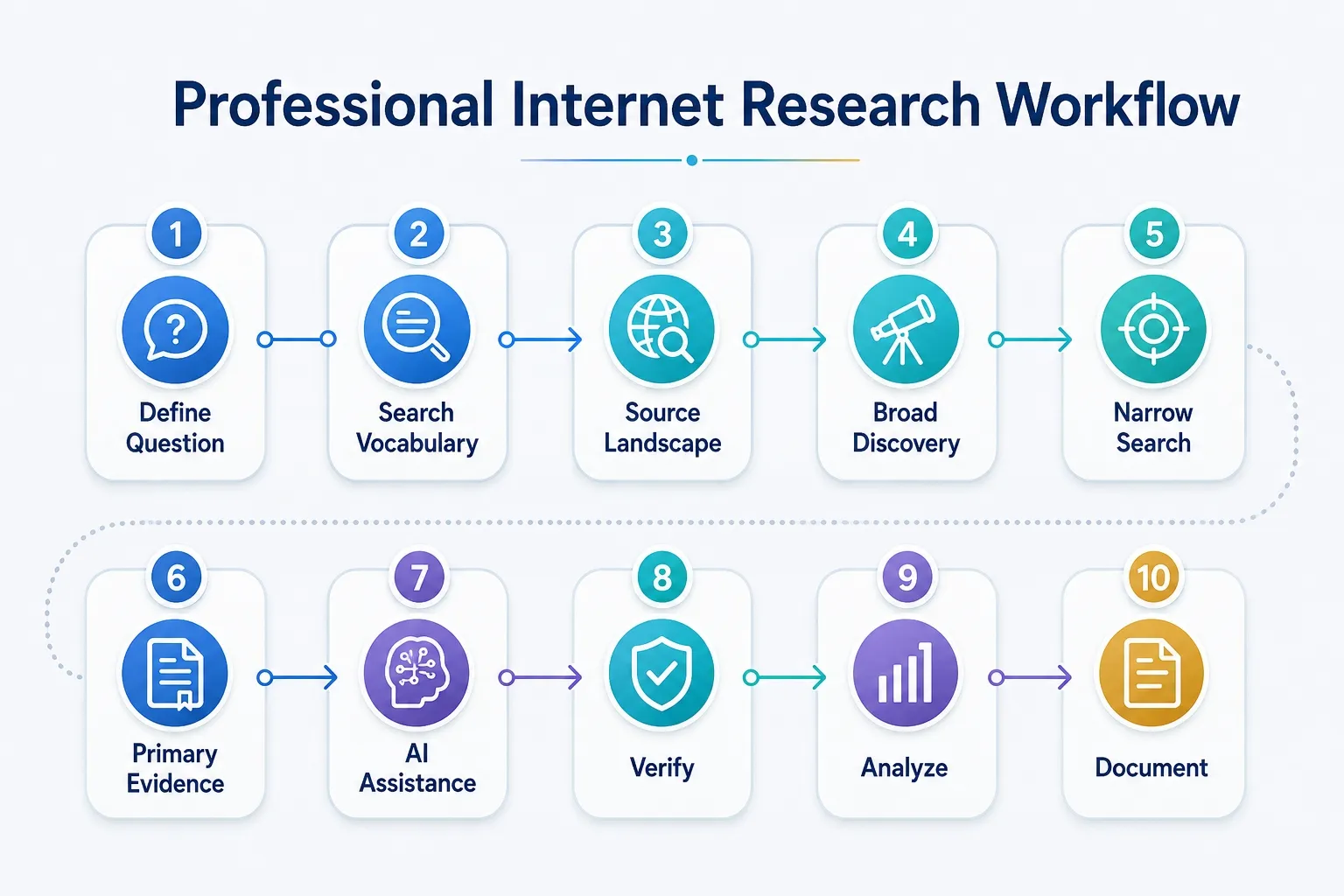
A 10-Step Professional Internet Research Workflow
Professionals who want a deeper methodological foundation can also study AOFIRS’ Research Methods and Search Methodology resources alongside the workflow below.
Step 1: Define the Research Question
Specify:
- Objective
- Scope
- Time frame
- Geography
- Population or market
- Required evidence
- Deliverable
Step 2: Build a Search Vocabulary
Identify:
- Core concepts
- Synonyms
- Acronyms
- Technical terms
- Organization names
- Alternative spellings
- Historical terminology
Step 3: Map the Source Landscape
Decide which sources may contain the evidence.
For example:
- Search engines
- AI answer engines
- Government sites
- Academic databases
- Company filings
- News archives
- Web archives
- Industry databases
Step 4: Start Broad Enough to Learn the Landscape
Use general search or AI-assisted discovery to understand the topic, major entities, terminology, disputes, and likely primary sources.
Step 5: Narrow the Search
Apply exact phrases, domain restrictions, date filters, file types, database fields, subject headings, or specialized search systems.
Step 6: Move Toward Primary Evidence
Do not stop at a convenient summary if the underlying report, dataset, filing, paper, judgment, regulation, or technical document is available.
Step 7: Use AI as a Research Assistant
AI can help with:
- Query expansion
- Question decomposition
- Summarization
- Terminology discovery
- Comparison
- Translation
- Document analysis
- Pattern identification
- Identifying gaps
Step 8: Verify and Triangulate
Check consequential claims against the original evidence and, where appropriate, independent sources.
Step 9: Analyze
Separate:
Step 10: Document the Research Trail
Record:
- Searches
- Prompts
- Databases
- URLs or document identifiers
- Access dates
- Publication dates
- Key evidence
- Conflicting findings
- Decisions
- Limitations
A professional conclusion should be explainable to someone who did not perform the research.
Why Human-in-the-Loop Research Still Matters
The most useful model for AI-assisted professional research is:
AI can accelerate several stages.
Human responsibility remains central.
The NIST Generative AI Risk Management Profile identifies confidently presented erroneous or false information as a meaningful generative-AI risk. This reinforces the importance of verifying quotations, statistics, references, and consequential source-based claims.
Similarly, UNESCO’s guidance on generative AI in education and research advocates a human-centered approach rather than treating generative systems as replacements for human agency and judgment.
Research Skills That Still Require Human Judgment
AI systems can assist with many of the following tasks, but professional responsibility should remain with the researcher when judging:
- Whether evidence is sufficient
- Whether a source is appropriate for the claim
- Whether methodology is credible
- Whether conflicting evidence changes the conclusion
- Whether a statistic is being interpreted correctly
- Whether commercial interests affect a claim
- Whether context has been omitted
- Whether a conclusion goes beyond the evidence
- Whether sensitive information should be collected or disclosed
- Whether the research process is ethical
The question is therefore not:
The better question is:
Information Overload in the AI Era
Information overload has evolved.
Researchers now contend with:
- Conventional web pages
- AI-generated articles
- Automated summaries
- Synthetic media
- Duplicate reporting
- Syndicated stories
- Outdated copies
- SEO-oriented content
- AI-generated citations
- Citation loops
- Conflicting statistics
- Repeated secondary reporting
This changes the research objective.
A researcher who retrieves 500 sources but cannot rank their evidentiary value may be less effective than one who identifies five authoritative sources and understands their limitations.
Search Bias, Ranking Systems, and Algorithmic Filtering
Search results should never be treated as a neutral map of all available knowledge.
Different systems can return different material because they use different indexes, ranking systems, language-processing methods, contextual signals, freshness mechanisms, and interfaces.
Researchers can reduce dependence on a single retrieval pathway by:
- Comparing different search systems
- Reformulating the question
- Searching alternative terminology
- Changing date boundaries
- Searching in another language where relevant
- Searching official domains
- Using specialized databases
- Looking for original documents
- Comparing jurisdictions
- Searching for disagreement
- Using AI and conventional search together
The goal is not to create a mythical “bias-free” search.
The goal is to make the research process more transparent, diverse, and defensible.
Data Literacy: Turning Information Into Intelligence
Finding information is only one part of research.
The next progression is:
Professionals therefore benefit from basic analytical skills such as:
- Data cleaning
- Spreadsheet analysis
- Descriptive statistics
- Percentage and rate calculations
- Trend analysis
- Comparisons
- Identifying outliers
- Data visualization
- Understanding sample size
- Distinguishing correlation from causation
- Reading methodology notes
- Recognizing misleading charts
AI can assist with these tasks, but the researcher should still understand what the calculations mean and whether the underlying data justify the conclusion.
Advanced Internet Research Skills Framework
| Skill | Beginner | Intermediate | Advanced |
|---|---|---|---|
| Query formulation | Enters descriptive keywords | Uses synonyms, phrases and filters | Decomposes problems into multi-stage search strategies |
| Operator use | Uses basic exact-match searching | Uses domain, exclusion, date and file filters | Combines retrieval methods across engines and databases |
| Source selection | Uses general search | Adds academic and official databases | Maps source classes before research begins |
| Source evaluation | Checks publisher and date | Compares multiple sources | Evaluates provenance, methodology and conflicts |
| Primary-source research | Uses summaries | Follows citations | Systematically traces claims to original evidence |
| AI research | Uses general prompts | Gives structured requirements | Builds multi-stage AI + retrieval + verification workflows |
| Verification | Reads several sources | Cross-checks major claims | Triangulates primary evidence and conflicting sources |
| Data analysis | Reads tables | Uses spreadsheets and visualizations | Interprets patterns, uncertainty and methodology |
| Documentation | Saves bookmarks | Records citations | Maintains an auditable and reproducible research trail |
| Communication | Summarizes findings | Distinguishes facts and interpretation | Communicates confidence, limitations and unresolved evidence |
Practical Examples of Professional Internet Research
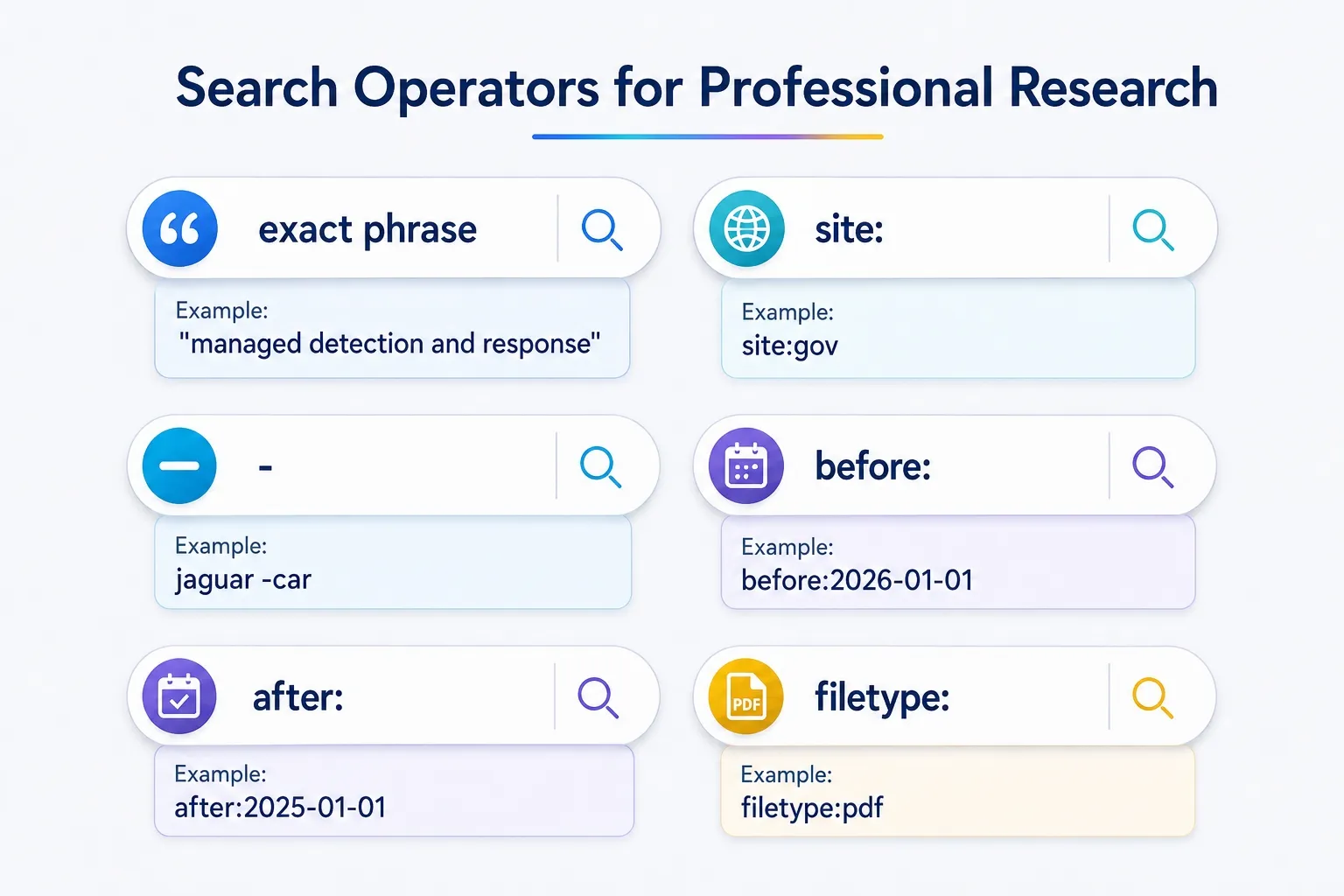
Useful search operators can narrow results by exact phrase, website, date, exclusion terms, and file type.
Example 1: Market Research
Suppose an analyst needs to evaluate a competitor’s expansion.
A weak workflow:
A professional workflow:
AI may help compare documents, but original filings and official disclosures remain critical evidence.
Example 2: Investigative Research
An online post claims that an organization changed a policy.
The researcher might use:
The Wayback Machine or another archive can be particularly valuable when a page has changed or disappeared.
Example 3: Academic Research
A researcher studying a biomedical question might use:
AI speeds orientation.
The literature remains the evidence.
Weak Search vs. Professional Search
Example 1
Weak:
Better:
More targeted:
site:gov “managed detection and response” filetype:pdfExample 2
Weak:
Better:
More targeted:
site:europa.eu “artificial intelligence” regulationExample 3
Weak:
Better:
More targeted:
site:gov “utility-scale solar” filetype:pdf after:2025-01-01The goal is not to make every query complicated.
The goal is to use enough structure to retrieve the evidence required.
12 Common Internet Research Mistakes
| Mistake | Better Practice |
|---|---|
| Using only one search engine | Compare retrieval systems when the question matters |
| Accepting the first result | Evaluate evidence independently of rank |
| Using overly broad queries | Decompose the research problem |
| Ignoring synonyms | Build a search vocabulary |
| Depending entirely on AI | Use AI for assistance, not final authority |
| Trusting AI citations automatically | Open and verify each important source |
| Using summaries instead of original evidence | Trace claims to primary sources |
| Ignoring dates | Verify publication and event dates |
| Confusing popularity with credibility | Evaluate expertise and methodology |
| Failing to record searches | Maintain a research trail |
| Ignoring contradictory evidence | Search deliberately for disagreement |
| Treating AI output as a source | Cite the underlying evidence whenever possible |
How to Develop Advanced Internet Search Skills
Advanced search literacy develops through practice, methodology, and reflection.
Self-Directed Practice
Useful exercises include:
- Find the original dataset behind a news statistic.
- Research the same question using three search engines.
- Ask an AI system for a sourced answer, then verify every important citation.
- Locate government documents using site: and filetype:.
- Research a historical webpage using a web archive.
- Reconstruct the source trail behind a viral claim.
- Compare a general web search with an academic database search.
- Keep a log showing how each query evolved.
AOFIRS also provides Modern Researcher User Guides that can support self-directed learning across internet research, search techniques, and related professional research topics.
Structured Training
Formal training can accelerate development by providing a systematic framework for:
- Query formulation
- Advanced search
- Research methodology
- Source evaluation
- Verification
- AI-assisted research
- Data analysis
- Internet law
- Research ethics
- Research reporting
Professionals who prefer structured learning can explore the AOFIRS online research courses, which cover online search, research methodology, AI in online research, data analysis, Google search, and related research skills.
Explore AOFIRS Research Courses ↗
Professional Certification
Professionals who want a structured learning pathway may also consider formal certification.
The AOFIRS Certified Internet Research Specialist (CIRS™) training program provides a broader pathway covering advanced online search, research methodology, AI-assisted research, data analysis, and legal and ethical considerations.
The value of certification should not be confused with the value of evidence.
A credential can provide structure, assessment, and a learning framework.
Professional credibility still depends on the quality of the research a person actually performs.
For people considering research as a career, the AOFIRS guide on becoming an internet researcher provides additional context on skills, training, and professional development.
Advanced Internet Research Checklist
Before accepting a research conclusion, ask:
- Have I clearly defined the research question?
- Have I defined the relevant date range and geography?
- Have I identified alternative terminology?
- Have I searched more than one appropriate retrieval system where necessary?
- Have I used specialized databases when general search is insufficient?
- Have I located primary evidence where possible?
- Have I confirmed who produced the evidence?
- Have I checked publication dates?
- Have I reviewed methodology?
- Have I verified consequential claims independently?
- Have I opened and checked AI-generated citations?
- Have I searched for contradictory evidence?
- Have I separated facts from interpretation?
- Have I documented my search process?
- Can another researcher understand how I reached the conclusion?
- Have I stated meaningful uncertainty or limitations?
Conclusion
Professional research in 2026 is not about choosing between traditional search and artificial intelligence.
Traditional search gives researchers direct access to documents, databases, archives, sources, and evidence.
AI systems can help researchers ask better questions, explore unfamiliar subjects, expand queries, analyze documents, compare information, and synthesize large amounts of material.
Neither removes the need for research discipline.
The modern professional needs to know where to search, how to search, what to trust, what to verify, when to use AI, when to return to primary evidence, and how to explain the reasoning behind a conclusion.
And in an information environment where finding an answer is becoming easier while determining whether the answer deserves confidence remains difficult, search literacy is becoming one of the defining professional skills of the AI era.
Frequently Asked Questions
What are advanced internet search skills?
Advanced internet search skills are the abilities used to formulate precise queries, select appropriate search tools and databases, locate primary evidence, evaluate source credibility, verify claims, use AI-powered research responsibly, analyze findings, and document a defensible research process.
Why are internet research skills important in 2026?
Search engines and AI systems can retrieve and synthesize enormous amounts of information, but retrieval does not guarantee accuracy. Professionals need research skills to identify appropriate evidence, verify generated answers, distinguish primary from secondary sources, and communicate uncertainty.
What are the most important advanced search techniques?
Important techniques include question decomposition, phrase searching, domain filtering, date filtering, file-type searching, Boolean logic where supported, specialized database searching, primary-source discovery, citation tracing, lateral reading, and iterative query refinement.
Are Google search operators still useful in 2026?
Yes. Google’s Search Help documentation continues to describe useful operators and filters, including quotation marks, site:, exclusion with -, before:, after:, and filetype:. Their greatest value is providing tighter control over conventional web retrieval.
How has AI changed internet research?
AI search systems can break down questions, run multiple searches, synthesize information, analyze documents, and support conversational follow-ups. Google’s description of AI Mode and query fan-out shows how search is moving from one-query retrieval to multi-stage, AI-assisted discovery.
Can ChatGPT replace traditional search engines for professional research?
Not completely. ChatGPT Search is useful for conversational discovery, current information, synthesis, and query refinement, but professional researchers should still inspect important sources directly and use conventional search when precise document retrieval or independent verification is required.
How do professional researchers verify AI-generated information?
They open the cited source, confirm that it exists, check the publication date and publisher, locate the evidence supporting the claim, determine whether the citation is primary or secondary, compare important claims with independent sources, and document unresolved conflicts.
Which search engine should professional researchers use?
No single engine works best for every research question. General web search, specialist databases, scholarly indexes, archives, government databases, and AI answer engines solve different retrieval problems. The appropriate choice depends on the evidence required.
What is search literacy?
Search literacy is the ability to translate an information need into an effective search process and then critically evaluate the results. In professional research, it includes query design, source selection, verification, interpretation, AI literacy, and documentation.
Do professional internet researchers need data-analysis skills?
Increasingly, yes. Research often requires comparing figures, calculating changes, identifying trends, evaluating samples, or interpreting datasets. Finding the information is only the first stage; analysis turns that information into useful evidence.
Can AI citations be trusted?
Check them rather than automatically trusting them. The NIST Generative AI Risk Management Profile identifies confidently generated inaccurate information as an important risk, reinforcing the need to inspect the underlying evidence.
Is formal internet research training useful?
Structured training can provide a repeatable methodology, practical exercises, assessment, and exposure to areas that self-taught researchers may overlook, including verification, research ethics, data analysis, and systematic search planning. Professionals can explore AOFIRS research courses or the CIRS™ professional training pathway depending on the level of structured learning they need.





