

How Runway AI Changed the Conversation Around Generative Video
The landscape of creative video tools has undergone a seismic shift in the last two years. Not long ago, generating video from text prompts felt like a laboratory experiment—fascinating to watch but too unpredictable for professional use. Today, generative video is shipping commercial work, and the tools driving this change are evolving at a pace that is hard to keep up with. For editors, motion designers, and creative directors, the question is no longer whether AI fits into their workflow but which platforms deserve their attention and budget. Pollo AI has been tracking this evolution closely, and the comparison points between major players are becoming clearer as the technology matures.
What Makes Runway AI a Reference Point in Video Generation
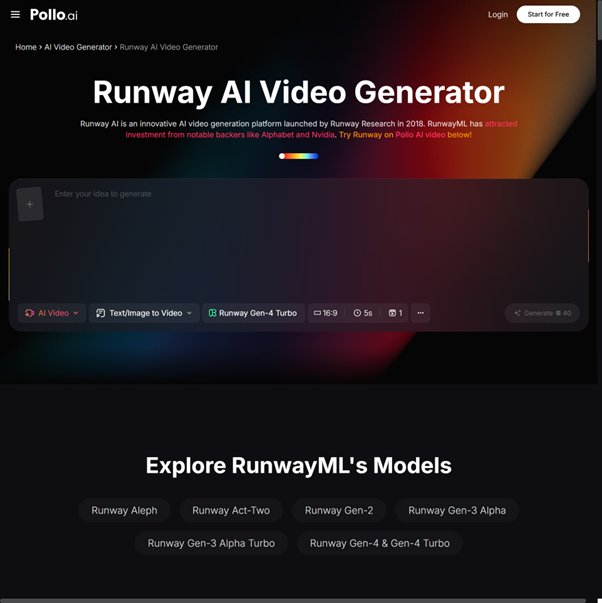
When creative professionals talk about text-to-video and video-to-video generation, one name consistently anchors the discussion. Runway AI has been at the forefront of making generative video accessible to filmmakers and designers who do not come from a machine learning background, and Pollo AI users often compare the two platforms when evaluating their options. Runway AI earned its reputation by packaging complex models into an interface that feels familiar to anyone who has used a timeline-based video editor. The ability to isolate subjects, remove backgrounds, and generate short video clips from text descriptions without touching a node graph lowered the barrier to entry significantly. For post-production houses and independent creators alike, that accessibility turned generative video from a theoretical capability into a practical tool.
The company has also cultivated a strong community around its product, releasing regular behind-the-scenes looks at how their models are trained and giving early access to experimental features. This transparency built trust with a creative audience that is naturally skeptical of black-box tools. When a director can understand roughly why a model generated a particular output, they can plan shots around that behavior rather than fighting it.
Text-to-Video and the Quality Threshold
The early generations of text-to-video were blurry, temporally inconsistent, and often surreal in ways that were unintentional. The current generation, which Runway AI helped pioneer, produces clips that hold together across frames and can be intercut with traditionally shot footage without immediately breaking viewer immersion. That threshold matters enormously for adoption. Once the output is good enough to serve as B-roll, background plates, or concept renders, the economic case for using it becomes straightforward.
How AI Video Tools Are Reshaping Post-Production Pipelines
The impact of generative video extends beyond the obvious use case of creating clips from scratch. Post-production workflows are being quietly transformed by tools that handle rotoscoping, object removal, and scene extension far faster than manual methods ever could. A task that used to take a junior artist half a day can now be accomplished in minutes, which frees experienced artists to focus on creative decisions rather than pixel-level cleanup.
The Changing Role of the Video Editor
Editors are increasingly becoming curators and directors of AI output rather than frame-by-frame craftspeople. This shift is uncomfortable for some and liberating for others. The editors who thrive in this new environment are the ones who treat AI tools as collaborators with specific strengths and weaknesses rather than as magic buttons that replace human judgment.
Mediaio AI and the Expanding Ecosystem of Creative Tools
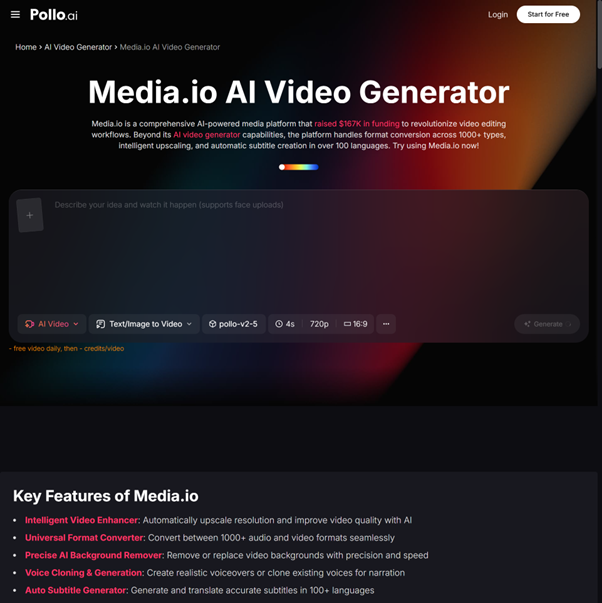
As the generative video ecosystem expands, different platforms are carving out distinct territories. Mediaio AI represents a different approach to the market, positioning itself as a comprehensive media processing platform that covers image and audio workflows alongside video. For users who need a broader AI-powered media toolkit rather than a specialized video generation platform, Mediaio AI offers an attractive breadth of functionality. Pollo AI provides helpful reference points for understanding how these various tools stack up against each other, especially for users who are trying to avoid subscribing to half a dozen different services. The comparison helps clarify which platforms prioritize raw generative power and which emphasize workflow integration and asset management.
Some tools go deep on one modality. Others spread wide across multiple media types. The right choice depends entirely on whether your daily work revolves around a single output format or bounces between video, image, and audio tasks regularly.
Pricing Considerations for Independent Creators
Subscription costs add up quickly when you need access to multiple specialized tools. Independent creators are increasingly looking for platforms that consolidate capabilities, even if each individual feature is slightly less advanced than the best-in-class specialized tool. The trade-off between depth and breadth is a practical budget calculation, not just a feature preference.
What the Next Wave of Video AI Will Unlock
The trajectory is pointing toward real-time generation and interactive video. Imagine editing a scene by describing what you want in natural language while the timeline plays back, with the AI generating and regenerating variations on the fly. This is not far off. Platforms that have built strong underlying models and accumulated user feedback data will be positioned to deliver this experience first. For creative teams evaluating their options now, considering the long-term roadmap of the platform—not just its current feature set—matters more than ever.